The Needle Issue #25

Juan-Carlos-Lopez
Juan Carlos Lopez
Andy-Marshall
Andy Marshall

The approval of multiple anti-amyloid monoclonal antibodies (mAbs) — aducanumab (Aduhelm; now withdrawn), lecanemab (Leqembi) and donanemab (Kisunla) — over the past five years has opened the era of disease-modifying Alzheimer’s drugs, albeit with only modest benefits in addressing cognitive decline (30% slowing) and associated serious safety risks, such as CNS inflammation and cerebral hemorrhages, which has limited clinical uptake. While many drug development programs target biological processes other than amyloid formation (e.g., tau and tangles, neurotransmitter receptors, neuroinflammation, autophagy, and mitochondrial or metabolic dysfunction), companies continue to optimize anti-amyloid monoclonals, but also look for alternative ways to therapeutically target Aβ.

One alternative therapeutic modality to antibodies is chimeric antigen receptor (CAR) immune cell therapy. In recent weeks, we have been thinking a lot about in vivo chimeric antigen receptor (CAR)-T therapies, which were one of the dealmaking trends in 2025, and we recommend readers check out an excellent summary of trends in the area from the consultancy firm Scitaris (you don’t even have to give them your details to download the report).

CAR-T treatments have established their clinical niche as last-ditch treatments for B-cell malignancies, with some remarkable outcomes for late-stage patients. In some cases, they have been shown to be at least twice as effective as T-cell engager bispecific antibodies in clinical studies. But they remain rather blunt instruments.

Despite advances in the clinical management of cytokine-release syndrome and immune effector cell neurotoxicity syndrome (ICANS), CAR-T treatments continue to be associated with serious risks. And while there have been advances in managing these adverse eventsatypical non-ICANS neurotoxicities (NINTs) can also create serious clinical management issues, with risk factors predisposing patients to development still only poorly understood.

That said, over the past year, we have seen an increasing trend for the use of CAR-T treatments outside oncology. They have started to be applied with promising efficacy in various areas of autoimmunity (systemic lupus erythrematosuslupus nephritissystemic sclerosisSjögren’s syndromeantisynthetase syndromemyasthenia gravis and idiopathic inflammatory myopathies) and neuroinflammatory conditions (multiple sclerosis). In this respect, a recent paper in Science caught our attention. In it, Marco Colonna and his colleagues at Washington University in St. Louis harness astrocytes to clear amyloid plaques by promoting their ability to phagocytize Aβ.

To that end, they used in vivo gene therapy to generate astrocytes carrying chimeric antigen receptors (“CAR-As”), a strategy not unlike the one used in cancer immunotherapy. Although both macrophages (CAR-Ms) and conventional CAR-Ts have been tested in preclinical models of Alzheimer’s disease with limited success, this study reports the first attempt to directly engineer astrocytes in the body to generate CAR-As.

In broad terms, the construct used to generate CAR-As consisted of an Aβ-binding domain and the phagocytic signaling protein MEGF10 (multiple epidermal growth factor-like domains protein 10). The team examined a variety of constructs and chose two for in vivo testing. One of them combined a fragment from the Aβ-binding antibody crenezumab and MEGF10, which is primarily expressed in astrocytes. The second construct combined a fragment of aducanumab with the phagocytosis receptor Dectin-1, which is primarily expressed in microglia.

The authors packaged the constructs in an adeno-associated viral (AAV) vector under the control of an astrocyte-specific promoter and injected them intravenously into 5xFAD mice (which carry five familial Alzheimer’s disease (FAD) mutations, driving rapid Aβ plaque formation, synaptic loss, and cognitive decline starting around 2–4 months). Both CAR-As reduced amyloid burden and neuritic dystrophy, and the treatment worked both in the prophylactic and therapeutic settings.

Single-nucleus RNA sequencing and immunostaining showed that the CAR-As adopted the transcriptomic profile of activated astrocytes and readily clustered around amyloid plaques. Microglial cells, in turn, also responded to the treatment by showing a reduction of the disease-associated transcriptomic profile that is often seen after administration of monoclonal anti-Aβ antibodies. This is of interest because this disease profile of microglial cells has been suggested to contribute to the inflammatory reaction sometimes seen after Alzheimer’s immunotherapy.

A caveat of the study is that the authos saw no improvements in cognition following therapy, albeit behavioral results in mouse models have been notoriously poor at predicting outcomes in humans. However, the translational questions don’t stop there.

If in clinical practice the CAR-A approach would require an AAV vector, then immunogenicity of the treatment is going to be an issue. Pre-exposure to AAV is often a problem for gene-therapy programs, where patients are much younger. Given that Alzheimer’s is a disease associated with an elderly population, immunogenicity is likely to be exacerbated. Similarly, the delivery of 1013–1014 viral genomes to elderly patients living with Alzheimer’s—many of whom will already have a brain prone to neuroinflammation—makes the specter of unwanted side effects a major concern. In this respect, finding Alzheimer’s patients whose disease stage and age would be appropriate for a therapy with potentially highly toxic consequences for fragile recipients is also difficult to gauge.

That is not to say that CAR-immune cell therapy may not have a place in CNS disease. It just seems like neurological conditions, such as multiple sclerosis where patients are younger and potentially less fragile, are the place where much of the translational groundwork and clinical management for CAR-A or CAR-T therapies must be worked out before moving into neurodegenerative disease for elderly and cognitively compromised patients.

Hot Investor Mandate: Europe-Based Life Science-Focused Investment Firm Seeks Early-Stage Biotech Companies With Strong Preclinical Data

The firm is a life sciences-focused investment arm of a broader innovation platform, established recently and based in Europe. The firm is actively deploying capital from an early-stage fund and typically makes initial investments in the low single-digit millions. The firm is open to syndicating with co-investors to support portfolio company growth. While the firm has a current geographic emphasis on regional opportunities, it maintains a global investment outlook.  
 
The firm focuses on early-stage biotechnology opportunities emerging from academic and research environments, with a strong emphasis on translational science progressing toward first-in-human studies. The firm prioritizes therapeutic programs supported by robust preclinical data, including modalities such as peptide-based therapeutics. Areas of interest include indications like chronic and nerve-related conditions, among others. The firm seeks programs with a clear and credible path to clinical entry within a defined development timeline, supported by validated targets, strong in vivo data, and early safety work. While therapeutics is the primary focus, the firm actively collaborates with external partners to advance high-potential biological innovations.  
 
From a company and management team perspective, the firm seeks academic founders and early-stage scientific teams developing differentiated therapeutic candidates with strong translational potential. The firm prioritizes opportunities with defensible intellectual property, rigorous preclinical validation, and well-defined development strategies toward IND-enabling studies. The firm works closely with portfolio companies by providing scientific, regulatory, and operational support and engages with teams capable of executing early development milestones. The firm is open to leading or co-leading rounds and partnering with additional investors to support clinical and commercial advancement. 

If you are interested in more information about this investor and other investors tracked by LSN, please email salescore@lifesciencenation.com

Hot Investor Mandate: Non-Profit Organization Invests in Therapeutics and Medtech Companies in Rare Diseases and Pediatric Innovations

A non-profit organization was established to address gaps in drug and device development for small patient populations and underserved markets. The firm focuses on identifying and acquiring stalled or overlooked programs with strong underlying potential, with the goal of advancing them into clinical development, particularly in pediatric and rare disease settings.  

The firm typically adds a small number of new assets each year and is open to engaging with companies globally. While upfront financial commitments are generally modest, the firm structures partnerships to include downstream value sharing, aligning incentives around successful development and commercialization.  

The firm is actively seeking medical device opportunities focused on pediatric applications, particularly solutions for congenital conditions. Areas of interest include technologies that can be tailored or customized to address the unique anatomical and clinical needs of pediatric patients.  

On the therapeutics side, the firm focuses on rare and orphan diseases as well as pediatric oncology. The firm prioritizes assets that are near clinical readiness or already in clinical development, including pre-IND and early clinical-stage programs.  

The firm does not impose strict requirements on company or management team composition. 

If you are interested in more information about this investor and other investors tracked by LSN, please email salescore@lifesciencenation.com

Hot Investor Mandate: Global VC Firm With Asia Headquarters Seeks Therapeutics, Medical Devices, AI-Driven and Enabling Technologies

A global investment firm headquartered in Asia invests across the full company lifecycle, from early-stage venture investments through growth equity and buyout transactions. Early-stage investments typically fall in the low single-digit millions. The firm maintains a diversified portfolio, with a dedicated allocation to life sciences and healthcare alongside broader technology investments. The firm invests globally and is actively seeking opportunities outside its home market.  

Within life sciences and healthcare, the firm invests across therapeutics, medical devices, enabling technologies, and AI-driven platforms, particularly those that support or accelerate drug discovery and development. While the firm has historically been active in therapeutics, it has become more selective and is increasingly focused on device innovation, life science tools, enabling technologies, and computational approaches such as AI-based drug discovery. Areas of thematic interest include aging and longevity, immuno-oncology, and advanced therapeutic modalities including cell and gene therapies.  

From a company and management team perspective, the firm prioritizes opportunities with strong scientific or technical foundations, clear differentiation, and the ability to achieve key development milestones. The firm favors teams with deep domain expertise and the capability to execute across both clinical development and commercialization. The firm invests flexibly across stages, typically co-investing alongside established investors and supporting companies with global scaling potential. 

If you are interested in more information about this investor and other investors tracked by LSN, please email salescore@lifesciencenation.com

Hot Investor Mandate: US-China Cross-Border Firm Invests in Early-Stage Life Science Companies With Compelling Early Clinical Data

The firm is a private investment firm based in Asia, supported by a major scientific research institution and led by professionals with combined experience in R&D, entrepreneurship, and investment across both Asia and the United States. The firm invests in early-stage life sciences and healthcare companies, with typical allocation sizes ranging from approximately $0.5M to $5M. The firm is open to both leading and participating in financing rounds and evaluates opportunities across China and the United States.  

The firm invests broadly across life sciences sectors, including biopharmaceuticals, medical devices, diagnostics, life science R&D services, and healthcare services. The firm has a particular interest in clinical-stage molecular diagnostics and shows comparatively less interest in very early-stage projects, though it remains open to select preclinical opportunities. The firm is disease-agnostic.  

From a company and management team perspective, the firm seeks experienced teams with validated products or technologies. The firm can provide strategic support for regulatory approval and commercialization in China by leveraging a network that includes pharmaceutical partners, CROs and CMOs, academic institutions, and distribution channels. The firm may also seek distribution rights in China and consider board representation on a case-by-case basis.

If you are interested in more information about this investor and other investors tracked by LSN, please email salescore@lifesciencenation.com

Technical Risk – From Belief to Evidence 

By Dennis Ford, Founder & CEO, Life Science Nation (LSN)

DF-News-09142022

In the first article, The Problem Is Not the Science, Life Science Nation established that investability begins with defining a real, urgent market need. But once that foundation is clear, the next question becomes unavoidable: does the product actually work, and can that be demonstrated in a way others trust?

The next focus is technical risk, where belief must become evidence. It outlines how companies move from early signals to reproducible, credible, and translatable results—covering mechanism of action, proof of concept, reproducibility, safety, and scalability.

Once market risk is clear, the next question becomes unavoidable: does the product work, and can that be demonstrated in a way that others trust?

This is where many companies overestimate their position. Early data, promising signals, or strong academic foundations often create internal confidence. But investors are not evaluating belief; they are evaluating evidence. The distance between those two states defines technical risk.

Technical risk is not simply about whether something works once. It is about whether it works consistently, whether the mechanism is credible, and whether the results can survive the transition from controlled environments into real-world use.

The first layer of clarity comes from the mechanism of action. There must be a coherent explanation of how the biology or technology produces the intended effect. This is not a description of experimental outcomes; it is a causal story. Without it, data is difficult to interpret and harder to trust.

Proof of concept establishes that the signal exists. This can take the form of in vitro data, animal models, early human data, or a working prototype, but it must be observable and measurable. Reproducibility then determines whether that signal can be relied upon. A single experiment is not enough. Results must hold across time, cohorts, and independent attempts.

Translatability introduces another layer of complexity. What works under ideal conditions does not always work in patients, clinics, or real-world settings. Understanding how findings extend beyond the initial model is critical, particularly in biologically complex indications.

Safety, performance, and durability define the product profile. Even if effective, a product must be safe enough for its intended use, deliver a meaningful effect, and sustain that effect over time. A transient or marginal benefit rarely justifies the cost and risk of development.

Finally, manufacturability, scalability, and data integrity complete the picture. A product that cannot be produced consistently and at scale cannot become a company. Data that is poorly designed, uncontrolled, or selectively presented undermines confidence, even when the underlying science is strong.

Technical risk is resolved when the product moves from an interesting idea to something that consistently works, can be trusted, and can be translated into real-world use.

Core Elements of Technical Risk

  • Mechanism of action
  • Proof of concept
  • Reproducibility
  • Translatability
  • Safety
  • Performance and durability
  • Manufacturability and scalability
  • Data quality and integrity

Next in the series: Regulatory Risk — Navigating the Path to Approval

How Early-Stage Companies Should Think About June in San Diego 

By Max Braht, VP of Business Development, LSN

Max-Braht-Headshot

Whether in San Diego, Philadelphia, or Boston, there are a handful of weeks each year when the life science industry gathers in force. Founders, investors, pharma, and advisors all show up at once. Multiple events run in parallel, each with its own programming, audience, and purpose. From the outside, it looks like one opportunity.

It is not.

Each event is designed to serve a specific audience. Some programs are intentionally broad and inclusive. They bring together large numbers of participants across the ecosystem and create a wide surface for interaction. Others are more focused. They are designed to reach a narrower audience with a specific objective.

The challenge for early-stage companies is that it is not always obvious which environment they are actually entering.

Most of the broader convention programming is built around partnering between established biotech companies and large pharma. These conversations assume a certain level of maturity. The data has been prepared for external review. Development paths are clearer. The work is far enough along for a downstream buyer to evaluate.

For companies at that stage, the environment works. For earlier-stage companies, the situation is different.

They enter the same system, but the conversations are not always aligned with what they need. Licensing discussions can be premature. Data packages are still forming. Investor meetings are possible, but they are not the primary function of the week. Competition for attention is high, and much of that attention is directed toward later-stage opportunities.

Nothing is wrong with the environment. It is doing exactly what it is designed to do.

The issue is alignment.

Early-stage companies are not primarily seeking licensing outcomes. They are seeking capital. Capital behaves differently. It requires a higher concentration of relevant investors, a structure built around evaluation, and conversations that lead to funding decisions. Seed rounds up to two million, Series A up to ten million, and Series B up to fifty million are fundamentally different conversations than late-stage programs discussing Phase III data, scaling, and commercial expansion with pharma. They are different buyers, different expectations, and different decision processes.

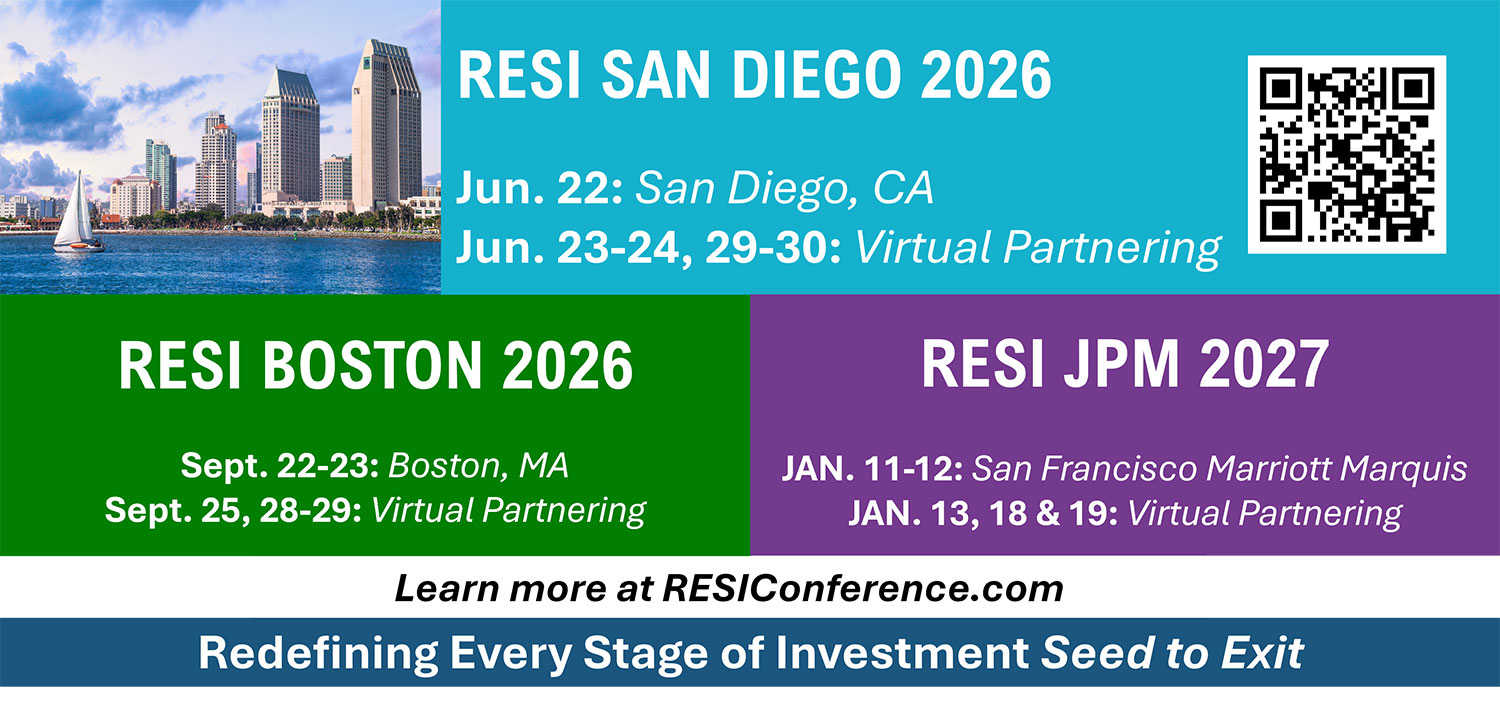
During that same week, RESI operates as a separate market focused on early-stage capital formation. The investor base is concentrated around seed through Series A and early Series B. The conversations are centered on investment. The environment is designed to match companies with investors who are actively deploying capital into emerging opportunities.

This creates a different dynamic.

Instead of competing for limited attention in a broad, later-stage environment, companies operate in a setting where the density of relevant investors is higher, and conversations are aligned with their stage. This is not a question of which event is better.

The question is whether you are in the right room.

If your objective is licensing or a strategic partnership with large pharma, the broader convention environment is the right place to spend your time. If your objective is to raise capital at the early stage, the question becomes more direct. Where are the investors actively deploying to companies like yours, and how concentrated are they? Many companies try to do both. Some can. Most dilute their effort. The cost is not just the registration fee. It is time, focus, and missed opportunity. In weeks like this, the difference between being in the right room and the wrong one is not subtle. Please choose a room that fits your stage.

Register for RESI San Diego