A PE firm that is headquartered in Hong Kong with additional offices throughout China currently manages over US$4 billion in assets and invests across several industry sectors including healthcare. The firm is interested in pre-growth and growth stage companies. Typical investment size ranges from US$5-10 million in Series A rounds. The firm seeks to lead but is open to syndicating with co-investors. The firm is now looking for opportunities in China, the US, and Canada.
Within healthcare, the firm focuses on medical devices and diagnostic technologies that have a China angle. The firm prefers products that have achieved clinical validation with proven advantages. The firm is also interested in clinical-stage biopharmaceutical opportunities as well as health information technology. The firm is opportunistic in terms of indication areas but is less interested in orphan diseases.
The firm is looking for experienced management teams with track record of success. The firm typically requests board representation in its portfolio companies.
If you are interested in more information about this investor and other investors tracked by LSN, please email mandates@lifesciencenation.com.
A new venture fund started investing in pre-seed, seed and Series A rounds. The firm’s main investment areas are in companies that advance and improve human health through novel models of care delivery and in companies that are at the cutting-edge of frontier technology, such as neurotech, brain/machine interfaces, genomics and AI. The firm will consider digital health companies as well as diagnostics and medical device companies, as long as they have a software component. The firm will only invest in companies with disruptive technology, not incremental innovations. The firm will invest between $.1-1.5M in the initial investment, with the possibility of participating in following rounds. The firm is willing to lead or co-invest, has made 7 investments to date and is looking to invest in 4-6 companies a year.
The firm will consider digital health companies that are focused on improving patient care. Ideally, companies will already have a pilot with some outcomes-based data indicating traction. The firm is also interested in medical device companies, but will only invest if there is a significant software and/or radical innovation component. The firm will also consider diagnostics, such as genomics-based technologies, but not in vitro diagnostics. The firm will not invest in traditional therapeutics (i.e. small molecule or biologics) companies but will consider software-as-medicine and bioelectronic medicine.
Due to the firm’s preference for cutting-edge technology, the firm prefers that there be at least one technical expert in the company leadership. If acting as a lead investor, the firm will take a board or board observer seat. The firm prefers to be an active investor, providing multi-faceted support to portfolio companies.
If you are interested in more information about this investor and other investors tracked by LSN, please email mandates@lifesciencenation.com.
The first half of 2018 has brought to the surface many debated topics not only for the United States but also the world—universal healthcare, innovation, and leadership. This year, headlines continue to arise almost daily detailing reforms to the healthcare system, while other countries continue to make advances in their universal healthcare programs. One of the biggest corporations in the world, Amazon, is accelerating their involvement in the healthcare industry with big-name partnerships, leadership appointments, and strategic acquisitions. They’ve also recently purchased office space in Boston, MA, one of the biggest life science hubs in the world—where Life Science Nation (LSN) began its focus on helping early-stage life science companies seeking capital.
The urgency in healthcare.
Life Science Nation was founded with the intention to move life science innovation forward for a real impact on the global development of healthcare, which has only become more urgent. Throughout LSN’s experience supporting life science companies, lack of access to capital is holding back the advancement of many life science companies. LSN dedicates itself to helping early-stage companies navigate the funding ‘Valley of Death’, which is why LSN created a new three-day event called RESI Healthtech Week. Today, LSN will discuss the benefit of attending Day 1, the First Coast Innovator’s Gathering, for tech hubs across the northeast with technologies or companies looking to change the future of healthcare.
What is the First Coast?
The First Coast, as LSN has deemed it, is the location identified as the premier hub for life science innovation, similar to how Silicon Valley is viewed as the premier (and original) tech hub. Over the years the First, Second, and Third Coast have been identified as hubs across the country made up of different states including Houston and New York City. All have been vying to be central locations for massive innovation in the life sciences. However, Life Science Nation takes the First Coast to include the entire northeast corridor, from DC to MA, including all the premier universities and research institutions in the region.
RESI Healthtech Week’s new First Coast Innovator’s Gathering is focused on expanding the traditional Redefining Early Stage Investments (RESI) Conference to include more nascent technologies and companies in the life science space. By bringing together innovators from the entire northeast corridor with global investors and strategic partners, LSN promotes a one-of-a-kind opportunity for the advancement of healthcare innovation.
Who are the best-fit attendees?
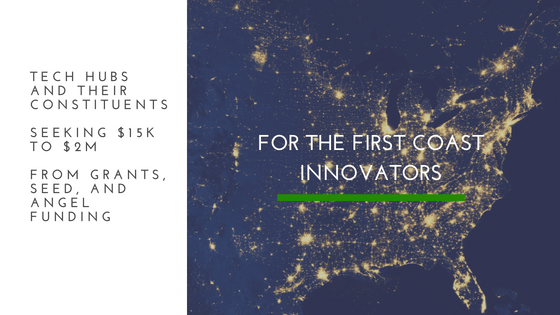
Day 1 will feature the next generation of healthcare innovation and their earliest stage companies from the northeast region: DC, MD, PA, NJ, NY, RI, CT, and MA—now known as First Coast, who are invited to participate in a day of partnering and networking.
Qualifying First Coast Day 1 registrants are the northeast corridor incubators, accelerators, tech transfer offices, university translation initiatives, hospitals, research labs and their constituents as well as the investors and partners that seek them.
Ideal candidates include those seeing funding anywhere from $15k to $2M from grants, seed, and angel funding.
Affordability
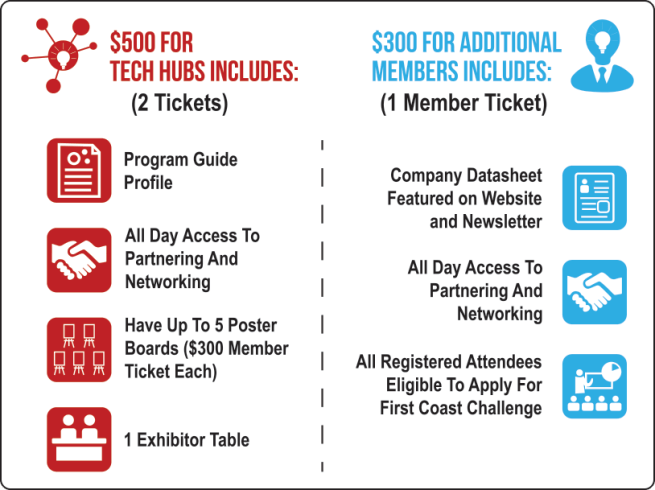
LSN created an affordable registration price that will facilitate more startups attending the three-day event. Tickets start at only $500 for tech hubs (includes two tickets) and $300 for each additional constituent member. The pricing structure and benefits are presented in the chart below.
Showcase Your Technologies.
The conference will include ample opportunities for you to represent and showcase your technologies to global investors and strategic partners. This includes exhibiting, online features and placements, as well as a competition for a spot to pitch investors during the First Coast Innovation Challenge.
The exhibit hall has limited space for one exhibit table per tech hub (as space allows). Each organization can have up to 5 poster boards for their table to showcase their tech hub members and constituents.
In addition, all tech hubs will be featured in the RESI Healthtech Week Program Guide. Their technologies represented by their constituents and tech hub members will be featured on the newsletter and website with a datasheet.
All qualifying First Coast registrants are eligible to apply for the First Coast Innovation Challenge where the top 5 finalists will give 10-minute pitches to an elite panel of investor judges from 3:00-5:00 during the First Coast Innovator’s Gathering. This will be a rewarding opportunity to pitch your technologies and receive valuable feedback.
Access to global investors.
LSN’s network of early-stage global investors will be able to see all the key players in one place and learn about the innovative technologies coming out of the First Coast.
A day of partnering and networking.
Day 1 of the RESI Healthtech Week will feature the First Coast Innovator’s Gathering; partnering and networking opportunities, just like it’s traditional RESI.
The RESI Partnering Platform helps you find nontraditional partners from the newest sources of capital, including family offices, foundations, academic institutions, and philanthropic organizations that will be a fit for your technology and stage of development. Attendees can schedule up to 16 meetings using the Partnering Platform. It will open one month before the conference, so companies, global investors, and strategic partners can request and book meetings in advance. Some key highlights of the Partnering Platform include:
Review profiles of other RESI Conference participants.
Schedule one-on-one and/or group meetings.
Build your customized RESI Conference schedule, from panels to presentations to partnering meetings.
The system will be available one month before and one month after the conference for ease of use.
Launches August 6th for RESI Healthtech Week (September 5-6th) partnering.
In addition to the Partnering Platform, attendees can also participate in ad hoc meetings at exhibit tables and poster boards throughout the day.
Venue Information
The First Coast Innovator’s Gathering will take place at the Boston Marriott Copley Place, 110 Huntington Ave, Boston, MA 02116, on September 5th, 2018 followed by the traditional Redefining Early Stage Investments Conference on September 6th, and the Entrepreneur’s Academy Workshop Series on September 7th.
Registration starts at 7 AM. Exhibit halls and meetings are available from 8 AM to 5 PM.
In conclusion…
Life Science Nation will continue to connect early-stage companies with global investors and strategic partners through RESI Conferences and first-in-class data platforms, in the hope that downstream we can help bring treatments to the patients that need them. As the landscape for healthcare and healthcare policy changes, so too will LSN in order to meet the needs of the early-stage players.
By Dennis Ford, Founder & CEO, Life Science Nation; Creator of RESI Conference Series & RESI Healthtech Week
If you haven’t heard, Life Science Nation provides consulting services for branding and messaging, both critical to the fundraising process. The LSN mantra is, “We echo to our clients what the investors tell us they want to see”. Through conversations with investors through the years, LSN has the knowledge to help shape your marketing collateral to address what investors are looking for, whether you meet during a RESI Conference or on your own time.
Top Three Pieces of Marketing Collateral You Need
There are three key marketing documents investors generally evaluate to form a first impression of your company: the executive summary, pitch deck, and company website. These three pieces of content have one purpose: they serve to whet the target investor/partner’s appetite and convince them to request a meeting with you and start a dialogue. Below is a list of all supporting marketing collateral you may need for your fundraising campaign. This article will go into further detail on the executive summary, pitch deck, and website and what the content should highlight.
Marketing collateral every entrepreneur needs.
If you are looking for more detailed information on defining and developing your marketing collateral, please read Chapter 6 of Dennis Ford’s book, “The Life Science Executive’s Fundraising Manifesto“.
What “value” does your business add?
One key takeaway from all your marketing collateral should be the value of your company and its technology. Investors want to easily understand your message and value-add right away, no matter what the marketing collateral. Investors tend to be very busy, but if you can pique their initial interest, you will have plenty of opportunity to provide more information as the dialogue unfolds. The investor does not want to have difficulty understanding your company value so make sure you have a clear message for them.
There is no standardization.
Many of our clients go through a learning curve due to the lack of standardization of the fundraising collateral (executive summary etc.) required by investors. This makes it extremely difficult to provide a course on the basics of fundraising branding and messaging. This has led to the service we provide, creating custom marketing collateral.
An investor can receive as many as 100 solicitations per week. Investors have become experts at skimming and looking for a spark to ignite their interest. If that is not found, they quickly move on to the next opportunity.
How to get started.
An executive summary (ES) is typically no more than 2 pages and can be accompanied by a visual PowerPoint (your pitch deck) of 10-12 slides. Usually, they are sent together when you reach out for an initial introduction as it provides the investor with key background information upfront. The goal is to move them from either document to your website for more detailed content.
Here are five main points we have learned regarding the ES and pitch deck.
Send both an executive summary and a pitch deck. Some folks click on an executive summary and others click on the deck. Most investors have an innate preference for one or the other. Since you won’t know before reaching out, LSN recommends that you send out both.
The executive summary is the story of your company and how you got to your current state.
The pitch deck should reflect what is in the executive summary, but in bullet form, with the addition of more information that shows the value-add of your firm and product.
The pitch deck is your tool to present your company position to investors, therefore replacing your voice. It needs to stand completely on its own because it is read in your absence. Unlike a standard deck used for a presentation with bullets designed to trigger your dialogue, the pitch is being read as it is. The challenge is to be able to deliver the complete message with as few, concise words as possible and no need for a presenter.
Remember, it’s the investor’s first introduction to your company. The investor will not have the full context, and therefore some level of contextual detail may be necessary.
Your website represents your company brand.
Your company website is a detailed representation explaining your company and its technology. It needs to offer a “deep dive” on the company and team, more detailed than is possible in your executive summary and pitch deck. The website should provide all of the detail and context that tell the full story of your company and its value. Even so, it is necessary to maintain consistency with your language and provide a clear message.
If done right and the message comes across, then the target partner will be able to assess that you’re a good fit and decide to initiate a conversation. The executive summary, the pitch deck and the website are all created for one reason – to give enough compelling information that an investor decides to initiate the first meeting.
Remember, it’s about the buyer: a busy investor with cash to allocate. Keep in mind they will do a quick scan of your deck and executive summary. They will be looking for something that will impart enough interest that they will want to have a chat with you and your firm.
Life Science Nation knows summertime can be a lull for fundraising, with many investors out of the office. This can make it more challenging and extend a fundraising campaign. LSN spoke with one of the investors attending and speaking at the RESI Healthtech Week this fall, asking him to share his insights into an often-overlooked resource in the fundraising process—foundations as investors.
Jim Golubieski, President of New Jersey Health Foundation and its affiliate, Foundation Venture Capital Group, LLC, will be speaking on the “Foundations” panel, sharing his insights and experience. It will discuss non-profit organizations that provide support and funding to early-stage startups.
Below are the answers to two questions asked by Life Science Nation.
What will RESI attendees learn from you?
Jim: “The most important takeaway from my session would be for attendees to know that many foundations and other not-for-profit organizations are no longer simply fundraising organizations but can also be great sources of capital funding that might be overlooked. It is also important to explore all avenues when seeking funding – attendees should research individual foundations to see what types of organizations and projects they fund, to explore if their missions and goals are compatible with their own.”
What makes you excited to attend RESI?
Jim: “From a strategic perspective, attending RESI means that all the components needed for early-stage investment opportunities are under one roof, in one place at one time, to meet with and explore the entire funding cycle. The opportunity to talk with our colleagues—investors, CEOs, scientists, entrepreneurs and potential partners— is an exciting concept.”
The Foundations Panel will be held on Day 1 – First Coast Innovator’s Gathering
Wednesday, September 5th, 2018 at 2:00 PM – 2:50 PM
Panel topics to be discussed may include:
What is the foundation’s preferred stage of development when supporting companies?
How to approach foundations for fundraising.
What criteria do non-profits use to evaluate opportunities?
What are the differences between support from non-profit investors compared to for-profit investors?
When foundations support startups, it is with an eye to their mission as opposed to profit. These missions can range from regional development to advancement of a cure or treatments for a particular disease. Foundations play an important role in the fundraising landscape, often assisting companies to grow to the level required by more traditional investors. Panelists will discuss their approach to supporting early-stage companies and how these companies can benefit from a partnership with a foundation.
James M. Golubieski is President of New Jersey Health Foundation and its affiliate, Foundation Venture Capital Group, LLC, a company that provides pre-seed funding to new health-related startup companies founded by New Jersey researchers to help them advance toward commercialization.
Mr. Golubieski works closely with the companies in which Foundation Venture has invested, sits on their Boards and provides guidance in helping them to develop their business models.
Previously he had been CFO of Array Medical, Inc., a medical device start-up company established in 1995 that developed a groundbreaking blood test to test platelet function. The company was sold in 1999. Mr. Golubieski was also the chief operating officer and senior executive vice president of Glendale National Bank and a member of its board of directors, president of Glendale Investment Corp. and Glendale Mortgage Services, Inc. and chief financial officer of Glendale Bancorp, which was acquired by Mellon Financial. For 10 years prior he had been with KPMG.
A Seoul-based venture capital firm founded in 2015 and affiliated with a leading pharmaceutical company in South Korea closed their first fund in 2016 and has recently raised a second fund of approximately $60M USD. The firm has made 8 investments to date, in 3 Korean and 5 USA-based companies. The firm continues to seek global opportunities. The firm generally participates in financings of Series B and beyond, participating in Series A rounds on a case-by-case basis. However, the firm has started to look for earlier stage opportunities and is most interested in spin-out assets and forming new companies in South Korea. Within this angle, the firm is highly interested in companies who are interested in entering the Korean market and looking to leverage on the capital and clinical infrastructure in South Korea.
The firm is focused on therapeutics companies and does not invest in medical devices, diagnostics, or digital health. The firm is open to considering assets of very early stages, even those as early as lead optimization phase. The firm considers various modalities, including antibodies, small molecules, and cell therapy. Currently, the firm is not interested in gene therapy. Indication-wise, the firm is most interested in oncology and autoimmune diseases but has recently looked at fibrotic diseases and certain rare diseases as well.
With regards to companies raising a Series A round, the firm prefers working with experienced management teams with high-profile scientific founders being involved. The firm incorporates a different strategy depending on the company’s headquarters. For companies based in South Korea, the firm serves as a hands-on, active investor and seeks board representation. In the USA, the firm prefers to be a more passive investor and generally seeks to co-invest with established venture capital firms that have a footprint in the USA.
If you are interested in more information about this investor and other investors tracked by LSN, please email mandates@lifesciencenation.com.
A boutique venture capital firm founded in Hong Kong currently manages a $100M USD fund and a $200M RMB fund. The fund is industry agnostic within China while it focuses only on healthcare ex-China. The firm generally participates in Series A or B rounds but would also consider seed and growth-stage funding. Typical equity investment size ranges from $1-5M. The firm is open to both leading and co-investing. The firm is actively seeking new opportunities from across the world with a focus on companies in China, U.S., Europe, and Israel. The firm helps portfolio companies get into massive and fast-growing markets of China and Asia, and assists Chinese companies to expand abroad.
The firm is opportunistic across all subsectors of healthcare. Within MedTech, the firm is most interested in medical devices, artificial intelligence, robotics, and mobile health. The firm is seeking post-prototype innovations that are FDA cleared or are close to receiving clearance. Within therapeutics, the firm is interested in therapeutics for large disease markets such as oncology, neurology, and metabolic diseases. The firm is open to all modalities with a special interest in immunotherapy and cell therapy.
The firm is in search of ambitious companies with strong, experienced management teams. The firm takes a hands-on approach to portfolio companies and can work with incomplete teams. The firm can contribute expertise in essential services: branding, marketing, channel development, overseas expansion, human resources and finance. The firm may also request distribution or negotiation rights in China.
If you are interested in more information about this investor and other investors tracked by LSN, please email mandates@lifesciencenation.com.