Diagnostic Investors Share their Insights

By Christine A. Wu, Senior Research Analyst, LSN

chrsitine

We see a lot of innovative point-of-care diagnostics out there, but what do these opportunities truly mean to diagnostic investors? How do diagnostic companies climb the reimbursement hurdle and how will the actionable information provided by these new diagnostics change healthcare delivery? Diagnostic investors discussed these questions at LSN’s Redefining Early Stage Investments Conference in San Francisco on January 9th.

Moderated by Akhil Saklecha, Partner of Artiman Ventures, we heard from:

  • Jenny Rooke, Venture Partner, F-Prime Capital
  • Alessio Beverina, Founder & Managing Partner, Panakès Partners
  • Eric Hargarten, Investment Associate, Sandbox Industries
  • Wouter Meuleman, Director of Investments, Illumina Ventures

Last week, we summarized what we heard from the Big Pharma panel. Now what about the diagnostics side? Below are the main takeaway points.

Consider how the diagnostic would effectively disrupt the current healthcare delivery system to solve the problem. Investors are looking at the rest of the diagnostic system, how solutions are currently being delivered, and how your solution solves the workflow of delivery. Areas these investors noted as “uncapped and wide open” are concussions and head injuries, genomics, proteomics, and oncology.

“Point-of-Care” diagnostics is too crowded an area, especially when the company does not know at what point or for what care. There are many barriers to entry for point-of-care diagnostics to demonstrate usefulness in the healthcare system. How does the point-of-care diagnostic affect a clinical decision? Other oversaturated diagnostic areas are liquid biopsies, such as blood-based oncology tests, and NGS software tools.

Focus on payor-relations by continually publishing clinical evidence, especially if aiming for reimbursement. One of the large concerns for diagnostics is reimbursement. If the company can solve a significant problem for patients, but cannot demonstrate a business case for the key players in the healthcare system, adoption will be a huge issue. Particularly in the U.S. where the expectation is for third-party insurance companies to pay, it becomes imperative for diagnostic companies to perform trials and demonstrate clinical utility in practice. Investors suggest having a person on the team dedicated to publishing studies aimed at winning over payors. How many studies should you complete before getting reimbursement, you ask? “One more than you have,” quotes Eric Hargarten from Sandbox Industries.

Think more broadly than classic venture money—VCs are not your only source of capital, especially for diagnostics. Apply for non-dilutive grant money—SBIRs are a great way to progress early-stage development. Other equity, dilutive funding sources that are not exactly the classic healthcare investors also exist. These can be tech investors that are interested in the data-side of diagnostics, as well as corporate and strategic partners. Companies should also seek foundations and family offices that are perhaps more mission-driven around the problem at hand. Incubators are also a source to gain early proof-of-concept.

Final Advice for Entrepreneurs:

  1. Have a high level of clarity. This demonstrates proprietary insight of the clinical problem and will get the investors’ attention to drive further conversation. Be sure the issue you are trying to solve is explained as clear as possible.
  2. Consider the strategic alignment with the investor. Also consider the market size, particularly for payor or provider-backed venture funds.
  3. Be prepared for technical conversations. Investors are excited by great science and great technology that solves problems others are not able to solve (think diagnosing Alzheimer’s disease before any symptoms appear!). Have your technical material on hand and be prepared to go deep. That said, be sure to also know your business model and plans for regulatory reimbursement.
  4. Carefully pick your advisors, board of directors, and KOLs. Be sure they understand what you are doing and truly champion your company.
  5. Think about what your company will look like in five years, and know what it takes to get there.

 

Hot Investor Mandate 1: Large Bay Area Based VC Seeking Global Opportunities with Focus in Therapeutics and Digital Health in Life Sciences

A venture capital firm with offices in the Bay area invests in a wide variety of industries and is currently making investments from two separate funds that total to $700M: one being a venture fund investing primarily in Series A and B rounds, and a fund investing in growth stage opportunities. The firm is flexible in investment structure, with typical Series A investments of $5M – $10M upfront with capital reserved for subsequent rounds. The firm usually leads investments and seeks a board seat, but may also invest as part of larger syndicates. The firm is active in their portfolio companies and seeks to add value through network, recruiting, and experience in startup strategy and operations. The firm will invest globally.

The firm is open to investing in multiple sectors, but has a strategic focus in life sciences and digital health. The firm has special interest in therapeutics (especially platform technologies), digital health (especially digital therapeutics and chronic care management) genomics, and synthetic biology.

The firm believes passionately that their role is to support and serve great management teams and entrepreneurs.

If you are interested in more information about this investor and other investors tracked by LSN, please email mandates@lifesciencenation.com.

Hot Investor Mandate 2: Newly Launched USA Investment Firm Focused on Diagnostics Investments

A recently formed venture capital firm is focusing on the big-data aspect of personalized diagnostics. The firm is seeking early-stage companies raising seed to Series B rounds. The firm has a $200M target fund and seeks to make 15 –20 new investments within the year. The firm seeks to make $2M – $4M initial investments per company, but will make smaller initial seed investments as well. The firm prefers to be actively involved in their portfolio companies, and therefore prefers companies based near the west coast, though is open to other U.S.-based companies.

The firm is focused on early-detection diagnostics, such as discovering cancer when it is still monogenetic versus heterogeneous and already invaded in other parts of the body or detecting Alzheimer’s 8-10 years before dementia symptoms are present. The firm is interested in point-of-care diagnostics (for influenza A/B/bacterial, etc.) that can diagnose specifically and efficiently. The firm is especially interested in technology with a big-data component, and involved in genomics and personalized medicine to provide the right treatment as early as possible. The firm seeks preclinical to clinical-stage technology, though will also look later-stage depending on the opportunity.

The firm requires a smart management team that is diverse in knowledge, and a company with good IP that may come from a leading institution. The firm will usually seek early-stage companies with less than half a dozen people.

If you are interested in more information about this investor and other investors tracked by LSN, please email mandates@lifesciencenation.com.

Hot Investor Mandate 3: VC with Strong Ties to Asia Invests in Early-Stage Therapeutics, Molecular Diagnostics, and Digital Health

An early stage investment firm with offices in North America and Asia focuses on facilitating the development and commercialization of high-potential, high-impact life science innovations arising from the U.S., Canada, South Korea, China and other markets that represent a significant source of opportunities for outsized value creation. The firm makes initial seed investments of US$100K – 1M and can bring in strategic capital from Asia to facilitate global development and market entry. The firm expects to make 2-3 new investments in the coming year.

Within life sciences, the firm is mostly interested in therapeutics, molecular diagnostics and digital health. The firm takes an opportunistic approach when it comes to disease areas and targets early stage innovation on the cusp of preclinical proof-of-concept or validation.

The firm is looking for capable teams developing innovative technologies. The firm works actively with entrepreneurs to devise and implement development and commercialization strategies, help assemble management personnel, and secure additional capital. For more mature opportunities, the firm will add value by using its fundraising, monetization, business development and licensing expertise to help secure investments and partnerships that will fund and expedite eventual commercialization.

If you are interested in more information about this investor and other investors tracked by LSN, please email mandates@lifesciencenation.com.

Hot Investor Mandate 4: Bay Area Venture Capital Looks to Invest in Mobility and Data-Driven Technologies in Life Sciences and Healthcare

A Silicon Valley-based venture capital firm founded in 2012 currently has $300M AUM and investing from its third, $100M fund. The firm focuses on early-stage investments from Seed to Series A, and initial size of investment can range from $500K to up to $3M. The firm reserves a significant part of the fund as follow-on investment. With the current fund, the firm seeks to invest in a total of 6-8 companies, with a preference for companies that are within proximity to their office in the Bay area.

The firm is interested in technologies that incorporate mobility and data. In terms of life sciences and healthcare, this includes digital health, AI and big data in discovery, precision medicine, etc. The firm has made several investments in digital health companies – examples include a mobile coaching app that promotes smarter decisions and better outcomes, a digital health platform for chronic disease management, etc.

The firm looks for driven management teams – relevant industry experience is a definite plus, but not an absolute requirement. The firm works closely with portfolio companies, providing companies with the needed resources and expertise to achieve scalability. The firm prefers to act as the lead investor, typically taking a board seat in such cases.

If you are interested in more information about this investor and other investors tracked by LSN, please email mandates@lifesciencenation.com.

Agenda Launches For RESI on MaRS

By Lucy Parkinson, Director of Research, LSN

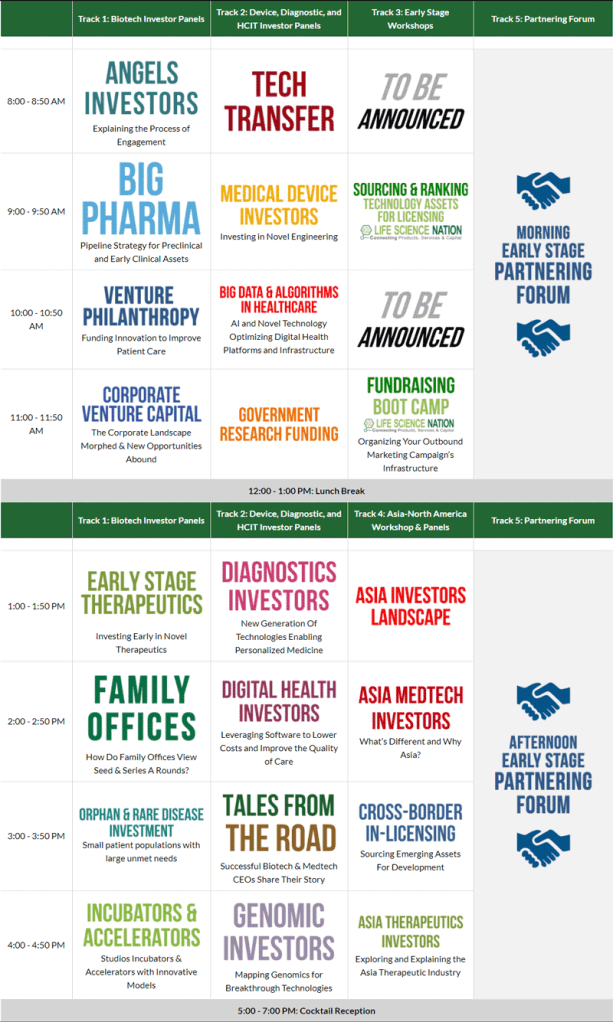
With RESI returning to MaRS in Toronto on April 10th, LSN has prepared a full day agenda of panel and workshop content. In addition to RESI’s high quality one-on-one partnering, attendees will also have the opportunity to hear directly from investors on a variety of topics in early stage fundraising.

For this RESI event in Toronto, we are introducing panels on Tech Transfer and on Government Research Funding, both of which are key topics in the local ecosystem. RESI on MaRS will also see the return of perennial RESI sessions such as Early Stage Therapeutics, Medical Device Investors, Diagnostics and Digital Health. Additionally, RESI will include panels on increasingly popular topic areas – Family Offices, Genomics, and Big Data & Algorithms in Healthcare. Finally, RESI’s Track 4 presents 4 workshops and panels focused on Asia-North America Partnerships, with deep dives on Cross-Border In-Licensing, the Asia Investors Landscape, and more.

RESI on MaRS is a chance to immerse yourself in the early stage life science fundraising world for a day, with full-day partnering and the opportunity to educate yourself on the latest in funding new healthcare technologies and building strategic relationships. If you’d like to attend, sign up now.

Working with Early-Stage Innovations – Insights From Big Pharma Panelists

By Claire Jeong, Research Analyst, LSN

claire

In last week’s newsletter, you may have read about LSN’s review of 2017 licensing deals and how licensing deals are happening even earlier. Despite the high risk, pharmaceutical companies all across the globe are aggressively seeking partnership opportunities in hopes of identifying breakthrough therapies.

During RESI San Francisco – our first conference of the year – we invited 5 panelists from the world’s leading pharmaceutical companies to share their insights on early-stage partnerships. How do they assess value? How can companies differentiate themselves, especially those who are in an overcrowded space?

Moderated by Chris Haskell, VP, Head of West Coast Innovation Center, Bayer HealthCare, the Big Pharma panelists were:

Some takeaway points from the panel discussion:

Understand the value that you bring with your technology. Demonstrating strong scientific expertise is key. Knowing how your technology is differentiable and providing a cogent explanation on why your technology might work seem like obvious pointers, but this is particularly important for companies who are in overcrowded indications. Most likely, the potential pharma partners who you will be in conversation with are already familiar with what has succeeded and failed.

Know why you want to work with a certain group and think of this as a long-term relationship. Every pharmaceutical company is different, so it is essential to do research on your potential partners and fully understand how they could benefit your company. When they provide suggestions and feedback on how to improve, make sure that these are fully understood and addressed at the next meeting. After all, large pharmaceuticals aren’t there just to provide you with an excess of capital. They want to work with likeable management teams with whom they can develop a cooperative relationship over many years.

It is better to keep things simple in an introductory discussion. You will not need to provide every single piece of information that is attributed to your company’s work. Eventually, detailed materials (i.e. patents, detailed data on a given asset, etc.) will be reviewed as needed, but the initial conversation should be focused on understanding what your company is doing and what differentiates your technology.

Don’t be afraid to follow up, but understand that the process takes a while. Most pharmaceutical companies are organized into groups based on therapeutic area and expertise. It can take a while for these groups to review the entire portfolio and send promising opportunities up the corporate ladder. In an initial conversation, it is good to ask when you will hear back so that you can act accordingly based on those expectations. Eventually, large pharmaceuticals will make sure you receive a response from them, one way or the other.