Hot Investor Mandate 1: China Investment Firm Seeks Medical Devices and Diagnostics for Oncology, Cardiovascular and Other Large Markets

An investment holding company based in China specializes in equity investment, debt financing, and equity investment services. The firm is current investing from its newest US$100 million and RMB 1 billion funds closed in 2016. Typical equity allocations range from US$2-6 million in an early stage company, while the firm can participate from pre-series A to pre-IPO financing rounds. The firm is currently seeking opportunities from China, US, and EU.

The firm currently focuses on medical devices and IVD tools in late clinical development or early commercial stage with high entry battier. The firm focuses on diseases with large market potential such as oncology and cardiovascular conditions.

The firm is looking for experienced management teams. The firm typically syndicates with other investors and takes 10%-20% minority stake in a financing round. Board representation is often required. The firm prefers China-based companies, Chinese-owned foreign businesses, or products with a China-angle; however this is not a requirement. The firm can provide its expertise to help with registration, distribution, M&A, and formation of joint venture and strategic partnership in the country.

If you are interested in more information about this investor and other investors tracked by LSN, please email mandates@lifesciencenation.com

Hot Investor Mandate 2: $200 Million Fund Invests in Innovative Devices, Genomics, and Healthcare IT

A venture capital firm based in California invests in multiple areas of technology: mobile, health, e-commerce, enterprise, education, fintech, and connected devices. The firm is currently investing out of a $200M fund that allocates $500K – $10M per company. The firm is stage agnostic and invests in seed, Series A, and growth rounds, and can both lead and co-invest. The firm invests globally, but the companies must have ties to the U.S (either offices or customers).

The firm is interested in innovative medical devices, genomics, healthcare IT, wearables, and consumer technology. The firm is not interested in technology that will require FDA approval and has a preference for those that at least have initial traction with pilot customers.

If you are interested in more information about this investor and other investors tracked by LSN, please email mandates@lifesciencenation.com

Hot Investor Mandate 3: Midwest Fund Seeks Approved Data-Driven Devices and Diagnostics

A venture capital firm based in the US Midwest makes growth-stage, equity investments in a variety of sectors, including the life sciences, typically in the $2M-$10M range. The firm prefers to lead rounds, but will also syndicate deals. The firm’s first fund closed late in 2015, and is targeting between 3 and 5 investments per year, focusing on the Midwestern United States. However, this includes all states except for those in the North East and those on the West Coast.

Within the Life Science space, the firm is primarily interested in data-driven, connected medical devices and diagnostics as well as any technology that improves drug adherence (mobile apps, devices, etc.). The firm has deep domain experience in IT and is therefore very interested in healthcare IT, such as enterprise software solutions. In addition, life science tools are also an area of interest. The firm is open to all sectors within the life sciences, with the exception of therapeutics, given the product is already FDA approved or is exempt from regulatory approval.

The firm prefers to work with experienced management teams and serial entrepreneurs, however the firm is open to working with first-time entrepreneurs. The firm prefers to lead rounds and requires a board seat along with an investment.

If you are interested in more information about this investor and other investors tracked by LSN, please email mandates@lifesciencenation.com

Hot Investor Mandate 4: Private Wealth Fund Invests in UK Life Science Companies with High Growth Potential

A privately owned fund based in London, United Kingdom, seeks to invest in life science companies with significant growth potential. The initial investment typically ranges from £500,000 to £2,000,000 for equity investments with reserved capital for follow-on investments. The firm also provides standby loans of up to £1,000,000. The firm only invests in companies that are based in the UK.

The firm will consider investments in the life sciences across all sectors including Medical Devices, Therapeutics, Diagnostics, Healthcare-IT and platform technologies. The firm is completely opportunistic in terms of subsector and indication. The firm is open to consider companies in all stages of development from pre-clinical stage all through to commercialization stage.

The firm focuses on private companies with a sizeable and clearly defined target market. The firm is looking to be an active investor, usually taking a seat on the board.

If you are interested in more information about this investor and other investors tracked by LSN, please email mandates@lifesciencenation.com

How to Use Your Pitch Deck to Pique Investor Interest

By Lucy Parkinson, Director of Research, LSN

To raise capital for an early stage biotech or medtech venture, you’re going to need a pitch deck.  But it’s very hard to make an engaging pitch deck.  At LSN we see a lot of pitch decks from our clients and RESI Innovation Challenge applicants, and as we engage with investors every day, we’ve found out a lot about what works and what doesn’t.

The goal of the pitch deck is to get the first meeting

It’s very important to bear in mind that the pitch deck is not, in and of itself, going to sell your round.  You, the CEO, are going to sell your round.  The deck’s purpose is to pique the investor’s interest for a deeper conversation with you.  You can’t go into depth on the company’s value proposition in 12 slides but what you can do is create an interest in learning more.

The hardest part is making it short enough

Investors receive dozens of pitches per day.  The easier and faster it is for them to digest your company’s pitch, the more likely you are to hear back from them.  A pitch deck should generally be 10-12 slides long.  Many life science companies use much longer decks in the hope of explaining their scientific or business case in full; unfortunately, we’ve seen many that are 30 pages or even longer.  A long deck is likely to put a hurdle in the investor’s path to your door, because you’re asking for a lot of assessment time before your relationship with them can even begin.

Showcase management achievements

Entrepreneurs with a scientific background may be tempted to believe that the investor will simply be on the lookout for solid, innovative science with proof of concept data.  Nothing could be further from the truth.  Many investors focus primarily on the strength of the team and the successes they’ve achieved in the past.  It’s important that when you profile your management team, you demonstrate their achievements as well as their scientific pedigree, particularly if they’ve been involved in a successful startup in the past.  If the company’s founders are new to industry, having experienced and reputable advisors can round out your team a lot.

Make the business case

A novel scientific discovery may have immense scientifc value but that doesn’t necessarily mean it’s investible.  Building a business involves more than building a product.  Investors will want to see that you’ve thought about the potential market, current incumbents, competitor products in the pipeline, and when and how to exit.

The latter is often the most important factor; many investors will be looking out for opportunities that can potentially generate large exits in as little as 2-3 years.  It may be useful to include a timeline that shows how much capital will be needed for the company to reach key inflection points.

Include the ask

Your deck needs to clearly show how much money you’re aiming to raise, and what you intend to do with the money.  It helps to center this aspect of the deck on inflection points; perhaps you are aiming to use the round to file an IND, or to obtain data that will create a value inflection or exit opportunity.

For a later-stage company, investors will also want to know who invested in the earlier financing rounds and how much money has been invested in total.  Investors are also often interested to see how much non-dilutive financing has been raised for the product.

Use your data – but sparingly

As I mentioned above, it’s very hard to make your deck short enough.  It’s natural to want to cover all the scientific evidence that supports your company’s product.  It’s vital to show that your company is based on solid scientific work; however in order to make this case fit on a few slides, you’ll need to prioritize the most important data points and save the rest for the meeting.  LSN has heard from investors that one of the most vital points is the safety data.  While it’s tempting to use your limited space to show the proof of efficacy, make sure you also cover the safety studies.

It’s a work in progress

LSN’s clients very often polish up their pitch decks and head out to meet investors, only to hear some unexpected pushback on a point that they had thought was too simple or obvious to be worth mentioning.  They then go back and add that information to the deck.  While it’s important to not let the pitch deck get overloaded with addressing every single objection that the company has heard, after a few meetings with investors it’s often clear what extra points need to be addressed.


Korean Life Science Companies Taking Center Stage of Cross-Border Collaborations

Shaoyu Chang, MD, MPH, Director of Research & Asia Business Development Liaison

Shaoyu 10*10

With the rapid growth of Asia’s biotech sector, cross-border activities are on the rise. Previously, we discussed how Greater China investors are now looking for opportunities beyond their geography. We’d like to use this posting to examine Korea’s biotech and how a regional player can take a significant part on the global stage.

Fueled by growing economy and strong government will, Korea is estimated to become the world’s 5th biggest spender of bio-related R&D. From 2006 to 2015, the 50-million population country has the largest number of total drug trials in Asia. We searched LSN Company Database and found more than Korean 450 entities in biopharma, medtech, healthtech, R&D service, and suppliers. The quantity and diversity of organizations indicate a fledging ecosystem.

korean-p1

As Korea’s biotech strides into an innovation-oriented model, it has generated a considerable amount of early stage assets. We searched in the LSN company Database and found 730 assets ranging from preclinical stage to NDA, with oncology drugs being the largest group among all indications. While many of these assets are in the preclinical stage, a significant number of them have reached late-stage clinical development or even NDA. Eighty-nine percent of these assets are available or will possibility be available for out-licensing.

korean-p2

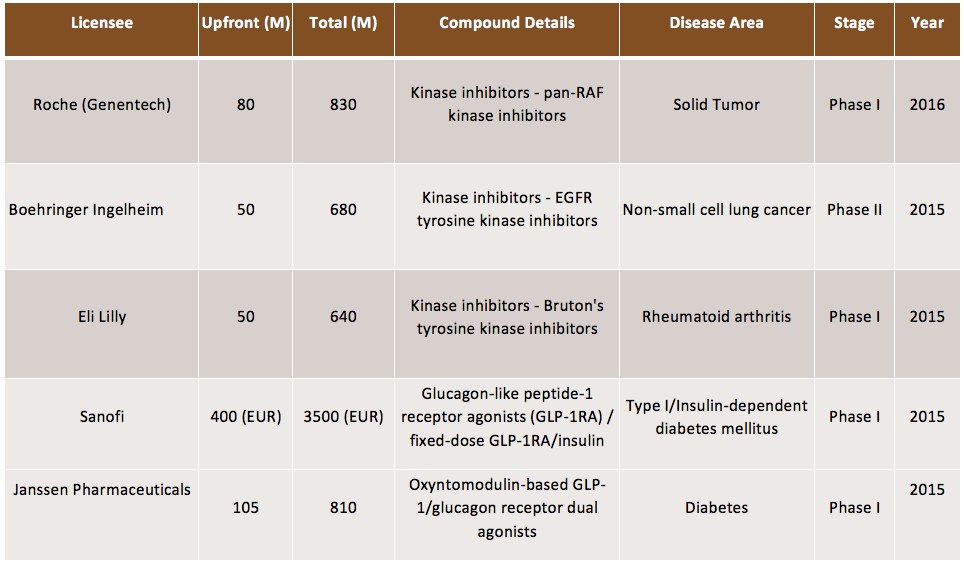
In terms of licensing deals, Hanmi Pharmaceutical clearly leads the race with mega-deals with Roche, Eli Lilly, Boehringer Ingelheim, Sanofi, and Janssen. The company’s success stems from a strong focus on collaboration with global partners on various co-development and business opportunities to achieve synergy effect.

korean-p3

Many small- and medium-sized Korean biopharmaceutical companies are following Hanmi’s steps to go outbound. The LSN team has interacted with many Korean entrepreneurs in various occasions in North America and Europe. Many choose to keep most activities at home and just send out their business development staff to conferences.

More creative arrangements have been tested. A two-step model seems to be working, at least among the entrepreneurs we have interacted with– first, startups emerge from an open innovation collaboration of academic research institute and biotech venture capital in Korea. Second, the startup set up R&D centers and BD team in major life science hubs such as Boston, San Francisco, and San Diego. This way, the startup can generate innovation while gain exposure to top-tier sector expertise and strategic partners at a very early stage.

The global biomedical field is becoming flatter. Instead of being limited by the size of their domestic market, Korean biopharma businesses are maintaining their advantage by actively connecting with the world’s key industry hubs. As the healthcare demand in Asia continues to expand, we expect to see more Asian biomedical startups on the horizon that connects innovations and markets.

RESI San Francisco Panel Announcement: Big Pharma

By Cole Bunn, Senior Research Analyst, LSN

cole-wp

As we gear up for the biggest RESI event of the year, during the heavily anticipated JPM week, we’re happy to once again announce the Big Pharma panel. This is typically one of the most popular panels at the RESI conference, and for good reason – large pharmaceutical and biotech companies, through a variety of deal structures, are looking earlier and earlier for assets, but tend to represent a daunting challenge for entrepreneurs seeking to successfully engage and navigate.

Senior-level executives from some of the world’s top pharmaceutical companies will provide some color around their process and strategy, and how entrepreneurs can best prepare to present to and work with organizations like theirs.

Big Pharma panelists will include the following:

  • Monica Viziano, Sr. Director, Business Development, Gilead
  • Barbara Sosnowski, VP External R&D Innovation, Pfizer
  • Lesley Stolz, Head, JLABS California, Johnson & Johnson Innovation
  • Christian Schubert, Director, Corporate Development & Strategy, Biogen
  • Jeremy Grunstein, Executive Director, Business Development, Amgen

By registering for RESI San Francisco on January 10 (Tuesday of JPM week), you’ll be able to listen to this panel live and gain insight into the dynamics of partnering with a strategic player as well as experience numerous opportunities to expand your network in the life sciences and learn more about the fundraising process in general.

resi-san-francisco-2017