LSN Summer Chapter Series: Issue #2

By Nono Hu, Director of Marketing, LSN

Welcome to the second installment of the LSN Summer Chapter Series. This week we’ll finish up the legal section of The Life Science Executive’s Fundraising Manifesto by covering the rest of the necessary regulatory underpinnings for your fundraising campaign: how to market your offering and potentially tap the crowd for capital.

Chapter 2, “The Legal Landscape — Crowdfunding and IPOs,” was contributed by Robert H. Cohen, Esq. This chapter provides a comprehensive look at the possibilities created for life science companies by the JOBS Act of 2012, including crowdfunding, publicizing a private offering under Regulation D, and new regulations for IPOs. Cohen takes the reader through the nuances of what is and is not permitted in terms of publicizing your offering, and also explains the different types of securities that might be offered.

Click here to download/print the PDF.

We hope you enjoy this chapter. Next week, join us for “Chapter 3: Going It Alone or Choosing a Fundraising Partner.”

Enjoyed the preview? Buy now from Amazon.com or Barnes & Noble

Bookcover-Front

Hot Investor Mandate 1: Multi Family Office Seeks Growth-Stage Medtech & Healthcare IT

An investment firm with offices in the USA and Europe manages focused private equity funds for family offices and high-net worth individuals. The firm seeks to transform SMEs with local traction to global front-runners. Their typical investment size is $1 M – 20 M. They are looking to make 4 new investments in the next year, and are currently focused on OTM medical technology.

The firm is opportunistic and will consider deals across the life sciences board, but is currently focused on medical technology, industrial processes, materials, HCIT and digital health with high tech underpinnings, and food production, distribution, and transformation.

The firm desires an experienced, passionate team of entrepreneurs with international experience, capable of building a fast growing global business. They do not invest in start ups. They look to acquire 20-80% equity in SME’s with $3-5 M in revenue, or fast growing companies that will be generating revenue within a year with all regulatory barriers cleared. They require a clear, scalable path to globalization. The firm pursues a 60-day due diligence period when considering a deal.

If you are interested in more information about this investor and other investors tracked by LSN, please email mandates@lifesciencenation.com

Hot Investor Mandate 2: Joint Venture Fund Invests in Digital Pharma Technology and Personalized Medicine

A joint venture investment company backed by two large corporations is investing in healthcare from a $100 million fund. The firm strives to catalyze the success of digital medicine products, services and business models by investing in early-stage companies. The firm prefers to co-invest and makes equity investments of up to $5 million per deal. The firm is currently seeking opportunities in the US, EU, and Israel.

The firm is seeking entrepreneurs using digital technology to transform pharmaceutical products, sales and marketing, R&D, and enterprise operations. The firm also considers personalized medicine using -omics science. Examples may include enterprise software solutions that improves clinical care or mobile sensors for disease management in home care settings. The firm is less interested in consumer products. The firm is seeking products with some market traction or credible customers.

The firm works with strong founders who demonstrate full understanding of their market sector.

If you are interested in more information about this investor and other investors tracked by LSN, please email mandates@lifesciencenation.com

Hot Investor Mandate 3: Corporate VC Targets Healthcare IT & Services for the Elderly

A fund backed entirely by a consortium of Senior Living Systems looks to allocate anywhere from $.5 – $5 million into commercial stage companies with products or services for the aging and elderly population, typically in a series A, B or C round. The firm has the majority of its portfolio dedicated to companies based in the US although they do have the ability to invest internationally as well. The firm could make as many as 4-5 investments over the next 6-12 months.

The firm is looking for companies operating in the Healthcare IT and Services sectors, with products or services for the aging and elderly population. The firm is only interested in investing in companies with products already on the market that have been able to demonstrate some market traction prior to investment.

The firm is looking for privately held companies with experienced management teams. The firm prefers there to be a complete management team in place prior to investment and often looks to take a board seat.

If you are interested in more information about this investor and other investors tracked by LSN, please email mandates@lifesciencenation.com

Hot Investor Mandate 4: Transatlantic Fund Invests In Early Stage Therapeutics and Diagnostics for Chronic Diseases

A transatlantic healthcare technology focused on seed-stage funding sources opportunities from global institutions, leading technology incubators and its deep healthcare network. The firm typically leads investments as the first money into projects spun out of these entities. The firm focuses on companies based in the U.S. and the UK.

In the Life Sciences space, the firm is currently seeking new investments in therapeutics, diagnostics, and digital health targeting chronic disease. In terms of stage of development, The firm focuses on early stage technology, which has demonstrated proof of concept and received grant funding.

In the early stages of the company’s development, the firm provides extensive management support including technical guidance, administrative support, legal, IP and commercial expertise. As companies mature through key milestones, the firm will recruit experienced industry leading CEOs to drive the next phase of growth, attract additional external capital and secure favourable exits. The firm seeks to invest in game-changing technologies based on strong science with great commercial potential.

If you are interested in more information about this investor and other investors tracked by LSN, please email mandates@lifesciencenation.com

Emerging Opportunities in Medical Robotics

By Shaoyu Chang, MD, MPH, Senior Research Manager, LSN

Shaoyu 10*10

Medical robotics technology is changing the paradigm of surgery, prosthetics, rehabilitation, and many other medical disciplines. Entrepreneurs and investors are eyeing on the game-changing potential in both physicians’ practice and patients’ homes.

One example is the development of bionic limbs and exoskeletons. Such technology can be applied in various fields including amputees, persons with disability, and emergency response. The US Defense Advanced Research Projects Agency (DARPA) has recently launched new initiative to develop prosthetic limbs that feel and function like natural limbs for amputees. One of its grant awardees is a Utah-based company with an implantable wireless device that aims to increase reliability of prosthetic limbs and create a more natural movement.

Another highly anticipated area is bionic eyes and artificial organs. The world’s first bionic eye received FDA approval in 2013. Thanks to advanced microelectronics and material science, the next generation of the bionic eye, artificial urinary sphincter, and other life-supporting implantable devices are underway and are expected hit the market in the foreseeable future.

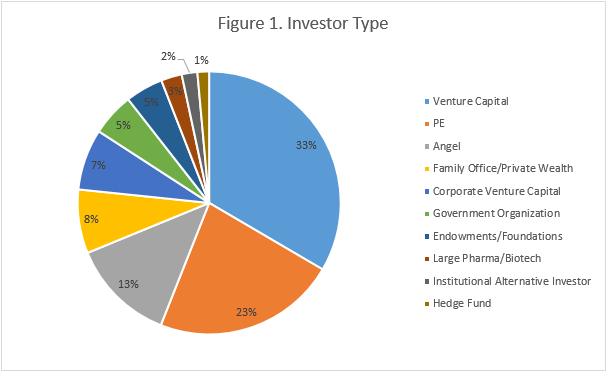
The investment community has also shown strong appetite for medical robotic innovations. A search on the LSN Investor Platform for investors interested in ‘Active Implantable Devices,’ ‘Electro Mechanical Medical Devices,’ and ‘Technical Aids for Disabled Persons’ yielded 625 results. We see interest from throughout the investor spectrum; the majority are VC/PE firms, and we also see interest from angel groups, family offices, and corporate VC funds (Figure 1).

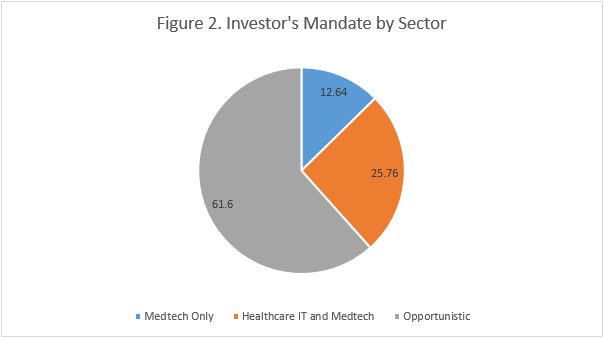
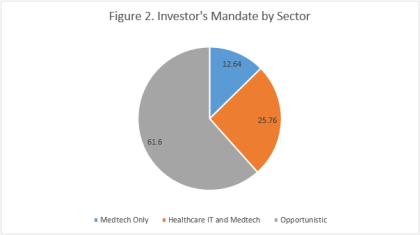
Many of the 625 investors are opportunistic, meaning that they are spread across sectors from MedTech to diagnostic to biotech to healthcare IT. However, 79 investors we have spoken to specifically indicated their mandate to find only novel devices that address unmet needs, including VCs and large medical device companies (Figure 2).

A growing trend is that traditional IT investors are seeing medical robotics as an entry point to the healthcare field. For example, we recently spoke to a California-based evergreen fund backed by founders of a major telecommunications company. The fund manager told us that he is seeking data capturing, data analytics and instruments/robotics application in healthcare. With no expertise in drug development, his team avoids therapeutic projects. However, they are happy to take on $250K – $1M investment in early-stage companies in the medical robotics field.
s1

s2

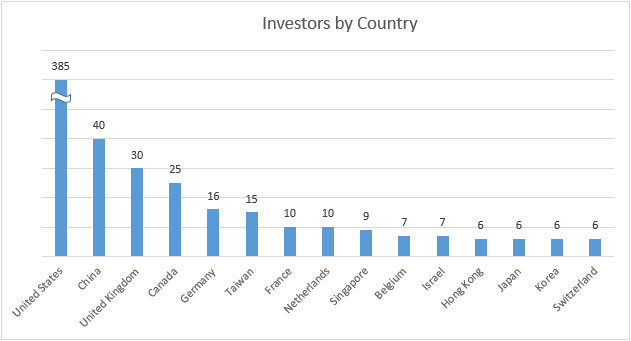
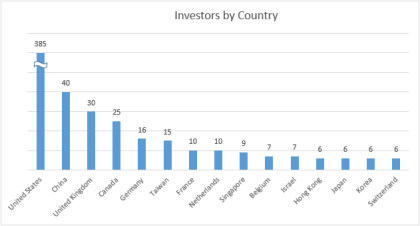
Medical robotics have truly attracted global interests (Figure 3). The USA clearly leads the field with 385 investors. Canada, the UK, Germany, France, and Netherlands are also very active. Asia-Pacific countries, including China, Taiwan, Singapore, Hong Kong, Japan, and Korea, are seeking medical robotics to help with their rapidly aging populations and rising rate of chronic diseases.

For example, in January this year a Beijing-based investor led a $17M round for a Massachusetts-based bionic prosthetic startup company. The company is developing lower-limb prosthesis that mimics normal ankle movement and offers powered propulsion for persons with disability. The capital is intended to form new strategic partnerships and expand into the China market.
s3

Strategically, many China-based investors are eager to turn their traditional manufacturing powerhouse into high value-added healthcare innovations. A manager of new VC fund from Beijing said that his team is most interested in minimally invasive surgical instruments, artificial intelligence and robots, diagnostic tools, and mobile health innovations. His fund is backed by one of China’s largest TMT companies, and his mandate is to find solutions that can capture large healthcare market share and are compatible with the founder’s IT background.

Medical robotics entrepreneurs are entering an exciting time when a growing number of investors from various backgrounds are jumping in to the intersection of computer science, material science, and medicine. It is imperative for entrepreneurs to think strategically when building alliances globally that will propel their products to the next stage.


An LSN Summer Chapter Series

By Cole Bunn, Senior Research Analyst, LSN

cole-wp

Summer has arrived, even here in Boston.  To help your fundraising efforts keep on through the coming heatwaves without flagging, LSN will be running our summer reading series again.  Each week, we’ll share a chapter of The Life Science Executive’s Fundraising Manifesto by Dennis Ford, packed with advice and tips for positioning, branding and marketing your life science financing round.

Bookcover-Front

The Life Science Executive’s Fundraising Manifesto helps scientists understand the fundamental skills needed to brand and market their companies. It discusses how to use a consistent message to achieve compelling results from a fundraising campaign and how to aggregate a list of potential global investors that are a fit for your company’s products and services. The book also explains how to efficiently and effectively reach out to potential investor targets, start a dialogue that fosters a relationship, and ultimately secure capital allocations.

The LSN Summer Reading series begins with “The Legal Landscape: A Basic Overview.” Contributed by Gerard P O’Connor, Esq, this first chapter provides a whistle-stop tour of all the legal issues a fundraising CEO needs to consider when raising capital.

Click here to download/print the PDF.

O’Connor introduces the regulatory bodies a fundraising CEO will encounter, defines accredited investors, and presents some of the alternative options to pursuing venture capital funds. The chapter also informs entrepreneurs regarding key concepts in dealmaking, including dilution, terms, and working with brokers.

We hope you find this exploration of the legal considerations involved in fundraising to be informative. Join us next week for Chapter 2 — “Crowdfunding and IPOs.”

Enjoyed the preview? Buy now from Amazon.com or Barnes & Noble