A venture capital firm based in North America focuses on making primarily Seed-stage investments but maintains flexibility to invest from Pre-Seed through Series A. It typically writes first checks ranging from USD 100,000 to USD 1 million, with a sweet spot around USD 500,000, and is open to follow-on participation. The firm has a flexible capital structure and can invest via equity, SAFEs, convertible notes, or other early-stage instruments. It is comfortable acting as lead, co-lead, or syndicate participant, and generally makes 6-10 new investments per year. While its geographic focus is North America, the firm is open to global opportunities where companies are looking to expand into the U.S. market.
The firm invests primarily in digital health companies and selectively in diagnostics and medical devices, particularly those with significant data value or differentiated data-driven technologies. Within digital health, the firm looks broadly at software and AI-enabled solutions. It is also interested in biotech platform technologies, particularly those enabling delivery or translational efficiency, but tends to avoid single-asset drug candidates. In medtech, the firm is open to all device classifications but shows stronger interest in technologies with clear regulatory or technical differentiation, rather than lightly regulated tools.
A key focus for the firm is the founding team. Team quality is one of the most important decision-making factors, and the firm evaluates teams holistically, including personality, market fit, experience, and leadership traits. The firm prefers to back experienced and well-rounded teams with a clear execution edge.
If you are interested in more information about this investor and other investors tracked by LSN, please email salescore@lifesciencenation.com.
A pharmaceutical company known as a global leader in consumer healthcare operates a significant prescription pharmaceutical business. Its consumer healthcare portfolio includes over 250 products and generates approximately USD 2.4 billion in sales annually. In recent years, the firm launched an internal innovation unit that was established with the mission of developing new businesses through open innovation or by acquiring new technologies. The firm focuses on early-stage innovation, particularly seed and Series A companies, and explores opportunities via direct investment as well as collaborative research and product licensing.
The firm targets transformative concepts in healthcare, such as preventative technologies, non-invasive treatments, and early diagnostic tools. The firm typically invests between USD 300,000 and USD 5 million, though the firm does not lead investment rounds. The firm prefers to invest alongside a lead VC or within a syndicate of investors. The firm’s geographic focus lies predominantly in North America and Europe.
The firm has outlined three priority areas of interest: (1) technologies “beyond the pill,” which includes digital therapeutics, software-based interventions, and medical devices, with a strong emphasis on neurotechnology such as neuromodulation, neurofeedback, and biofeedback; (2) advanced therapies, encompassing novel modalities and emerging therapeutic approaches; and (3) sensing and monitoring technologies, including wearables and vital sign sensing. While the firm does not require board representation, it may seek observer rights when appropriate.
If you are interested in more information about this investor and other investors tracked by LSN, please email salescore@lifesciencenation.com.
A venture capital firm backed by a major global financial services group actively invests across multiple sectors, including life sciences. The firm typically invests USD 1–2 million per round, though it is capable of larger allocations depending on the opportunity. While globally active, the firm focuses on opportunities with strong relevance to specific market needs in Asia.
In the life sciences space, the firm is currently targeting therapeutic and medtech products that address major unmet medical needs in its home market. It favors companies with a clear strategy to collaborate with regional pharmaceutical partners, whether through licensing, co-development, or strategic equity participation. The firm considers a range of therapeutic modalities including small molecules, biologics, biosimilars, and reformulated drugs. It primarily seeks products in Phase I clinical trials but may also invest in assets within one year of entering the clinic. Indications of strong interest include oncology and orphan diseases.
The firm only co-invests in opportunities outside of its home country and strongly prefers that a reputable institutional lead or established syndicate be in place before participating. As such, it tends to evaluate international deals with a co-investment mindset alongside other institutional investors.
If you are interested in more information about this investor and other investors tracked by LSN, please email salescore@lifesciencenation.com.
This venture capital firm headquartered in Northern Europe, is currently deploying capital from a life science focused fund. The firm primarily invests in biotech and digital health companies based in the Nordic and Baltic regions. The firm participates from Pre-Seed through Series A rounds, typically writing initial checks ranging from €250,000 to €3 million. The firm is open to both leading and co-investing in financing rounds.
While the firm’s primary focus lies in biotech and digital health, the firm is also open to investing in medical devices and diagnostics. Within biotech, the firm supports companies from the preclinical stage through to Phase I, with Phase II generally considered the latest point of entry. The firm maintains a disease-agnostic approach and is more focused on platform potential and scientific merit than on specific indications.
In most investments, the firm will seek a board seat, or at minimum, observer rights, reflecting its active involvement and strategic engagement with portfolio companies.
If you are interested in more information about this investor and other investors tracked by LSN, please email salescore@lifesciencenation.com.
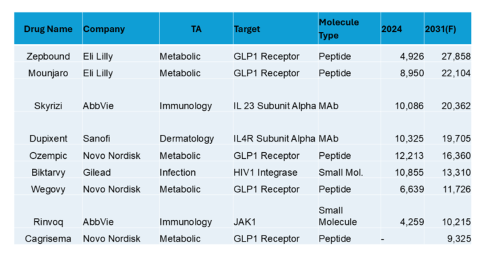
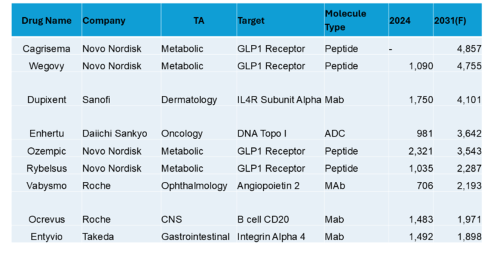
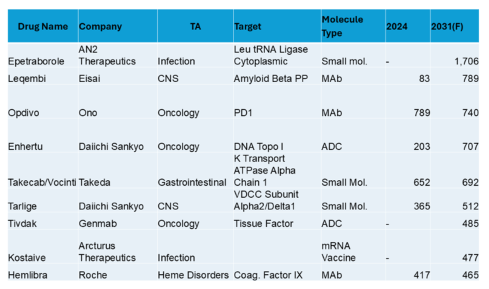
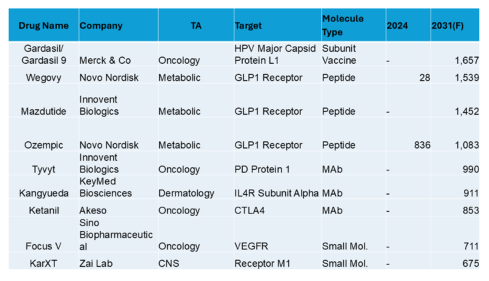
What do analysts think will be the top 10 drugs in the year 2031 (as searched in GlobalData)?
Top 10 in the US in 2031 (USD Millions)
In the US analyst forecasts for 2031, obesity dominates (with immunology, derm and infection for other TAs). Along with the obesity peptides are 2 small molecules and 2 MAbs. The sales are in the tens of billions.
Top 10 in Europe (USD Millions)
In Europe, along with the obesity drugs and dupixent in derm, we see the oncology ADC Enhertu, the ang2 ophthalmology drug Vabysmo, a CNS CD20, and a GI integrin in the top 10. Sales are in the single digit billions.
Top 10 in Japan (USD Millions)
In Japan, obesity is not visible in the top 10. An anti-infective tops the list, followed by CNS, oncology, GI and including heme disorders. There are companies not in the top 20 for global sales. Most of the top 10 have sales below $1B.
Top 10 in China (USD Millions)
For China, obesity is back in the top 10, but Gardasil, an oncology HPV vaccine tops the list. Local company “fast followers” are apparent and most of the top forecasted drugs are not yet launched (presumably a reflection of the rapidly evolving pharmaceutical environment). To get into the top 10, sales are above $500M.
Conclusion: The marketplace for drugs shows considerable variation in different regions around the world.
Just over a week ago, AbbVie paid $2.1 billion for Capstan Therapeutics’ in vivo anti-CD19 chimeric antigen receptor (CAR)-T cell therapy (CPTX2309) for B cell-mediated autoimmune disorders, which is currently in phase 1 testing. In the past few days, EsoBiotec (acquired by AstraZeneca earlier in the year) also published its first clinical data on a lentiviral-delivered anti-B-cell maturation antigen (BCMA) CAR-T approach (ESO-T01) for multiple myeloma, detailing responses in four patients, two of whom showed complete remission. With a host of other companies working on in vivo delivery into endogenous T cells—including Interius BioTherapeutics, Umoja Biopharma, and Orna Therapeutics, the field of in vivo delivered CAR-T cells appears poised at a tipping point.
Ex vivo generation of CAR-T cells (left) is a complex and lengthy procedure, entailing isolation of T cells from patient blood (1), followed by activation, transduction, and ex vivo expansion for several weeks. After undergoing conditioning treatment (2), patients are infused with a bolus of expanded CAR-T cells (3). In the in vivo approach (right), delivery vector (targeted LNPs or lentiviruses, depicted as red dots) are infused directly into the patient, where they encounter T cells and selectively deliver genetic material encoding the CAR (red). Source: Molecular Therapy.
Since transforming the face of cancer treatment in 2017, autologous CAR-T cell therapy has been dogged by logistical issues that have limited commercial rollout and increased costs—the need for leukapheresis, laborious cell harvesting, heterogeneous cell expansion, lengthy turnaround times, and inconsistency of batches—with access limited to just a few clinical centers. Extensive waiting lists can mean many patients die before even being treated, which has driven the search for ex vivo approaches that shorten manufacturing times using fully closed systems and/or miniaturization. Given these challenges, delivery of a CAR-encoding mRNA to a T cell in vivo could be a game-changing technology: No need for viral vectors; no leukapheresis/chemo; no ex vivo manipulation, no requirement for multiple patient hospital visits; no convoluted training of personnel; and no risk of second primary T-cell cancers due to insertional mutagenesis. This last issue has loomed over the field, with all CAR-T therapies carrying black box warnings, although at the end of June the FDA removed all requirements for Risk Evaluation and Mitigation Strategies (REMS).
Writing in Science, the founding team of Capstan Therapeutics, headed by Carl June and Bruce Levine at the University of Pennsylvania and Haig Aghajanian of Capstan, report proof of concept data that functional CAR T cells with antitumor activity can be produced in animal models without any ex vivo manipulation. A key breakthrough in their effort was the development of lipid nanoparticles (LNPs) specifically designed to target T cells and to overcome the propensity of LNPs to accumulate in the liver. To avoid this problem, the authors screened a set of ionizable lipids to identify L829, a lipid that incorporates a tertiary amine headgroup that reduces non-specific interactions with the hepatic system due to its pH-dependent protonation and neutral charge. Ester cleavage sites in the lipid also promote rapid breakdown in, and clearance from, hepatocytes. A final step was to decorate L829 LNPs with a mAb targeting CD5, a T-cell specific marker. The resulting LNP showed limited liver uptake in rodents and non-human primates compared with control LNPs.
To test the potential of L829-containing LNPs to generate functional CAR-T cells, the team engineered them to incorporate 1) mRNA encoding a CAR that binds CD19 on B cells and 2) an antibody targeting CD8+ T cells. These CD8-L829-CD19 targeted (t)LNPs successfully delivered the mRNA in vitro to CD8+ T cells from healthy subjects and from people with B cell-mediated autoimmune diseases. In vivo, these CAR T cells had anti-tumor activity in a humanized mouse model of B cell acute lymphoblastic leukemia.
The Capstan approach to CAR-T cell therapy: An IV bag, a targeted LNP, and an mRNA encoding the CAR of interest. Source: Science.
In cynomolgus monkeys that received repeated doses of CD8-L829 tLNPs containing anti-CD20 CAR mRNA (instead of anti-CD19, which is not cross-reactive between human and monkey), sustained B-cell depletion was observed that lasted for one month. Importantly, reconstituted B cells were predominantly naïve, implying an immune reset — a key therapeutic goal in autoimmunity.
The Capstan in vivo mRNA-encoded CAR T platform eliminates the need for ex vivo manipulation and lymphodepleting conditioning. It avoids the risks often associated with the use of viral vectors that integrate into the genome. It also is transient, allowing dosages to be optimized and quickly stopped if patients suffer adverse events associated with neurotoxicity or cytokine-release syndrome. It will be interesting to see whether the approach is scalable and whether it can open up conditions where long-term CAR-T cell persistence might not be necessary, such as autoimmune disease.
Going forward, an important question will be to determine the potential immunogenicity of the tLNP formulation (especially as the mRNA treatment may be given multiple times), and whether tLNPs cause elevations of human liver enzymes like alanine transaminase or aspartate aminotransferase. Liver toxicity of a novel liposome formulation already caused a clinical hold for Verve Therapeutics’ base editing therapy last year. Future work will also need to define optimal dosing, durability, and long-term safety of this approach. But the work of June, Aghajanian and their colleagues is a compelling advance promising a new era of widely available adoptive T-cell therapies for B-cell driven hematological cancers and autoimmune conditions. A single dose of any of the seven currently approved commercial ex vivo CAR-T therapies costs ~$500,000. A vial of an in vivo treatment is likely to cost an order of magnitude less.
A Europe-based venture capital firm manages a dedicated fund focused on diabetes and related conditions. Its investment sweet spot ranges from Seed to Series A, with typical check sizes between $1–3 million. The firm invests globally and is open to both leading and co-investing. Its team brings strong scientific and industry expertise in the diabetes space and actively supports portfolio companies, including through board and observer roles.
The firm focuses on diabetes and related indications such as comorbidities or conditions where diabetes is a key driver (e.g., kidney disease, wound care, and vision loss). It primarily invests in medical devices and digital health solutions, avoiding traditional biotech therapeutics. For hardware, the firm seeks technologies beyond the prototype stage with early data (lab, clinical, or first-in-human). For software, it prioritizes products showing commercial traction or scalable business models. For B2B products, validation through partnerships with medtech firms or healthcare systems is a strong advantage.
There are no specific requirements regarding a company’s founding team.
If you are interested in more information about this investor and other investors tracked by LSN, please email salescore@lifesciencenation.com.