
By Maximilian Klietmann, VP of Marketing, LSN
 Licensing deals comprise one of the most important aspects of the life sciences industry. However, many entrepreneurs fail to properly research the trends around biotech licensing, despite how critical these trends are to anyone seeking partnershipsor capital from big pharma. LSN’s Licensing Deals Database curates publicly available licensing deal data from around the world. A search for information on the past three years yields approximately 100 licensing deals for each year (99 in 2011, 101 in 2012, and 100 in 2013). This allows us to get a sense of some of the trends surrounding big pharma licensing activity, and what the data could mean for emerging biotech executives in 2014.
Increasing Early Stage Focus:
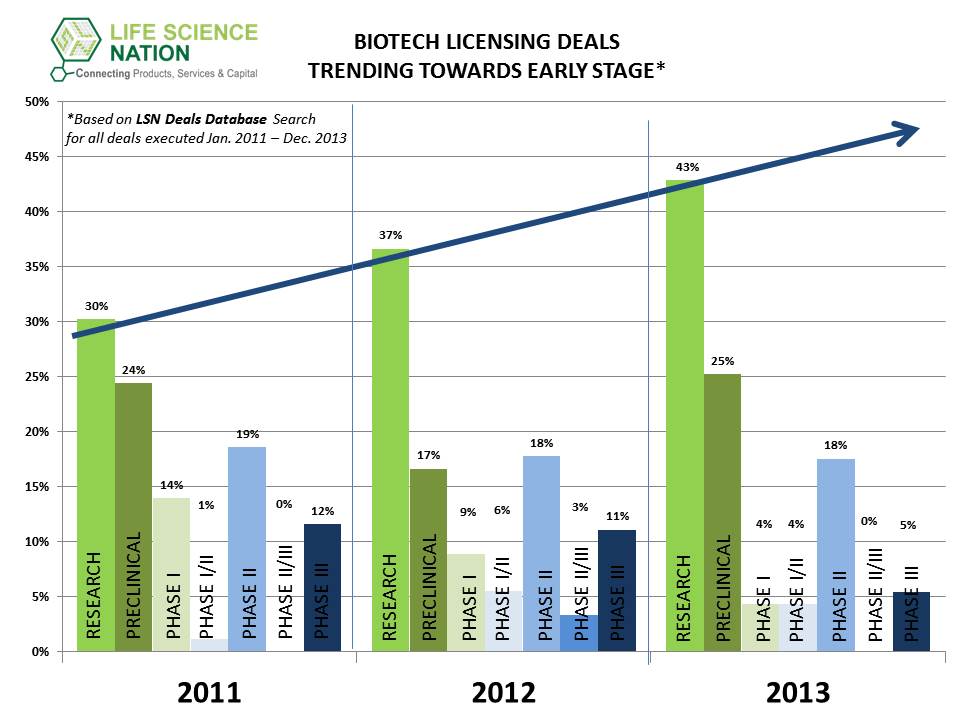
One of the most immediate trends shown by the data is an increased early stage focus as a percentage of deals. This reflects the trend of big pharma relying more heavily on in-licensing to augment R&D pipelines that LSN discussed in late 2012, when it was first emerging. Given the data and conversations LSN Research has had with several big pharma search and evaluation groups, this trend will most likely continue over the course of 2014, as big pharma continues to look at in-licensing as a source of innovative science to shore up pipelines.
Oncology and Other Major Indications Remain Hot:
When it comes to trends surrounding specific indications, oncology is by far the leader. This indication area has consistently represented about 30% of licensing deal activity for the last three years in a row. This is good news for early stage companies in the space, as big pharma isn’t showing any signs of decreasing activity in this disease area. One good angle of attack for emerging biotech companies may be to position themselves with non-traditional approaches to cancer (for example, the increased buzz surrounding immunotherapies for cancer). Runners up in indication popularity are CNS and infectious diseases.
So What Does It Mean?
For early stage companies, this trend is welcome news. Resources and capital that were formerly out of scope for an emerging entrepreneur are becoming tangibly accessible. Also, the consistency of indication focus over the past three years shows stable demand for certain products, giving entrepreneurs some predictable trends to watch. The key is finding the right strategy for targeting these investors, and beating the competition to the punch.


 Next Phase Newsletter
Leave a comment