Archive | October, 2015

Life Science Corporate Venture Capital Panelists Discuss Investment Trends

15 Oct

By Christine A. Wu, Research Analyst, LSN

chrsitine

What are life science corporate venture capitals excited about these days? What is the best point of entry to get to them? How early do they invest in, and how long is the investment timeline? The Corporate Venture Capital panelists hooked a full room of entrepreneurs as they offered their intriguing perspectives at LSN’s RESI Boston conference in September.

Moderated by Donnie McGrath, VP of Business Development, Bristol-Myers Squibb, panelists include:

Each CVC has its own unique structure.

Not one of the firms represented on the panel had the same venture structure as the other (structures listed below do not encompass all CVCs).

Dependent on the Parent Company

Traditional CVC structures, like Sanofi-Genzyme BioVentures (SGBV), make investments dependent on the context of what the parent company seeks. SGBV makes “plain vanilla” investments with no rights and no agreements, explained DeWitt, and weighs the desires of its parent company heavily as a strategic investor for the Sanofi pipeline.

Independent of the Parent Company

Boehringer Ingelheim Venture Fund invests in therapeutic platform companies outside of what BI is currently researching. The CVC is usually the first money in, and helps companies run their business plan and business agents.

Limited Partnership (LP) Agreements Only

As a drug development organization, and not a venture capitalist, Bristol-Myers Squibb (BMS) takes LP positions with venture capital firms with trusted companies, and partners with “those who are good at what they’re doing,” explains McGrath, “[we will] not to be something when we won’t be as good as others out there, so we partner with companies.”

CVC of a Large CRO with External LPs

WuXi Venture Fund invests to leverage its parent company WuXi PharmaTech, a large CRO that helps clients in product development from seed to commercial stages. While the firm enables companies to discover products more efficiently, explains Hu, WuXi also recently raised its global fund, where 25% came from capital and 75% came from Asia-based family offices.

The timeline of investment can vary.

Phase of Development

CVCs can invest as early as its first onset with just the entrepreneur and concept. Even while most WuXi investments are series A, once the license comes up, WuXi would form a company. Similarly, BI Venture Fund is usually the first money in. Heidecker describes his earliest investment was when the company didn’t even have an IP, which was unusual.

Other CVCs will invest in what makes sense at the time. SBGV will look depending on context, opportunity, and the company’s investment thesis.

Integrium, on the other hand, will only look post series C. This CVC supports financing for companies until their next inflection point. Powers explains that companies come to them, usually referenced from other VCs, when there is a piece of financing that had not shown up and is necessary for its next point of development. Integrium looks at how to get the company from one value to the next and whether it can be done in a matter of months before handing it off upstream.

Time Between Meeting the Company and Closing the Deal 

It can be a fast process. Heidecker explains that the competition in the space can push the flow to the deal. Yet, the process is also fast when the CVC comes across a technology that “you just can’t invest in.”

On the other hand, it can take as long as 2.5 years before finally investing. The added element of looking for co-investors also extends the overall timeline.

CVCs are interested in lots of HOT opportunities.

“I can get excited about many things!” both Heidecker and DeWitt exclaimed. Other than the more “common” indications of interest—such as oncology, cardiovascular, diabetes, MS, among others—panelists highlighted their particular interest in transformative therapies—therapies that fundamentally change the life of the patient, as well as microbiome and the way the immune system can crosstalk with bacteria. And then, of course, “Gene therapy is more and more hot.

Your final advice:

  1. Have a clear plan – You should have a clear idea of where you want to take your company and to what level. Do you have a path (with convincing data) to your inflection points? As an entrepreneur yourself, you probably know more than anyone else. “If we don’t have this confidence, then we won’t start this conversation,” says Hu.
  2. Be introduced through CVC leadership – the best point of entry is when you directly have a relationship with someone inside the leadership team and are introduced.
  3. Establish some type of credibility – whether a paper publication, an academic fund, an established CEO, mark yourself.
  4. Have a perfect 30-second pitch – “It’s amazing how crisp you can be in 30 seconds to tell us what it is you’re about and why we should continue our conversation,” says DeWitt.
  5. Don’t be married to your protocol or approach – When you and the CVC convert to the clinical setting, generally things will change 90% of the time.
  6. And finally, “If my group says no, don’t go to my boss!” McGrath concludes.

Emerging Opportunities in Global Health Impact Investments

15 Oct

By Shaoyu Chang, MD, MPH,  Senior Research Analyst, LSN

Shaoyu 10*10

Earlier this week, one of the largest money managers announced the first US impact-backed mutual fund, reflecting a trend of impact investing in the investment community. Impact investing attempts to address the dual bottom line of financial returns and measurable social and/or environmental impact. It has been gaining traction quickly in recent years, especially among a new generation of socially-conscious investors, with an estimated market of $50 billion.

The global health community is also seeing the rise of impact investment. One reason is the growing awareness of the global disease burden, partially thanks to outspoken philanthropists, foundations, and advocates such as the economist Lawrence Summers. In his recent article, Summers was on a mission to bring preventable maternal, child, and infectious diseases to universally low levels by 2035. He argued that “the necessary investments [in global health] would have benefits that exceeded their costs by a factor of 10.”

Their optimism is well grounded. The convergence of medicine and communication technology has created unprecedented opportunity to tackle age-old diseases worldwide. The better understanding of disease and human biology has led to new diagnostic, treatment, and prevention methods for disease that plagued the world’s poor for centuries. Coupled with the widespread use of mobile phones and the Internet to facilitate patient monitoring and outbreak surveillance, global health agencies are hopeful to completely eradicate several ancient diseases, such as polio, malaria, and filariasis.

Another reason for a growing interest in impact investment is a financial one. According to a 2015 analysis that reviewed data from 1998 to 2010, social impact investment funds performed as well as conventional mainstream funds in terms of financial returns. In Asia, health tech saw the fastest growth in venture funding among all healthcare sectors.

Driven by a growing middle class and a rising healthcare demand, developing economies are seen as a source of future growth, especially by multi-national corporations. Global health serves as an ideal platform for them to build non-competitive collaborations with entrepreneurs, academia, and other corporations.

Based on our interviews with several global health investors, LSN has discovered that these investors are not only interested in startup teams emerging from low-income countries, but also in repurposing or adapting developed world innovations for specific, global health-related applications. Entrepreneurs could receive additional funding if they are flexible and willing to explore their technology’s applications.

While many global health entrepreneurs are passionate about their work, they frequently have a mismatch between their passion and their “investment readiness.” Entrepreneurs urgently need basic education on business strategy and investment landscape to realistically assess their assets and reach out to the right funding sources.

Development of health technology is a long, risky, and capital-intensive process. In global health, a successful project may involve multiple funding sources, including government grants, donations, impact equity, and impact debt. Entrepreneurs should carefully choose “smart money” investors who understand the timeline and provide strategic guidance when necessary. Good financial planning can help entrepreneurs pool capital from different sources to achieve milestones within a reasonable timeframe. The report by the Global Health Investment Landscaping Project provided a few useful case studies.

The increasingly crowded investment landscape poses both opportunities and challenges for entrepreneurs in the healthcare arena. We expect the growth of local innovation and global collaboration will advance healthcare for all.

CRISPR and Trends in the Gene Therapy Space

15 Oct

By Cole Bunn, Research Analyst, LSN

cole-wp

The allure of gene therapy is very strong, mostly due to its potential to cure, not just treat symptoms, of any disease with a genetic basis. The so-called “magic bullet” treatment—that if perfected, would revolutionize medicine (not to mention several other industries)—has drawn a lot of attention since its inception, and rightfully so. The field has seen many advances as well as setbacks, leaving investors and other industry stakeholders with a lot to ponder and speculate. All things considered, most leaders in the life science industry believe that major breakthroughs are right around the corner, including big pharma who has partnered with several of the biotechs developing these therapies.

The relatively recent gene editing technologies that have surfaced, with the CRISPR/Cas9 technology getting the most attention (more on this later), have once again put the spotlight on gene therapy. Given that gene therapy efforts are still moving forward, we have decided to utilize the Life Science Nation (LSN) company and investor platforms to create a sample of the space and look at some of the current trends.

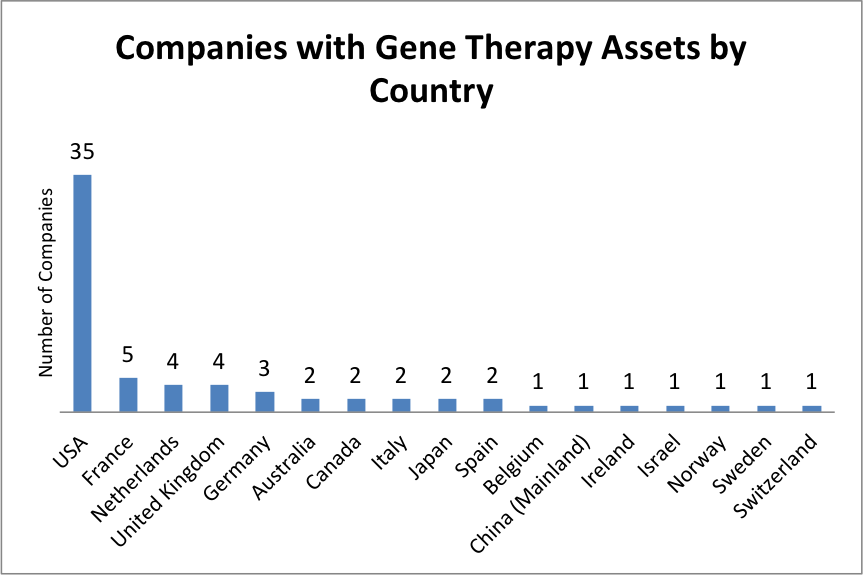
The LSN company platform, which tracks 30,000 biotech, medtech and healthcare IT companies around the globe, provides a nice sample of what is happening in the industry. Using the platform to look at gene therapy companies by country, the LSN platform found 68 companies that were operating in the gene therapy space. As shown in Figure 1, the U.S. led the way with 35 gene therapy-related companies, with most others spread out fairly evenly across Western Europe.

figure 1

Figure 1 | Companies with Gene Therapy Assets by Country Data from LSN Company Platform | October 13, 2015

Treatment of genetic disease is usually what comes to mind when thinking about gene therapy, but this technique also has utility in treating infectious disease. Gene therapy for infectious diseases requires the introduction of genes designed to specifically block or inhibit the gene expression or function of gene products, such that the replication of the infectious agent is blocked or limited [1]. In addition, gene therapy techniques have several uses in research, including studying protein function and creating genetically modified cell and animal models.

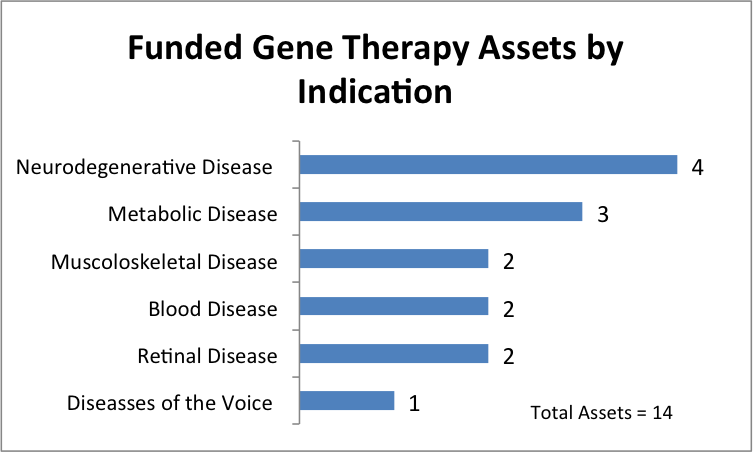
The rekindled interest in the viability of these treatments, given new technologies and more clinical data, is bringing an influx of capital into the space. Using the LSN company platform, we’ve looked at a sample of gene therapy financings. Figure 2 shows the number of funded gene therapy assets, by indication, from the five largest funding rounds over the past three years.

figure 2

Figure 2 | Funded Gene Therapy Assets by Indication Data from the LSN Company Platform | October 13, 2015 *Data of the five largest gene therapy funding rounds ranged from $45M-$75M

The new gene editing technologies, CRIPSR/Cas9 in particular, has excited researchers and certainly peaked the interest of some noteworthy investors and big corporations alike. So what’s the hype? What is CRISPR?

The CRISPR/Cas system is a prokaryotic immune system that confers resistance to foreign genetic elements such as plasmids and phages [2]. The gene editing technology known as “CRISPR” is a bacterial immune system that researchers have learned how to exploit in order to edit specific genes of interest in plants and animals. In nature, the system works by chopping up pieces of invading viral DNA, inserting some of these sequences into its own genome so that the next time the viral DNA is encountered, it is recognized (based on the specific DNA sequence – this is KEY to technology) and destroyed via the Cas enzyme. Simply put, using the system to actually edit genes works like this – researchers are able to guide the Cas enzyme to a specific gene sequence, which cuts the DNA strand in the specified location, allowing for editing/correcting the sequence.

The CRISPR technology has brought a lot of excitement along with it due to its targeted nature and compact system, among other advantages over conventional gene therapy technologies. However, this new technology isn’t exempt from some of the roadblocks that previous gene therapies encountered, most notably delivery of the gene editing therapeutic itself.

It is yet to be seen if gene therapy will be a realized therapy, but there is no doubting the enormous potential of the field, given some of the inherent issues are resolved (not to mention ethical implications and possible pricing scenarios). There are a lot of gene therapy hopefuls out there and most everyone from angel investors to big pharma have a horse in the race. If you’d like to learn more, we find this article useful to read. The LSN team will keep you informed as we continue to track trends in the gene therapy field.

  1. Bruce Bunnell and Richard Morgan, Gene Therapy for Infectious Diseases. Clinical Microbiology Reviews (1998) 11(1): 42–56.
  2. CRISPR.  Wikipedia: The Free Encyclopedia. Wikimedia Foundation, Inc., 10/14/2015.

Hot Life Science Investor Mandate 1: Multinational VC Fund Seeks Breakthrough Biopharmaceuticals

15 Oct

A venture capital firm founded in 2012 with offices in Eastern and Western US and Ireland is currently looking to make new investments into biopharmaceutical and medical device companies from its $172 million fund. The firm looks to invest in companies in seed to series B rounds and can provide up to about $17 million to a company over the lifetime of the investment. The firm is most interested in companies based in the US, Canada, and Ireland and will also consider exceptional opportunities elsewhere in Europe and in Asia. The firm plans to make approximately 4-5 new investments over the next 6-9 months.

The firm is interested in companies developing either biopharmaceuticals or medical devices. For biopharmaceuticals, the firm is interested in all modalities including small molecules, biologics, and cell and gene therapies. The firm is primarily interested in platform companies with the potential for multiple assets and strongly prefers technologies to be 1st in class or best in class, often originating from breakthrough chemistry or biology discoveries. The firm is looking for companies with assets in preclinical development through Phase 1 clinical trials. For medical devices, the firm is primarily interested in companies working on devices that are therapeutic in nature, as well as devices for self-pay markets, including aesthetics. The firm is indication-agnostic in both biopharmaceuticals and devices.

The firm can both lead and co-lead investments, with a preference for taking a board seat. The firm prefers working with management teams with positive track records; however, they are open to working with incomplete or non-permanent management teams as well, especially for very early stage opportunities. The firm’s team has extensive operating experience and deep networks, which they can leverage to support companies as needed.

If you are interested in more information about this investor and other investors tracked by LSN, please email mandates@lifesciencenation.com

Hot Life Science Investor Mandate 2: Big Pharmaceutical Looks for Biomarker-Based Oncology Therapeutic Assets

15 Oct

A big pharmaceutical corporation based in Western Europe with offices worldwide forms partnerships with early-stage biotech companies. The firm also invests via a venture arm, which is highly strategic in nature; the firm shares access to opportunities with the fund. The firm invests in technologies from an early discovery stage onwards, and partners with companies worldwide.

The firm’s therapeutic areas are Oncology & Cancer Immunotherapy, Ophthalmology, Immunology, Infectious Disease & Specialty Care, and Neuroscience. In the oncology sector, the firm seeks assets that have a biomarker hypothesis that can be used to select and stratify patient populations; in addition to therapeutic assets, biomarker diagnostics are also of interest. In Ophthalmology, the firm focuses on ‘back of the eye’ diseases such as AMD, diabetic retinopathy, and diabetic macular edema, and is also interested in other eye diseases such as retinitis of prematurity, retinitis pigmentosa, uveitis, dry eye, and glaucoma. In immunology/infectious disease, the firm focuses on hepatitis B, influenza and antibacterials; the firm is also interested in respiratory infections, HPV and HIV. In neurology, the firm focuses on neurodegenerative diseases (Alzheimer’s, Parkinson’s), schizophrenia, multiple sclerosis, depression, and autism spectrum disorders. Opportunities from the lead op stage onwards are evaluated by the firm’s therapeutic area groups.

The firm is interested in companies that align with the firm’s areas of focus and which have attained proof of principle or proof of concept data for their asset, and prefers that assets have obtained robust preclinical data across several species. Evidence of target engagement is of importance. In oncology assets, the possibility of combinability with the firm’s asset is also of interest.

If you are interested in more information about this investor and other investors tracked by LSN, please email mandates@lifesciencenation.com

Hot Life Science Investor Mandate 3: VC Firm Invests in Medical Devices and Healthcare IT Companies Based in Mid-Atlantic Region

15 Oct

A venture-capital firm supports early stage companies in the Mid-Atlantic Region – Maryland, Virginia, Washington, DC, and North Carolina. The firm makes approximately 6 investments per year into companies seeking investment rounds less than $4m. During a single round, the firm will typically make an equity investment of $500k to $1.0m. For companies that require larger financing rounds, the firm will look to syndicate deals with other investment groups in their network.

The firm is interested in medical devices (class 1 or 2) and healthcare IT opportunities. The firm looks for companies already generating revenues or close, within 12-18 months of doing so. Within medical devices, the firm requires FDA clearance or close to doing so. The firm is open to all indication areas.

The firm looks for a strong, proven leadership team with a clear path and desire to exit, unique value proposition, competitive term sheet and interest in investors who can provide value beyond the checkbook.

If you are interested in more information about this investor and other investors tracked by LSN, please email mandates@lifesciencenation.com

Hot Life Science Investor Mandate 4: Multinational Specialist Healthcare Company Seeks In-Licensing and Acquiring Therapeutic and Med Devices

15 Oct

A specialist healthcare company with offices in Europe, North America, and Australia, is looking to in-license and acquire therapeutics and medical devices that are of strategic interest. The firm is capable of making allocations ranging from £10 million to over £100 and more for later stage acquisitions. The firm is primarily interested in companies that are looking to be marketed in the United States although they are open to global opportunities as well.

The firm is interested in Therapeutic assets and Medical Devices. For therapeutics the firm’s current products include antidotes to treat snake envenomation and toxicity associated with medicines used for heart conditions and cancer. The firm is open to therapeutics within these areas as well as other indications pending they are intended to be hospital products. The firm primarily focuses on small molecule therapeutics. For medical devices the firm is looking for companies that have 510 K approval in Oncology, Vascular and Pulmonary fields. The firm’s current device products include Interventional Oncology products used to treat patients with liver tumors and Interventional Vascular products used to treat patients with severe blood clots.

The firm is interested in working with founding management teams prior to investment and is open to in-license from public and private clients.

If you are interested in more information about this investor and other investors tracked by LSN, please email mandates@lifesciencenation.com