
Archive | October, 2015

September Mandate Roundup: Asian Based Investors Continue to Show Interest in Global Technologies

1 Oct

By Michael Quigley, Director of Research, LSN

mike-2

This September, LSN’s research staff managed to speak with and get mandates from 96 life science and healthcare investors from 15 countries all around the globe. As we have grown in the space over the past 3 years we are continuing to see more and more investors, particular from Asian countries like China (especially Hong Kong) and Taiwan with interests in investing in healthcare outside of their region. Figure 1 shows a breakdown of the countries where the investors we spoke with last month are based:

image001


Interestingly 75% of the mandates from Asia-based investors are looking for emerging technologies either globally, or to the US in addition to their local geographies. This is a trend that we have commented on in the past, and are seeing continue to grow and materialize as we speak with more and more investors.

In addition to the geographic breakdown of investors LSN’s research team spoke with last month, there was also diversity in the types of investors contacted.
02

This spread of investor types highlights an ongoing theme expressed by LSN; reaching out to one or a few types of investors is going to greatly limit your chances of receiving an allocation. As we have said time and time again, fundraising is a numbers game. You want to start with a wide net and work your way through a target list to ensure you leave no stone unturned.
03

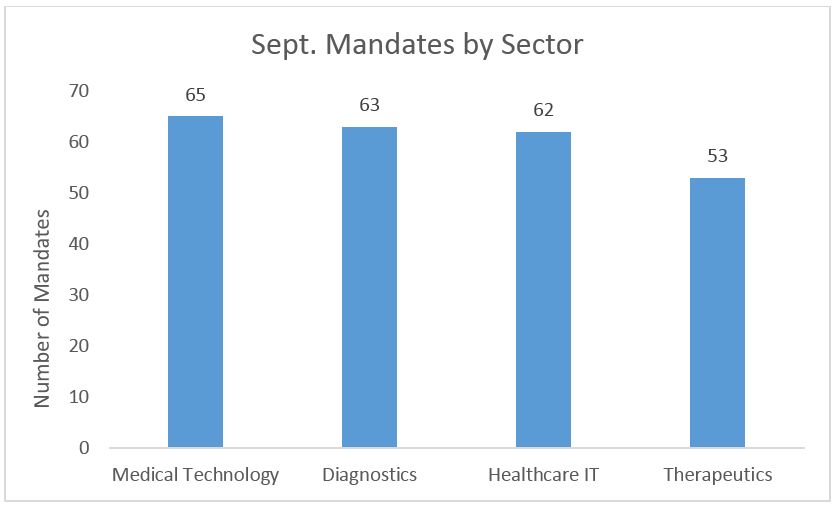
The spread of sectors these investors LSN’s research team spoke with in September are looking to invest in was fairly even, with medical technology, diagnostic and healthcare IT outpacing therapeutics by around 20%. This is a result of many investors including a number of large tech firms that we speak with that simply do not have the expertise or appetite to invest in the complex and time intensive realm of therapeutics yet still want exposure to healthcare innovation.

04
05

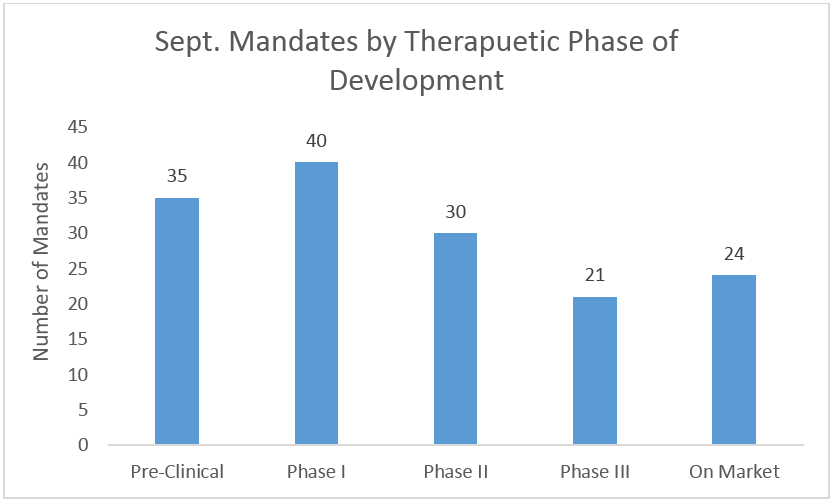
LSN’s Research team focus on finding and speaking with investors looking for early stage companies. Interestingly across devices, diagnostics and therapeutics, investors seem to be most interested in companies that are obtaining their first-in-man data. These assets often see large spikes in valuation at the end of their first clinical studies or when showing early signs of efficacy in humans, so it’s logical that early stage investors target their allocations at this particular development point.

While this roundup provides an overview of the information we have recently gathered regarding investor interest, we collect many other details that help us identify suitable opportunities for each investor, including which indication areas and technological approaches the investor focuses on, and what kind of financing rounds the investor is open to participating in. These details are invaluable to a life science company looking to find the right investor fit. We look forward to speaking with more life science investors and continuing to share our findings with our readership.

Biotech Investor Trend: Combination Therapies

1 Oct

By Lucy Parkinson, Senior Research Manager, LSN

LSN Research keeps in regular ongoing dialogue with 900 active life science investors and tracks an additional 4000 global investors. Those conversations often bring to light new trends that are on the minds of investors as they identify their mandate priorities. Recently, we’ve heard several investors express an interest in companies that could potentially use their asset as part of a combination therapy.

Combination therapies are currently a hot topic in biotech, although the approach has long been borne out in some disease areas, such as HIV HAART combinations and many cancer treatments. By using two drugs that interact favorably, one can affect a disease via multiple routes that may produce a powerful effect when combined. However, in the past these combinations have often been uncovered after a drug has been developed; by uncovering potential combination uses for an asset earlier in the development process, a biotech startup can increase the value of their asset. Investors are taking notice of this opportunity to add extra value to their portfolios.

A broad range of investors have expressed interest in this trend, and many have been creative in their approaches to combination therapy investment.

For a large pharma company looking to in-license new assets, the situation is relatively straightforward: they look for early stage therapeutics that they can combine with a drug from their own portfolio in order to make a more powerful therapy. This widens the market for their own assets, and in some cases may extend the patent life of an older drug by allowing the firm to register a new combined drug.

If you’re a biotech entrepreneur looking for a major strategic partner, you may wish to consider this angle when pitching to pharma companies. Look at the firm’s portfolio and pipeline to see if there’s an asset that would fit into a combination alongside your own. If the potential is clear, a large pharma company may be interested in performing a trial to assess the strength of the combination; if successful, a combination approach could increase the value of a partnership for both sides.

Outside of the pharma world, we have heard from investment funds that are highly interested in the combination potential of early stage biotechs. Combinations are particularly of interest to virtual pharma investment funds that focus on assets rather than on equity rounds. These investors may be interested in aggregating early stage assets in a particular indication area and exploring potential combinations within their portfolio. However, as combination uses add value to an asset, if you’re pitching to any investment fund it’s worth being aware of what else is in their portfolio and highlighting any combination opportunities that you see.

LSN has also heard from philanthropic groups involved in this trend, particularly in the cancer space. One cancer foundation that we’ve spoken to uses a nondilutive approach to funding combination research; if an entrepreneur approaches the foundation regarding an asset that has combination potential, the foundation’s oncology experts will select another drug that may make a promising combination with the asset, and will then finance a trial to gauge the efficacy of the combination. Foundations may be very hands-on in this regard and typically favor assets that have already obtained human proof of concept data; by funding combinations of these derisked later stage assets, a foundation can have a near-term impact on patient care.

Why is this varied group of investors converging on combination strategies? It’s a highly impactful approach, particularly in oncology, where a combination dose might target two different pathways to fight the same tumor. Initial tests to validate a combination may be relatively inexpensive, if the asset has already been validated alone. Whether the investor is motivated by impact, strategic needs, or return on investment, discovering a combination will help them realize value.

If you can see combination potential in your asset, do your homework on the portfolio of each investor you meet with and work this strategy into your pitch.

RESI Boston Preclinical & Phase I Investors Panel

1 Oct

By Christine A. Wu, Research Analyst, LSN

chrsitine

At our RESI Boston two weeks ago, Preclinical/Phase I stage investors joined us on a panel discussing their approach in seeking new early-stage deals, what they look for, and their process and advice for entrepreneurs.

Moderated by Steven Gullans, Managing Director, Excel Venture Management, our panelists include:

The panel opened up saying that the industry is built on trust. Trust in partnering within their network, along with trust in developing relationships with their portfolio companies in terms of their management teams, their quality of science, and their clinical regulatory pathway potential.

Trust in Networking & Partnering—

Listing a target range of 2-6 deals per year for early-stage ventures, the panelists emphasized that a number of deals are done with each other with waves of requests in September after Labor Day, January after JP Morgan, and May.

There is a particular attractiveness to partnering with corporate venture capital firms, as the partnership would acquire benefits from their capabilities. When looking at big pharma, it is valuable to see what applies to them as they generally have large portfolios and companies can never be sure of how the project is prioritized. However, panelists highlight the existence of an asymmetry in partnership with pharmaceutical companies, in which they learn about assets in what the small company is doing in the space, but are reluctant to share what they’re doing and what they have learned.

Networking becomes incredibly essential when it comes to presenting a deal. The panelists emphasize how much more attractive the deal looks if it had come through someone they trust within their network.

Trust in Management Teams –

The panelists emphasize the positive asset in building the relationship between the investor and the company management team. Even after deciding in making the investment, it can take up to eight months to coach through and build a relationship to a point of comfort in the investment decision. This build of trust is particularly important with an early stage (series A) investment.

Trust in the Quality of Science –

Panelists emphasize clinical validation and the importance of presenting constructive data to show its ability to execute the process of development. The clinical asset sweet spot is a reliable and predictable animal model with the only exception being a completely novel breakthrough modality.

Another sweet spot is the company’s therapeutic strategy, which can be even earlier than the animal model. A company’s strategy, for example, may be identification of a new neuronal receptor as a pain target, and in order to test the hypothesis is to analyze medicinal chemistry.

In an area of science that has been around for a long time, the company should have a new twist in their modality. For a peptide molecule, for example, there must be a novel application in the operating space that is protectable and reliable. Companies should have the ability to rebrand technology with marginal potential.

In single-asset versus platform technologies, the panelists emphasize the value, and challenge, of understanding the “first” versus the “second” drug in the clinic. Generally 95% percent of a valuation rests on the lead asset, while the rest of the pipeline constitutes 5% of the value.

Trust in Clinical Regulatory Pathway –

Panelists stressed that they look for the company to have a clear path with a clear and thorough plan to prove that they know what lies ahead. Along with seeing a solid clinical process, the attractive preclinical time range is from 2 to 4 years in R&D. Panelists provided additional advice to have a pre-IND meeting to build a clinical path and plan for both the entrepreneur and capitalist to see the road ahead.

For preclinical to phase I companies, here is your overall advice –

  • Network! Come through with someone in the investors’ trusted network
  • Increase your credibility by reaching out to patient foundations for scientific advisory boards to support you. This will get investors to acknowledge that your product is important.
  • Build your relationships, and most importantly, build that trust.

Hot Life Science Investor Mandate 1: Asia PE Firm Seeks East/West Life Science Opportunities

1 Oct

A global private equity and corporate finance advisory firm is headquartered in Singapore with offices in India, Malaysia and London. The firm makes global investments into life science companies as well as services related to healthcare. The firm leads the round with a $0.5m – $10m investment and utilizes their network to seek out other co-investors. The firm will occasionally seek distribution rights for international investments.

The PE firm is interested in therapeutics, medical devices, diagnostics, healthcare IT, biotech R&D services and suppliers and engineering companies. The firm is both stage and indication agnostic and has no revenue requirement. The firm has flexible investment criteria but the East West Axis is very important as the firm is not interested in companies that are restricted to one country; the firm only looks for companies with a multinational, global component.

The PE firm is flexible with their management team requirements. The firm is open to bringing in their own talent to assist with management and have assisted scientists in becoming successful entrepreneurs. The firm is a value-added investor driven by opportunity. The firm takes a board seat when making investments.

If you are interested in more information about this investor and other investors tracked by LSN, please email mandates@lifesciencenation.com

Hot Life Science Investor Mandate 2: Hedge Fund Invests In PMA & 510(k) Devices and Diagnostics

1 Oct

A hedge fund with offices in New York and Miami looks to make 3-4 new equity investments into commercial-stage companies located from all geographies, however – the firm likes to see companies with commercial sales in North America and/or Europe. The firm cares less about company headquarters and more about where its products are approved and sold. For companies with enterprise values of $20M – $200M, the firm commits $5M – $20M and is willing to lead rounds or join syndicates as long as the investment gives a meaningful stake in the company for the purposes of being able to add value.

The fund is interested in medical devices and diagnostics. Within medical devices, the firm prefers devices with strong IP protection and generally with PMA or 510(k) approval. Within diagnostics, the firm is very opportunistic though their recent experience has focused on cancer genomic testing. The fund is open to all indication areas but historically has focused on cardiovascular, oncology and minimally invasive surgery.

The fund looks for seasoned management teams that have relevant experience in the sector the company is involved in. The firm likes to see this across the C-suite, particularly in the CEO and sales and marketing leadership. The firm takes a board seat when making investments and looks to add value through active involvement.

If you are interested in more information about this investor and other investors tracked by LSN, please email mandates@lifesciencenation.com

Hot Life Science Investor Mandate 3: Asian Pharma Company Seeks Oncology Assets

1 Oct

A biopharmaceutical company based in Asia seeks research collaboration, in-licensing, and partnering opportunities with companies mainly in the oncology space. The firm seeks 3-5 projects within the next year. The firm has a “no research, development only” model, and licenses drug candidates ranging from preclinical to clinical stages. The firm currently has projects from the USA and Europe, though is open to projects globally.

The pharma firm seeks biotech therapeutics in oncology and Asian prevalent diseases, such as hepatoma (liver cancer), soft tissue sarcoma, as well as other local diseases in Asia. The firm will consider therapeutics in all phases, and has a particular interest in small biotech companies.

The firm prefers a management team with experience in oncology and other relevant fields of science. As a public company, the firm will partner with the company and collaborate with its research and development.

If you are interested in more information about this investor and other investors tracked by LSN, please email mandates@lifesciencenation.com

Hot Life Science Investor Mandate 4: VC Arm of Merchant Bank Seeks Pain, Neuromodulation and Orthopedic Technologies

1 Oct

The venture arm of a New Jersey-based merchant bank looks at life science companies that have or are close to acquiring FDA approval, and are now seeking commercial capital. The firm typically leads and co-invests, and will look at early stage companies if the management team is well versed in the specific life science space. The firm typically invests between $5 million and $10 million, and opportunistically invests based on transaction. The firm typically makes 2-3 deals per year, and has invested over $40 million in the past year. The firm currently holds over $60 million in capital. The firm focuses on the east coast of USA, specifically from Boston to Florida, but is also open to Eastern Canada, including Toronto and Montreal.

The firm makes 60% of their activity in medtech devices, including those in healthcare IT and diagnostics. Around 20% of the firm’s activity involves biotech pharmaceuticals and therapeutics. The firm is interested in PMA and 510K medical devices, as well as software-enabled devices and lab equipment and drug development enabling technologies. The firm is open to all diagnostic subsectors—genomics, imaging, and in-vitro—as well as all therapeutic subsectors, though are focused on small molecules. The firm is interested in Phase III to on the market therapeutics, and is interested in medical devices in the development stage that have passed the preliminary design phase with a prototype. The firm has historically invested in assays in cancer diagnostics, as well as devices in the cardiovascular space. The firm is now focusing on opportunities in the pain and neuromodulation space, as well as orthopedics, cancer, and pediatric neurology.

The firm prefers a strong management team that has significant foothold in the space, and has great potential to make good partners. The firm will help fill the management team if necessary, and typically takes a board seat after an investment.

If you are interested in more information about this investor and other investors tracked by LSN, please email mandates@lifesciencenation.com