By Lucy Parkinson, VP of Investor Research, LSN

At LSN, we talk a lot about life science partnering meetings: our goal is to make RESI Partnering as productive for our RESI attendees as possible. LSN founded RESI because we had learned that while there are many other partnering events in the life science world, the experience was often lacking and we thought we could substantially improve it (and we have). Partnering is so instinctive for us that we rarely stop to think about what partnering is, and why it’s so important in the life science sector in particular: you might say partnering is just in our DNA.
As we’ve brought RESI to Asia, we’ve learned about how Asia has a different style of doing business conferences, where partnering is much less widely known. We therefore wanted to make a ground-up introduction to life science partnering.
Why Partnering, Why In Life Science?
Partnering was originally driven by the needs of big pharma companies. These firms have an intense focus on developing their future pipelines, and this often means looking for external assets that they could license in to bolster their strategies as existing products move toward the end of patent life. Pharmas draw up specific maps of the technologies that they need, and have sophisticated teams that look externally for these assets.
The life sciences industry is as much a people business as it is a technology business. When a pharma company licenses an asset, that often means embarking on years of co-development work in which the pharma and the startup share resources and expertise to bring the product through clinical trials. It’s therefore essential to meet people face to face, get to know how they work, and learn to trust them. However, networking in a conference hall isn’t the best way to find the people who are developing those specific technologies that are needed.
Partnering events offered pharma BD staff a way to meet lots of drug development entrepreneurs in one place, by using an online system to receive meeting requests and select in advance who they wanted to connect with at the event. This offered much more efficiency than networking, and a much more personal connection than watching a startup give a pitch on a stage.
Since its origin, partnering events have also served other investors and life science players as well, such as CROs and other service providers who can use the events to connect with new customers who need their particular expertise.
What happens at a partnering event?
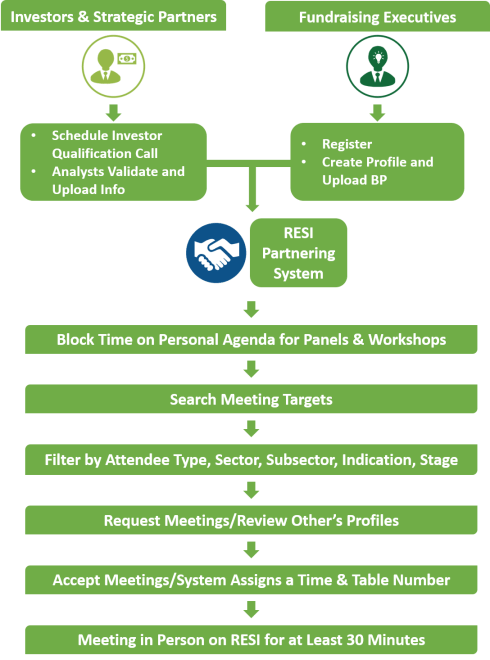
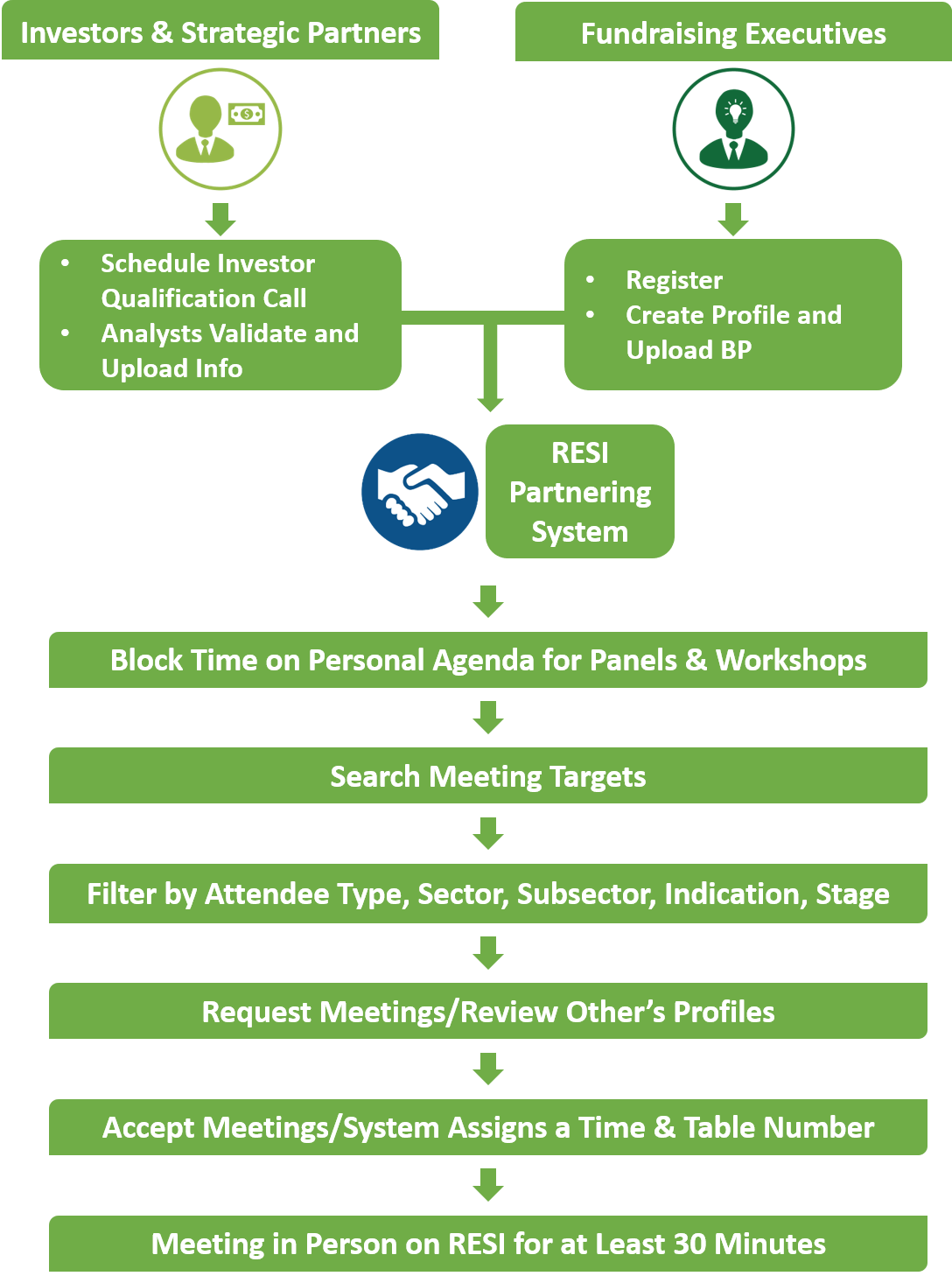
When you register for a partnering event like RESI, you will be added to an online meeting schedule system that you can use to plan your day. You can use this system to send messages to other attendees and ask them to meet with you. You will also receive messages from other attendees, and can decide whether to accept or decline their meeting requests. In this way, every attendee manages their own schedule and decides for themself who they would like to meet.
If a meeting request is accepted, the system will find a time and location for the meeting. The locations will be numbered tables or booths where you can sit down and talk to your meeting partner, usually for 30 minutes. It’s therefore possible to have in-depth conversations about your business with lots of people in one day.
If you have other plans throughout the day, such as a presentation or panel session you wish to attend, the partnering system will allow you to mark yourself as unavailable for meetings at those times. Be sure to set your availability before you make any meeting requests.
How did RESI change partnering?
While partnering is generally more efficient than networking, it is still often hard to find meeting partners who are a good fit for your business. For example, if you are an entrepreneur developing a new cell therapy product in the cardiovascular space, it might be difficult to identify investors who are interested in this type of technology. You might inadvertently send requests to people who aren’t a relevant fit, and receive a poor return on your efforts. From the investor or pharma point of view, it can be very challenging to receive many unsuitable meeting requests at an event, and time-consuming to filter through them for good fits.
The other big challenge for entrepreneurs attending a partnering event is simply finding real investors who are ready to allocate. At many events, active investors are thin on the ground, and you might end up meeting someone who claims to be an ‘investor’ but is really just a broker or investment banker.
RESI’s key insights are thus: in life science, there are buyers (typically investors, big pharma and other corporations that invest strategically such as medical device corporations), and there are sellers (scientist-entrepreneurs and early stage companies). Good partnering depends on both of these sides having fully developed profiles that can be filtered to look for relevant fits.
The second key insight is that it takes a dedicated team to find investors, vet investors, invite them to the event, and profile their requirements. LSN’s Investor Research team is dedicated to speaking with investors and pharma/strategic investors worldwide and learning what they are looking for. Most RESI events have a 1:1 ratio of startups to investors, thereby maximizing an entreprenur’s chance of getting investor meetings.
The third key insight is that the life sciences industry is an extremely granular business. Everyone has their own niche of expertise and technological savvy, from antibodies to robotics to medical AI. In addition to technology type, stage of product development is also an extremely significant variable. There are some investors who specialize in making investments in preclinical or prototype-stage companies; meanwhile, others prefer to only invest after the company’s product has proven its clinical safety and/or efficacy. It’s therefore not enough to simply bring investors to an event, or to offer startups a chance to send messages to them. LSN’s Investor Research team prepopulate investor profiles with information on what the investor is looking for and what their criteria are, in order to help startups identify the investors who are truly a fit for them.
So how does that affect entrepreneurs? It means you are more likely to meet the right people. It means that when you sit down across from an investor, you already know you have a good fit – they’re interested in technologies like yours, and they have money to invest in people like you. For hundreds of RESI attendees, these initial meetings have eventually led to receiving an investment.
As we bring RESI Partnering to Asia for the first time, we hope to continue this success and make many more new connections happen.


















































 Next Phase Newsletter