
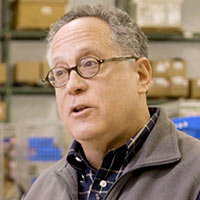
 Thomas Forest Farb-Horch |
Interview with Thomas Forest Farb-Horch, CEO and Co-Founder, Thrive Bioscience, Inc.
By Caitlin Dolegowski, Marketing Manager, LSN |
 Caitlin Dolegowski |
Caitlin Dolegowski (CD): Please introduce us to Thrive Bioscience and the company’s technology.
Thomas Forest Farb-Horch (TF): Thrive Bioscience is the seventeenth company I have been involved in founding, and I am working hard to make it my eighth unicorn. We started Thrive, based in Boston, because we saw an urgent need to improve cell and tissue culture and live cell-based processes. We want to increase the likelihood of cell-based research to make it to an approved therapy.
Even though the key to many fields of life sciences, cell and tissue culture (including related cell-based experiments, cell engineering, and cell therapies) has been performed almost entirely manually and with little data and analytics.
Thrive has orders for over 50 of its instruments at an average sales price of $200,000. Major pharmaceutical companies, institutes, and medical practitioners are capturing and analyzing massive and comparable image/data sets on live cells for machine learning, breakthrough insights, and improved cell culture.
Thrive is doing for the huge field of cell biology what sequencing did for genomics – producing extensive amounts of comparable and needed data. In addition, we are “industrializing biology” by bringing knowledge-driven automation to the field.
CD: Tell us about Thrive Bioscience’s team.
TF: I am glad you ask that question, because it takes a village! Many of my unicorns have been a success because we found neglected problems that are best solved through combining deep expertise in many fields. In order to solve the lack of data, analytics, and automation in cell and tissue culture requires an integrated team that spans many disciplines – AI, image processing, databases, robotics, and many types of engineers — software, mechanical, electrical, and optical engineers.
We have a small but agile team of 24 staff. My Co-founder and Thrive’s Chief Scientific Officer, Alan Blanchard, is brilliant and hands-on, with a background in genomics, instrumentation, physics, mathematics, neural computing, and biology.
Currently, the fastest growing part of the company is now sales and marketing because our focus is on revenues. And in addition to our staff, I consider my investors, Advisory Board Members, Board Members, distributors, and consultants as part of the team. They help us immensely.
And it is not common at our stage to have a full-time General Counsel, but because there has been limited innovation in cell culture and live-cell imaging, we have amassed a portfolio of 96 patent applications of which 34 have been issued.
CD: Thrive Bioscience has been to many RESI conferences. How did you initially learn about the conference and what were you looking to accomplish at your first one?
TF: I asked around at the incubator where Thrive started, InnoVenture Labs in Beverly, MA, as well as my seed investors, which included Life Science Angels and some family offices such as the Estee Lauder family, and industry veterans. They all pointed me to RESI and I have now been at least a dozen times.
Although most of my 17 companies are in life sciences, I had spent the previous five years not in purely life science companies and I needed to get up to speed quickly on investing trends and meet investors in a very targeted way, in early-stage life sciences companies.
CD: What were you looking to accomplish at RESI when you originally registered at RESI in 2014 at Fenway Park and what have you accomplished at RESI conferences since?
TF: You beat me to it! I was going to mention that the first RESI Conference I attended and the most recent one were both in Boston! So, it was very satisfying for me to win first place in the Innovators Pitch Challenge in my hometown last month.
In fact, RESI Boston in 2014 was the very first conference I went to after founding Thrive, and the first time I went to a RESI conference. I had just started raising a Seed round, and raised about $500,000 at RESI. Pretty good for my first conference! It was very easy to meet a lot of people.
I have raised to date about $7 million out of $35 million from investors at RESI conferences. That is a significant percentage! But it takes time to get to know investors and they like to see you a few times and track your progress. You cannot expect to go once and raise everything you need, although I did very well.
And one of the most powerful aspects of RESI conferences is the number of panels and attendees from larger companies and CVC’s. At the same time as meeting investors, you can meet “strategic investors” as well. That is one of the more difficult hurdles and RESI is an excellent way to make this happen.
CD: What stage of fundraising is Thrive Bioscience in and what are you looking to accomplish now
TF: We are just finishing our Series B Convertible Note. We are already oversubscribed with $10 million and will close with more than that. I am about to start concentrating on our Series B offering which we are targeting to complete towards the end of this year and with the assistance of RESI conferences!
CD: What advice would you like to give to fellow entrepreneurs about RESI conferences?
TF: Sometimes you can have excellent results going to one RESI, but I have found you have to plan on making the effort in going to several or many RESIs. I had good results at my first one, but to get to the $7 million I raised from RESI conferences took time and persistence. Many investors do not respond the first time you contact them but I am persistent and the second, third, or fourth time I often hear from a RESI investor attendee, “Oh yeah, I have heard about you guys.” I am thinking to myself, “Yup, that is because I have messaged you at five conferences.” You have to remember that your own priorities aren’t other people’s priorities.
And, of course, when you request a meeting on the platform, it is an opportunity to tell your story – but research the investor, tailor your message, and do it concisely. It catches people’s attention when it is clear you have done your research. And remember, you do not have to answer every possible question the first time you make contact!
RESI offers you shots on goal. But you have to take advantage of each situation. You get back from RESI what you put into it. When you go to the panels, don’t sit in the back of the room! Sit right in the front row so you are the first one to hand your card to a potential investor.
I highly recommend reading Dennis Ford’s book, The Life Science Executive’s Fundraising Manifesto, which is downloadable for free. It has lots of practical advice on researching investors and approaching investors and being prepared. It is the best book I have read on fundraising and he makes it available for download without charge!
Finally, I have gotten to know some of the RESI team and you should ask them for thoughts on who to approach. They know lots about the attendees. And read the RESI newsletters! They publish mandates for free. The staff spends a lot of time making this information available to us and it is a great resource. Again, the more you put into a RESI conference, the more you are going to get out of it!
CD: Congratulations on your first-place win in RESI Boston June Innovator’s Pitch Challenge (IPC)! You’ve had some success in previous IPCs as well. What did this success bring to Thrive Bioscience?
TF: Yes, I did win before at one of the RESI-focused conferences. I am not very good at promoting my own company, but buzz does matter. RESI helps me get the word out. Hey, participating in the IPC got me this interview and I am sure I will get some inquiries from it! Thank you for interviewing me.


 Next Phase Newsletter
Leave a comment