Inomagen Therapeutics: RESI Boston June IPC Winner

Inomagen Therapeutics, led by Chief Business Officer Eric Sandberg, is working to redefine how atrial fibrillation is treated—starting at the molecular level. A recent winner in the Innovator’s Pitch Challenge at RESI Boston June. In this interview, Sandberg shares insights into the company’s novel approach, development progress, and how RESI helped build investor momentum.

Eric Sandberg
CaitiCaitlin Dolegowski

Caitlin Dolegowski (CD): Tell us about Inomagen Therapeutics, what is your core focus, and what inspired your approach to treating atrial fibrillation?

Eric Sandberg (ES): Inomagen Therapeutics is a preclinical-stage biotechnology company developing a non-viral gene therapy to improve the treatment of atrial fibrillation (AF), the most common sustained heart rhythm disorder affecting 10M people in the US alone.  Patients with AF do not feel well and have a 4-5x increased risk of stroke, 2x risk of having a heart attack, and AF is a major cause of heart failure.  Unfortunately, current therapies, including cardiac ablation, have proven ineffective for many patients because they do not address the underlying mechanisms of the disease.

Inomagen’s approach is based on research conducted by our Founder, CEO and practicing electrophysiologist, Dr. Rishi Arora.  In his research laboratory, Dr. Arora identified major molecular mechanisms that contribute to AF in a majority of patients with AF; identified major trans-genes to selectively target these mechanisms in the atrium; utilized low energy electroporation to achieve therapeutic gene transfer and expression; and decreased AF in clinically relevant, large animal models of AF.

CD: What differentiates your platform from other therapies available to treat atrial fibrillation?

ES: Ablation is the mainstay of AF treatment. However, ablation success rates are suboptimal in patients with persistent AF. This is thought to be in large part because ablation is an anatomic procedure that is not targeted to the molecular mechanisms underlying AF. Inomagen has developed a non-viral gene therapy that targets one or more major molecular mechanisms underlying AF.  Specifically, we have demonstrated preclinical success delivering NOX2 shRNA plasmids to atrial tissue to achieve gene knockdown, to silence upstream mechanisms of AF, in order to achieve a therapeutic effect.  To be clear, our gene therapy is not replacing genes or editing genes, we are knocking down the expression of genes that are causing AF.  Based on our preclinical results, we believe that our gene therapy can potentially surpass cardiac ablation as the therapy of choice for atrial fibrillation.

To achieve safe and effective targeted gene delivery, we have developed a novel transvenous gene delivery system that uses low energy reversible electroporation to achieve high levels of gene transfection into atrial tissue.   We believe that our physical gene delivery approach overcomes the known challenges of using viral vectors which include insufficient gene transfection and well publicized off-target effects.  As such, we believe our gene delivery approach can potentially serve as a platform technology for other companies developing cardiac gene therapies, including gene therapy in the ventricles for congestive heart failure.

CD: Where are you in terms of preclinical or clinical development, and what are your near-term goals?

ES: With our recent development of a proprietary NOX2 shRNA gene plasmid and a gene delivery catheter, we have now achieved program readiness to initiate IND-enabling studies to gain FDA approval for a Phase I/IIa clinical study.  In the near term, we will be conducting IND-enabling studies in the 2nd half of the year in preparation for a pre-IND meeting with the FDA early next year prior to conducting pivotal tox and filing an IND in late 2026.  We aim to initiate our Phase I/IIa clinical study in 2027.

CD: What are you seeking in your current fundraising round, and what kind of investors or strategic partners are you hoping to connect with?

ES: We are currently raising a $5M Series Seed round and will be initiating a larger Series A round later this year to support the program through a Phase I/IIa study.  In the near term, ideal investors for Inomagen include angel groups and individuals, while we anticipate our Series A to be led by venture capital investors. Additionally, given the potential of Inomagen’s gene therapy to markedly improve the treatment of atrial fibrillation, we have several potential strategic partners who are tracking our progress.

Inomagen has multiple gene targets in our pipeline and a robust IP portfolio that includes 18 issued patents protecting genes/biologics and gene delivery.  We have an experienced team committed to bringing our gene therapy to the clinic.

CD: How did your participation in the Innovator’s Pitch Challenge at RESI Boston contribute to your visibility or investor outreach efforts?

ES: Our participation provided the opportunity to continue to share the progress that we are making with the attendees at RESI.  And being recognized as a top company in the Pitch Challenge has certainly provided increased visibility for Inomagen through Life Science Nation’s extensive readership.  We have experienced a further increase of interest in Inomagen, including a significant increase in traffic to our  website.

CD: Can you share any valuable feedback or connections that came out of the pitch sessions or RESI partnering meetings?

ES: Following our presentation in the Pitch Challenge, we added several more partnering meetings with interested investors. Given our experience at the June RESI meeting, we registered to attend the September RESI meeting as well.

CD: What advice would you give to fellow early-stage biotech founders about preparing for and participating in a RESI pitch competition?

ES: The RESI pitch competition provided a good opportunity to make sure that we are communicating the Inomagen opportunity clearly to potential investors. We appreciated the opportunity to join the many impressive companies presenting at RESI who have a passion to improve health care for patients and providers.

Applications are now open for the Innovator’s Pitch Challenge at RESI Boston this September.
New! The IPC Pitch Package now includes an optional second full RESI pass at no additional cost—bring a teammate to support investor meetings, pitch preparation, and maximize your conference presence.

Apply to Pitch at RESI Boston Sept. 2025

Hot Investor Mandate: North America-Based VC Backs Early-Stage AI-Enabled Healthtech Companies with Flexible Capital Structures

A venture capital firm based in North America focuses on making primarily Seed-stage investments but maintains flexibility to invest from Pre-Seed through Series A. It typically writes first checks ranging from USD 100,000 to USD 1 million, with a sweet spot around USD 500,000, and is open to follow-on participation. The firm has a flexible capital structure and can invest via equity, SAFEs, convertible notes, or other early-stage instruments. It is comfortable acting as lead, co-lead, or syndicate participant, and generally makes 6-10 new investments per year. While its geographic focus is North America, the firm is open to global opportunities where companies are looking to expand into the U.S. market. 

The firm invests primarily in digital health companies and selectively in diagnostics and medical devices, particularly those with significant data value or differentiated data-driven technologies. Within digital health, the firm looks broadly at software and AI-enabled solutions. It is also interested in biotech platform technologies, particularly those enabling delivery or translational efficiency, but tends to avoid single-asset drug candidates. In medtech, the firm is open to all device classifications but shows stronger interest in technologies with clear regulatory or technical differentiation, rather than lightly regulated tools. 

A key focus for the firm is the founding team. Team quality is one of the most important decision-making factors, and the firm evaluates teams holistically, including personality, market fit, experience, and leadership traits. The firm prefers to back experienced and well-rounded teams with a clear execution edge. 

If you are interested in more information about this investor and other investors tracked by LSN, please email salescore@lifesciencenation.com. 

Hot Investor Mandate: Europe-Based VC Seeks Pre-Seed to Series A Innovations in Biotech and Digital Health, With a Focus on Nordic and Baltic Regions 

This venture capital firm headquartered in Northern Europe, is currently deploying capital from a life science focused fund. The firm primarily invests in biotech and digital health companies based in the Nordic and Baltic regions. The firm participates from Pre-Seed through Series A rounds, typically writing initial checks ranging from €250,000 to €3 million. The firm is open to both leading and co-investing in financing rounds. 

While the firm’s primary focus lies in biotech and digital health, the firm is also open to investing in medical devices and diagnostics. Within biotech, the firm supports companies from the preclinical stage through to Phase I, with Phase II generally considered the latest point of entry. The firm maintains a disease-agnostic approach and is more focused on platform potential and scientific merit than on specific indications. 

In most investments, the firm will seek a board seat, or at minimum, observer rights, reflecting its active involvement and strategic engagement with portfolio companies. 

If you are interested in more information about this investor and other investors tracked by LSN, please email salescore@lifesciencenation.com. 

Hot Investor Mandate: VC Firm Backed By Major Financial Services Group Seeks Co-Investment Opportunities in Early-Stage Therapeutics and Medtech Sectors

A venture capital firm backed by a major global financial services group actively invests across multiple sectors, including life sciences. The firm typically invests USD 1–2 million per round, though it is capable of larger allocations depending on the opportunity. While globally active, the firm focuses on opportunities with strong relevance to specific market needs in Asia. 

In the life sciences space, the firm is currently targeting therapeutic and medtech products that address major unmet medical needs in its home market. It favors companies with a clear strategy to collaborate with regional pharmaceutical partners, whether through licensing, co-development, or strategic equity participation. The firm considers a range of therapeutic modalities including small molecules, biologics, biosimilars, and reformulated drugs. It primarily seeks products in Phase I clinical trials but may also invest in assets within one year of entering the clinic. Indications of strong interest include oncology and orphan diseases. 

The firm only co-invests in opportunities outside of its home country and strongly prefers that a reputable institutional lead or established syndicate be in place before participating. As such, it tends to evaluate international deals with a co-investment mindset alongside other institutional investors. 

If you are interested in more information about this investor and other investors tracked by LSN, please email salescore@lifesciencenation.com. 

Hot Investor Mandate: Global Pharma Innovation Arm Invests in Early-Stage Innovations in Digital Therapeutics, Neurotech and More Across North America and Europe

A pharmaceutical company known as a global leader in consumer healthcare operates a significant prescription pharmaceutical business. Its consumer healthcare portfolio includes over 250 products and generates approximately USD 2.4 billion in sales annually. In recent years, the firm launched an internal innovation unit that was established with the mission of developing new businesses through open innovation or by acquiring new technologies. The firm focuses on early-stage innovation, particularly seed and Series A companies, and explores opportunities via direct investment as well as collaborative research and product licensing. 

The firm targets transformative concepts in healthcare, such as preventative technologies, non-invasive treatments, and early diagnostic tools. The firm typically invests between USD 300,000 and USD 5 million, though the firm does not lead investment rounds. The firm prefers to invest alongside a lead VC or within a syndicate of investors. The firm’s geographic focus lies predominantly in North America and Europe. 

The firm has outlined three priority areas of interest: (1) technologies “beyond the pill,” which includes digital therapeutics, software-based interventions, and medical devices, with a strong emphasis on neurotechnology such as neuromodulation, neurofeedback, and biofeedback; (2) advanced therapies, encompassing novel modalities and emerging therapeutic approaches; and (3) sensing and monitoring technologies, including wearables and vital sign sensing. While the firm does not require board representation, it may seek observer rights when appropriate.

If you are interested in more information about this investor and other investors tracked by LSN, please email salescore@lifesciencenation.com. 

Pullan’s Pieces #2 – Top Drug Sellers by Geo

By Eric Hayes

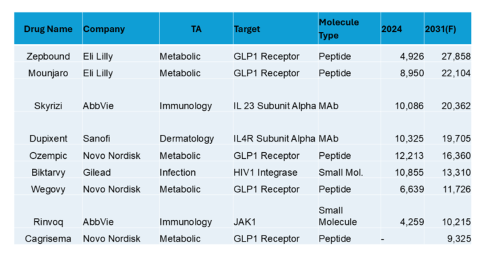
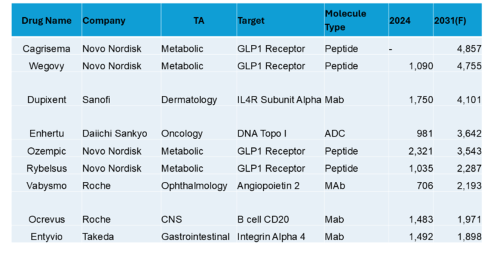
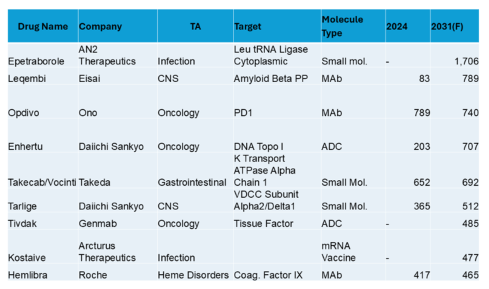
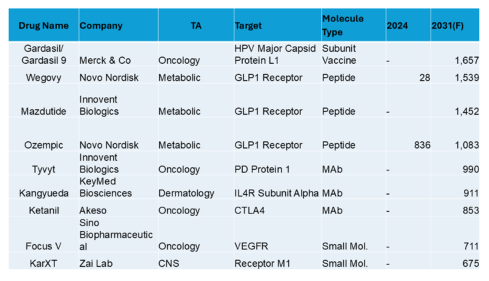
What do analysts think will be the top 10 drugs in the year 2031 (as searched in GlobalData)?

Top 10 in the US in 2031 (USD Millions)

In the US analyst forecasts for 2031, obesity dominates (with immunology, derm and infection for other TAs). Along with the obesity peptides are 2 small molecules and 2 MAbs. The sales are in the tens of billions.

Top 10 in Europe (USD Millions)

In Europe, along with the obesity drugs and dupixent in derm, we see the oncology ADC Enhertu, the ang2 ophthalmology drug Vabysmo, a CNS CD20, and a GI integrin in the top 10. Sales are in the single digit billions.

Top 10 in Japan (USD Millions)

In Japan, obesity is not visible in the top 10. An anti-infective tops the list, followed by CNS, oncology, GI and including heme disorders. There are companies not in the top 20 for global sales. Most of the top 10 have sales below $1B.

Top 10 in China (USD Millions)

For China, obesity is back in the top 10, but Gardasil, an oncology HPV vaccine tops the list. Local company “fast followers” are apparent and most of the top forecasted drugs are not yet launched (presumably a reflection of the rapidly evolving pharmaceutical environment). To get into the top 10, sales are above $500M.

Conclusion: The marketplace for drugs shows considerable variation in different regions around the world.

The Needle Issue #10

Juan-Carlos-Lopez
Juan Carlos Lopez
Andy-Marshall
Andy Marshall

Just over a week ago, AbbVie paid $2.1 billion for Capstan Therapeutics’ in vivo anti-CD19 chimeric antigen receptor (CAR)-T cell therapy (CPTX2309) for B cell-mediated autoimmune disorders, which is currently in phase 1 testing. In the past few days, EsoBiotec (acquired by AstraZeneca earlier in the year) also published its first clinical data on a lentiviral-delivered anti-B-cell maturation antigen (BCMA) CAR-T approach (ESO-T01) for multiple myeloma, detailing responses in four patients, two of whom showed complete remission. With a host of other companies working on in vivo delivery into endogenous T cells—including Interius BioTherapeutics, Umoja Biopharma, and Orna Therapeutics, the field of in vivo delivered CAR-T cells appears poised at a tipping point.

Since transforming the face of cancer treatment in 2017, autologous CAR-T cell therapy has been dogged by logistical issues that have limited commercial rollout and increased costs—the need for leukapheresis, laborious cell harvesting, heterogeneous cell expansion, lengthy turnaround times, and inconsistency of batches—with access limited to just a few clinical centers. Extensive waiting lists can mean many patients die before even being treated, which has driven the search for ex vivo approaches that shorten manufacturing times using fully closed systems and/or miniaturization. Given these challenges, delivery of a CAR-encoding mRNA to a T cell in vivo could be a game-changing technology: No need for viral vectors; no leukapheresis/chemo; no ex vivo manipulation, no requirement for multiple patient hospital visits; no convoluted training of personnel; and no risk of second primary T-cell cancers due to insertional mutagenesis. This last issue has loomed over the field, with all CAR-T therapies carrying black box warnings, although at the end of June the FDA removed all requirements for Risk Evaluation and Mitigation Strategies (REMS).

​Writing in Science, the founding team of Capstan Therapeutics, headed by Carl June and Bruce Levine at the University of Pennsylvania and Haig Aghajanian of Capstan, report proof of concept data that functional CAR T cells with antitumor activity can be produced in animal models without any ex vivo manipulation. A key breakthrough in their effort was the development of lipid nanoparticles (LNPs) specifically designed to target T cells and to overcome the propensity of LNPs to accumulate in the liver. To avoid this problem, the authors screened a set of ionizable lipids to identify L829, a lipid that incorporates a tertiary amine headgroup that reduces non-specific interactions with the hepatic system due to its pH-dependent protonation and neutral charge. Ester cleavage sites in the lipid also promote rapid breakdown in, and clearance from, hepatocytes. A final step was to decorate L829 LNPs with a mAb targeting CD5, a T-cell specific marker. The resulting LNP showed limited liver uptake in rodents and non-human primates compared with control LNPs.

To test the potential of L829-containing LNPs to generate functional CAR-T cells, the team engineered them to incorporate 1) mRNA encoding a CAR that binds CD19 on B cells and 2) an antibody targeting CD8+ T cells. These CD8-L829-CD19 targeted (t)LNPs successfully delivered the mRNA in vitro to CD8+ T cells from healthy subjects and from people with B cell-mediated autoimmune diseases. In vivo, these CAR T cells had anti-tumor activity in a humanized mouse model of B cell acute lymphoblastic leukemia.

In cynomolgus monkeys that received repeated doses of CD8-L829 tLNPs containing anti-CD20 CAR mRNA (instead of anti-CD19, which is not cross-reactive between human and monkey), sustained B-cell depletion was observed that lasted for one month. Importantly, reconstituted B cells were predominantly naïve, implying an immune reset — a key therapeutic goal in autoimmunity.

The Capstan in vivo mRNA-encoded CAR T platform eliminates the need for ex vivo manipulation and lymphodepleting conditioning. It avoids the risks often associated with the use of viral vectors that integrate into the genome. It also is transient, allowing dosages to be optimized and quickly stopped if patients suffer adverse events associated with neurotoxicity or cytokine-release syndrome. It will be interesting to see whether the approach is scalable and whether it can open up conditions where long-term CAR-T cell persistence might not be necessary, such as autoimmune disease.

Going forward, an important question will be to determine the potential immunogenicity of the tLNP formulation (especially as the mRNA treatment may be given multiple times), and whether tLNPs cause elevations of human liver enzymes like alanine transaminase or aspartate aminotransferase. Liver toxicity of a novel liposome formulation already caused a clinical hold for Verve Therapeutics’ base editing therapy last year. Future work will also need to define optimal dosing, durability, and long-term safety of this approach. But the work of June, Aghajanian and their colleagues is a compelling advance promising a new era of widely available adoptive T-cell therapies for B-cell driven hematological cancers and autoimmune conditions. A single dose of any of the seven currently approved commercial ex vivo CAR-T therapies costs ~$500,000. A vial of an in vivo treatment is likely to cost an order of magnitude less.