The Digital Sponsorship Model Works, Providing Bang for Sponsor Dollars

By Dennis Ford, Founder & CEO, Life Science Nation; Creator of RESI Conference Series

The world of partnering and life science conferences has moved from the function hall to the world wide web. Exhibit halls once ringing with chatter and the sound of house wine-filled glasses are now silent, giving way to server buzzing and unintentional background noise when you’re certain your Zoom account was already muted… The question remains: how can companies leverage digital event sponsorship, and is the virtual exposure worth the very real, non-virtual cost?

The answer is yes – companies that would normally be interested in sponsoring partnering and life science conferences, should be throwing their hats into the virtual arena. Digital platforms are providing more flexibility and evening the playing field. Sponsors no longer need to pray for a prime booth near the food and beverage corner or impress potential partners with better branded t-shirts and water bottles. There is direct-to-consumer access that aligns with the values of partnering events – connecting the buyers and the sellers to move the needle in early-stage life science partnering.

Service Providers Can Leverage Digital Events

Life Science Nation (LSN)’s ecosystem has always been deal-focused and transaction-centric from its inception. LSN partnering conferences are experiential, interactive, and frequent, to promote continuing development of business relationships, all the way up to the closing of contracts. While the onsite model has changed to a web-based platform, the mission remains the same, with increased access and flexibility.

Virtually any service provider who has a product to sell to early-stage CEOs can really be successful getting their message out at online partnering events. Half the attendees at LSN partnering events are raising capital to spend on the services they need to develop their products, and our sponsors are able to not only find the right companies that are a fit for their own products and services, but also have the extra added capability of learning about the bevy of portfolio companies that are sitting in LSN’s vast investor network.

CROs, CMOs, legal, staffing, consulting, accounting – all the service providers that make the healthcare ecosystem thrive have successfully used LSN partnering events to deliver their message and develop their brand. The good news is that the latest move by LSN to feature elongated digital partnering events has increased attendance by 30% and opened-up the global market to our sponsors.

LSN Partnering Events See Attendance Surge, Boding Well for Sponsors

Being a sponsor at LSN partnering events is a great way for companies in the early-stage life science arena to increase their brand and garner global attention. LSN has 2,000+ fundraising CEOs regularly attending Redefining Early Stage Investments (RESI) events, and the same growth trend applies to LSN’s investors, channel partners and the Pharma network. Funded early-stage life science CEOs are still meeting at the proverbial water hole, and its web-based features enable sponsors to actively engage with their target audience and close the deals that save lives.

Check Out LSN’s Digital Partnering Conference Sponsorship Brochures Below:
RESI 2-Day Partnering Event – Partnering Goes Live July 13!

By Karen Deyo, Senior Investor Research Analyst, LSN

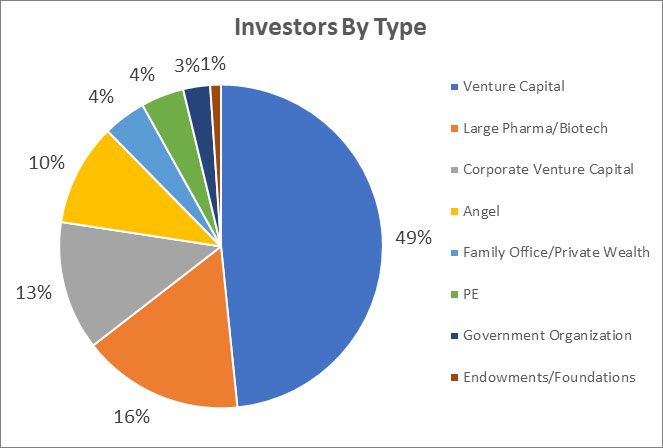
The RESI 2-Day Partnering Event is just over two weeks away, and we are launching the Partnering Platform on Monday, July 13! With a 50% increase in registered attendees over our last Dedicated Partnering Event, with participants representing over 20 countries on 4 continents, the partnering event is a testament to RESI’s global reach, and our ability to help startups and investors connect from their home offices and keep the dialogue going. Registered companies span the 4Ds: Drugs, Devices, Diagnostics and Digital Health, and are meeting with investors. However, making the right match is essential for successful partnering. We’ve broken down our registered investors, not only to show the vast diversity available at RESI, but to help attendees narrow their search for the perfect partner. Take a look at the list of registered investors here.

Make sure to check out the following links on how to be successful at partnering, and keep an eye out for our partnering tutorials to maximize your meetings!

There is still time to register before we launch partnering, register now!

The Digital Model Works If You Do it Right!

By Dennis Ford, Founder & CEO, Life Science Nation; Creator of RESI Conference Series

The summer months may look different in 2020, but what remains the same is that there’s no rest for fundraising CEOs and investors with mandates to fill in the healthcare arena. Companies in the diagnostics, drugs, devices, and digital health realms are still chipping away at their fundraising goals, but for many, the new ecosystem of digital partnering is unknown and varies from event to event. Luckily, the most successful participants have learned how to play this new game, and there’s still time to jump in before the summer ends.

The Life Science Nation (LSN) international partnering superstructure has made LSN the premier player in the early-stage deal-making arena because LSN events connect global buyers and sellers. LSN has not been sidelined by the new business climate. On the contrary, LSN has accelerated, and is eager to share the top strategies from their playbook:

Make the Right Match.

To make the most out of a digital partnering event, it is imperative to match meetings with buyers or sellers based on development stage and product fit. LSN’s partnering system keeps a detailed up-to-date profile of the constituents so that a match can be made on fit. Matching the stage of development and product keeps the dialogue going long after the right match is made. Efficient partnering avoids the pitfall of a wasted meeting and sitting at a (virtual) table and realizing the person facing you is not a fit.

Partnering is an Ongoing Experiential Activity.

Partnering cannot be done once or twice a year, as business deals do not work that way. In the life science domain, it can take 9-18 months to put a deal together. Buyers and sellers, now more than ever, need a simple, low-cost, straightforward vehicle to meet and interact together frequently in order to find new opportunities for their respective pipelines, advance a conversation, continue to vet and develop a relationship or close a deal.

Pivot to Digital. 

Pivoting and moving from onsite gatherings to a digital format has been a major hurdle for life science conferences, but it doesn’t need to slow down partnering activities. Many large firms are trying to dock the proverbial aircraft carrier into a new berth, and need to be nimble enough to change direction and adapt quickly to the new reality. Dive into this changing landscape by joining digital partnering events and taking advantage of the flexibility digital conferences offer, such as pre-recorded panels and presentations and 24-hour partnering platform to accommodate global conversations.

The Digital Model Works, but Only if You Do, Too. 

LSN has created a new model which is a combination of extending our typical onsite one-day events into three-day virtual events, which has seen a 30% increase in attendance. Companies across life science are discovering that a hybrid business model going forward can take advantage of certain digital perks, while enjoying the in-person experience we all miss.

Check out LSN’s lineup of digital partnering events at https://resiconference.com/ and its Inaugural 4D Meets AI digital partnering conference at http://4dmeetsai.com/. Don’t put your fundraising goals or your investments on hold like vacation plans, because unlike the summer months, the best deals won’t be back next year.

Increase Your Exposure at Digital RESI September

By Claire Jeong, Vice President of Investor Research, Asia BD, LSN

claire

We are excited to announce the launch of two opportunities to increase your company’s exposure at the Digital Redefining Early Stage Investments (RESI) Conference in September – The Innovation Challenge and Featured Company Pitch Sessions.

Showcase Your Technology at the Innovation Challenge

This marks our third time organizing the Innovation Challenge in a digital format. The Innovation Challenge is always a great opportunity to increase your exposure and showcase your technology. 30 finalists will be selected from a pool of over 100 applicants, and all companies will have their own dedicated page to upload their virtual poster, video, and other supplementary materials. RESI attendees will be able to vote for up to 5 companies that they find the most innovative.

If you are interested in increasing your visibility to 400+ investors, please apply! The deadline is Wednesday, August 12th.

Pitch Your Company to a Panel of Investors

The Featured Company Pitch Session is a great opportunity to gain exposure for your company and get valuable feedback from a panel of investors. For an added fee, companies get a dedicated page featuring their pitch, followed by a virtual Q&A session with a panel of investors and a live audience. Applications are accepted on a rolling basis, so make sure to submit your application as soon as possible!

Business as (Un)usual During the Covid-19 Pandemic

Andy Merken
Partner at Burns & Levinson and Co-Chair of the Life Sciences Group

Gregory Mannix
Chief Conference Officer, VP International Business Development, LSN

After the major disruptions of the last few months, everyone has readjusted to a new normal. I recently spoke with Andy Merken, Partner at Burns & Levinson and Co-Chair of the Life Sciences Group, to learn his perspective of how things have changed, and how the industry has evolved.

GREG MANNIX (GM): These are certainly crazy times. How has the Covid-19 pandemic affected your work at Burns & Levinson?

ANDY MERKEN (AM): Crazy is an understatement. March was a time of uncertainty, with everyone in the business world – clients, their business partners, investors, and M&A  professionals – trying to get their heads around what was happening and how it would impact their businesses and the broader life sciences industry. From a few rumblings in late February/early March to almost a full-blown panic starting in mid-March, client work continued forward unabated but with a growing sense of uneasiness. The first few weeks of April were consumed with helping clients navigate all of the questions – and the almost-daily changing guidance – with respect to PPP Loans, particularly for venture-backed companies. A number of deals were put on hold in April and early May, but the good news is that most of them have now returned, though some with slightly less favorable deal terms, particularly for medical device deals. Deal terms for biotech, pharma, healthcare IT and healthcare services all seem to be holding steady. What we are finding now in early July is that workflow is almost back to normal – both day-to-day matters as well as patent filings, financings (both seed stage and venture stage) and M&A. There is a growing sense of optimism that the worst is over – not with respect to the pandemic itself but as to the long-term business impact that it will have on our clients.

GM: Do you think any of these new ways of communicating, like videoconference calls, are here to stay after the pandemic is over?

AM: Absolutely. I have been pleasantly surprised at how seamless the transition has been from the physical world to the virtual world. After a week or two of people saying, “Zoom? Why would I want people to see me working at my dining room table?”, everyone has jumped on the videoconference and remote working bandwagon in earnest. We are  finding that productivity has not been harmed, and in fact, has actually improved given the loss – in a good way – of commuting time for most people. That being said, there are still business advantages to being able to meet people in person (especially new contacts), to walk down the hallway to chat with a co-worker, and generally to collaborate. For these reasons, I believe that in-person workplaces will return in full force, but with  videoconference calls  remaining much more a part of our daily work lives moving forward.

GM: Burns & Levinson is a sponsor of RESI, and you have been to a number of on-site RESI conferences across the country. Since we had to make the pivot to a digital RESI, what was your impression of the new format? Was it a productive way to interact with people?

AM: The new format exceeded my expectations. The videoconference technology was seamless. Just about everyone that I spoke to, as part of RESI, had the same comments. And, for those doing the 1-to-1 partnering meetings, they benefited from the conference being held for 3 days instead of 1, the ability to meet people from other parts of the country and all over the world who otherwise would not have been able to travel in, and the ability to meet people across multiple time zones. Those that I spoke with were thrilled with the scheduling flexibility and the ability to meet more people than at an in-person event. Nevertheless, people would still like the opportunity to meet live, especially when they are already traveling in for JPM, BIO, Boston Biotech Week and other conferences that RESI is scheduled around. It may be that a hybrid approach is what ultimately makes the most sense – in-person, but with a digital component, as well.

GM: Burns & Levinson will be a Gold Sponsor at both Digital RESI and the new 4D Meets AI conference coming up in September. Is the firm planning any specific educational content for the early-stage companies who are participating?

AM: Yes. We are really excited about being involved with both conferences. We are still in the early planning stages for panels and presentations, but areas that we hope to be able to cover for early-stage companies include overviews of, and issues relating to, seed stage and venture capital financings, patent prosecution, in-licensing and out-licensing,and the FDA process and regulatory scheme.

GM: We all miss the in-person seminars and networking events of the past, and it is hard to guess when things like that will resume. Are you planning any web-based informative sessions or webinars over the next few months to partially fill that gap?

AM: We certainly are. Just last week we hosted a virtual panel entitled “Life Sciences M&A and VC Financing Update: Dealmaking During the Pandemic”. Panelists were Randy Scott of HealthQuest Capital, Tom Miller of GreyBird Ventures, and Ben Conway of Consilium Partners – 2 Venture Capital investors and 1 Investment Banker. Tom and Randy, by the way, are active participants in RESI. We had over 140 attendees register for what was a very informative panel discussion and Q&A, followed by breakout room networking, about the current state of life sciences VC financing and M&A, including changes to valuations, deal terms and timelines caused by COVID-19, as well as predictions for the short- and long-term future. This event took the place of a summer in-person event that we typically run. We have gotten great feedback from attendees and are planning to offer quarterly panels. We are considering a “CEO Forum” for the fall, where life science CEOs can discuss their companies and what they are seeing in the industry. This idea came from talking with one of the attendees, so we are reaching out to our network to source ideas for additional panels – please contact me with ideas!

Check Out the Digital RESI September 14 – 16 Agenda

By Karen Deyo, Senior Investor Research Analyst, LSN

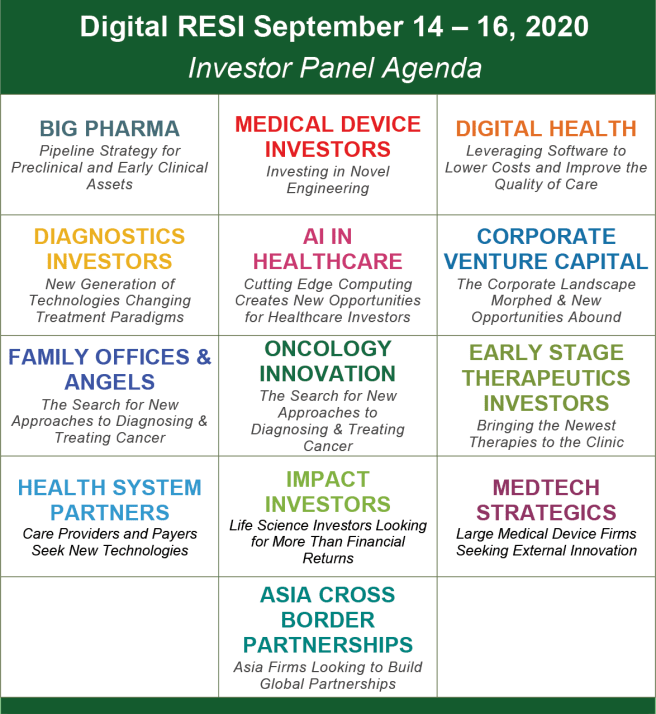
RESI is continuing to improve our digital events, adding features and content to increase the efficiency of interactions between investors and fundraising company CEOs. While RESI is a partnering-focused conference, the panel and workshop content offer key insights for startup CEOs, helping them avoid common pitfalls when interacting with investors. LSN is pleased to announce our panel lineup for our upcoming Digital RESI, taking place September 14-16. With panels focusing on different sectors and indications, such as Medical Device Investors, Diagnostics Investors, and Oncology Innovation, as well as panels featuring different investor types, such as Health System Partners, Seed Funds, and Impact Investors, startups can find a panel of investors that can provide them with valuable tips to help in their fundraising campaigns. While most of the panels will be prerecorded, attendees will be able to listen in to live sessions during the conference, with the ability to submit questions for Q&A. Make sure to register to gain access to this valuable content.

Digital RESI June Recap: Virtual Medical Device Investors

By Joey Wong, Investor Research Analyst, LSN

LSN’s last virtual conference, Digital RESI June, featured a number of investor panels educating entrepreneurs on how investors look at opportunities in their sectors and the best approach to engage investors in discussions.

The Medical Device Investor Panel brought together 5 investors from North America and Europe with extensive experience in the Medtech industry, sharing their perspectives on working with early-stage companies as an investor or strategic partner. The panelists shared their thoughts on various topics, including their deal sourcing process and the do’s and don’ts for early-stage companies. In the end, the panelists shared their thoughts on the shifting of investment strategy and focus areas in light of the Covid pandemic.

The panel featured the following panelists:

  • Geoff Dacosta, Director, Business Development & Licensing, Medtronic (Moderator)
  • Diana Saraceni, Founder, Managing Director, Panakes Partners
  • Neil Swami, Life Sciences Advisor and Investor
  • Bryan Grulke, Partner, Volcano Capital
  • Sam Ifergan, President & CEO, iGan Partners

Here are some highlights of their discussion. To watch the full session, click here.

The panelists are in consensus that it is vital to identify the right investors at an early stage, specifically in both areas of expertise and the types of investors. For early-stage companies that might not have the clearest business plan or exit strategy, investors who have invested in the same subsector previously or have strong expertise in the space would most likely see your company’s potential. Importantly, in the Medtech space, a lot of interest comes from non-institutional investors. Early-stage companies may consider finding additional sources of capital from high-net-worth individuals or family offices to de-risk their companies and to prepare for high-quality institutional investors.

The panelists also talked about the importance of researching the person that you are pitching to and tailor the pitch for that person. While it is good to have a well-prepared pitch that covers all aspects of the company, companies should also consider that investors will have different preconceived ideas, depending on their background, and it is good to quickly adjust your pitch accordingly to the investor’s perception and expertise. Additionally, the panelists all agreed that a hard sell at the first meeting can be a turn-off and that companies should think of conferences like RESI as a way to start building a relationship instead of a one-shot opportunity. The goal is to get investors to invest their time to learn more about the opportunity after the conference, not to close a deal on the spot. Many panelists agreed that they oftentimes watch and interact with companies for as long as 6 months before they get fully engaged. “Play the long game,” one of the panelists said.

Regarding the current investment landscape under the effect of the Covid pandemic, most of the panelists think this is going to be a short-term hit but long-term benefit for the medical device sectors. The primary focus of investors right now is to support and bridge their current portfolio companies through these times. Companies that are currently fundraising should expect lower responsiveness from investors and a longer period of time to raise capital. Some panelists are seeing renegotiations and aggressive deal terms from VCs. However, a few panelists mentioned that they are closely monitoring any emerging opportunities related to the Covid pandemic and admitted that the pandemic has shone a different light in diagnostics and infectious disease areas.

The panel ended on an optimistic note – all panelists believe that the negative impact of the Covid pandemic on the medical device sector is temporary. They agreed that the pandemic has highlighted the needs for non-biotech companies and they expect to see an increase of deal activity and capital investments in the medical device sectors in the medium to long term.