Digital RESI June Recap: Virtual Medical Device Investors

25 Jun

By Joey Wong, Investor Research Analyst, LSN

LSN’s last virtual conference, Digital RESI June, featured a number of investor panels educating entrepreneurs on how investors look at opportunities in their sectors and the best approach to engage investors in discussions.

The Medical Device Investor Panel brought together 5 investors from North America and Europe with extensive experience in the Medtech industry, sharing their perspectives on working with early-stage companies as an investor or strategic partner. The panelists shared their thoughts on various topics, including their deal sourcing process and the do’s and don’ts for early-stage companies. In the end, the panelists shared their thoughts on the shifting of investment strategy and focus areas in light of the Covid pandemic.

The panel featured the following panelists:

  • Geoff Dacosta, Director, Business Development & Licensing, Medtronic (Moderator)
  • Diana Saraceni, Founder, Managing Director, Panakes Partners
  • Neil Swami, Life Sciences Advisor and Investor
  • Bryan Grulke, Partner, Volcano Capital
  • Sam Ifergan, President & CEO, iGan Partners

Here are some highlights of their discussion. To watch the full session, click here.

The panelists are in consensus that it is vital to identify the right investors at an early stage, specifically in both areas of expertise and the types of investors. For early-stage companies that might not have the clearest business plan or exit strategy, investors who have invested in the same subsector previously or have strong expertise in the space would most likely see your company’s potential. Importantly, in the Medtech space, a lot of interest comes from non-institutional investors. Early-stage companies may consider finding additional sources of capital from high-net-worth individuals or family offices to de-risk their companies and to prepare for high-quality institutional investors.

The panelists also talked about the importance of researching the person that you are pitching to and tailor the pitch for that person. While it is good to have a well-prepared pitch that covers all aspects of the company, companies should also consider that investors will have different preconceived ideas, depending on their background, and it is good to quickly adjust your pitch accordingly to the investor’s perception and expertise. Additionally, the panelists all agreed that a hard sell at the first meeting can be a turn-off and that companies should think of conferences like RESI as a way to start building a relationship instead of a one-shot opportunity. The goal is to get investors to invest their time to learn more about the opportunity after the conference, not to close a deal on the spot. Many panelists agreed that they oftentimes watch and interact with companies for as long as 6 months before they get fully engaged. “Play the long game,” one of the panelists said.

Regarding the current investment landscape under the effect of the Covid pandemic, most of the panelists think this is going to be a short-term hit but long-term benefit for the medical device sectors. The primary focus of investors right now is to support and bridge their current portfolio companies through these times. Companies that are currently fundraising should expect lower responsiveness from investors and a longer period of time to raise capital. Some panelists are seeing renegotiations and aggressive deal terms from VCs. However, a few panelists mentioned that they are closely monitoring any emerging opportunities related to the Covid pandemic and admitted that the pandemic has shone a different light in diagnostics and infectious disease areas.

The panel ended on an optimistic note – all panelists believe that the negative impact of the Covid pandemic on the medical device sector is temporary. They agreed that the pandemic has highlighted the needs for non-biotech companies and they expect to see an increase of deal activity and capital investments in the medical device sectors in the medium to long term.
Origami Therapeutics Leverages RESI Innovation Challenge to Meet Investors

25 Jun

Beth J. Hoffman, Ph.D.
Founder, President & CEO of Origami Therapeutics

Erich White
BD Manager of LSN

We are always happy to share success stories from companies that have attended RESI. As a finalist in the RESI Innovation Challenge, Origami Therapeutics used that to their advantage in their investor outreach. I spoke with Beth J. Hoffman Ph.D., Founder, President & CEO of Origami to see if she could share her insights with me.

Erich White (EW): Congratulations on a successful RESI event! What is your tagline and elevator pitch, to get the audience calibrated?

Beth J. Hoffman (BH): Tagline: “Discovering drugs that reshape proteins to restore health”

Elevator Pitch: Origami Therapeutics is taking a precision medicine approach to discover disease-modifying treatments for neurodegeneration caused by toxic protein misfolding. Origami plans to generate a pipeline of small molecule therapeutics that prevent or delay the onset and the progression of neurodegenerative diseases by targeting the underlying genetic cause of disease. Leveraging the founder’s experience in discovering transformational therapies for Cystic Fibrosis that modulate CFTR conformation, the company’s focus is to treat neurodegeneration by directly modulating pathogenic proteins. Our platform enables discovery of both protein degraders and conformation correctors, allowing us to match the best drug to treat each disease using patient-derived disease models. Currently, we are selecting the optimal compound to advance into preclinical testing for Huntington’s disease and initiating programs for additional indications.

EW: Tell me about your technology. Where it came from and current status?

BH: Our technology relies on the demonstrated ability of small molecules to influence how a much larger protein functions. Proteins are the molecular machines in your cells. They are made as a linear string and must fold into the proper shape in order to function properly. If there is a failure to fold properly, disease can result. In short, we use small molecules that directly interact with mutated disease-causing proteins to either repair their folding (conformation correctors) or to further disrupt their folding (protein degraders) to shunt them into degradation pathways. In either case, the toxic proteins are reduced and cellular function can return to a normal healthy state. At Origami, we started with a proprietary high-throughput screen to identify protein conformation modulators for Huntington’s disease. Currently, we have several potential lead molecules from which we are selecting a lead to optimize and advance into preclinical testing for Huntington’s disease.

EW: What is your funding history, and what are your upcoming goals?

BH: Origami has been self-funded thus far. We are currently seeking Seed funding and non-dilutive grant funding.

EW: Enter RESI.  How has LSN and RESI been helping to get you in front of investors? Please describe the coaching and what you have learned.

BH: First, I have to credit Women in Bio and their efforts to get us engaged with the WIB Pitch Competition and the Innovation Challenge.  I would not have been likely to become engaged with RESI without the WIB engagement and pricing discounts.

The most important aspect of the RESI coaching has been to adopt my pitch materials to the “RESI approach”.  The process, itself, enabled me to view my pitch differently, adding important details such as a “Risks & Mitigations” slide. Adapting my materials to the RESI Executive Summary and Tear Sheet formats enabled me to focus on slightly different aspects of Origami, making the totality of our materials much richer and brought out more storytelling in the written materials – information I would typically include in a verbally delivered pitch.

EW: Tell me how it has been going for you in terms of getting in front of investors

BH: I’ve been very fortunate to be part of JLABS @ San Diego and the San Diego/ SoCal ecosystem (i.e. Biocom, San Diego Entrepreneur Exchange, WIB). This has afforded me opportunities to get in front of investors at fairly regular intervals through investor hub meetings (JLABS), pitch competitions and partnering days. We’ve been quite successful in being selected for 1:1 meetings and platform pitches. These are roughly monthly or bimonthly and a combination of VC, strategic and Angel groups.

EW: What is your frequency of outreach and how big is your investor list?  Did the fundraising dynamic change after RESI how?

BH: I’ve participated in the April RESI and the June RESI, both digital meetings.  I’ve gotten in front of many more investors and different types of investors. By selecting investors by funding round and disease area interest, I was able to meet a greater percent of investors interested in what Origami is doing.  I joined April RESI with very little lead time yet still managed to have 13 meetings.  At the June RESI, I had 22 meetings plus 3 other interactions.  Perhaps, in part, as a result of being selected as an Innovation Challenge finalist, I received meeting requests from 8 investors that I had not pursued. Six of these 8 were new interactions. I’ve had several meetings before and after the official June RESI dates and continue to have follow up meetings.

EW: How do you see the innovation Challenge and how did you approach it?

BH: I saw the Innovation Challenge as an opportunity to draw attention to what Origami is doing and to provide our information in multiple formats. I believe that these multiple formats enable our message to be received by the broadest number of people. As a follow-up to my initial meeting request, I send the link to our IC page. Doing the voice over for the poster was critical in refining my meeting pitch.

EW: You also participated during the Digital RESI 2-Day Partnering Event last month. How many meetings were you able to secure?

BH: I had 13 meetings out of a total of 26 requested.

EW: How did you secure so many meetings? What did you do to get so many?

BH: Our entry into the April RESI was quite last minute, so there wasn’t time for follow-up messages. I’d say we did the bare minimum in this case. For June, I used the announcement of the Innovation Challenge finalists to follow-up with those who had not responded to meeting requests.

EW: What helped you most to get those meetings?

BH: I would have to imagine that the novelty of our approach/ technology and the disease area (neurodegeneration) probably piqued interest. Being named as an IC finalist definitely brought attention to Origami.

EW: How did those meetings go? Any follow-up yet?

BH: I’ve already had 2 follow-up meetings, 5 requests for additional information and 1 CDA.  There are still 2 more initial meetings upcoming in the next 2 weeks.

EW: What have you learned so far participating at RESI?

BH: The large number of meetings in a small amount of time definitely honed my pitch and sharpened how I approached and handled each meeting. I think the virtual nature helped minimize the running around and let everyone be a bit more relaxed and attentive.

In addition, it’s critical to have a team member with you to take notes, observe people’s reactions and add comments in case I forget something. It also helped in debriefing after the meetings. In a virtual meeting when the audience is not in front of you, it’s very hard to pitch and notice facial expressions, body language, attentiveness, etc. This is especially true if you are also negotiating slide sharing.

Hot Investor Mandate: China-Based Biotech Focused VC Invests Up to $6M in Early Stage Therapeutics Companies in All Indications

25 Jun

A China-based VC focused exclusively on the biotech industry combines a deep understanding of drug development, industry networks, as well as regulatory expertise to help portfolio companies to achieve strategic goals efficiently. The partners of the fund have combined decades of drug industry experiences before establishing the firm in 2019. The fund invests in true innovations with a major impact on patients’ lives. The firm’s investment size can range from $1 M and up to $6 M, in which the typical size would be $3 M~$4 M. The firm is actively looking for new investment opportunities in North America and Europe. The firm can act as lead or co-investor.

Within biotech, the firm focuses on companies in pre-IND to phase II. The firm is opportunistic in all indications and willing to consider orphan indications.

The firm has no specific requirements for companies. The firm generally takes a board seat or an observer seat.

If you are interested in more information about this investor and other investors tracked by LSN, please email mandates@lifesciencenation.com.

Hot Investor Mandate: Paris-Based VC Firm Invests in Various Life Science Sectors, Focusing on Companies Located in France & Western Europe

25 Jun

A VC firm based in Paris invests primarily in seed/series A with significant follow-on capability.

The firm is now investing with two funds; the first fund is dedicated to investing in companies based in the Paris region across various sectors (digital, deeptech, life science), while the second fund is dedicated to investing in Digital Health companies in Western Europe. The firm generally invests between 0.3-1.5M EUR in the initial investment, and can invest up to 2-5M EUR overall in a company, and will invest in up to 10 companies a year.

The firm invests differently from their two current funds :

– The first fund is sector agnostic, and will invest in Life Science (therapeutics, diagnostics, devices and digital health companies) in the Paris region.
– The second fund covering Western Europe is focused primarily on digital health, due to the strategic interest of the fund investors in this area (several healthcare companies)

The firm can lead or co-invest, and do frequently lead. They will take a board seat in any case – the firm is an active investor providing hands-on support to its portfolio company (Strategy, HR, Financing, …).

If you are interested in more information about this investor and other investors tracked by LSN, please email mandates@lifesciencenation.com.

Hot Investor Mandate: USA Investment Firm Seeks Global Opportunities in Medical Devices, Diagnostics, and Digital Health, Investing Up to $10M

25 Jun

A venture capital firm founded in 2020 and based in USA is seeking opportunities in the medical devices, diagnostics, and digital health sectors of life sciences. The firm is looking to engage in Series A to Series B financing rounds with check sizes between 5 – 10 million USD. The firm prefers to lead the financing rounds but is open to co-investing. The firm will consider opportunities globally.

The firm is interested in early-stage opportunities in medical devices, diagnostics, and digital health sectors but does not invest in therapeutics. The firm is overall opportunistic and will consider various subsectors and indications. For digital health, the firm prefers b-to-b over b-to-c products. The firm will invest in all early-stage companies including pre and post commercial enterprises.

The firm seeks to work with management teams that have prior entrepreneurial experience. The firm prefers to lead financing rounds and will most likely take a board seat when leading. The firm considers themselves an active investor and will work closely with companies.

If you are interested in more information about this investor and other investors tracked by LSN, please email mandates@lifesciencenation.com.

Hot Investor Mandate: Venture Fund Invests in Intersection of Technology & Life Science, Interested in Global Opportunities

25 Jun

A venture fund focusing on the intersection between technology and life sciences is willing to invest globally, investing in seed-series A stages, but will consider series B opportunities as well. The firm will generally invest between $0.5-2M in seed stages, $3-5M in series A rounds, and may invest up to $15M over the lifetime of the investment.

The firm invests in solutions to complex problems in human and animal health. The firm partners with entrepreneurs and academic scientists across all stages of venture investing, and its investments span the full continuum of the healthcare ecosystem. Previously funded companies include a microbiome-based drug discovery platform, a company sequencing T-cell receptors to analyze immune function and a company developing a continuous monitoring system using a dermal patch.

The firm remains actively involved in companies after investing. The firm generally takes a board seat or board observer position in their portfolio companies.

If you are interested in more information about this investor and other investors tracked by LSN, please email mandates@lifesciencenation.com.

Calling All AI Investors and AI CEOs for Panelist Slots – 4D Meets AI Digital Conference September 17 -18

18 Jun

By Dennis Ford, Founder & CEO, Life Science Nation; Creator of RESI Conference Series

Life Science Nation (LSN), through its Redefining Early Stage Investments (RESI) global conference series, has built an international partnering and funding infrastructure that helps investors source assets, and CEOs find capital and channel partners. LSN’s basic thesis is that having a conference once or twice a year doesn’t map well against the actual needs of doing business, and so it created the RESI conference series of partnering events taking place every couple of months to keep the dialogue moving. RESI facilitates early-stage life science players to develop new relationships, move along existing conversations or finalize the potential for a deal. This creates a vehicle to source, vet and finalize opportunities that fills a large gap in the life science arena, resulting in hundreds of companies that have been funded through the LSN network.

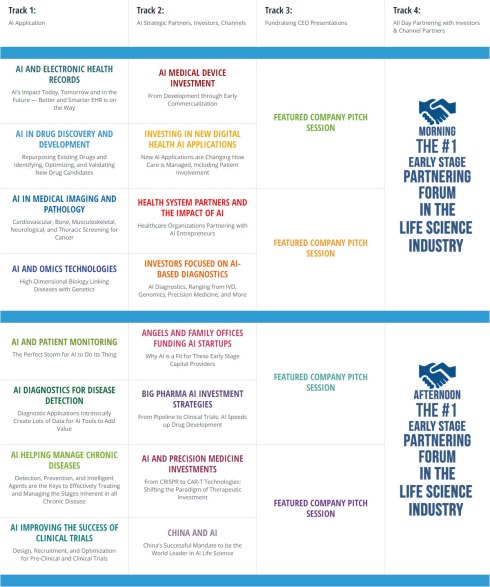
Extending the RESI partnering event by adding a standalone 4D Meets AI Digital Conference alongside RESI is a natural next step for LSN’s global partnering strategy. LSN’s current plan is to aggregate and embed new, cutting-edge, technologies into our global funding infrastructure to leverage the tsunami of new products and services emerging in the healthcare domain. If you are part of the Artificial Intelligence, Machine Learning, Big Data/-omics, Intelligent Agent, Smart Monitoring, Expert System, AI/Drug Development, AI Preclinical and Clinical, AI Imaging and Precision Medicine communities, and would like to participate as a panelist, please fill out the form below for this exciting opportunity. Please review the agenda below.

Preliminary Agenda Now Available
Accepting New Panelists!