Hot Investor Mandate: Western Europe-Based VC Seeks Therapeutics Investment Opportunities Across the Globe, With Strong Interest in Targeted Therapies 

28 May

A venture capital firm headquartered in Western Europe is led by a small, academically focused team located throughout the globe in London, the USA, and Israel. The firm makes, on average, 4-6 investments per year with a total of 20 initial ticket investments via their current fund. The firm invests in pre-clinical companies in early stages, with a sweet spot for Seed and Series A rounds. The firm is open to making investments via any investment vehicle, typically in the form of equity, safe or convertible notes. The firm will invest up to $5-6M. The firm invests globally, with a large number of investments in North America. 
 
The firm invests solely in therapeutics. The firm is focused on “advanced therapeutics”, encompassing anything that is highly targeted such as gene therapy, cell therapy, siRNA, genetic medicine and computational biology. The firm is indication agnostic, with a large interest, however, in oncology. 
 
The firm will co-lead or syndicate rounds, with a preference to co-lead. The firm has no specific team requirements. 

If you are interested in more information about this investor and other investors tracked by LSN, please email salescore@lifesciencenation.com

Hot Investor Mandate: Early-Stage VC Fund Invests in Pre-Seed and Seed Stage Companies in Therapeutics, Diagnostics, Life Science Tools 

28 May

A venture capital firm actively invests in pre-seed and seed stage companies. Typical initial size of investment ranges from $1-1.5M. The firm focuses on the following areas: digital economy, climate & environment, health & well-being. The firm is strongly interested in companies based in North America and Latin America. 
 
Historically, the firm has been agnostic towards technology area and indications. That said, the firm is currently interested in exploring opportunities in new modalities and biologics, and expanding their interests in peptide-based therapies and induced proximity therapeutics (i.e. molecular glues, PROTACs). The firm invests mainly in pre-clinical and early clinical therapeutics. The firm actively invests in therapeutics, diagnostics, and life science tools. 
 
The firm seeks to work with exceptional entrepreneurs who are passionate about their work, and is open to working with first-time entrepreneurs. The firm’s investment process starts from an initial meeting and evaluating the opportunity, a decision analysis including the addressed market, life stages assessment, and a final assessment, and if choosing to move forward, proceeding with legal due diligence and signing/execution. To date, the firm has led about 50% of their deals, and following in the other half. 

If you are interested in more information about this investor and other investors tracked by LSN, please email salescore@lifesciencenation.com

Beyond Big Pharma Panel at RESI Boston June 

28 May

By Joey Wong, Director of Investor Research, Hong Kong BD, LSN

Joey-New-Headshot

At the upcoming RESI Boston conference this June, the panel Beyond Big Pharma: Partnering Early to Foster Innovation offers a rare window into how pharmaceutical companies identify, evaluate, and engage with early-stage innovators. As the healthcare industry continues to prioritize external innovation, pharma firms are increasingly scouting novel therapeutics at earlier stages than ever before. This panel brings together industry leaders who are on the front lines of these partnerships.

Panelists include:

Marc-Appel
Marc Appel

Managing Partner
Pacific Bridge NY (Moderator) 
Salma-Al-Zubi
Salma Al-Zu’bi

Investment Principal
Hikma Ventures 
Dirk-Buscher
Dirk, Büscher

Sr Director Grifols Innovation and New Technologies
Grifols
Chloe-Lepretre
Chloé Lepretre

Head of Global R&D Search and Evaluation
 Servier
Nicolas-Stalder
Nicolas Stalder

Sr. Investment Manager
Debiopharm Innovation Fund 

This panel will shed light on how pharma companies, whether the biggest players or mid-size companies, source assets, the evaluation process behind partnering decisions, and what factors drive interest at the earliest stages of development. Panelists will also share perspectives on the evolving therapeutics landscape, where unmet needs remain, and what kinds of assets are positioned to lead in the years ahead.

Whether you’re a first-time founder or a seasoned entrepreneur, this session will help demystify the strategic thinking behind pharma partnerships and provide tangible guidance for building investor interest.

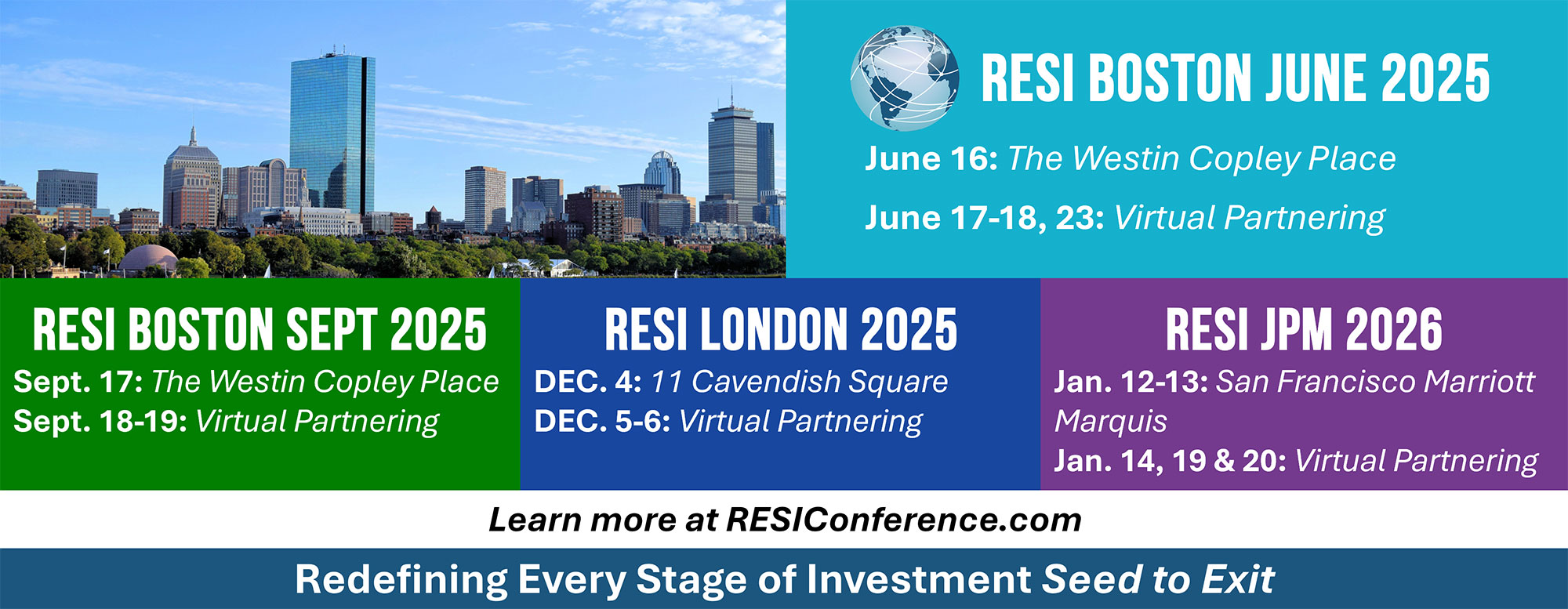
RESI Boston is your gateway to strategic investors, global pharma leaders, and actionable feedback. Join us in person this June to attend this panel and over a dozen others, meet with investors through our partnering system, and experience the collision factor that defines RESI.

Meet the Finalists: 14 Sessions of Cutting-Edge Innovation at the RESI Boston June Innovator’s Pitch Challenge 

28 May

By Claire Jeong, Chief Conference Officer, Vice President of Investor Research, Asia BD, LSN

The Innovator’s Pitch Challenge (IPC) returns to RESI Boston this June with a robust lineup of 14 pitch sessions featuring early-stage companies from across the life science spectrum. Finalists span core sectors including Medical Devices, R&D, Therapeutics, Diagnostics, and Digital Health. Several sessions will highlight technologies with a specific focus—such as surgical applications, oncology, gene therapy, and advanced delivery systems—providing a deeper look at high-impact areas of healthcare innovation.

These sessions offer RESI attendees the opportunity to explore a wide range of breakthrough solutions and meet the entrepreneurs behind them. Each company will present to a panel of active investors and strategic partners, engaging in live Q&A and receiving valuable feedback. Beyond the pitch stage, IPC finalists will also be featured in the RESI exhibition hall, where they will host tables to continue conversations and meet one-on-one with potential partners and investors.

IPC voting will take place online throughout the conference, with attendees selecting their top picks. The three companies with the highest number of votes will be recognized at the conclusion of the event and featured in Life Science Nation’s Next Phase newsletter. In addition to this recognition, winners will receive complimentary registration to future RESI conferences.

More than just a pitch event, the IPC is designed to help fundraising companies gain visibility, validate their approach, and connect with a global network of partners in the early-stage life science ecosystem.

See the full list of pitching companies:

The Hero’s Journey: A CEO’s mission to find a cure to save his sons

28 May

Sougato-DasNick Sireau became a new father in 2000. However, the usual joys of parenthood were quickly cut short when Nick discovered his son had black bone disease, also known as alkaptonuria, a debilitating condition for which there was no treatment. Two years later a second son came into Nick’s life, similarly afflicted. Nick, a solar power entrepreneur, embarked on the journey of a lifetime to find a cure. Raising money any way he knew how, from half marathons to grants from the European Commission, Nick funded and led the research needed to repurpose a drug and get it approved for alkaptonuria. Click here to watch the incredible story of courage, resilience, and a refusal to give up that produced a near-perfect treatment for an ultra-rare disease that diminishes the lives of over 20,000 patients worldwide. Repurposed drugs for ultra-rare diseases rarely see the light of day due to lack of commercial incentive. Heroes like Nick, and rare disease patients everywhere, need policy-based help to provide the incentives for investors and pharmas to move more promising assets forward. At Life Science Nation, we are dedicated to connecting innovators with the capital they need to help patients. Join Nick and other heroes at Life Science Nation’s RESI conferences and become part of the solution.

The Needle Issue #5

28 May
Juan-Carlos-Lopez
Juan Carlos Lopez
Andy-Marshall
Andy Marshall

Last week’s ASGCT 2025 provided a stark contrast between excitement around DNA- and RNA-editing platforms and commercial interest in traditional gene replacement and cell therapy. Over the past few months, Pfizer decided to stop the commercialization of its hemophilia B gene therapy Beqvez, lentiviral gene therapy flagship Bluebird Bio agreed to acquisition by private-equity firms Carlyle and SK Capital Partners, and earlier this month, Vertex announced its was discontinuing its gene-therapy programs.The remarkable clinical progress achieved with base editing modalities over the past year was highlighted in an ASGCT keynote by Kiran Musunuru of the University of Pennsylvania on the ultra-rare condition carbamoyl-phosphate synthetase 1 (CPS1) deficiency. The fact that the UPenn group were able to design, preclinically validate and bring the treatment to a child in just 7 months is staggering:

Source: New England Journal of Medicine

Writing in the New England Journal of Medicine, the team led by Musunuru and Rebecca Ahrens-Nicklas describe the development of a personalized base-editing therapy with guide RNAs designed to remove the UGA stop codon in a neonate diagnosed with a Q335X variant of CPS1. Using an adenine base-editor, the team designed a bespoke, corrective therapy delivered in vivo using lipid nanoparticles (LNPs) comprising an ionizable amino lipid (ALC-0307), cholesterol, 1,2-distearoyl-sn-glycero-3-phosphocholine (DSPC), and a PEG lipid (ALC-0159).

After preclinical validation in cell lines, mice and non-human primates, the authors administered two intravenous doses of the base editor, dubbed ‘k-abe’ — 0.1 mg/kg at seven months of age and 0.3 mg/kg one month later. Following treatment, the patient tolerated increased dietary protein and showed a reduced need for ammonia-scavenging medication, with no serious adverse events. Long-term clinical outcomes and safety remain under evaluation.

One of the most striking features of the study is the speed of therapy development—from diagnosis to treatment in a mere seven months, during which the team had to create cell and mouse models of the disease, screen various base editors with guide RNAs covering the site of the mutation to identify the most efficient approach, carry out toxicological assays in non-human primates, and obtain FDA regulatory approval to treat the child. The workflow reported represents a blueprint for rapid development of customized gene-editing therapies for patients with ultra-rare variants and provides one of the first glimpses of a coming era in advanced therapeutics.

The FDA has taken a very progressive attitude regarding N-of-1 therapies that involve platform technologies such as base editing. An accompanying Editorial in the NEJM, authored by Peter Marks, former Director of the FDA’s Center for Biologics Evaluation and Research, elaborates on the need for a regulatory approach that takes advantage of the data from the elements that remain consistent from one therapeutic product to the next, while allowing the customization required for individual patients — in the case of base editors, a short sequence of guide RNA.

Of course, despite the openness of regulatory authorities, several hurdles remain before bespoke DNA and RNA editing therapies becomes a reality. Among them, manufacturing, scalability and distribution are particularly problematic, and represent the biggest challenges for big pharma to address before widespread adoption of such approaches. Also, existing lipid nanoparticles preferentially travel to the liver. Targeting other organs remains a huge challenge for the field so ultrarare liver disease will remain the option in reach for base editing in the near term. But despite these concerns, we think that the report by Musunuru and his colleagues is a milestone in the development of genetic medicines and underscores the potential of gene-editing approaches to deliver bespoke cures for ultra-rare diseases.

BioMetas and Life Science Nation Form Global Accelerator Alliance to Transform Early-Stage Therapeutics 

20 May

By Dennis Ford, Founder & CEO, Life Science Nation (LSN)

DF-News-09142022

BioMetas Group, a leading preclinical contract research organization (CRO), and Life Science Nation (LSN), a global leader in life science commercialization and capital formation, have joined forces to launch a strategic cross-border accelerator alliance. This partnership aims to reshape how early-stage therapeutic startups are sourced, developed, and scaled, combining scientific execution with commercialization readiness to build globally fundable companies.

The new alliance links BioMetas Innovator (Singapore) and LSN Labs (Boston) into a fully integrated platform. Together, they will select and support elite early-stage therapeutic assets from their shared networks in North America, APAC, and Europe.

At the heart of the partnership is a joint service-for-equity model designed to address one of the most persistent challenges in early-stage biotechs: the capital gap between scientific promise and commercial viability. By providing critical services in exchange for equity, both accelerators aim to empower promising startups that might otherwise stall due to limited funding.

“The early-stage ecosystem often fails not because of science, but because of timing, execution, and lack of access,” said Simon Hua, Founder of BioMetas. “By partnering with LSN, we combine rigorous preclinical testing with a global commercialization platform to help these companies reach key inflection points and engage the world.”

BioMetas will deliver milestone-based development and scientific validation through its CRO services. With a team of over 150 experienced scientists and deep experience across oncology, immunology, and other diseases, BioMetas provides a full suite of preclinical services, including in vivo / in vitro pharmacology, PK/PD modeling, biomarker discovery, protein science, and IND enabling package studies. These capabilities are offered under a service-for-equity structure, allowing startups to generate high-value, decision-driving data before raising their first institutional capital.

LSN will provide its entrepreneurial education curriculum, global partnering and roadshow training, access to its proprietary investor and licensing partner database, BD Assist meeting scheduling, and the tools needed to prepare and execute global roadshow campaigns. Companies will also gain exposure by participating in the RESI global partnering conferences that connect startups with capital investors and business development teams annually at five international events.

Launching with a 20-company pilot cohort, the alliance will apply a shared diligence framework to evaluate scientific potential and commercial readiness. Participating startups will gain access to targeted development services, curated partner matching, and cross-border exposure to capital and licensing partners.

Too often, scientific founders are left to navigate commercialization alone. The new program provides a structured bridge from discovery to global market engagement, giving founders the tools, systems, and support to thrive.

“This alliance creates a new engine for global therapeutic innovation,” said Dennis Ford, Founder of Life Science Nation. “It’s not just about helping scientists become entrepreneurs — it’s about giving them the infrastructure, the partners, and the roadmap to succeed on a global stage.”

This initiative marks the first step in building a scalable venture-building infrastructure for early-stage therapeutics. As the platform expands, startups will gain access not only to services and education, but to a growing ecosystem of capital partners and strategic collaborators committed to advancing breakthrough innovation.

Media Contact:
info@lifesciencenation.com
www.lifesciencenation.com | www.biometasgroup.com