Seed Funds – Investing Early

By Karen Deyo, Investor Research Analyst, LSN

The last Redefining Early Stage Investments (RESI) conference on Sept. 6th in Boston launched the inaugural First Coast Innovator’s Gathering featuring the earliest stage companies and technologies from incubators, accelerators, universities, hospitals and research organizations. These companies, when seeking seed funding, often look for more than just the funds that investors can provide – they may also rely on the investors’ expertise and experience to help them grow. The Seed Funds panel featured five investors from funds focused on seed-stage investing, willing to take the larger risk to support companies at an earlier stage.

In their discussion, the panelists brought to light the differences that exist between various seed funds. Some provide funds, guidance and contacts with experts, but otherwise use a light hand. Others work closely with the founders, often scientists with no entrepreneurial background, guiding the business and the founders until they have the knowledge needed to direct the company. Also discussed was the complex issue of valuation at such an early stage and how many seed investors use convertible notes as a way to postpone the firm valuation until more milestones are reached and a bigger round is raised.

One thing the panelists agreed on – investing early is part of their mission, even though the risk is bigger. As Sunil Shah from o2h Ventures said, by focusing on building great companies, a great exit will follow. Below are some highlights from the panel, featuring discussions prompted by the questions listed.

The panel was moderated by Sunil Shah, CEO of o2h Ventures and featured:

  • Atul Varadhachary, Managing Partner at Fannin Innovation Studio
  • Chris Hanson, Partner at Grant Park Ventures
  • Mackenzie Lowry, Entrepreneur In Residence at Rock Health
  • Mike Wiley, Vice President at Foundation Venture Capital Group

What support do investors provide portfolio companies, apart from funds?

What do investors look for in these companies and how do they get a ROI? 

How do investors approach valuation? 

Given the additional risk, why invest so early?

What information do investors want when companies approach them?

What level of involvement do investors have after investing?

This panel will be featured again in our upcoming RESI conference on November 5th in NYC.

Please be sure to join us if you are interested in hearing more!

Hot Investor Mandate: Chinese Investment Group Invests in Devices and Diagnostics Technologies in Cardiology, Neuromodulation Indications

An investment group founded by Chinese medical device experts with headquarters in China seeks to allocate 5-20 Million RMB ($0.7 – 3 Million USD) in various early stage life science opportunities. The firm seeks to make several investments in the upcoming year and focusing on opportunities raising angel, pre-A, Series A, and B rounds. The firm seeks to make use of their founders’ expertise and successes in the medical device industry to help guide their investments towards growth and success.

The firm is primarily interested in medical devices and in vitro diagnostic (IVD) technologies and/or companies. More specifically, they’re interested in opportunities in areas related to cardiology, neuromodulation, in vitro diagnostics, and imaging as that is where they have the most expertise. However, they are willing to look at other areas as well so long as the opportunity is interesting and has the potential to be developed. The firm is also interested in investing in R&D services as well. The firm’s most recent investment was in a company that utilized AI to process images for better and faster diagnoses.

The firm heavily prefers that the company has a China angle to work with. They believe that they can contribute more to companies who wish to work in China through connections they have already made such as through helping acquire non-dilutive funds from the government of China and utilizing various connections in industrial parks across China. The firm also wishes to work with companies that are willing to work with the partners at the firm so that they can utilize their prior experiences to help the companies grow.

If you are interested in more information about this investor and other investors tracked by LSN, please email mandates@lifesciencenation.com.

Hot Investor Mandate: Venture Fund of USA Health System Strategically Invests in Digital Health Technologies and Care Delivery Models

A venture fund established by a large USA health insurer is seeking to develop a portfolio of investments that, as a whole, focus on improving the national health care market, enhance the core business of the company and generate revenue.

These strategic investments are expected to be integrated into the company as part of its overall long-term strategy. The firm prefers to syndicate with a strong lead investor in a financing round and expects to make 5 – 7 new investments of $0.5-2 million in the coming year. The firm considers opportunities across the US and around the world with preference given to companies in the middle of the country.

The firm is interested in digital health technologies and care delivery models that can improve healthcare. The firm prefers products with prototype and customer traction.

The firm would like to be a strategic partner, as a payer, for startups. The firm prefers early stage teams backed by experienced management, supported by reputable early stage VC and/or angel groups that have a history of follow-on investments in Series A and B.

If you are interested in more information about this investor and other investors tracked by LSN, please email mandates@lifesciencenation.com.

Hot Investor Mandate: USA-Based VC Firm with China Resources Invests Broadly Across Therapeutics, Devices, Diagnostics, Digital Health with Greatest Interest in Devices

A venture capital firm based in the Bay area has a partner in China that can provide support to companies interested in China market entry, but companies do not need to have a China angle. The firm has great experience with working with regulatory agencies to gain product approval for both FDA and CFDA. The firm continues to actively seek life science investments, aiming to invest in 8-10 companies per year. The firm usually participates in Seed to Series B financing rounds with check sizes between $500K – 2M and will consider companies based in USA and China.

The firm is opportunistic and will consider all early-stage opportunities in therapeutics, medical devices, diagnostics, and digital health, as long as the technology is considered highly disruptive. The firm’s greatest focus lies in the medical device sector in which the firm has the strongest expertise. In therapeutics, the firm will consider pre-clinical and phase I assets. In medical devices and diagnostics, the firm is open to all classes of medical devices including 510k and PMA that are in development or clinical trials. The firm has reviewed companies of various stages in the past: those that have just developed a valid prototype, and those that were already profitable prior to investment.

The firm seeks to work with companies with an experienced management team, ideally led by a serial entrepreneur with a successful track record. The firm can both lead and co-invest but prefers to lead financing rounds for medical device companies and will most likely take a board seat.

If you are interested in more information about this investor and other investors tracked by LSN, please email mandates@lifesciencenation.com.

Hot Investor Mandate: East Coast Venture Capital Firm Invests in USA-Based Companies in Digital Health and Technology-Enabled Service Businesses

A venture capital fund based in the East Coast leads investments in high growth, mostly US-based digital health, SaaS, PaaS and technology-enabled service businesses. The firm has a flexible model to right-size equity investments with initial investments typically in the range of $1M to $10M. The firm is active in governance and seeks to remain involved through multiple financing rounds. The fund targets a 5-year investment window.

The fund’s investments are focused on a few key themes in businesses that improve the human condition and deliver value-based care. It seeks investments in B2B or B2B2C companies with proven business models and experienced teams pursuing end-market opportunities large enough to support creation of companies with $1B in enterprise value. Thematic areas of focus include personalized medicine, patient navigation, referral management, and enablement of payer-provider risk sharing.

The firm is open to working with management teams with various levels of experience. The fund does seek a board seat along with investment and prefers to be fairly involved with the management team and strategy of the company. The fund does not purchase secondary shares of a company.

If you are interested in more information about this investor and other investors tracked by LSN, please email mandates@lifesciencenation.com.

Investor Participation is Taking Off at RESI NYC

By Lucy Parkinson, VP of Investor Research, LSN

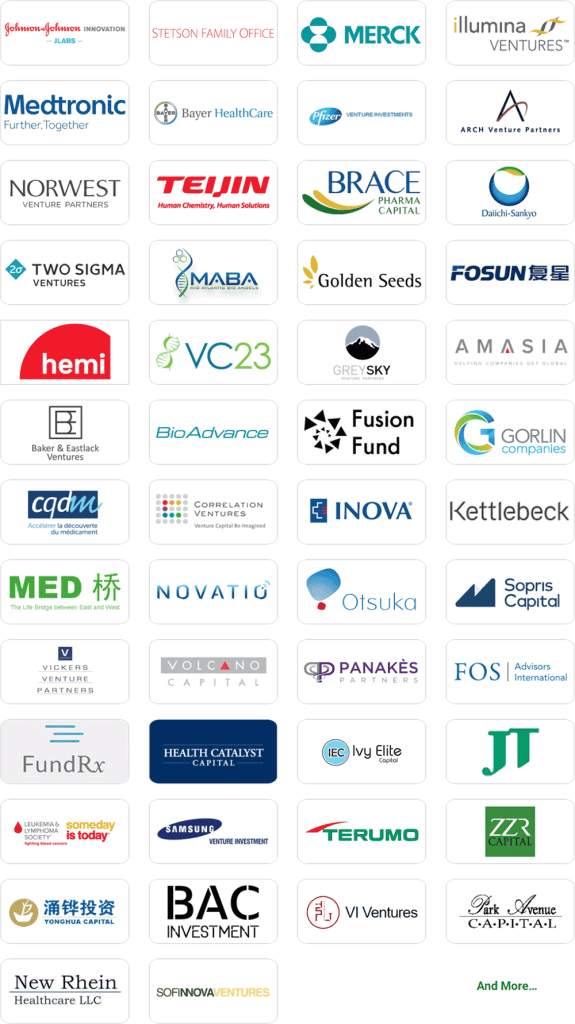
With RESI returning to NYC on November 5th, investors are flocking to sign up to participate. RESI’s unique high-touch partnering and breadth across the four key life science verticals of biotech, medtech, diagnostics, and digital health have attracted an audience of active investors from all over the globe.  The ratio of startups to investors at RESI events runs close to 1:1; there’s no better opportunity to find the right investor for your life science technology. See below for a selection of the registered investors.  We hope you can make it to RESI NYC to meet them.

Confirmed Investors and Strategic Partners

As of September 20, 2018

How to Be Successful in the RESI Innovation Challenge

By Gregory Mannix, Vice President International Business Development, LSN

LSN holds a high-profile life science competition at every RESI conference – the Innovation Challenge. Thirty early-stage fundraising companies with top-tier life science technologies are selected as finalists to exhibit a poster display of their programs to hundreds of investors and other conference attendees.  These companies compete for the exposure and visibility of being named as the top Innovation Challenge company. So you might ask: out of the hundreds of applications we receive, how do we choose the top thirty?  The LSN scientific review team has compiled a list of attributes we look for in a company and its IC application.

While the following applies to the Innovation Challenge application itself, the criteria and the tips we provide are also guidelines for companies to use in their fundraising efforts. Much of our evaluation and the questions we ask are based on standard criteria that entrepreneurs will face when speaking with investors.

What are the key elements of a high-scoring company?

The LSN scientific review team uses a detailed rubric with a 200-point scoring system. Our evaluation process is based not only on scientific merit, but also on how ready the company is to present to an investor (“investor-readiness”). A perfectly scored company would have a transformational technology that can achievably address a highly unmet need using a differentiable, novel approach or target. Alongside high innovation, differentiation, unmet need and market fit, the 200-point company would have a broad IP position, an experienced management team and CEO with top-tier advisors and strategic alliances with manufacturing, commercial or clinical partners. The company will also receive high marks for having what we call “investor-ready” marketing collateral (executive summary, pitch deck, website).

Application Tips

Clearly describe your technology.

Like any marketing material, you need to be clear. Be sure you understand and answer the questions fully. The team has seen unclear descriptions of a company’s technology is and its significance in improving on current technology, making it difficult to evaluate.

Be forthcoming in your answers.

The team frequently reviews applications that state they have no competitors in the space, when that is not actually the case. Even novel products have competitors; there is a standard-of-care for any given disease or condition.  If your product represents an incremental improvement, just say so.  It can still be compelling!

For example, competitors for your disease-modifying therapeutic may be symptom-treating therapeutics in the same indication that are either commercialized or being developed. You should identify these symptom-treating therapeutics and highlight your novel, targeted approach that makes your product disease-modifying.

Explain your current status in detail.

Outline everything you have in terms of your current standing, while also providing your outlook on where you hope to go. Avoid ambiguous statements such as, “CEO is an experienced entrepreneur”. Instead, provide details that highlight the CEO’s experience – years as an entrepreneur, number and names of companies exited, background expertise, etc.

Provide near-term and-long-term projections.

If you do not have certain criteria, such as a strategic alliance or IP, it’s OK. State your current standing and provide what steps you are currently taking to reach those milestones. For Alliances and Collaborations, state your partners and likely partners (even if you just have a verbal commitment); for IP status, state how many patents you have filed or are planning to file. Providing us with your strategy is better than a simple yes or no.

Provide sufficient detail, but no need to overdo it.

You shouldn’t finish this application in 5 minutes, nor should it take you 5 hours. Your answers should be brief but detailed.  We have received hasty, effortless applications that were subsequently quickly given a low score. On the other hand, as a fundraising company, you shouldn’t need to spend an excessive amount of time on the application. These are all straightforward questions that you should be familiar with and be comfortable answering, as your executive summary should contain all of this information. This application is the backbone of our evaluation process and is, essentially, your executive summary to us.

Send us your marketing collateral.

If you have marketing collateral, send it. This includes your pitch deck, executive summary, website, videos – any supplemental material that can boost our understanding of your technology and whether your company is investor-ready. The application provides limited space – while this forces you to get straight to the point, supplemental material explains what an application cannot (i.e. figures, graphs, pipeline, non-confidential data, etc.).

Overall, applying for the Innovation Challenge is great practice for fundraising companies. For those who have yet to apply, be sure to take note of these suggestions and apply here by October 3rd!