Hot Investor Mandate 1: Canada VC Invests In Biotech, Medtech and Green Technology

A venture capital firm based in Canada provides equity capital to portfolio companies and is very flexible in the size of investments it makes, placing a high emphasis on innovation of potential portfolio companies. The firm is currently investing in Canadian companies only, with no set limit on the amount of funds or number of investments.

The firm is looking to invest primarily in innovative green technology as well as biotech therapeutics and medical technology, and is also open to looking at companies in diagnostics and healthcare IT. The firm will consider products of any stage of development, from pre-clinical to phase III as long as the company’s product displays high potential to positively impact the environment or healthcare. In addition, the firm is agnostic to indication and will look at anything that fits in the environment or healthcare sectors.

The firm has taken a board seat in its portfolio companies before, but this is not required by the firm. The companies do not need to have an experienced management team, as innovation is the most important factor that the firm expects from companies. The firm prefers to act as the lead investor, but is open to co-investing with other firms that share the firm’s interests.

If you are interested in more information about this investor and other investors tracked by LSN, please email mandates@lifesciencenation.com

Hot Investor Mandate 2: Corporate VC Invests Strategically in Early Stage Drugs

The corporate investment arm of an Asia-based pharma firm is focused on early stage therapeutic companies that are a strategic fit for its parent company. Typical equity investments range from $0.5-5 million. The firm is also open to other forms of partnerships such as collaborative research, licensing, and M&A. The firm is currently seeking opportunities from across the US with a focus in the Bay Area.

The firm is looking opportunistically across all therapeutic subsectors from small molecules to biologics, gene therapy and cell therapy. The firm is most interested in assets in pre-IND to Phase II stages. The firm is agnostic to disease indications.

The firm is looking for experienced management team with strong sector knowledge. The firm may request board representation on a case-by-case basis.

If you are interested in more information about this investor and other investors tracked by LSN, please email mandates@lifesciencenation.com

Hot Investor Mandate 3: China-based Fund Seeks Clinical-stage Molecular Diagnostics, Drugs and Devices

A private investment firm based in Beijing, China, is investing from its 300 million RMB (US$50 million) fund into early stage ventures in the life sciences and healthcare sector. Typical allocation size ranges from US$0.5-5 million. The firm can either lead or follow in a financing round. The firm is seeking opportunities from China and the US.

The firm works on a wide range of life science sectors including biopharmaceuticals, medical devices, diagnostics, life science R&D, and medical services. The firm is especially interested in clinical stage molecular diagnostic products, while it would also consider preclinical stage projects with a lesser interest. The firm is agnostic to disease indications.

The firm is looking for experienced management team with proven products. The firm can assist with registration and distribution in China by leveraging its network of pharma partners, CRO/CMO, academic centers, and distribution channels. The firm is interested in distribution rights in China and may request board representation on a case-by-case basis.

If you are interested in more information about this investor and other investors tracked by LSN, please email mandates@lifesciencenation.com

Hot Investor Mandate 4: Venture Fund Invests in Therapeutics and Medtech in the USA & Canada

A venture firm with offices in Canada and the USA is investing from its second fund. The firm makes equity investments in early-stage life science companies based in Canada and the USA, and prefers to lead or co-lead investments. Initial investments will typically be of about $5 million CAD, with capital reserved for potential follow-on investments of up to $15 million CAD total per opportunity. The firm is likely to make 12-15 investments over the fund’s lifetime, with a focus on Canada; the firm also invests in the USA.

The firm will make most of its allocations in the therapeutics sector, with the remainder invested in diagnostics, medical devices, and/or tools or healthcare IT. The firm prefers to invest in early-stage opportunities; in the therapeutics sector, investments may be made in companies with a lead product 12-18 months prior to IND. The fund is generally agnostic in terms of technological field and indication area.

The firm only invests in those therapeutic companies that have identified a lead product candidate.

If you are interested in more information about this investor and other investors tracked by LSN, please email mandates@lifesciencenation.com

Canada’s Life Science Landscape

By Cole Bunn, Senior Research Analyst, LSN

cole-wp

As we look forward to 2017, there is certainly a lot of speculation regarding how the biotech sector will fare in the wake of a lackluster 2016 for public market performance, M&A transactions and venture funding for life science/healthcare companies, not to mention the intense pricing pressure drug makers are now facing. All things considered, most biotech folk are optimistic on what the new year will hold for the life science startups and the healthcare sector as a whole.

One geography that may be uniquely positioned to take advantage of these potential tailwinds is Canada, with its rapidly developing life science hubs. As we gear up for the second RESI conference at the MaRS Discovery District in Toronto on April 4, 2017, we wanted to take a closer look at what’s going on in the Canadian life science scene.

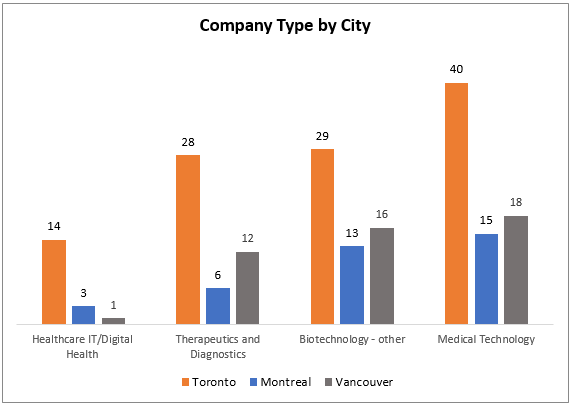
Taking a sample of Canada data from the LSN Company Platform, we can assess the most popular sectors for life science startups in Canada’s top three most populous cities.

c01

Medtech was the most represented sector. There are a couple of different possible reasons for this: 1) medical technology is a fairly broad term and there tends to be some overlap with digital health given that underlying a lot of medical devices, primarily the newer ones, is a software component; 2) generally speaking, the amount of capital required from inception to commercialization for a medical device tends to be considerably less than for a biopharmaceutical product due to fewer and smaller clinical trials, and given that there are less venture and corporate dollars available for Canadian startups as compared to the U.S., entrepreneurs pursue less capital-intensive opportunities.

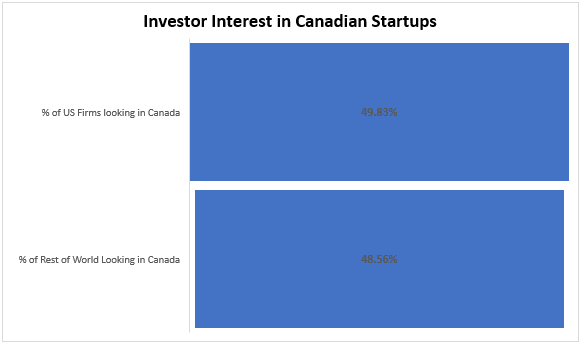
Taking a look at the LSN investor platform, the below data shows the percentage of investors in the U.S. and the rest of the world (excluding Canada) that have stated they are actively looking for technology in Canada.

c02

One thing we hear over and over from early-stage investors, particularly those based in the US East Coast or Silicon Valley, is that Canadian startups are attractive due to their reasonable valuations, as compared to valuations in traditional life science hubs such as Boston and San Francisco. Some U.S.-based investors are going as far as setting up offices in Canadian cities to take advantage of this fact. In addition, well-established VCs in the U.S. hubs see just about every deal out there, and are increasingly looking for innovation in less saturated areas. About half of the U.S. investors and investors in the rest of the world that are tracked by the LSN research team are looking to invest in Canadian startups.

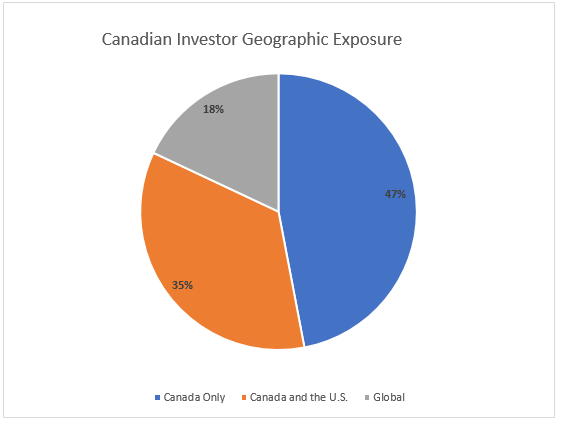
As for the Canadian investors, about half of them are putting money to work only in their own country.

c03

We’re excited to bring the RESI conference back to Toronto for a second time and get a firsthand look at the innovation that is happening in this rapidly developing life science hub, as well as expose the technologies to a diverse group investors and strategic partners.

resi-on-mars-2017-media-sponsors

Licensing Deals in 2016: Big Pharma Looks Earlier For New Assets

By Lucy Parkinson, Director of Research, LSN

2016 has been a mixed year for pharma, with new drug approvals well down from the 2015 highs, but major pharma firms continue to search outbound for the drugs of the future. The LSN Licensing Deals Platform provides detailed information on announced pharma deals, and this data allows us to take a look at the overall dealmaking landscape in 2016.

The LSN Licensing Deals platform doesn’t include M&A, and only covers deal announcements in which some financial information was stated, such as upfront and milestone payment amounts and/or a royalty percentage. In 76% of cases, the data includes an upfront payment amount; these varied considerably, with some preclinical deals providing under $1 million in immediate cash, and some Phase II and Phase III deals bringing in hundreds of millions.

Most 2016 Deals Were Preclinical

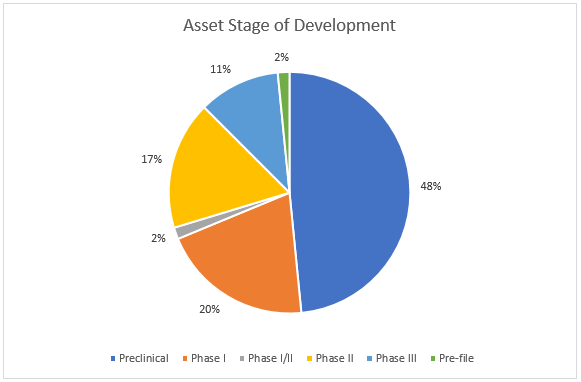
Among deals in which an asset stage of development was stated, preclinical assets were by far the most common, featuring in almost half of these deals. This figure has shot up since 2015. In an increasingly competitive arena, major pharma firms inked deals early.

l01

Oncology Remains Supreme, Digestive Interest Increases

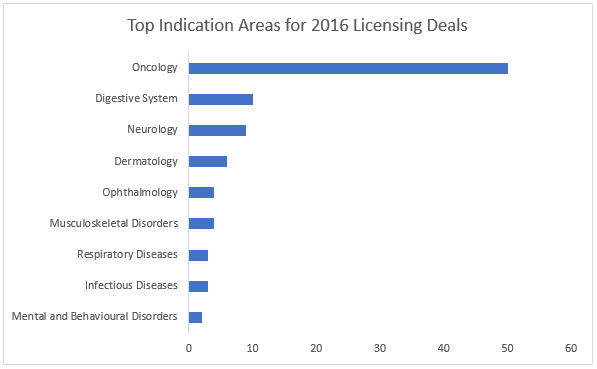
In deals in which a single specific disease area was identified, oncology opportunities predominated, exceeding other major fields of medicine by several times over. In surprise second place came the digestive system, with a 50% increase in reported deals over 2015. Other popular fields include neurology, dermatology, ophthalmology and musculoskeletal disorders.

l02

Both New Innovations And Mainstays Attract Deal Interest

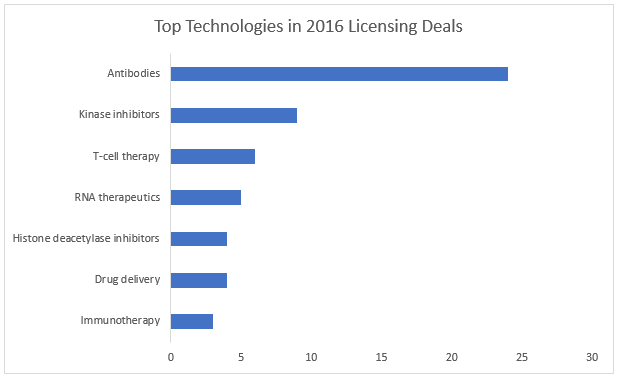
For many deals, the LSN Licensing Deals Platform describes the type of technology involved in the transaction. Some are widespread, while others are in a class of their own. There’s still a considerable amount of interest in antibody innovations, with over 20% of all deals involving an antibody. Antibody technologies were primarily either monoclonal or bi-specific antibodies, with several other types of antibody technologies being shopped, such as antibody-drug conjugates.

T-cell technologies (including CAR-T) continue to attract interest. However, so do kinease inhibitors, proving that this small molecule approach is not yet ‘yesterday’s science’ . Other technologies that remain sought after include RNA therapeutics and drug delivery technologies.

l03

There’s A Lot Of Fish In The Sea

As ever, you won’t be surprised by the names of the most prolific licensees in the dataset (it’s evens between Roche, Merck and Bristol-Myers-Squibb, with other well-known global pharma firms very close behind them). However, over 70 pharma firms, located in every corner of the globe, announced a licensing deal last year. If you’re looking for a strategic partner for your asset, it’s worth hunting beyond the top 10 or even top 50 largest firms. The LSN data platforms provide detailed information on potential development or exit partners far outside that mainstream.


RESI San Francisco Asia Pacific Investors Panel

By Shaoyu Chang, MD, MPH, Director of Research & Asia Business Development Liaison, LSN

Shaoyu 10*10

During JPM this year, close to 1,000 investment professionals from China gathered in San Francisco, according to unofficial statistics. What hot sectors are they looking for? How can you initiate and maintain a relationship with them? At RESI San Francisco, entrepreneurs and investors filled up the Asia Pacific Investors panel room to learn about the nuts and bolts of cross-border investment.

Moderated by Jimmy Lu, Managing Director, WI Harper Group, the panelists include:

Key takeaway points from the panel:

  • Chinese investors are pushed to look overseas by the following forces: asset price, scarcity of high-quality products, and scarcity of exit in the public market. Many of them are seeking one or more of the following factors from US early stage companies: cutting-edge technologies, large sales potential in their domestic markets, and access to the US market.
  • The Chinese government’s new currency restriction has impacted some transactions and created uncertainty in the future. Dual currency funds (firms that manage domestic RMB and offshore USD funds) are less affected.
  • To engage a Chinese partner, it is key to identify a ‘China hook’ of your product. Large patient population is only one factor. Regulatory process, medical practice, and reimbursement should also be considered.
  • A good partnership can come in different forms: direct investment, licensing, joint venture, M&A, etc. Entrepreneurs should work with experienced investors to form a partnership that is most suitable for their product sector and stage.