RESI Boston Early Bird Special Ends Tomorrow: Seeking Fundraising CEOs for RESI Innovation Challenge (View Past Winners Here)

With RESI Boston coming up soon, LSN’s scientific team is preparing to review the RESI Innovation Challenge applications from biotech, medtech and healthcare IT companies.  We’re excited to receive applications from companies at the cutting edge of biomedical science.  On September 13th, all RESI attendees will have the opportunity to vote on the 30 Innovation Challenge finalists.  See below for the past winners – a diverse group of startups from every area of the life sciences.

Every 90 days, RESI gathers hundreds of active early stage life science investors for a one-day partnering event. RESI Innovation Challenge finalists are provided with an all day showcase to attract the attention of those investors using their branding and messaging. It’s a unique opportunity to be a featured company in the life sciences industry. All applicants are vetted by LSN’s scientific review team, with a view to not just the quality of the company’s scientific work, but also the strength of the management team and how well-positioned the company is to receive investment.

What makes the RESI Innovation Challenge so valuable?  We’ve included a few words from previously successful participants below, but in short, being part of the Innovation Challenge provides startups with a new way to get attention and start dialogues with the investors who attend RESI.  Participants can share their message all day in the exhibit hall, with their Innovation Challenge display providing a starting point for a meaningful conversation about the opportunity.

Here is what our previous winners are saying about the RESI Innovation Challenge:
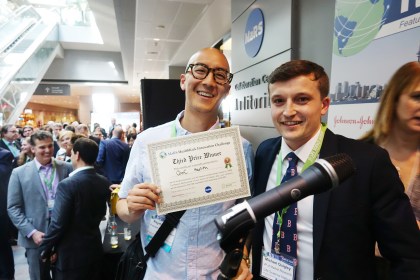
DSC00392

“It was an absolute pleasure to participate in the RESI conference held at MaRS in Toronto. The unique structure of the conference facilitated creating new relationships with potential investors and partners. In particular, the Innovation Challenge pushed us to introduce ourselves to new people, which will be useful as we look towards a future financing round. I definitely recommend the RESI conferences to entrepreneurs seeking financing in the bio / health space.”
 
– Raymond Shih, President, Co-Founder, QoC Health
3rd Place, RESI on MaRS, June 23, 2016

“I love the RESI Innovation Challenge because it is a great way to give our pitch to practice it and try to obtain a scarce resource from these investors. Practicing with these investors is a great way to build relationships and continue that on to the real investment conversations.”

– Niko Skievaski, Co-Founder, Redox

1st Place, RESI@TMCx, June 8, 2015

02

“The RESI Innovation Challenge is a really good opportunity to meet investors and other companies in the space.  It’s a good showcase to reach that audience.”

– Jessica Ching, CEO, Eve Medical

2nd Place, RESI San Francisco, January 12, 2016

“The RESI Innovation Challenge is a unique way to pitch, and provides a great opportunity to see what other companies are doing in the industry, while allowing you to meet with potential investors and strategic partners outside of the partnering meetings.”

– John Connolly, VP Corporate Development, Rna Diagnostics

1st Place, RESI Boston, September 16, 2015

01

“RESI offers small companies like GeneSegues a direct line to potential partners and potential investors in a small setting conducive to relationship building and conversation. The Innovation Challenge was a particularly great way to introduce our company to a broader audience than I could meet with personally which allowed us to leverage the showcasing of our technology more efficiently.”

-Laura M. Brod,Chief Executive Officer,GeneSegues Therapeutics

-1st Place, RESI @TMCx, April 11, 2016

RESI on MaRS June 23, 2016

1st Place
Paul Weber, President & CEO, Perimeter Medical Imaging
2nd Place
Geoff Fernie, CEO & CTO, Bresotec Inc
3rd Place (Tie)
Chancellor Crawford, Co-Founder & CEO, QoC Health

Ilana Odess, CEO, Woven Orthopedic Technologies

RESI@TMCx April 11, 2016

1st Place
Laura Brod, CEO, GeneSegues
2nd Place
Austin Dirks, CEO & CO-Founder, GreenLight Medical
3rd Place
Alexander Schüller, President, Adhesys

RESI San Francisco January 12, 2016

1st Place
 Shravanthi Reddy, COO, ClearSight
2nd Place
Jessica Ching, CEO, Eve Medical
3rd Place
Jonathan W. Gunn, JD, PhD, CEO & Co-founder

RESI Boston September 16, 2015

1st Place
Jonathan W. Gunn, JD, PhD, CEO & Co-founder, Rna Diagnostics
2nd Place
Matthew R. Gevaert, Ph.D. CEO & Co-founder
3rd Place
Kenneth J. Slepicka, CEO & Director

RESI@TMCx June 8, 2015

1st Place
Niko Skievaski, Co-founder, Redox
2nd Place
Wade Lange, CEO, NeuroFx
3rd Place
Laura Bosworth, CEO & co-founder, TeVido BioDevices

RESI San Francisco January 13, 2015

1st Place
Shawn Iadonato, Ph.D., CEO, Kineta
2nd Place
Eric Goslau, CEO, Transverse Medical
3rd Place
Robert Thompson, President & CEO, Amorphex Therapeutics

RESI Boston September 17, 2014

1st Place
Robin Smith, CEO, ORIG3N
2nd Place
Jeff Missling, CEO, SpineThera
3rd Place
Kurt Dieck, President & CEO, Biosortia

RESI Boston March 24, 2014

1st Place
Pam Randhawa, Founder & CEO, EMPIRIKO
2nd Place
Marcia Fournier, CEO, BIOARRAY
3rd Place (Tie)
Magdalena Leszczyniecka, President & CEO, STC Biologics

Tasos Smeros, Founder & CEO, Multineurons

Apply today for the chance to join!

button

Hot Investor Mandate 1: Family Office Invests in Healthcare IT to Lower Cost of Care

A private investment firm based in New York, NY has launched a health technology fund to invest in early stage companies that are developing innovations that can significantly reduce healthcare costs. The firm makes equity investments where the investment size is highly variable depending on the stage of development and particular need of each company. The firm invests in companies that are based in the US and is actively seeking new investment opportunities.

The fund focuses on early-stage healthcare IT projects that could substantially lower the cost of healthcare delivery in the United States. Examples of good candidates include projects that help consumers make more informed decisions when selecting local service providers (cost transparency); use remote monitoring technology to help patients better manage illness; or provide more meaningful tracking of health metrics for patients (health and wellness analytics).

The firm is an active and engaged investor.

If you are interested in more information about this investor and other investors tracked by LSN, please email mandates@lifesciencenation.com

Hot Investor Mandate 2: Hong Kong VC Seeks DNA Diagnostics

A venture capital firm based in Hong Kong makes seed and early stage investments across several sectors including the life sciences. The firm typically allocates USD 75K to 500K per company as well as possible continuation into Series A. The firm can invest globally and is actively seeking new investment opportunities.

In the life sciences, the firm is interested in DNA genetic testing. For example, technologies such as pre-natal testing and DNA testing for oncology screening. The firm is also interested in and health & wellness technology for preventive care or management of chronic illness such as diabetes. The firm will focus on startups that have already gained some traction. The firm historically invested in molecular diagnostics and DNA screening.

The firm looks to partner with exceptional entrepreneurs and generally looks to take a board seat post investment, though this is not a requirement.

If you are interested in more information about this investor and other investors tracked by LSN, please email mandates@lifesciencenation.com

Hot Investor Mandate 3: Europe Fund Invests in Clinical-Stage Medtech and Therapeutics

A venture capital firm based in the United Kingdom seeks to invest in companies that need capital within the range of £1m to £10m with a typical investment size at £3 million per company. The firm focuses on investments in life science companies at clinical or growth stage. The firm has a syndicated fund of £100 million, and seeks to make 1-2 new investments within the next year in addition to their current portfolio of 8 active companies. The firm typically leads investments, though will co-invest depending on the opportunity. The firm focuses on UK-based private companies, though is open to companies based in Europe and the U.S.

The firm is currently looking for new opportunities in the Medical Technology and Therapeutics sectors. The firm will also consider diagnostics companies, depending on the opportunity. For therapeutics, the firm will invest in both small molecules and biologics. The firm will consider all classes of medical devices, and prefers to invest in devices with a regulatory pathway. The firm invests in clinical-stage to commercialized products, and prefers clinical-stage technology with a clear path towards revenue.

The firm focuses on private companies and prefers companies with a strong management team and significant growth potential that are able to deliver returns for investors within a 3 to 5-year timetable. The firm looks to take a board seat post investment.

If you are interested in more information about this investor and other investors tracked by LSN, please email mandates@lifesciencenation.com

Hot Investor Mandate 4: Venture Fund Raises New Fund for Medtech & Healthcare IT

A venture capital firm based in the central US is currently in the process of raising its 2nd fund, targeted at $50 million. The firm typically makes equity co-investments in seed and early stage companies ranging from $50,000 to $8 million with most investments in the $250,000 to $1.5 million range. The firm typically makes 6-8 allocations per year, and is open to opportunities throughout the United States and Canada.

The firm is looking for companies in telemedicine, healthcare IT, pathology, diagnostics, bioinformatics, medical devices, and healthcare automation. The firm does not look at pharmaceutical opportunities. The firm is interested in early stage companies from pre-prototype or pre-clinical to clinical stage that have a cost efficient and innovative product with a clear pathway to exit in approximately 3-5 years. The firm is open to consider all indications and types of devices. The firm is not interested in late stage investments into companies that already have a product on the market. The firm focuses on opportunities that focus on patient care improvements, healthcare IT or products that solve critical problems that hospitals, doctors or patients face—and for which the company can receive reimbursement.

The firm is looking for entrepreneur-based management teams with experience who are open to work with them. The firm looks to take a board seat following investment. In addition to capital, the firm is capable of providing strategic mentoring as well as incubation services both locally and remotely in areas of HR, Marketing, Accounting and Software Development.

If you are interested in more information about this investor and other investors tracked by LSN, please email mandates@lifesciencenation.com

10th RESI Marks Milestone with Asia-North America Investor Track

By Shaoyu Chang, MD, MPH, Senior Research Manager & Asia Business Development Liaison, LSN

Shaoyu 10*10

Asia-based drugs, devices, diagnostics and healthcare IT companies all have a cross-border strategy. These entities have demonstrated impressive growth in recent years in terms of talent, research capacity and capital. Now on both sides of the Pacific Ocean, investors and entrepreneurs have set out to find opportunities and form new partnerships. At the Boston-Cambridge biotech hub, the tenth RESI Conference is poised to become the go-to platform for US-Asia early stage life science investments.

Life Science Nation has teamed up with a committee of highly experienced investors and organizations to implement the new Asia Track at RESI Boston. Interested attendees will have the opportunity to learn about the Asia-North America investment landscape and meet face-to-face with potential partners in biopharmaceuticals, medtech, and diagnostics.

The steering committee is composed of representatives from Wuxi Apptec, Simcere Pharmaceutical, Lyfe Capital, MP Healthcare Venture Management, Korea-Seoul Life Science Fund, Chinese-American Biomedical Association (CABA), and Sino-American Pharmaceutical Professionals Association (SAPA). The committee brings together diverse backgrounds and deep experience in early stage life science investments.

The LSN team has traveled to innovation hubs such as San Francisco, Houston, Toronto, and Boston. Everywhere we went, we were greeted by a growing number of Asia-based investors, fund managers, pharmaceutical corporations, and big corporations that are looking outside their local region for investable life science technologies. However, geographic and cultural barriers often limit their ability in deal-sourcing, evaluation, negotiation, and post-investment management.

On the other hand, many US and Canadian entrepreneurs are looking at the other side of the Pacific for capital, strategic partners, and business growth and expansion. They are faced with a different set of challenges: ignorance of risks and benefits in these new marketplaces, inability to identify a good fit from a wide array of advisors and consultants, and difficulty in establishing and maintaining long-term cooperative relationships.

The Asia Track at RESI Boston aims to address all of the above issues. Past RESI events have stressed the globalization of early stage life science investments. This time, the Asia Track will bring to you seasoned investors who understand your sector and can pinpoint emerging opportunities in China, Japan, Korea, and other Asian countries. Next Phase will announce these Asia investors panels in the coming weeks.

RESI-Boston-2016_v2

Big Data in Healthcare: Investors Weigh in On New RESI 10 Panel Topic

By Caitlin Kramer, Research Analyst, LSN

caitlin-wp

As Life Science Nation’s 10th RESI Conference approaches, we are proud to offer a glimpse into the topic of a new panel which will debut in Boston on September 13th: Big Data in Healthcare. This panel will feature the insight of five investors actively seeking companies that are advancing big data solutions to problems in healthcare and medicine.

The paradigm of digital information is still relatively new, and techniques for dealing with massive quantities of it – Big Data – are still in their early stages. LSN asked investors for their thoughts on the space, and their responses are below.

What is exciting about big data? What role do you see it playing in the future of healthcare?

One of the areas I continue to see active investor interest in is companies working with patient data. There’s a lot of excitement about innovative solutions that help patients and practitioners securely manage and share medical records and data while still maintaining regulatory compliance. This extends into the insurance industry as well.

I’ve also found the application of big data-native concepts like computer vision, machine learning, and natural language processing to the medical field incredibly interesting. Examples include technologies that help doctors diagnose diseases earlier based on a programmatic analysis of medical imagery, or a cross-correlation of 200 million patient records looking for subtle trends, or a mental health patient conversing with a digital psychologist AI to help set some context before scheduling a meeting with a licensed doctor.

Another investor said:

I believe that within my lifetime, it will be considered malpractice for doctors to diagnose without using computational aid. Systems biology is too complex to be held in the brain, and AI will become a routine, standard part of medicine.

With so much excitement about the potential big data has to transform healthcare, the space is prone to hype. Entrepreneurs should keep in mind the unique challenges of working in the space, especially when speaking with investors. This led us to ask:

What are the biggest hurdles you see to using big data in healthcare?

An investor we spoke with countered with another observant question:

Why hasn’t there been a big medical breakthrough or discovery yet, despite billions of dollars already invested in big data AI and machine learning?

He continued on to discuss why:

Most big data projects indiscriminately mine data without considering uncertainty. These can be uncertainties in measurement, biological variability, or patient comorbidity. When I ask CEOs of big data companies simple questions about how they plan to deal with mismatches in ontology, or error propagation, I am often met with a blank stare. Medical science, done well, requires setting up an experiment, making measurements, accounting for uncertainty in measurement, and propagating that uncertainty. To effectively do that at this stage, we need to first focus on developing algorithms that work on small data with constraints, and a scope confined to the clinical question.

Another core component to developing big data algorithms for use in healthcare is recognizing that the needs of the algorithms differ from those applied in other fields. A failure to correctly classify or categorize a piece of information used in a marketing or financial setting can be corrected later, while the failure to distinguish between a benign and malignant tumor image can cost a life when applied in medicine. The mentality of software development needs to understand the consequences of error.

Important insights and opinions such as these will ultimately shape how big data manifests a presence in healthcare in the coming years. We look forward to announcing the panelists for Big Data in Healthcare in the coming weeks, and to hearing more investors speak about their experiences investing in this new and exciting future for medical care at RESI 10.