Hot Investor Mandate 3: Cross-Border Firm Raises New Fund to Invest in Digital Health and Medical Devices

A firm founded in 2014 and based in Silicon Valley invests in several fields including digital health, healthcare IT, and medical devices. The firm is currently raising its second fund, and typically invests an average of $300,000 per company, though this is dependent on the technology as the investment size may increase, particularly for hardware-based technology. The firm typically co-invests at present but is anticipating leading investments with the new fund. The firm typically makes 12-20 new investments per year, and focuses on companies based in North America (USA & Canada), though is open to looking at companies based on a global-level. Furthermore, the firm has a considerable value-add in supporting companies that may be interested in moving their markets to Asia by passing potential deals to the firm’s Shanghai office as its source of deal flow, and making the right introductions to Asian investors and/or distribution partners.

The firm is open to all subsectors of digital health, healthcare IT, diagnostics, mobile app healthcare technologies, and all classes of medical devices. The firm is indication agnostic and looks primarily at early-stage companies, particularly at the seed pre-Series A stage.

The firm does not have a particular management team requirement. The firm will help the company fill the team if necessary. If leading the round, the firm will take a board seat after an investment.

If you are interested in more information about this investor and other investors tracked by LSN, please email mandates@lifesciencenation.com

Hot Investor Mandate 4: International Seed Fund Invests in Medtech, HCIT, and Medical Data and AI Technology

An investment firm with offices worldwide manages a $30 million seed-stage fund that seeks to invest in companies across a variety of industries, but it is most interested in A.I. technology and data-oriented companies. The investment is general in term of equity, but convertible loans will be considered as well. The typical investment size ranges from $250K to $500K and seeks 25 new investments per year. The fund generally invests in seed stage, but occasionally will invest in Series A and Series B rounds with co-investors. The firm will consider new opportunities around the globe.

In healthcare, the firm is currently looking for new investments in the medical technology and healthcare IT sectors. The firm will not consider investments in biotech therapeutics or drug development space. For medical devices, the firm considers Class 1&2 devices, depending on the opportunity, but it is most interested in low-risk devices that do not need FDA approval. In healthcare IT, the firm looks to invest in companies developing m-Health and e-Health. In terms of stage of development, the current fund focuses on seed-stage investments. Historically, the firm was active in companies targeting digital health and clinical data platform.

The firm looks to invest in private companies across the globe. The firm prefers to invest in companies with a strong and full management team with significant growth potential.

If you are interested in more information about this investor and other investors tracked by LSN, please email mandates@lifesciencenation.com

RESI does Toronto, where health means business. Lots of it.

By Dianne Carmichael, Managing Director, Health Innovation & Venture Services, MaRS Discovery District

Dianne-Carmichael

The Redefining Early Stage Investments (RESI) Conference is going abroad for the first time. RESI on MaRS will take place on June 23rd in Toronto, the heart of Canada’s financial and health industries, where early stage investment in life sciences and digital health is on the cusp of a major breakthrough.

Take the launch of Johnson & Johnson’s JLABS @ Toronto in May — also a first outside the United States, and in the very same building RESI will take place, the 1.5-million-square-foot building that is MaRS Discovery District. Or the recently announced centre for advanced therapeutic cell technologies, the first of its kind in the world, which is also moving into MaRS thanks to a $40-million collaboration between the government of Canada, GE Healthcare and the Centre for Commercialization of Regenerative Medicine (CCRM).

These initiatives offer a glimpse of how major strategic firms and investors in the health sector are recognizing the Toronto area’s resources, including the region’s pool of skilled talent, its recognized high quality of life, its world-class health research institutions, its strong entrepreneurial culture, and the generous tax incentives available for R&D locally.

While local early stage investing in life sciences picked up last year, venture capital players are still few and far between in Canada. Total venture deal activity for Canada’s life sciences sector hit $511 million (all values in Canadian dollars) for the first nine months of 2015 — a jump from $422.5 million the year before. Canadian companies closing major deals during 2015 included Highland Therapeutics ($50 million) and Trillium Therapeutics ($55.2 million). Another three Canadian life sciences companies collectively cut deals worth $114 million in 2015 — Clementia Pharmaceuticals ($60 million), Northern Biologics (US$30 million) and Profound Medical ($24 million).

Early stage investors active in the Canadian health sector are also tapping into medical devices and the digital health sector, which includes consumer apps that help people manage their own health. Toronto, already known as the City of Apps, is particularly poised to take advantage of the crossover between health and digital technologies that is fuelling innovation in wearables. Precision medicine and robotics are some of the other areas gaining traction in the Canadian investment scene.

The intersection between 3D printing and health is also taking off with Autodesk Toronto and their award-winning research division moving to MaRS, the fastest growing technology and medical research community in Canada. There are over 100 researchers at Autodesk global, 60 of them based in Toronto. This team is already breaking new ground using 3D-printing technology to develop low-cost, prosthetic limb sockets and build highly realistic human models for biomechanical simulation and research. Future developments include 3D bioprinting: the production of living cells from simple tissues to complete organs. The market for this is expected to reach $2.84 billion globally by 2022 and Canada is poised to be a leading player.

Canada is also home to a diverse variety of early stage investment sources. In addition to VC firms such as Lumira Capital, Genesys Capital, Versant Ventures Canada and CTI Life Sciences, Canada also has many other types of active investors. The local angel investment community is becoming more active in the health sector, and many institutional investors already have a strong presence. That is the case of the heavyweight Caisse de Dépôt et Placement du Québec, which manages public and private pension funds.

Canada is also experiencing a rise in capital for health startups from the social impact and venture philanthropy investment trend, which Canada is pioneering. Virgin Unite, Richard Branson’s foundation that links innovators and entrepreneurial ideas to challenge tough issues and improve peoples’ lives, has just recently partnered with the MaRS Centre for Impact Investing to launch the MaRS Catalyst Fund. One third of this early-stage, cross-Canada direct investment fund will be put toward the health sector.

As interest ramps up on the early stage investmenet front, MaRS is growing its support for entrepreneurs, including expanding its team of advisors with experience in early stage investment. This includes a health entrepreneur advisory board chaired by Stefan Larsen, CEO of Northern Biologics, to support accelerating companies that can scale globally.

The graph is trending upwards in Toronto’s early stage health investment sector. RESI on MaRS will welcome innovators and investors from around the globe to engage in the heart of Canada’s rising health innovation hub in Toronto.

RESI-Toronto-2016

RESI@TMCx – Houston Texas Delivers BIG Time

By Dennis Ford, Founder & CEO, LSN

dennis-websit

LSN is laser focused on the early stage investment dynamic; the ever changing relationship between buyer and seller, between investor and fundraising CEO/scientist-entrepreneur. LSN staff program the content to be specifically about investors detailing their investment processes to the entrepreneur audience – RESI’s panels and workshops are selected for relevance to early stage investment.

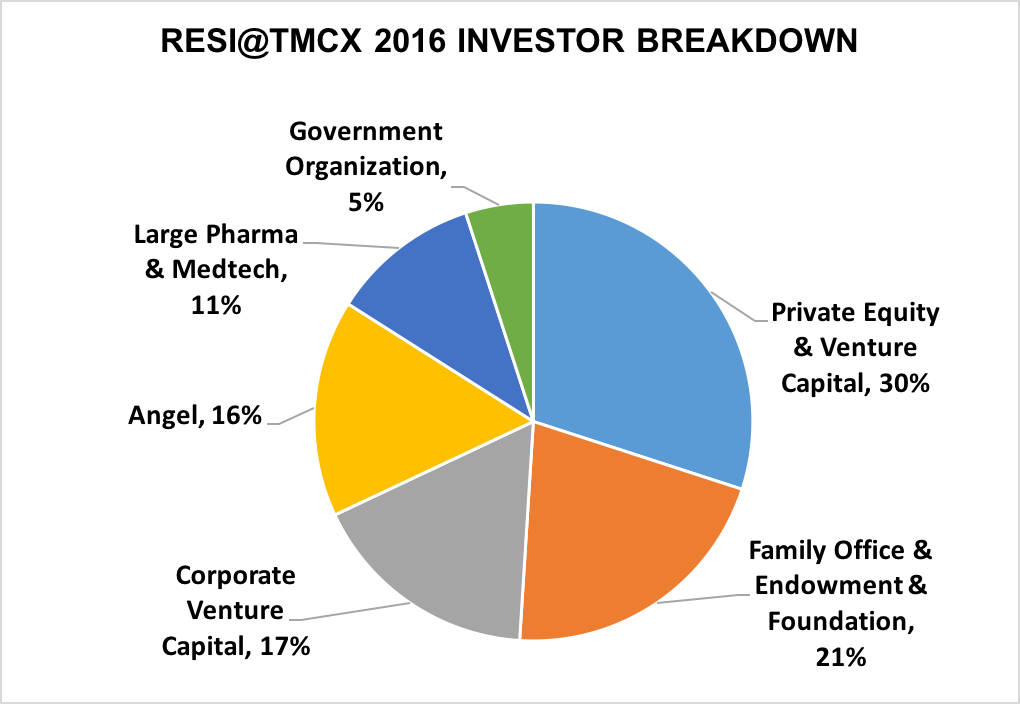
After the investor landscape morphed, LSN created RESI to be a venue to feature all the players in the early stage investment arena.   LSN tries hard to present current state-of-the-state content relevant to the investor marketplace. It’s not just about venture capital firms; there are nine other categories of investor that LSN invites to RESI, including Angels, Corporate VCs, Family Offices, Large Pharma/Med Device corporations, and Foundations. With VCs turning toward later-stage, derisked opportunities, it’s important for early stage companies to meet a broader group of investors that still have appetite for preclinical assets.

RESI is a hub in this new landscape, and while VCs are still an important part of this ecosystem, RESI aims to tell a wider story. I’ve received great feedback from attendees from throughout this ecosystem; LSN is proud to have created an event that yields a positive response from such a wide variety of early stage companies and investors.

Metrics for RESI @ TMCx

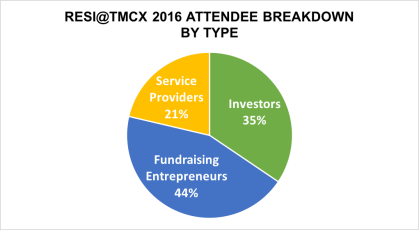
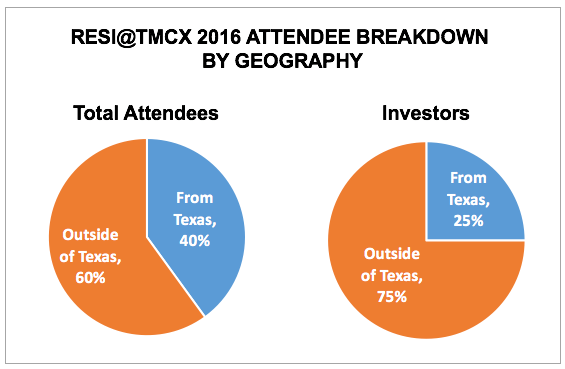
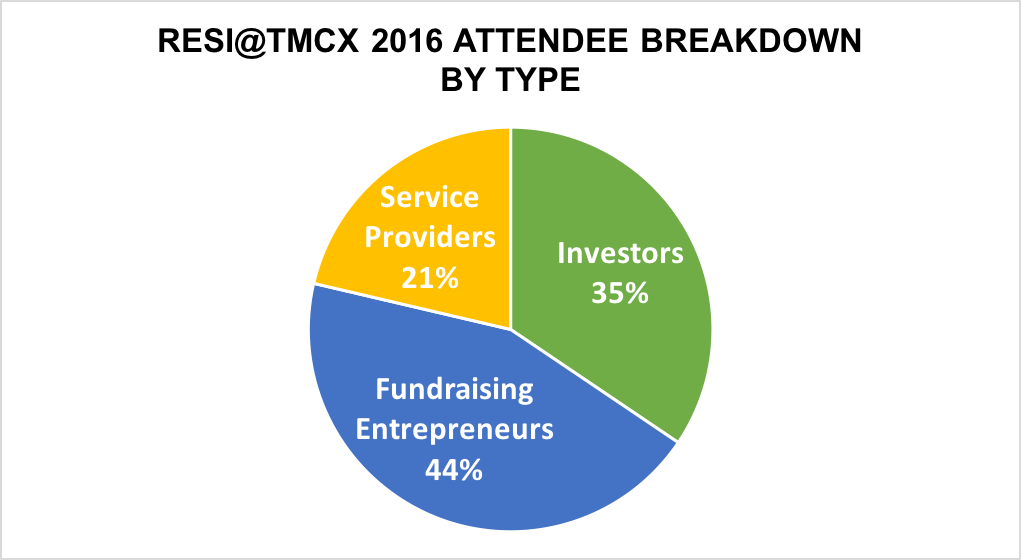
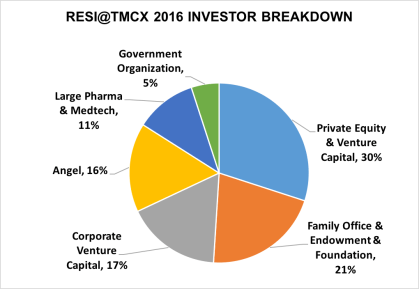
Breakdown of investors at RESI @ TMCx
w1

w2

w3

740 scheduled meetings through the partnering system

68% between entrepreneurs and investors – the game is afoot!

15% between investors and other investors – syndicates are a growing trend and investors source syndication partners at RESI

12% between service providers and investors – CRO relationships are becoming more important to investors

5% between entrepreneur and entrepreneur – it’s a very small CEO universe

Quotes I heard at the event

Family Offices

A VP from a large family office (they invest up $100 million per deal) based in the Mid-Atlantic region who has been to last 5 of our conferences, stated he had 16 partnering meetings. The one thing he appreciated most was that the majority were from the Texas region – that’s why RESI was great for him. He has seen enough companies from Boston and the Bay Area. He was impressed that most Texas companies were far more realistic on valuations than those elsewhere.

An investor from a California-based family office who had never been to RESI before said “I go to many conferences across various industries and this was a great combination of useful topics and the kind of opportunities I want to see.”

Corporate VC

A corporate VC investor said he made one investment in a company he met at RESI@TMCx last year, and this year he found 2-3 he said he was very interested in pulling the trigger on.

A new corporate venture fund from the insurance industry said he needs venues like TMCx and RESI where he can find next generations solutions for all future applications, and also meet investors and strategic partners for corporate initiatives.

A VP of new technology at a corporation, who funded a company sourced from a previous RESI, described RESI@TMCx as a great venue for finding technology assets.

Seed Fund

Funded by two Chinese Pharma and a Chinese CRO looking for early stage investments, this fund’s founding came to TMCx to see what kind of regional technology she could find.

Pharma

A U.S. Pharma BD and Licensing lead said “RESI @ TMCx is great for showing what great resources are in regions like Houston. I have met several companies at RESI that I will continue to investigate.”

A VP of Outsourced Technology said “I need to find companies before they get tied up with long term VC relationships. RESI Houston enables me to broaden my view of companies in a region I need to canvass. I need to get to know these companies at an early stage.”


RESI@TMCx Innovation Challenge Winners Announced

By Nono Hu, Director of Marketing, LSN

This week at RESI@TMCx, thirty companies from the biotech, medical device, diagnostic and healthcare IT sectors competed in the RESI Innovation Challenge. From among the applications we received, these companies were selected by LSN’s scientific review board to present their technologies in an exhibition-style format while RESI attendees cast their votes on the best innovations on display. Here are the top 3 winners!

First Prize Winner: GeneSegues Therapeutics

011

GeneSegues develops novel nanocapsule based solutions that can unlock the potential of promising drugs that need more precise delivery. Our technology is highly differentiated in that our ultra-small nanocapsule is 3x smaller than competing capsules and, due to their versatility and efficiency, can be readily designed to reach more targets with more drug leading to better treatment outcomes. We are using this technology to develop our own nanoencapsulated RNA drug for head and neck and colon cancers. In addition to developing our proprietary cancer drug candidate pipeline, we are seeking to partner our nanocapsules with drug developers in other cancer indications and other disease markets in need of innovative and effective targeted delivery solutions. We are actively engaged in a number of very high potential markets in need of new delivery technologies for RNAI, gene therapy and gene editing (also known as CRISPR). Because we can create new nanocapsules more quickly and significantly smaller than the competition, we can be a leader in some of the most exciting fields in medicine today.

01
Laura Brod, CEO, GeneSegues

Second Prize Winner: GreenLight Medical

022

GreenLight Medical is a cloud-based software to streamline the introduction, evaluation, and approval of new medical technology within hospitals. GreenLight is an end-to-end solution, offering a secure, collaborative, information-exchange platform to align medical device companies, medical sales representatives, hospital providers, and physicians in one all-inclusive tool. By eliciting coordination among multiple parties on new product evaluation, data, documents, and decisions can be analyzed from one shared space. GreenLight provides the actionable data and insights needed to enable medical suppliers and hospital providers alignment on cost, quality, and outcomes regarding new medical technology introduction.

02
Austin Dirks, CEO & CO-Founder, GreenLight Medical

Third Prize Winner: Adhesys Medical

033

Surgeons still suture or staple more than they’d like to, as medical glues don’t live up to their requirements. Adhesys Medical seeks to change the game, developing one-of-its kind polyurethane-based surgical adhesives. The technology is unique as it combines ease of use, strength, flexibility and biodegradability, allowing for wound-closure on and in the body within seconds and use in unprecedented areas of surgery. Venture backed and based in the US and Germany, it is our vision to advance surgery by providing physicians with the tools to minimize complications and maximize patient comfort.

Alexander Schüller, President & Laurence Zhu, Analyst from Adhesys with Emmanuelle Schuler Head of JLABS@TMC

Hot Investor Mandate 1: Global Asset Manager Seeks Disruptive Medtech in Robotics, Cardiovascular, Cancer, Diabetes and Orthopedics

A global alternative asset manager based in Shenzhen, China focuses on investments in the healthcare sector, currently focusing on acquisition or investment first and then acquisition. The firm is making new investments in venture stage companies from its 2015 vintage fund of US$50 million. Depending on the stage of the company, the firm can invest from several hundred thousand to tens of millions in companies with valuation under 1 billion RMB. The firm considers companies based in the US, Europe, Israel, and Asia with a focus on China-based businesses. The firm is actively seeking new investment opportunities.

In the Life Sciences, the firm is currently seeking to invest in medical devices that are novel and disruptive. The firm considers a broad range of medical devices with a focus on robotics, cardiovascular, cancer, diabetes, orthopedics, and ophthalmology. The firm typically invests in clinical stage projects but would consider devices at all stages.

Currently, the firm is only looking for privately held companies and typically requires board representation post-investment. The firm prefers to exit within 5 years, but can be flexible on a case-by-case basis.

If you are interested in more information about this investor and other investors tracked by LSN, please email mandates@lifesciencenation.com

Hot Investor Mandate 2: Strategic Fund Seeks Advanced Medtech Platform Opportunities in USA

A California-based firm backed by strategic LPs closed its first fund in early 2016. The firm invests in early stage healthcare technologies that are strategically relevant to its LPs, which are major foreign corporations. The firm has a fund size of $75 million and is a multi-stage investor, interested in companies from the seed stage through to late-stage venture rounds. Investments therefore vary by stage, but the firm’s Series A investments may typically be of about $1-3 million. The firm generally prefers to act as a co-investor. The firm is focused on US-based opportunities.

The firm is interested in new technologies in digital health, medical devices, diagnostics, and therapeutics. The firm’s primary focus is on the intersection between data and biotech, diagnostics and medical devices, with microfluidics, connected devices, digitization, and automation being areas of high interest. For therapeutics, the firm generally does not invest in single-asset companies; therapeutic platform technologies that have the potential to create multiple ‘shots on goal’ are preferred. The firm prefers to focus on patients for whom there is high unmet need and no currently adequate treatments; rare diseases are of high interest. The firm is a multi-stage investor, and is open to investing in assets as early as the preclinical or pre-prototype stage.

The firm seeks management teams that display knowledge of how to build a business out of a strong technology. The firm focuses on technologies that allow the firm’s LPs to provide a value-add in partnering, manufacturing or distribution; healthcare technologies involving sensors and materials science are high focus areas. The firm evaluates opportunities on a technical, clinical and leadership level; the firm then shares the results of their diligence with the company in order to help the company in their future efforts.

If you are interested in more information about this investor and other investors tracked by LSN, please email mandates@lifesciencenation.com