Hot Investor Mandate 2: Korea-based Pharma Invests In Cardio, Diabetes, CNS and Respiratory Drugs

A South Korea-based pharmaceutical company is interested in forming strategic partnerships with biopharmaceutical companies that are interested in entering the Korean market. The structure of the partnership includes in-licensing, co-marketing, co-promotion, join-ventures, and equity investment. The company is actively seeking new partnership opportunities.

The firm is currently seeking products in the following therapeutic areas: Cardiovascular disorder such as hypertension; Endocrinology disorder such as Type I, II Diabetes & Diabetic complications; CNS disorder such as Depression, Schizophrenia, Anxiety disorder, Insomnia, Alzheimer’s disease, Parkinson’s disease and Various pain types; Ophthalmic disorder; Respiratory disorder; Oncology disorder; Degenerative/Age-related diseases. The company prefers to invest in products that have attained human proof of concept, and is also interested in partnering with companies that have products on the market.

The firm will partner with companies from around the world that are interested in entering the Korean market.

If you are interested in more information about this investor and other investors tracked by LSN, please email mandates@lifesciencenation.com

Hot Investor Mandate 3: New Venture Philanthropy Vehicle In Pediatric and Neonatal Health

A children’s health foundation has launched a new financial vehicle to make program related investment in commercial companies developing technologies that can improve children’s health. The foundation expects to make 2-3 equity allocations in the current year. Typical investments range from $150,000 – $250,000 in pre-Series A rounds.  The foundation is seeking opportunities globally.

The foundation funds early stage projects to help them reach scale and sustainability. The foundation is looking for high impact innovations in children’s health with a special interest in neonatal care and pediatric neurology. The foundation is agnostic to technology sectors. The foundation is interested in single assets as well as platform technology that can be applied to the pediatric field.

The foundation seeks privately held companies with competent management teams with sector expertise. The foundation typically seeks board representation post investment.

If you are interested in more information about this investor and other investors tracked by LSN, please email mandates@lifesciencenation.com

Hot Investor Mandate 4: VC Seeks Diagnostics, Devices and Research Tools with Proof of Concept Data

A venture capital firm with offices throughout the US focuses on several verticals including medical devices, and diagnostics. The firm seeks opportunities that provide some degree of investment loss protection through strong intellectual property. The firm’s target investment size is $1-3M for each portfolio company spread over 1-3 rounds. The firm invests in companies that are based in the US and is actively seeking new investment opportunities.

In the life sciences, the firm is currently seeking to invest in early stage research tools, diagnostics, and medical devices. The firm is generally opportunistic in terms of subsectors and indications. The firm will consider products as early as in proof of concept stage, but typically looks at technology 12-18 months from attaining revenue. The company must have solid patent protection.

The firm seeks a strong and experienced management team that has a track record of bringing concept to market, and may take a board seat in applicable cases.

If you are interested in more information about this investor and other investors tracked by LSN, please email mandates@lifesciencenation.com
A Two Pronged Approach to Sourcing Life Science Technology

By Dennis Ford, Founder & CEO, LSN

dennis-websit

Sourcing quality assets is the key conundrum for life science investors. Using the LSN Company Platform, investors and strategic players can get visibility on 30,000 global early stage products. Many pharma scouting groups use this and other data tools to identify assets and vet the competitive landscape. The LSN Company Platform is a compelling tool, and LSN has also developed other tools and tactics to surface compelling life science technologies.

LSN’s quarterly Redefining Early Stage Investments (RESI) Conference series features the RESI Innovation Challenge, which provides LSN a unique view into hundreds of companies every year that are actively seeking capital. These applicants virtually qualify themselves as being in the game, as the first great metric for investment is whether the team has decided to raise funds and can adequately pitch their product.

Additionally, R&D facilities and incubators can be important strategic partners when it comes to sourcing technologies. Two of the RESI conferences are held at two of the largest R&D centers in North America:

  • Texas Medical Center’s new accelerator, TMCx, couples the resources of the world’s largest medical center with the innovative spark of entrepreneurs. TMCx facilitates the development of early stage digital health and medical device companies and, unlike most accelerators, does not charge membership fees or require equity from companies.
  • MaRS Discovery District in Toronto is one of the world’s largest urban innovation hubs. MaRS cultivates high-impact ventures and equips innovators to drive economic and societal prosperity. MaRS provides expert advice and market research, and makes connections to talent, customers, and capital. MaRS startup ventures have created 6,500 jobs, and, in the last three years alone, they have raised $1 billion in capital and generated $500 million in revenue.

The other two RESI conferences are held in Boston and San Francisco; these two life science hubs also give us great opportunities to connect with key early stage players.

At the end of the day, sourcing technology involves two facets: you must be able to ferret out what you are seeking, but you must also create a beacon that attracts the technology you seek to you . High visibility within the life science investment world can make it a lot easier for an investor or pharma firm to find high quality assets. A multipronged approach is the best path to investment success.


North Of The Border: An Early Stage Tour Of Canada

By Lucy Parkinson, Director of Research, LSN

On June 23rd, LSN will partner with MaRS Discovery District to create the first international Redefining Early Stage Investments event, RESI On MaRS in Toronto.

With MaRS on our horizon, it’s time for Next Phase to take a look at where Canada’s life science strengths lie.  Using the LSN Company Platform, we took a look at a sample of almost 500 therapeutic assets under development in Canada.

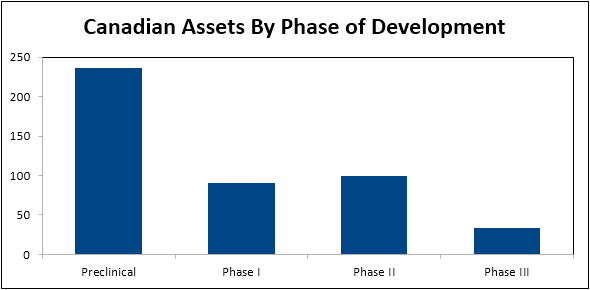
While we found life science innovation in almost every corner of Canada, the startup companies in our sample were concentrated in Ontario, Quebec and British Columbia.  These assets were spread across the full range of developmental phases, but with a noticeable skew toward early stage assets.  As assets mature through the development process, it’s possible that some are acquired by pharma companies based outside Canada before entering Phase III.

l1

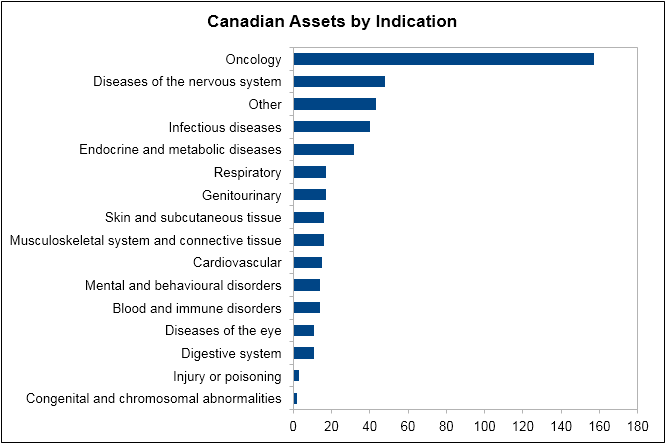
In terms of indication areas, oncology is by far the largest field.  Canada also has significant pipelines in CNS disorders, infectious diseases, and metabolic diseases.

l2

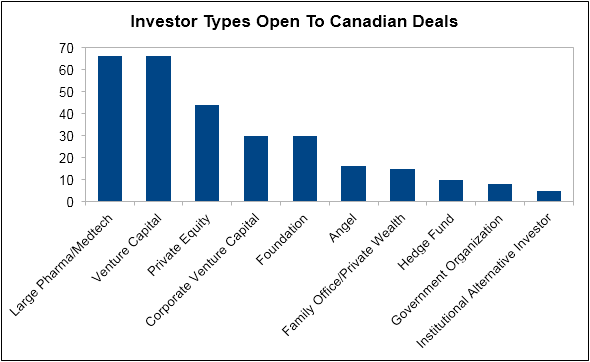
One question we often get asked at LSN is whether investors that are interested in US deals will also consider opportunities in Canada.  LSN Research specifically asks this question when we reach out to investors.  After interviewing hundreds of investors actively looking for opportunities in the US, what we’ve found is that over 50% will also look at startups in Canada.  This includes far-reaching global investors, US-based investors who are keeping an eye to the north, and also local Canadian investors who look at both Canadian and US opportunities.  (There’s also a few early stage investors who are focused on Canada alone).  Let’s take a look at the types of investors who are open to dealflow from Canada:

l3

Note that as many major pharma or medtech firms looking at Canada as there are venture capital firms; these strategic players are typically global players, interested in cutting edge technology wherever it can be found.  With RESI on MaRS, we hope to turn the eyes of this full spectrum of investors on to innnovation in Canada.

Medtech Strategics Share Their Insight

By Christine A. Wu, Research Analyst, LSN

chrsitine

On January 12, LSN gathered a panel of large medical device manufacturers at the RESI@JPM San Francisco Conference. Moderated by Greg Fleming, Investment Director of ALIAD, panelists from Becton Dickinson, Siemens Venture Capital, Abbott Ventures, and Johnson & Johnson discussed how they evaluate and engage with early stage medtech companies, their strategic approach to working with companies, and how early stage companies should approach them.

       For all medtech companies, here is your final advice:

  1. Have an understanding of what the strategic firm is looking for. Albert Lauritano (Director of Business Development, Becton Dickinson) stressed the necessity of doing your homework, while Bill Welch (Senior Director, Abbott Ventures) further advised that “you need to help make it apparent to us how you see [your product] fitting in.”
  1. Work through the accelerators and innovation centers. Lauritano and Charles Bridges (VP, J&J) emphasized that reaching out to them through their centers may be the best way to determine quickly whether the technology matches their interests. Furthermore, these accelerators may be an avenue of great support—both strategically and financially—for the entrepreneur. Often, there are cross-expertise transfers, where if you have the idea but not the manufacturing facilities, the center can provide for your needs, allowing both you and the center to benefit synergistically. “If you have a company and you want a place to target and grow it,” Bridges explained, “[the innovation center] is a great opportunity.”
  1. Summarize the differentiating key elements: the team, the IP, the business model, and the regulatory pathway. All panelists stressed the importance of covering these key components in 4-5 bullet points in your pitch deck and material. According to Fleming, these points should answer why the team is well suited to develop the product; what the business model is; what IP and IP potential you have; and the overall regulatory process. “I should very quickly find out what you do and how,” Andrew Jay (Investment Partner of Siemens Venture Capital) noted. “Make it relatively short and to the point,” Bridges added.
  1. Have a good website. “70-80% of people who are thinking about a company check out their website,” stated Jay.
  1. Keep in mind that strategics are generally not financially driven. According to Welch, rather than focusing primarily on ROIs and the timeline to reach the next round, strategics focus more on making good decisions, creating good data, and producing good engineering to come out with a robust product. “Time horizons are as long as it takes to get done,” Welch said. “We do require timeline and budgets, but we know things happen, especially when these are high-risk propositions.” While providing the strategic support, medtech strategics oftentimes work with financially-driven VCs as well. “We do want to see we’re not the only ones that believe in the company,” Fleming concluded.

To hear more from this panel, check out this RESI video recap.

Hot Investor Mandate 1: VC Invests In Healthcare IT, Data Science and Synthetic Biology to Target Inefficiencies In Healthcare

A Venture Capital firm based in California held a first close of a new fund in late 2015 of $75M, and expects to be fully closed in 2016 at $150M. The fund’s investment strategy is somewhat flexible, but seeks to initially invest in series A rounds in the range of $2M-$3M then provide capital throughout the company’s life via additional investments. The firm may write smaller checks (in the range of $250K) to companies that are of very high interest to the fund, but are deemed as too early, to serve as a placeholder for subsequent financing rounds. In terms of capital structure, the firm prefers to participate in priced equity rounds, however convertible notes or other structures may be considered in certain cases. The firm will act as a lead or follow-on investor depending on the nature/terms of the deal and other investors participating in the round.

The firm is most interested in disruptive technologies that target extreme inefficiencies in the healthcare system, such as digital health solutions based on artificial intelligence or big data platforms, as well as cutting-edge technologies and applications in the field of synthetic biology, or other technologies taking elements of data science to improve molecular processes. The firm is not interested in traditional medical devices and diagnostics, but rather devices whose core IP lies within in the backend or software component of the technology.

The firm is open to companies globally, but prefers to invest in companies based on the West Coast. Typically, companies that aren’t located in the U.S. would need to have some operations based in the United States. A lot of emphasis is placed on the strength of the management team when making an investment decision, and the firm seeks to work with entrepreneurs who have a strong understanding of their market and sound logic behind why their vision and business model will be successful. Although successful, repeat entrepreneurs are highly valued, the firm will work with entrepreneurs of all experience levels. Board seats are not required along with an investment, but may be sought depending on the deal.

If you are interested in more information about this investor and other investors tracked by LSN, please email mandates@lifesciencenation.com