A Boston Biotech Week note from Dennis Ford, Founder and CEO, Life Science Nation
By Dennis Ford, Founder & CEO, Life Science Nation (LSN)
Boston Biotech Week brings the whole industry into one city at once. Big stages, packed agendas, strategic executives, investors, and hundreds of emerging companies working the room. There is real value in all of it. But if you are an early-stage CEO trying to raise your next round, you have a narrower problem. You do not need to meet everybody. You need to meet the people who can actually fund you.
Over the last few years, I have watched the investor conversation change. The science is as strong as ever. What has changed is what happens after the science leaves the lab and somebody has to finance the long road to the clinic. Founders were taught to build a pitch deck: the unmet need, the science, the market, the team, the ask. There is nothing wrong with that formula, but it no longer answers the question an early-stage investor is actually asking: risk. What has been proven, what has not, where the company could fail, and what the next round actually retires. That is why the pitch deck is becoming something else. I call it the de-risked deck.
This matters because life science has a structural problem we do not talk about enough. We built an extraordinary discovery engine and pour billions into it, and it works. What we never built beside it, with the same discipline, is the commercialization engine. A scientist spends twenty years mastering a pathway and then is expected to run a company that demands regulatory strategy, clinical development, IP, reimbursement, capital formation, and partnering. That is a different profession, and we expect founders to learn it while keeping the company alive.
So too many companies start raising before anyone has put the asset through the full risk stack, and that gets expensive. A company can burn years and millions moving toward an IND only to find that a regulatory assumption was wrong or the IP is thinner than it looked. Problems that cost thousands to surface early cost millions once they are buried in the plan. The process should run the other way. Vet early. Find the risks while they are still cheap to address. Retire what you can, manage what you cannot, and build the financing strategy around the milestones that take those risks off the table. That is what makes a company legible to capital.
That is where RESI is different. In a week full of networking, RESI is built for one thing: the early-stage financing problem. By the time we open, roughly 400 international early-stage investors will be in the building, covering Seed up to two million, Series A up to ten million, and Series B up to fifty million. More than 200 investment firms have already registered. A founder does not come to RESI for another thousand names in a directory. They come to find the specific investors whose mandate fits their stage of development and product, and to get in front of them.
Investor Firms Exclusive to RESI Boston 2026

Two rooms make that sharper. The Global Family Office BioForum brings 40 family offices from around the world, patient private capital that is hard to reach, and this year they are taking partnering meetings alongside the forum. The Cross-Border Investor Luncheon puts international investors together with regional VCs, because a regional fund often has access to companies it cannot finance through multiple rounds, and an international fund has capital and reach but no visibility into the local ecosystem. Put them together, and you are not collecting contacts; you are building a syndicate.
None of this replaces the work. No conference makes an unprepared company fundable. The science has to stand up, the milestones have to make sense, and the CEO has to understand the risks well enough to have a conversation rather than deliver a presentation. When founders make that shift, it shows. FELIQS, one of our recent Innovator’s Pitch Challenge companies, told us RESI helped them sharpen how they communicated the clinical and commercial opportunity and opened the door to real financing discussions. The science had not changed. Their ability to make it legible to capital had.
The science is the reason a company exists. Making it financeable gives it a chance to survive.
LSN and RESI have been part of Boston Biotech Week since its inception. If you are an early-stage company looking for capital or licensing deals, RESI is the right room to be in. If you are there to shop for service providers, plenty of other rooms are built for that. RESI is built for matching partners and facilitating early-stage transactions.
Boston is our hometown, and this is where RESI shines. That is the de-risked deck, and this week, that is the conversation we want to have.
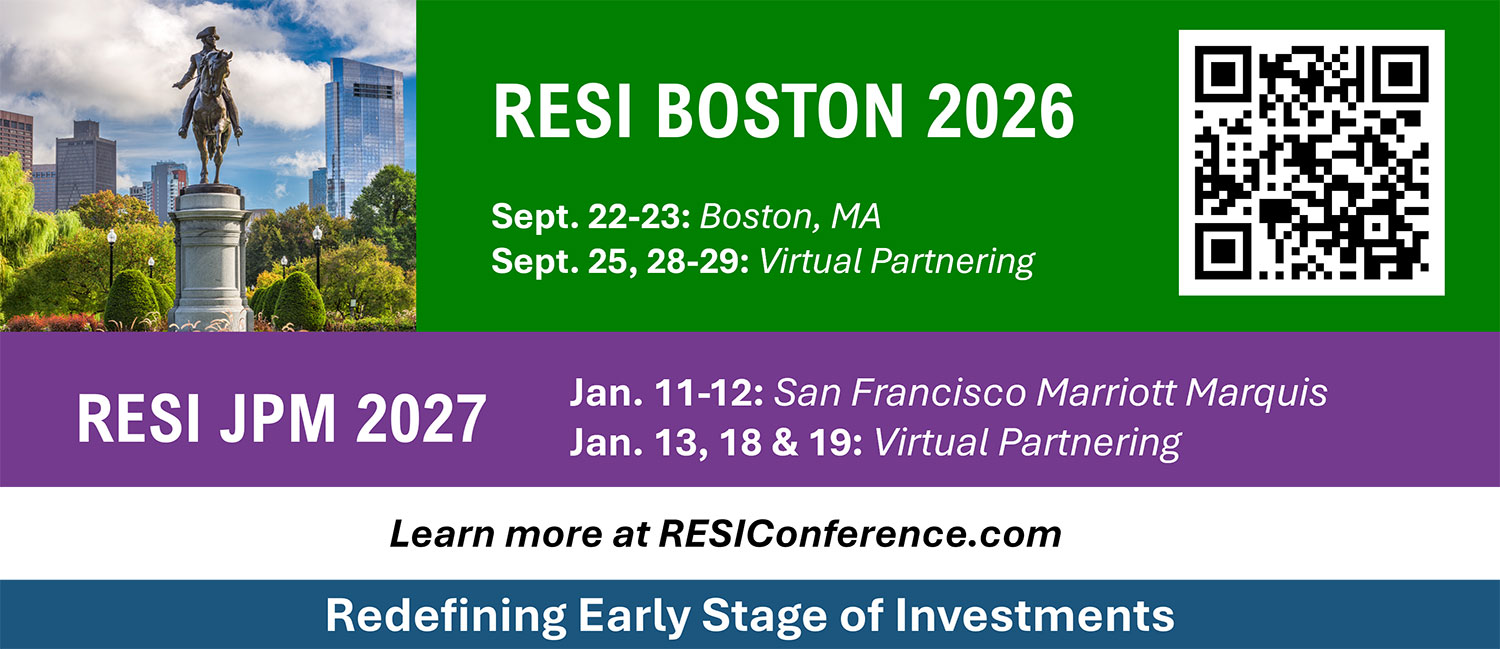
RESI Boston 2026 | September 22 to 23 | The Westin Copley Place, Boston
Virtual Partnering | September 25, 28 to 29
| Register for RESI Boston |