

Mandates Across Healthcare Silos

By Lucy Parkinson, Senior Research Manager, LSN 

lucy 10*10This week, we are featuring four additional investor mandates, focused on Therapeutics, Medical Device, Diagnostics, and Healthcare IT. LSN Research has seen investors from all across the globe looking for investment opportunities and would like to share more of a sample of the types of information that we gather.


1. Therapeutics: US Based Venture Arm of Chinese Family Office Seeking Preclinical Biologic Opportunities

A private investment group that was founded by a single family out of Hong Kong has four operations based in Shanghai, Beijing, Hong Kong and the US. The US-based venture investment arm is actively seeking new investments in the life sciences across the US, and it occasionally invests in companies in Europe. The group focuses on pre-clinical and clinical stage companies. The investment size will vary and typically it ranges from $2 million -$10 million. The group has no set number of allocations over the next 6-9 months.

In the life sciences the firm is looking for new investments primarily in the biotech therapeutics sector. The group will also look at medical devices and diagnostics opportunities, however, which are not their current focuses. For therapeutics, the group is most interested in biologics. The group invests in a variety of therapeutic areas with a focus on oncology. The group generally invests in pre-clinical stage companies without clinical data, and it also syndicates with other investors for clinical-stage investments.

The group invests in privately held life science companies. The group is generally not interested in commercial-stage companies.

If you are interested in more information about this investor and other investors tracked by LSN, please email mandates@lifesciencenation.com

2. Medical Device: Family Office Fund Seeking Early Stage Medical Devices

A family office/venture capital firm based in New York firm manages an evergreen fund that seeks to make seed, venture, and growth equity investments in early to mid-stage medical device companies, but will also consider secured debt to help revenue generating companies with short term cash flow issues. The firm will also consider pre-seed investments. The firm can allocate anywhere from $1M to $10M per company, but generally allocates around $8M. The firm typically does 3 rounds of financing with an initial investment of around $3M. The firm is geographically agnostic, but highly prefers to invest in companies that are based in the US. The firm seeks to make about 3-4 allocations in the next 6-9 months.

The firm is currently looking for medical device companies with a strong emphasis on products with a 510(k) regulatory pathway. In terms of subsectors, the firm is looking for products specifically in the areas of interventional radiology and cardiology, spine/orthopedics and minimally invasive surgery. The firm is generally opportunistic in terms of indication.

The firm is looking to invest in companies with a management team with a track record of success in the healthcare industry. However, the firm is generally flexible and does not require a full management team. The firm can assemble the management team over the course of the investment.

If you are interested in more information about this investor and other investors tracked by LSN, please email mandates@lifesciencenation.com
3. Diagnostics: Global Diagnostics Firm Looking to Make Strategic Investments

A global diagnostics companies is looking to form partnerships and make investments in emerging life science companies. The firm is highly flexible about the structure of its investments, and primarily invests in North America and Europe. The firm looks to act as a long-term, highly activist investor.

The firm primarily invests in the diagnostic imaging sector, including imaging devices and agents, CT and MR technologies, and angiography. The firm prefers to invest in companies at or near the market approval stage but is open to considering investments in earlier-stage companies. In addition to imaging technologies, the firm is also interested in cardiology devices, and other interventional devices including delivery devices.

The firm does not provide passive financing; the firm only invests in companies developing products that the firm would eventually market and sell.

If you are interested in more information about this investor and other investors tracked by LSN, please email mandates@lifesciencenation.com

4. Healthcare IT: VC Arm of Large Conglomerate Seeking HIT and Software Enabled Device Opportunities

The venture and expansion capital arm of a large conglomerate has approximately $270 million in total assets under management. In 2014 the firm closed a fourth venture capital fund at $185 million. The firm is current seeking new opportunities in the life science space. The firm’s initial equity investment range from $3-7 million, but are typically $12-$15 million total through subsequent rounds. The firm will only consider investment into US based firms.

The firm is most interested in the medtech, diagnostics, and information providers spaces. The firm is specifically looking for healthcare IT firms within the information providers space. Medical Devices with a significant software component are also of high interest. The firm is very opportunistic within the areas of diagnostics and medtech, and with that being said the firm would be willing to look at firms that fall within the full gamut of medtech and diagnostics subsectors.

The firm is most interested in early to growth stage companies generally investing in series A and B rounds. For HCIT businesses, the firm typically looks for companies with $3 million or more of revenue. For med tech the firm generally invests in businesses post design freeze and typically does not take product development risk.

If you are interested in more information about this investor and other investors tracked by LSN, please email mandates@lifesciencenation.com

Hot Life Science Investor Mandate 1: Family Office Seeking Digital Health and Novel Therapeutic Opportunities

A private investment firm funded by a single LP based in the Western United States invests in seed and early-stage health technology companies. The typical investment size for seed investment ranges from $250K to $1M (usually in equity or convertible notes). For early-stage companies, the firm typically co-invests with other VC firms in Series A and B financing and the investment size will depend on the company’s financial needs. The firm is geographically agnostic but prefers start-ups to be based on the West Coast. The firm is actively seeking new investment opportunities.

The firm has a focus on the digital health and informatics space, but also invests in novel therapeutics. Generally, the firm focuses on opportunities that avoid or mitigate FDA regulatory risks. The firm is agnostic in terms of subsectors and indications, but does not consider orphan indications. The firm will only consider technologies with proof of concept. Historically, the firm has invested in therapeutics that address oncology, infectious diseases, cardiovascular, and metabolic disorders; drug delivery; orthopedic devices; genomics.

The firm prefers to take a board seat but is generally flexible.

If you are interested in more information about this investor and other investors tracked by LSN, please email mandates@lifesciencenation.com

Hot Life Science Investor Mandate 2: Single Family Office Seeking Global Opportunities in Brain Health

A single family office based in the Western United States makes seed-stage and venture-stage equity investments; typical seed investments are of $250,000-500,000 initially with the potential for follow-on financing of up to $3 million. The firm is open to opportunities worldwide, and currently has portfolio companies in North America, Europe and Oceania.

The firm’s portfolio comprises ~30% of the total fund commitments, and is divided into two core categories. The first area of focus is Alzheimer’s Disease, where therapeutics (primary), diagnostics (secondary) and other solutions (tertiary) are all valid for consideration. The second area of investment is in technologies that enhance, accelerate, or reduce the cost of clinical trials and basic research, on the broadest scale, beyond Alzheimer’s Disease. This may include hardware and software tools, data analytics or aggregators, or novel approaches to current standards and protocols.

The firm seeks to make early-stage investments, but will also consider later-stage opportunities. The firm’s prior investments include drug discovery for the treatment of Alzheimer’s Disease, a diagnostic to track and recruit patients in early cognitive decline, a SaaS platform for clinical trial start-up workflow management, an automated imaging tool for micro-dissection of tissue samples, and a platform looking to reinvent the model for pre-human drug testing and development. The fund also has a global partnership to develop intellectual property into potential compound candidates to treat Alzheimer’s Disease.

The firm strongly prefers to invest in privately held companies and will only back top scientists with defendable research, pursuing breakthrough approaches; the fund does not invest in “me-too” ideas. In their Alzheimer’s portfolio, the fund looks to identify early-stage therapies that have received, and exhausted, non-dilutive sources of funding, such as grants from leading organizations; these companies will ideally be on the radar of large pharma counterparts but looking to obtain additional funds to collect the data required to form pharmaceutical partnerships. In the medical technology sector, the firm prefers to invest in companies developing platform technologies that can demonstrate and defend a clear value proposition addressing the ability to make clinical trials more efficient.

If you are interested in more information about this investor and other investors tracked by LSN, please email mandates@lifesciencenation.com

Hot Life Science Investor Mandate 3: Taiwan-Based VC Seeking Early Stage Medical Device Investments Globally

A venture capital firm based in Taipei, Taiwan solely invests in early stage medical technology ventures. The firm currently manages a Medtech Fund which was raised in 2012 and closed at USD 100 million. The firm focuses on Series A and B rounds and looks to allocate USD 500K to 3 million per round with reserved follow-on investments. The firm will target companies in Taiwan, Israel, and the US. The firm is actively seeking new investments.

The firm looks to invest in innovative medical devices. The firm seeks breakthrough products that are clearly differentiated and superior to existing products. The firm is opportunistic in terms of subsectors and will consider devices in Class I, II, and III. The firm is indication agnostic but only seeks large market opportunities of at least $500 million in targeted annual revenue.

The firm seeks a strong and experienced management team and typically seeks board representation post-investment.

If you are interested in more information about this investor and other investors tracked by LSN, please email mandates@lifesciencenation.com

Hot Life Science Investor Mandate 4: Ireland-Based VC Seeking Therapeutic, Diagnostic and Device Investment Opportunities

A venture capital firm based in Dublin, Ireland has approximately €100M AUM and focuses solely on the life sciences. The firm has 2 funds and plans to raise a third fund in the near future. The firm typically allocates between €5-7M of equity over the life of the investment. The firm primarily invests in companies that are based in Ireland and Europe. Exceptional opportunities in North America will also be considered. The firm is actively seeking new investment opportunities.

The firm invests in biotech therapeutic and diagnostic and medical device companies. For biotech, the firm prefers to invest in companies with first/best-in-class products in or nearing phase I, but will also consider phase II and outstanding companies in pre-clinical. For medical devices, the firm prefers companies with advanced prototype products or with initial clinical of concept completed. The firm is agnostic in terms of subsectors and indications, including orphan indications, but is very interested in products that address clear unmet opportunities. Historically, the firm invested in biotech therapeutics that addresses inflammatory, oncology, respiratory, autoimmune, and cardiovascular disorders. Medical devices: therapeutic for cardiovascular diseases, non-active implantable device for pulmonary embolism, renal and vascular diseases.

The firm requests a board seat in each portfolio company. The firm seeks a company with a strong and experienced management team or technical experts in the relevant technology.

If you are interested in more information about this investor and other investors tracked by LSN, please email mandates@lifesciencenation.com

An LSN Summer Chapter Series

By Scott Parks, Director of Marketing, LSN 

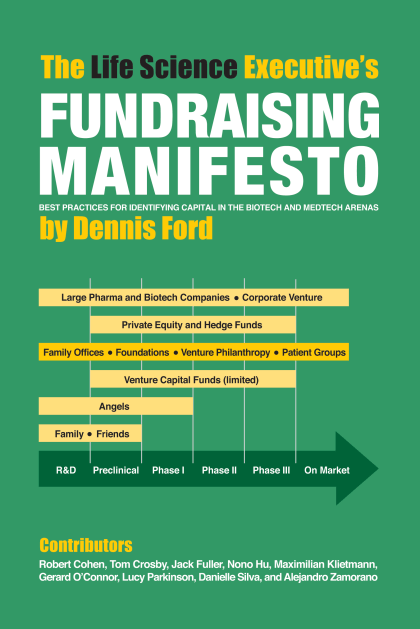
Scott 2Your fundraising efforts certainly won’t slow down this summer, nor will the team at Life Science Nation. We’re always on the clock, committed to providing early stage life science companies and investors with the critical data necessary to create compelling connections between technology and funding. In this spirit, LSN’s Next Phase will be publishing one chapter each week of our hit book from last summer, The Life Science Executive’s Fundraising Manifesto by Dennis Ford.Bookcover-Front

The Life Science Executive’s Fundraising Manifesto helps scientists understand the fundamental skills needed to brand and market their companies. It discusses how to use a consistent message to achieve compelling results from a fundraising campaign and how to aggregate a list of potential global investors that are a fit for your company’s products and services. The book also explains how to efficiently and effectively reach out to potential investor targets, start a dialogue that fosters a relationship, and ultimately secure capital allocations.

The LSN Summer Reading series begins with “The Legal Landscape: A Basic Overview.” Contributed by Gerard P O’Connor, Esq, this first chapter provides a whistle-stop tour of all the legal issues a fundraising CEO needs to consider when raising capital.

Click here to download/print the PDF.

O’Connor introduces the regulatory bodies a fundraising CEO will encounter, defines accredited investors, and presents some of the alternative options to pursuing venture capital funds. The chapter also informs entrepreneurs regarding key concepts in dealmaking, including dilution, terms, and working with brokers.

We hope you find this exploration of the legal considerations involved in fundraising to be informative. Join us next week for Chapter 2 — “Crowdfunding and IPOs.”

Enjoyed the preview? Buy now from Amazon.com or Barnes & Noble

Understanding a Pharmaceutical Company’s Internal Review Process

By Michael Quigley, Director of Research, LSN

mike-2

In order to provide our readers with a glimpse into the big pharma internal review process for collaborations and in-licensing, I recently sat down with an ex-sourcing executive from such a group. He stated that the process generally takes from 6 to 9 months from the initial contact, but can last longer as the company goes through a series of both internal meetings as well as meetings with the external innovators. The primary sources for innovation include both partnering and scientific conferences, (particularly for early stage technologies) as well as investors and bankers (particularly for later stage technologies that have already garnered some clinical data). It is generally members of both the scientific or technical review and business development teams who attend these events, speak directly with external partners, and are responsible for identifying these new opportunities.

Once an initial contact is made, if there is interest on the pharma company’s end, they will ask to review the pitch deck and executive summary, which should provide a clear description of the technology. This process of review is led by the business development team, and they manage the technical team that actually reviews the scientific merit of the innovation. Also during this time, there often is another scientific management team that is reviewing the strategic value that the innovation holds, given the pharma company’s current pipeline and strategy. Late stage assets generally get into this process sooner and involve a bigger team on behalf of the pharma company than preclinical opportunities, but that timeline can also be a function of the pharma’s interest in the technology.

If sufficient interest is garnered at this stage, the review will also include legal teams looking into the IP of the technology, regulatory teams evaluating clinical challenges and advantages, as well as a commercial viability team looking into commercial market factors. A solid pitch deck should provide information relevant to all of these teams who might be a part of this process. From here the pharma company will schedule a call (generally led by the business development team along with a technical scientist or others) to plug any holes that the pitch deck may have. If all goes well in this call, a face-to-face meeting will be arranged as a next step. These often take place at conferences where both parties are in attendance or mutually agreed-upon locations.

This face-to-face meeting will serve to answer any additional questions either party may have, as well as to give the big pharma company a stronger feel for the management team, especially in cases when a collaboration is being considered. At this point, at least several weeks from the initial contact, the pharma company may look to set up a data room and, if necessary, sign a CDA for the opportunity. By having a data room already set up with the relevant materials, you can help to expedite this process. Due to the number of opportunities that a pharma group may review in a given year, they often are not willing to sign a CDA until they have achieved this level of interest, to avoid excessive legal liability.

From here the internal review team will pull together a formal report on the opportunity to present to upper management, who will ultimately be making the final decision. The drafting and review of this report can be laborious, further lengthening the time required to finalize a deal. Often, in reviewing the strategic relevance of the opportunity, upper management will ask their internal review team to gather more information from the company, adding more weeks to the process. Once upper management has given the green light, lawyers from both sides will begin drafting the contract, a document that can be hundreds of pages in length and can take weeks or months to finalize.

If there is one key takeaway from this piece, it should be that the time this process requires is lengthy, so patience is necessary. This also speaks to the importance of entrepreneurs starting dialogues with potential investors early. As there is a very real possibility that, even toward the last phases of the process, the deal will fall through, it is an astute business practice to engage with multiple potential pharma partners simultaneously.

The more you can understand the internal process a pharma company maintains to review technologies, the better your chances of success. I hope this article was able to provide you with some new insights into that process, and I wish you the best of luck in your endeavor!