By Nono Hu, Senior Manager, Branding & Messaging, LSN
LSN is pleased to announce its inaugural RESI @ TMCx Conference on June 8th, in Houston at the Texas Medical Center, the leader in collaborative medicine.
LSN is bringing more than 300 emerging life science entrepreneurs together with nearly 120 early stage investors from around the world for a full day of panels, workshops and partnering.
Through an expansive series of investor panels, RESI @ TMCx will present current topics covering investment mandates and procedures for identifying and qualifying candidates. Additionally, RESI’s workshops will provide more in-depth advice on every aspect of the fundraising process. The RESI Partnering Forum will allow fundraising executives to identify and book up to 16 meetings with life science investors who fit their company’s technology sector and stage of development.
An evergreen life science venture fund located in Europe was established in 2009 and wholly owned by a strategic foundation. The fund’s evergreen structure allows flexibility in the investment approach and the possibility, when appropriate, to take a long-term perspective in the investments. The fund has an annual investment capacity of approximately €50m. Investments are typically above €10-35m, and the firm prefers to take above 10% ownership. The fund is looking to invest primarily in Europe and in the USA/Canada.
The fund invests exclusively in life sciences, focusing on pharmaceuticals and medtech. For therapeutics, the firm typically prefers to invest at phase I/II but has also made investments at earlier phases of development. The fund will consider investing in medtech companies at the commercialization stage. The firm is open to opportunities in all therapeutic areas and indications.
The fund is oriented towards opportunities in the US and Europe and will take the role of lead investor in Europe. In US/Canada the firm prefers to syndicate with well-established VC investors specialized in life sciences. The fund expects to be actively in communication with management and represented on the supervisory board of portfolio companies.
If you are interested in more information about this investor and other investors tracked by LSN, please email mandates@lifesciencenation.com
A private equity firm founded in 2001 and headquartered in San Francisco California recently closed its 3rd fund at $310 million. The firm makes growth equity investments ranging from approximately $15 to $40 million over the investment’s lifetime. The firm primarily invests within the United States but is open to consider international investment as well.
The firm is currently looking for commercial stage companies in areas of medical technology and devices, life science instruments and tools, healthcare IT, healthcare services, agriculture and animal health. The firm is agnostic in terms of therapeutic indication.
The firm only invests in companies with commercial revenue. The firm supports organic growth strategies, which allow for gross profit growth and investment in product pipelines and commercial expansion. The firm looks to take a seat on the company board and prefers to be the lead or sole institutional investor.
If you are interested in more information about this investor and other investors tracked by LSN, please email mandates@lifesciencenation.com
The corporate venture fund of a multinational healthcare company has allocated CHF 500 million to invest in and develop commercially successful innovative life science companies. The fund is an evergreen fund and makes equity investment in early-stage biotech therapeutic and diagnostic companies. The fund prefers Series A. The typical initial investment size ranges from CHF 1-5M with capital reserved for follow-on financing. The fund invests in companies that are based in Europe, North America, and the Pacific Region. The fund is actively seeking new investment opportunities.
The Fund is looking to invest in companies with innovative new technologies, medicines or diagnostics, particularly in the areas of interest to the fund’s parent company. This includes: Oncology, Central Nervous System, Inflammation, Anti-Infectives, Virology, in-Vitro Diagnostics, Diabetes Care, and Molecular Diagnostics. For therapeutic biotech, the fund is willing to invest in companies that are still 18-24 months away from the clinic. The fund highly prefers companies with both a discovery engine and a product pipeline.
The Fund invests in private and public companies. The fund only invests in public companies as part of a collaboration entered into by the parent company’s pharma or diagnostics division. The fund requests board seats and typically prefers to be in an ownership range of 15% or more. In general, the fund prefers to co-invest with leading venture funds as well as other corporate venture funds.
If you are interested in more information about this investor and other investors tracked by LSN, please email mandates@lifesciencenation.com
A venture capital firm with offices throughout Europe, The US and the Middle East has approximately €540M AUM and is currently managing five active funds. The firm’s fifth fund had its first close at €92M in October 2014, with the aim to raise €150-200M. The firm makes equity investment in life sciences and biomedical technology companies at all stages of development. However, the firm prefers late stage preclinical or early stage clinical for therapeutics and diagnostics and medical devices that are close to market approval. The typical investment per round is €3M to €7M. The firm looks for companies that are based in the US, Canada, Israel, and Europe. The firm is actively screening new investment opportunities.
The firm is generally opportunistic in the life sciences space. The firm targets therapeutics and diagnostics, medical devices, and biopharmaceuticals. In therapeutics, the firm focuses on drug development and is open to all indications including orphan indications. In medical devices, the firm has a special focus on interventional devices in cardiology, gastroenterology and pulmonology that are close to or on the market approval. However, the firm is equally opportunistic in other subsectors and indications for medical devices, but all with a therapeutic focus.
The firm invests in companies at all stages of their development. For drug development, the firm invests from late preclinical to mid-stage clinical development. The firm sometimes considers companies with products on the market. The firm seeks a company with a strong and experienced management team or technical experts in the relevant technology.
If you are interested in more information about this investor and other investors tracked by LSN, please email mandates@lifesciencenation.com
As a fundraising entrepreneur, you will likely find yourself engaging in initial face-to-face meetings with investors, whether at a conference, coffee shop, or in an office. Given the time constraints inherent in these kinds of meetings, it is crucial that you have a plan in place in order to get as much as possible out of them. What follows are suggestions for how best to manage one of these conversations.
In terms of what to bring for materials, a simple, cogent pitch deck made up of 10–12 slides can be a fantastic tool. However, before you even begin to present the first slides, you need to validate a fit between the investor and your company. This should be done in two steps:
Deliver a three- to five-sentence elevator pitch that addresses who you are, the space you are working in, and what differentiates you from your competitors.
Ask the investor to return the favor, so you can gain an understanding of their firm and what they are looking for in potential investments.
With this information both of you will be able to determine whether further dialogue would be of value within the first few minutes of the meeting. Additionally, you will be able to determine what specifically the investor might find interesting about your opportunity, which you can then emphasize later in your conversation.
Once you have both introduced yourselves and your goals (and hopefully identified fit), you can begin to walk the investor through your pitch deck. Particularly in this time-pressed type of scenario, you should keep the slides very simple. View them as a visual prompt for spontaneous conversation, rather than a script to read word for word. Remember that you can always send the investor more information via email, and that if they are interested, they will likely be asking for additional materials.
However, the slides should definitely address:
The market need for your product
The technology you are developing, and its origin and differentiating factors (provide a clear description)
Your strongest supporting data
The management team
Current partnerships
The status of IP
Financials, including historic spending, current needs, and future use of funds
Exit environment/strategy
Do not simply rattle off all of these details as the investor stares and nods. It is crucial for you to foster a dialogue to ensure that the investor is able to follow what you are saying and grasp your value proposition. By allowing for back-and-forth communication, you can identify and address any potential objections. Hopefully, if the investor is genuinely interested, they will ask you questions that will help direct the conversation. You should be comfortable enough with your slides that you can jump from one to another as the dialogue branches out.
After you have gone through the basic introductions and elaborated on your opportunity using your pitch deck, you should directly gauge the investor’s interest. The best way to do this is to be up front and ask whether your opportunity is something they would be interested in pursuing further. If the answer is yes, ask about the investor’s process and timeline for moving forward. Determine a firm follow-up date and whether there are any additional materials they would like to receive. If the answer is no, try to understand why. Is it too early in the development process? Perhaps they would be worth contacting later down the line. Aggregating a list of negative and positive responses can help you better understand your company’s inherent strengths and weaknesses and plan for the future.
Ideally you should close the meeting with a reminder of your main differentiating factor: that which makes your opportunity stand out from those of your competitors. Repeating your core value proposition at the end of the dialogue helps to solidify that message with the investor, so that when they think back on the conversation, it is what they will remember. Successfully navigating investor meetings, especially when they are brief or occur spontaneously, may take practice, but if you stay the course and follow these tips, you can become nimble and flexible, and have a higher chance of developing meaningful relationships.
By Shaoyu Chang, MD, MPH, Senior Research Analyst, LSN
The immuno-oncology field is seeing high-profile deals and increasing media attention. We have therefore used the LSN company database to analyze a sample of biotech companies working in this field. Cancer immunotherapies harness the power of the immune system to target malignant cells. Unlike traditional approaches to cancer such as radiotherapy and chemotherapy, these emerging technologies hold the promise of precise therapeutic effects while leaving the rest of the body unharmed. These products’ clinical benefits are impressive, and so is their financial performance. In 2014 alone, cancer immunotherapy drugs have generated about $41.0 billion in the United States, accounting for nearly 50% of the overall oncology drug market (1).
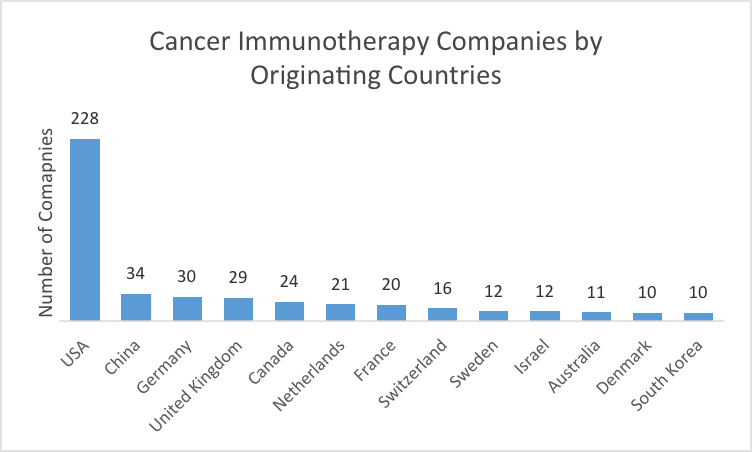
With more than 30,000 company profiles, LSN’s company platform provides a bird’s eye view of the global early stage biotech and medtech R&D landscape. Our search in the LSN company platform yielded 522 unique companies that are currently developing at least one cancer immunotherapy product. About one-fifth (119) of them are publicly listed, while the rest are private or subsidiary companies. Cancer immunotherapy R&D has become a global phenomenon with the United States as the leader in terms of number of companies, followed by China, Germany, the United Kingdom, and Canada, as shown in Figure 1.
Figure 1, Source: LSN Company Database | Data as of May 20, 2015
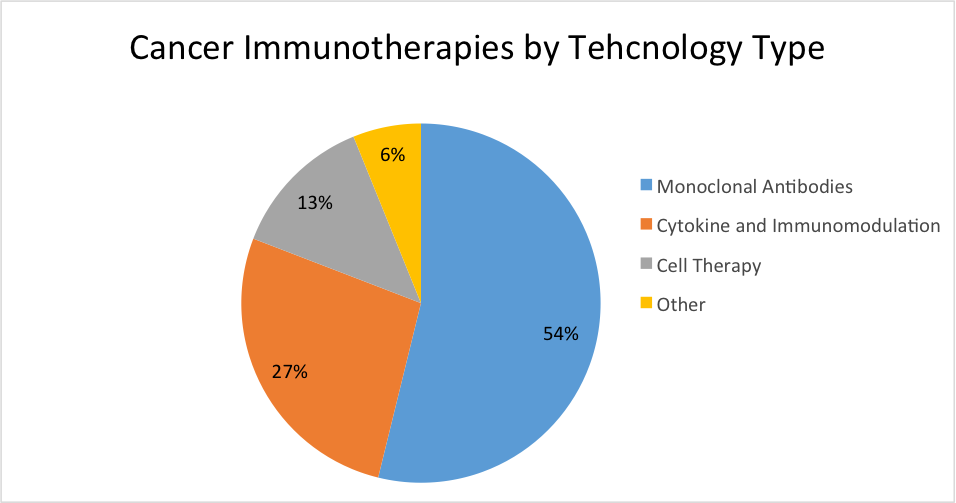
There are three major categories of cancer immunotherapies: cytokines and immunomodulation agents; monoclonal antibodies; and cell-based therapies. We further analyzed our sample of the 522 companies, and the breakdown of their technologies is shown in Figure 2.
Figure 2, Source: LSN Company Database | Data as of May 20, 2015
The original pioneers in cancer immunotherapy utilized cytokines such as interleukins and interferons to stimulate immune response against cancer. This is a broad-stroke approach that causes a response that’s often non-specific and therefore frequently leads to dangerous side effects. In recent years, newer, more sophisticated immune stimulation and modulation pathways have been explored, in an attempt to limit these side effects and increase efficacy.
In terms of commercialized products, monoclonal antibodies remain the mainstay of cancer immunotherapy. These biologic drugs can act either as carrier to deliver chemotherapy drugs to targeted sites, as inducer for an immune attack on a tumor, or as inhibitor of key biological pathways in cancer cells. Many major pharmaceutical companies are actively securing a strategic position in this field(2).
Cell-based therapies have attracted the most media attention with a number of highly visible public companies. In general terms, these technologies involve collecting immune cells, such as T cells or dendritic cells, from a patient with cancer. The harvested cells are reprogrammed through genetic engineering or peptide and adjuvant stimulation. Activated immune cells are equipped with the ability to recognize and kill cancer cells and are then reintroduced to the same patient to treat the disease. This approach is highly specific and has platform potential so long as appropriate tumor antigens are available.
Many of the above technologies can be referred to as ‘therapeutic vaccines’—induction or augmentation of immune responses against existing diseases. A significant minority of cancer immunotherapy companies are developing ‘prophylactic vaccines’ that aim to prevent cancers from developing in the first place. Their R&D efforts are concentrated in specific fields such as cervical cancer (HPV), liver cancer (hepatitis viruses), and gastric cancer (H. pylori). Many other cancer immunotherapy companies are exploring various areas including adjuvant technologies, tumor antigen discovery platforms, and nucleic acid-based vaccines.
Public awareness of cancer immunotherapy has increased as it enters regular clinical practice and mainstream news channels. However, we should caution that many of these technologies are still experimental, especially cell-based therapies. It remains to be seen how these therapies will help patients on a large scale. The LSN team will keep you updated as we closely monitor trends in this field.
PRNewswire.Global & USA Cancer Immunotherapy Market Analysis to 2020 – Analysis and Forecasts for the $41 Billion Market. Apr 10, 2015.
Press Release. Celgene Corporation Enters into Strategic Immuno-Oncology Collaboration with AstraZeneca to Develop PD-L1 Inhibitor Program for Patients with Serious Blood Cancers. MarketWatch. Apr 24, 2015.


 LSN is pleased to announce its inaugural RESI @ TMCx Conference on June 8th, in Houston at the Texas Medical Center, the leader in collaborative medicine.