When LSN began the Redefining Early Stage Investments conference series, one of our primary goals was to hear from new voices in the life science sector that were rarely heard at other events. Family Offices now represent an important source of capital in the life science field, and LSN has contacted numerous family offices that are seeking dealflow in the medical technology field. In January, RESI hosted a panel devoted to Medtech Family Offices for the first time; as this panel was hugely popular, RESI @ TMCx will once again feature a panel of speakers from the medtech family office world.
These investors will explain to the audience why they seek direct investments in medical technology, how their investment process works, and what they look for in an early-stage medtech opportunity. If you’re developing a medtech product and want to hear how family offices engage with your sector, join us at RESI @ TMCx.
The corporate venture capital arm of a global science-based company active in health, nutrition and materials is interested in strategic investment opportunities. The firm makes equity investments into seed and venture stage companies. The firm makes allocations ranging from a few hundred thousand dollars to $5 million initially with additional capital held for future financing rounds. The firm is looking to make approximately 5-10 investments over the next 6-9 months with +10 being made over the next 2 years. The firm invests in companies located around the globe with a focus on the U.S., Europe and Israel.
The firm is looking for companies in the intersection of Life and Materials Sciences. These includes companies developing devices and materials targeting indications of cardiovascular, orthopedics, ophthalmology, dental, drug delivery and next generation cellular therapy. The firm is also interested in companies in the Agbio and nutraceutical spaces. While the firm has invested in companies all the way from seed to 3-month pre-IPO, they generally invest into companies that do not yet have a product on the market.
The firm highly values experience in a firm’s management team and generally looks to take a board seeks and play an active role in its portfolio companies. The firm is looking for companies that are in cooperation/alignment with the parent business.
If you are interested in more information about this investor and other investors tracked by LSN, please email mandates@lifesciencenation.com
A family office founded by a successful medical device entrepreneur can make investments ranging from approximately $500,000 to $100 million into companies and due to its funding structure has no requirements for holding period or capital structure. The firm makes investments in the forms of equity, controlling interest, in-licensing, MBO/LBO, growth capital and is also willing to co-invest. The firm is looking for companies located around the globe and makes around 5-15 investments in a given year.
The firm is looking for companies in sectors of Biotech Therapeutics and Diagnostics, Medtech, Heathcare IT, R&D Services, and other areas of biotech such as industrial biotech and agbio. The firm is willing to consider all indications including orphan diseases, though they have some additional interest/experience is areas of Women’s Health, GI, Oncology, Cardiovascular, and Personalized Medicine including Proteomics and Genomics. The firm is most interested in companies that are in Phase II or later, nearing commercialization where the firm is capable of utilizing its operating company to scale up the company’s sales, marketing and distribution. That being said the firm has made earlier stage investments in the past and is open to considering highly innovative and compelling early stage companies. The firm is also interested in companies developing consumables/reagents, service providers, food and nutraceuticals.
The firm looks to work with management teams with experience and grit and generally looks to take a board seat although it is not a requirement. The firm looks to leverage the use of its operating company to assist the company’s sales marketing and distribution efforts as well as providing assistance in operations management.
If you are interested in more information about this investor and other investors tracked by LSN, please email mandates@lifesciencenation.com
The corporate venture capital arm of a large tech company is currently seeking to invest the in intersection of software and biology. The fund invests in companies at a variety of developmental stages and investments therefore vary widely, but typically range from $1-10m of equity. The firm is looking for opportunities globally.
Within the medical technology sector, the firm is interested in the intersection between communication and health, and particularly in technologies that improve delivery of patient care and make care more cost-effective. Areas of focus include traditional healthcare IT (particularly data and communications in a hospital setting), personalized medicine, mobile health technology (including connected medical devices, consumer apps, and patient monitoring technologies that can be used both inside and outside hospitals), and genomic platforms that provide actionable information for patient care (technologies used purely for gene sequencing are not of interest). While it is not an area of primary focus, connected lab equipment may also be of interest.
The firm invests only in privately-held companies. The firm backs innovative, creative entrepreneurs with expertise in their fields, and who are developing solutions that will have an impact on the health marketplace.
If you are interested in more information about this investor and other investors tracked by LSN, please email mandates@lifesciencenation.com
A life sciences venture capital firm based in Canada with an additional office in the US is currently investing from two new funds totaling approximately $165 million of new capital under management. The firm typically makes initial investments ranging from $1-$5 million of equity and looks to invest $8-$12 million over the lifetime of the investment. The firm plans to make 4-6 investments over the next 12 months and evaluates opportunities throughout the US and Canada.
The firm is currently looking for companies developing Therapeutics, Medical Devices, and Healthcare IT. The firm has a special interest in immunology, inflammation, cell therapy, vaccines and protein based therapies, although the firm will also consider other small molecule and biologics therapies in other areas. The firm is looking for companies with assets in phase I and II of clinical trials that have at least some human proof of concept with either early human efficacy signs or very strong animal data coupled with human safety data. In the medical devices space the firm is opportunistic in term of device type but also requires some in-human data to be evaluated for investment. In the past the firm has invested in devices for cardiology, obesity, medical imaging, and others. In the healthcare IT space the firm is most interested in subsectors of mobile health, patient monitoring and consumer based technologies, particularly in products that help make healthcare systems more efficient.
The firm is looking to invest in companies that are pre-revenue located throughout the United States and Canada. The firm does not look to take an active role on the management team but does look to take a board seat.
If you are interested in more information about this investor and other investors tracked by LSN, please email mandates@lifesciencenation.com
By Shaoyu Chang, MD, MPH, Senior Research Analyst, LSN
Mimi Liu, Research Analyst, LSN
As the world’s second largest pharmaceutical market with an estimated annual growth rate of 10%–13% through 2018[1], China continues to attract growth-seeking life science companies and investors from across the globe. What are the opportunities and challenges in entering in this market? This article provides an in-depth view by dissecting information gleaned from LSN’s company platform and the interviews we have conducted with investors based in Greater China.
The growth of China’s pharmaceutical market is driven by a large and aging population, increased access to healthcare, and nationwide policy reform. Over the past five years, the generic drug market has been growing steadily, while branded drugs have gained greater protection, due to the improvement of regulations and laws by the China Food and Drug Administration. Market demand has shifted from antibiotics to specialized drugs, with many therapeutics companies starting to focus on oncology, cardiovascular conditions, blood diseases, and supplements.[2]
We examined a sample of 553 innovative companies located in Mainland China, Taiwan, and Hong Kong that are developing biopharmaceutical assets from the preclinical through phase 2 trial phases (see Figure 1). Neoplasm and “lifestyle diseases,” including metabolic and cardiovascular diseases, have attracted the most number of biopharmaceutical innovators. These therapeutic indications are of high demand domestically with the potential of expansion into overseas markets. A significant number of innovative companies are working on infectious diseases that are endemic to the region, such as hepatitis, tuberculosis, and HIV. However, there seem to be fewer innovations in diseases of the nervous, digestive, and respiratory systems, despite their high health burden.
Figure 1 | Source: LSN Company Platform, Data as of April 15, 2015
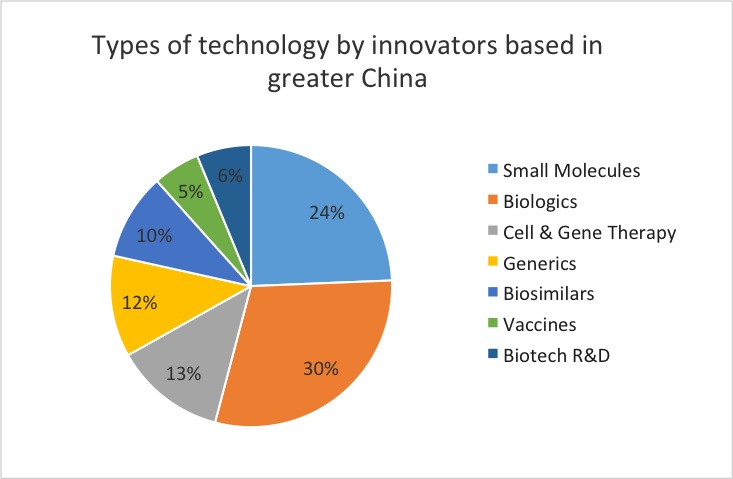
The development of China’s biotechnology sector is fueled by R&D centers set up by big pharmaceutical companies as well as the recruitment of Chinese expatriate talents, or “Haigui.” State-backed bioclusters are emerging in Beijing, Shanghai, Jiangsu, Shenzhen, Hong Kong, and Taiwan. Over half of the innovators in the region are developing therapeutics, including small molecules, antibodies, proteins, peptides, and nucleic acid drugs, as shown in Figure 2. There is also a significant interest in generics and biosimilars that addresses the strong demand for high-quality, low-cost products for the vast population.
Figure 2 | Source: LSN Company Platform, Data as of April 15, 2015
Medical device sales in China reached US$32 billion in 2013, making the country the second-largest market in the world[3]. Domestic manufacturers traditionally dominate the hospital equipment market, including medical carts, operation room and ICU equipment, and autoclave sterilizers. Devices for surgical, orthopedic, and dental use are also an arena saturated with locally based companies. According to BMI Espicom, China still has a high demand for imports, especially in the diagnostic imaging sector[4]. With the rise of cross-border partnership with international device manufacturers such as Johnson & Johnson, original equipment manufacturing (OEM) and original design manufacturing (ODM) have become important business units for medical technology companies in the region.
“Medical technology has been part of China’s national development strategy with increasing importance,” said Dr. Fan Yubo, president of the Chinese Society of Biomedical Engineering, at a recent medical device industry summit. “China’s upcoming 13th Five-Year Plan will focus on digitalized diagnostics, tissue repair and regenerative materials, molecular diagnostic tools and reagents, artificial organs and life support equipment, and health monitoring devices.”[5]
Let us take a look at the life science investment landscape in the region. To date, the LSN research team has spoken to over 50 life science investors who are based in Mainland China, Hong Kong, and Taiwan. While large pharmaceutical companies and venture capital funds are traditionally major players in this field, we have seen a growing trend of private equity funds, state-backed funds, and family offices showing an interest in life science investments, as shown in Figure 3.
Figure 3 | Source: LSN Investor Platform, Data as of April 15, 2015
We found that the investors who exclusively focus on China or Asia are typically interested in companies in clinical phase 2 or later of their development pipeline. On the other hand, about two-thirds of Greater China-based investors would like to look at new opportunities across the globe, with a specific focus on North America and Western Europe. These investors are generally stage agnostic, and many have a mandate to introduce cutting-edge technology back to the Chinese market.
During our conversations with those investors, the majority showed high interest in diabetes, cardiovascular, cancer, respiratory, digestive system, and nutrition fields, which are of great significance to the region. For example, China bears the highest burden of diabetics in the world, with an estimated 100 million people living with the disease[6]. One in five adults in China suffers from cardiovascular disease, which accounts for 40% of all deaths[7]. Moreover, the incidence of lung cancer in China has grown exponentially since the 1970s, due to smoking and air pollution. The disease is now the number-one cancer killer in the country, with over 487,000 new victims in 2010[8].
China represents immense opportunities for development of novel therapeutics and medical devices due to factors such as rapid market growth, the concentration of an educated workforce, and improving intellectual property protection and regulatory environment. In the medtech sector, state-led initiatives have identified high-end digitalized diagnostics, imaging devices, molecular diagnostic tools, and health monitoring devices as key strategic fields of development. Disease areas of the nervous, digestive, and respiratory systems present with high disease burden and relatively fewer innovations. Innovative biotech and medtech entrepreneurs should be able to find plenty of potential investors, as well as cross-border cooperation in R&D and manufacturing.
[5] Chinese Society of Biomedical Engineering. “Fan Yubo: Initial View on the Medical Device Strategies in the Thirteenth Five-Year Plan”. Chinese Society of Biomedical Engineering Website. 2015. Accessed from http://www.csbme.org/csbme/ch/showNewsDetail.asp?nsId=231
[6] Veronica Hackethal. “Diabetes Is a Major Public-Health Crisis in China”. Medscape. 2014.
Last week we used the LSN Company Database, which covers over 30,000 life science companies across the globe, to see what kinds of emerging therapeutics assets were being developed in European countries. This week we again utilized the database, this time to take a look at the emerging medical devices coming out of Europe, and we were able to identify over 400 products in development (see Figure 1). These devices all have yet to reach market approval and, as such, can likely indicate where the most innovation is currently taking place.
Figure 1 | Source: LSN Company Platform, Data as of April 15, 2015
In analyzing the data for the companies that we track, we found that reusable instruments, active implantable devices, and electromechanical medical devices are the most prevalent subsectors of in-development medical devices in Europe. By looking at the same cross section of medical devices in the U.S., we can observe how the innovation landscape compares across the pond (see Figure 2).
Figure 2 | Source: LSN Company Platform, Data as of April 15, 2015
In the U.S., active implantable devices are the definitive leader by number of products in development; however, the rest of the landscape looks fairly similar to that of Europe. This similarity might indicate a global trend in terms of where the most innovation is occurring in the medical device space. In the coming years, it will be very interesting to see how these charts correlate with the types of medical devices that reach market approval in both of these geographies.
It is also worth noting where in Europe these new devices are being developed (see Figure 3).
Figure 3 | Source: LSN Company Platform, Data as of April 15, 2015
Just as it led in our European-based therapeutics report last week, the United Kingdom is home to the largest number of in-development devices, although in the medical device space, it appears that there is a more even distribution of early stage technology across Europe than there is in the therapeutics sector. This is likely because the medical device sector is more nimble than therapeutics, which requires more capital, infrastructure, and existing expertise to support development of products. Medical device innovation is not limited to “innovation hubs” where all innovation follows the existing resources. While many local governments in Europe and around the world are pushing to develop themselves into one of these hubs, it takes a significant amount of time and resources to be able to attract and support innovation.
Finally, we can see the types of investors who are interested in early stage medical device development in this part of the world (see Figure 4).
Figure 4 | Source: LSN Investor Platform, Data as of April 15, 2015
Just as with our previous dissections of investor types, we notice a breadth of different investor classes with interest in this stage, sector, and geography. Venture capital again represents the most significant investor category; however, it is only just over one-third of the total capital pool. This is why it is vital to cast a wide net when fundraising. It not only will increase your odds of getting the capital you need, but also will allow you to hear valuable feedback from various viewpoints regarding your opportunity, ultimately helping you find the most strategically valuable investment partners.


 When LSN began the Redefining Early Stage Investments conference series, one of our primary goals was to hear from new voices in the life science sector that were rarely heard at other events. Family Offices now represent an important source of capital in the life science field, and LSN has contacted numerous family offices that are seeking dealflow in the medical technology field. In January, RESI hosted a panel devoted to Medtech Family Offices for the first time; as this panel was hugely popular, RESI @ TMCx will once again feature a panel of speakers from the medtech family office world.