

February Mandate Roundup: 79 Investors from 13 Countries

By Lucy Parkinson, Senior Research Manager, LSN

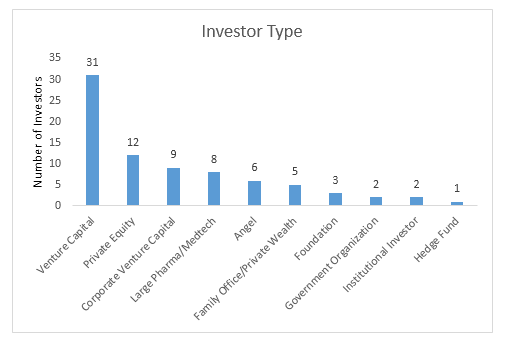
lucy 10*10This February, LSN’s research staff in Boston has seen not only a lot of snowfall, but also a lot of mandates. We spoke with a total of 79 investors during this short, snowy month. As Figure 1 demonstrates, we had conversations with every type of life science investor that LSN tracks:
 

01
Figure 1 | Source: LSN Investor Platform, Data as of February 28, 2015

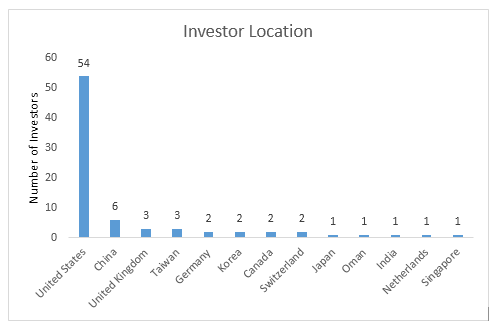
These investors are also diverse geographically; although most are based in the U.S., we also spoke to investors in 12 other countries around the world (see Figure 2). Fourteen of these investors are based in Asia, a region often untapped by entrepreneurs located outside of it; LSN has discovered through our mandate interviews that most Asia-based life science investors are looking beyond the region for investment opportunities. 
02
Figure 2 | Source: LSN Investor Platform, Data as of February 28, 2015

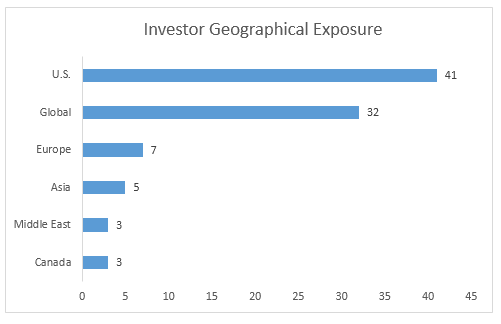
As you can see in Figure 3 below, almost half of these investors are interested in opportunities globally. The rest focus on one or several specific geographic regions, with the U.S. being the most common.
03
Figure 3 | Source: LSN Investor Platform, Data as of February 28, 2015

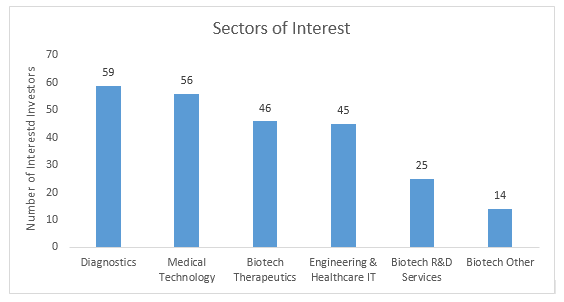
The investors we contact have varied interests across the life sciences; some invest opportunistically in any part of the field, whereas others focus on a particular area of speciality. In February 2015, the diagnostics sector attracted interest from the greatest number of investors, followed by medical technology and biotech therapeutics (see Figure 4). We’ve found from our discussions with investors that diagnostics companies receive attention from both medtech investors interested in diagnostic devices and imaging technologies, and also from biotech investors interested in molecular diagnostics and personalized medicine. In addition to these three sectors, we also speak to investors who are interested in engineering companies (including companies developing lab equipment or healthcare IT products), biotech R&D companies (including CROs), and other biotech opportunities such as industrial biotech or agricultural biotech.
04
Figure 4 | Source: LSN Investor Platform, Data as of February 28, 2015

LSN focuses on researching investors who are open to early stage life science opportunities, and those represented in February’s mandates are no exception. The investors we spoke with are most likely to be focused on companies that have successfully passed through the IDE/IND stage and have products in early clinical trials. However, we also spoke to many investors who look at other opportunities, including those offered by very early stage companies as well as late stage companies that have begun marketing their product. Figure 5 shows the stages at which diagnostic and medical technology investors prefer to invest:
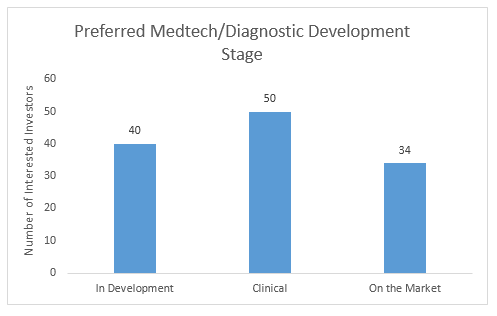
05
Figure 5 | Source: LSN Investor Platform, Data as of February 28, 2015

Figure 6 shows the stage at which biotech therapeutics investors prefer to invest. In this sector, you can see that interest in fully developed products drops off sharply, due to the much longer development cycle involved.
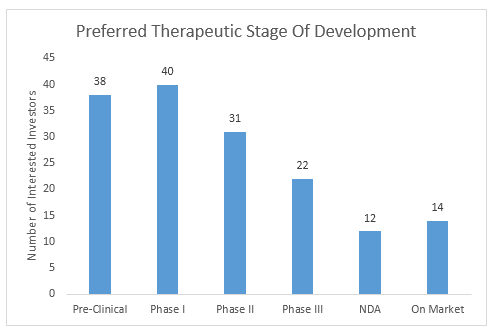
06
Figure 6 | Source: LSN Investor Platform, Data as of February 28, 2015

While this roundup provides an overview of the information we have recently gathered regarding investor interest, we collect many other details that help us identify suitable opportunities for each investor, including which indication areas and technological approaches the investor focuses on, and what kind of financing rounds the investor is open to participating in. These details are invaluable to a life science company looking to find the right investor fit. We look forward to speaking with more life science investors during March and beyond.

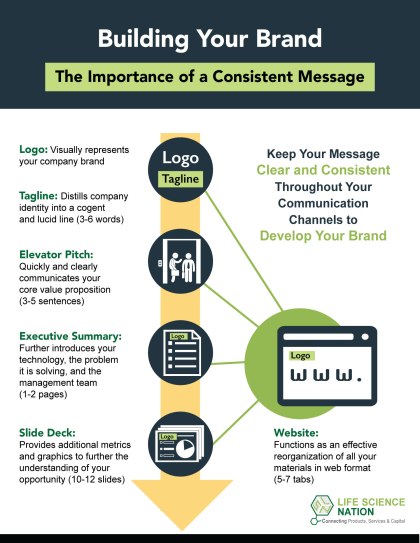
Building Your Brand: The Importance of a Consistent Message

By Michael Quigley, Director of Research, LSN

mike-2Scientist-entrepreneurs, often emerging from an insular academic environment, may not think about spending significant time and resources on their communications and marketing materials. Oftentimes these items are thought of only during the last moments of preparation for a fundraising campaign. “My technology speaks for itself, so it doesn’t need to be marketed” is the refrain we hear time and time again from entrepreneurs.

As science has protocols, so does fundraising, and adhering to the rules helps to move the process along. Understanding that it takes two to have a conversation and taking the time to find the best way to initiate that conversation is imperative. While all your data and publications are crucial to the success of your company, they are of no use to you if you cannot entice an investor to read and review them. Your brand and marketing materials are essential in capturing that initial interest. This newsletter has previously discussed the various marketing collateral required for fundraising, including your tagline, pitch deck, website, and introductory email; to effectively introduce yourself within the life science investment arena, it is essential that you keep your message and brand consistent across those mediums.

In its most refined state, your brand should be represented by a strong, simple logo accompanied by a cogent and lucid three- to six-word tagline by that is easily understood by people outside of your field. This logo and tagline should be present throughout all your marketing materials, including your business card, executive summary, pitch deck, website and anything else you are putting out into the marketplace. Stemming directly from your tagline should be an equally lucid three- to five-sentence elevator pitch that everyone at your company, from the bottom up, can clearly articulate. The elevator pitch provides a tactical and harmonious way for each person in your company to quickly communicate your core value proposition to whomever they may meet.

From the elevator pitch, you should develop a one- or two-page executive summary that elaborates your story and introduces your technology, the problem it is solving, and your management team. Your pitch deck should act as a visual representation of your executive summary, providing some additional metrics and graphics to further the understanding of your opportunity, and should consist of no more than 10 to 12 slides. Your website should effectively be a reorganization of your pitch deck in web format that also features links to additional supporting publications and relevant studies.

Building-Your-Brand-LSN
Click the image to download/print


It is important to keep colors, visuals, and language clear and consistent throughout all of these materials in order to develop your brand. By maintaining consistency you keep the same message echoing through the industry, allowing anyone who would be interested in your space to get a fundamental understanding of your opportunity. These materials should be updated simultaneously as new significant data is gathered, partnerships are formed, or other significant changes in your business take place. You don’t want to waste an opportunity to highlight your most recent progress, or cause potential confusion among interested parties by circulating different materials.

A cogent, consistent core message becomes easily reproducible by anyone with whom you come into contact, which can drastically increase the number of relevant people who hear about and understand your opportunity. A developed and understandable brand can be vital in capturing the initial interest of an investor, and can help to eliminate the unnecessary conversations with incompatible parties that can suck up crucial time in a campaign. Being able to establish interest is critical in getting the investor to engage in due diligence, and will put you that much closer to achieving your fundraising goal.

[Video] Healthcare IT Investors Panel at RESI 4

By Nono Hu, Senior Manager, Branding & Messaging, LSN

Nono 2For those who were not able to attend the fourth RESI Conference in January, LSN would like to bring the Healthcare IT Investors panel to you. In this panel, five investors explained their current investment mandates and shed light on the hot topics in the Healthcare IT field:

• What are the subsectors within healthcare IT that you are most interested in right now? Are there any you are “allergic” to?

• As you are looking at an investment in the space, what is unique to healthcare IT that you worry about and dig on the hardest as opposed to other investments in other sectors?

• As entrepreneurs are positioning their companies for investment, is there something like a particular a piece of information, data point or illustration that entrepreneurs can demonstrate that is particularly impressive, or able to distinguish themselves from the crowd?

• In general, where do you think the trend on valuations is going? Do you think about valuations in this space differently than in other spaces?

• Aside from Health IT pure plays are you seeing a trend where traditional biotech therapeutic, device or diagnostic companies are utilizing next generation IT or analytics to improve the efficacy or accuracy of their products. How do you view those opportunities as investors?

Watch the video to learn more.

Hot Life Science Investor Mandate 1: Corporate Venture Capital Firm Seeking Pre-Clinical Stage Novel Platform Therapeutics

A large European pharmaceutical company recently opened a US office to invest out of a $130 million evergreen corporate venture fund. The fund is interested in life science opportunities globally, and expects to make 3-4 new investments per year. The fund typically invests about $10 million over the life of an investment.  The fund is typically a lead investor, and participates in syndicates with other investment firms.

The fund seeks to invest in companies with preclinical assets.  The firm prefers to invest in companies developing therapeutic platform technologies.  The fund is only interested in novel technologies; while the fund will consider investing in any form of therapeutic technology, gene therapy and regenerative medicine are particularly of interest.  The fund is focused on investing in oncology, but will also consider opportunities in other indication areas.

The fund invests in technologies of strategic importance to its parent company. The fund only invests in privately held companies.  The fund typically does not invest in single asset opportunities; only companies with multiple pipeline assets are of interest.

If you are interested in more information about this investor and other investors tracked by LSN, please email mandates@lifesciencenation.com

Hot Life Science Investor Mandate 2: Chinese PE Firm Looking Globally for Medical Device, Diagnostic and Healthcare IT Opportunities

A private equity firm that was founded in 2004 and is headquartered in China is currently seeking new opportunities. The firm provides venture capital and growth capital to early-stage companies across various industries, including life sciences, energy, Internet and software. The firm is interested in all types of life science companies except drug development. The allocation size will vary, but the firm has the capability to allocate up to $20 million per company, depending on the opportunity. The investment is typically in form of equity, but convertible loan will be considered as well. The firm has an emphasis on technologies and products, and it is currently seeking new investment opportunities globally.

The firm is currently seeking to invest in medical device, diagnostics, biotech R&D services and healthcare IT sectors. The firm is very opportunistic in terms of subsectors and indications. Currently the firm will not invest in companies targeting drug development.  The firm will consider companies at all stages of development, from pre-clinical stage all through to commercial stage; however, the firm is most interested in companies in the pre-commercial stage.

The firm primarily invests in early-stage private companies. The firm does not have specific requirements for companies’ management team or revenues. The firm will take a board seat post-investment.

If you are interested in more information about this investor and other investors tracked by LSN, please email mandates@lifesciencenation.com

Hot Life Science Investor Mandate 3: Swedish VC Fund Seeking Clinical Stage Therapeutics Throughout Europe

A Swedish venture capital fund that invests in life science companies with a focus on therapeutics is currently seeking new opportunities. The firm has raised six funds to date, with the most recent fund size of €110M (2011 vintage). The firm can allocate up to €10-15M per company and typically provides equity as well as debt financing. The firm generally acts as the lead or co-lead investor and is open to invest in syndicates. Currently, the firm seeks to invest in companies that are based in the European Union or US company that is open to establish an EU entity.

The firm is currently seeking to invest in early to mid stage biotech therapeutics and pharmaceuticals. The firm is also interested in exceptional medical devices with a therapeutic application that is close to market or has generated some sales. The firm is opportunistic across the therapeutic subsectors but prefers products that target niche indications.  Currently, the firm is more interested in oncology and orphan indications.  The firm looks for products with proofs of concept in Phase I and II.

The firm requests a board seat in each portfolio company. The firm seeks a strong and experienced management team.

If you are interested in more information about this investor and other investors tracked by LSN, please email mandates@lifesciencenation.com

Next Phase Issue 100: A Look Back at Our Top Five Articles

By Michael Quigley, Director of Research, LSN

mike-2In honor of the 100th edition of the Next Phase newsletter, LSN would like to share five of the most popular articles to date. These articles provide a great snapshot of what this newsletter is all about: educating entrepreneurs and investors on the early stage life-science-investment landscape and providing tactical advice to entrepreneurs on how best to present their opportunity to the life science investment community. These articles all stem from our daily dialogues with both investors and entrepreneurs from around the world; this experience allows us to act as an information portal between these two groups.

Without further ado, here are the top five articles.

  1. 11 Tips for Creating a Successful Pitch Deck

By Shaoyu Chang, Senior Research Analyst

“Coming from a scientific background, I thought I knew well enough about using slides and making presentations, whether in laboratory journal clubs or at hundred-attendee conferences. However, as I start to help fellow scientists on their fundraising campaigns, it has become apparent to me that academia and business speak very different languages.”

  1. LSN Published in Nature Bioentrepreneur: “Beyond Venture Capital”

By Dennis Ford, CEO, LSN, and Barbara Nelsen, Founder, Nelsen Biomedical

“LSN is officially announcing the release of  ‘Beyond Venture Capital’ in the January 8, 2014, edition of Nature Bioentrepreneur! This piece, appearing in the current issue of Nature, is an in-depth analysis of the new life sciences fundraising environment, detailing what caused the paradigm shift in the investor landscape, who is active, and how fundraising executives should adapt. This is a must-read piece for anyone involved in the early stage life sciences arena, and an excellent primer for newcomers to the Redefining Early Stage Investments Conference.”

  1. Formulating the Introductory Email to Potential Investors

By Michael Quigley, Director of Research

“Having personally scheduled and held several hundred interviews with life science investors over the past year, I have developed and refined a formula for getting ‘in the door’ with an introductory email. As anyone who has embarked on a fundraising campaign knows, initiating the dialogue is often the hardest part of the process. Few introductory emails ever get opened, and even fewer earn a reply at all. However, there are a few concepts and tactics that can increase your efficacy substantially when it comes to initiating a dialogue and locking in that first meeting. This article will share some insights from my personal experience that may be helpful in your email outreach.”

  1. Pharma-Licensing Deal Trends in 2014

By Lucy Parkinson, Senior Research Manager

“LSN gathers data on early stage life science companies and investors worldwide, but we also track global licensing activity and trends through the LSN Deal Platform. We analyzed 20 pharma deals that were publicly announced from January through April and spotted three trends that offer a glimpse of what the industry may expect from pharma-licensing activity in 2014.”

  1. 10 Steps to a Life Science Fundraising Campaign

By Dennis Ford, CEO

“Executing a successful fundraising campaign in the life sciences space requires organization, professionalism, determination, a great technology, and an outstanding team. LSN has worked with hundreds of companies in this capacity—companies that are at all stages of development, in regions around the world, and pursuing various types of technology. We’ve been watching as the latest process for fundraising has surfaced, and I wanted to share what we see as the ten steps.”

We hope you have enjoyed Next Phase so far and found useful information in this newsletter. We look forward to continuing to provide you with tactical advice and forward-looking information on the early stage life-science-investment landscape in the months to come.