An international, nonprofit global health organization with more than 30 offices around the world acts as a bridging agent between the public and commercial sectors for the development of health technologies for use in low-resource settings.
The organization provides funding to selected technology development projects in the form of non-dilutive research grants to help reduce business risks and encourage critical private-sector investment. Size of funding is variable according to individual project’s needs and funding agency’s specifications. Proposals are generally solicited through request for proposal (RFP) sessions that are open to public and private entities.
The organization managed a portfolio of projects focused on appropriate technology solutions for the health needs of people living in low-resource settings. Areas of expertise include diagnostic technologies (with a special focus on point-of-care diagnostics), digital health solutions, health technologies for women and children, reproductive health technologies, new solutions for contraception and STI/HIV prevention, vaccine and pharmaceutical technologies, and water and sanitation technologies. The organization is working on a wide arrange of communicable disease areas including HIV, neglected tropical diseases, malaria, and tuberculosis, as well as non-communicable diseases including cervical cancer, breast cancer, diabetes, and hypertension. The fund generally avoids funding basic research and large clinical trials.
If you are interested in more information about this investor and other investors tracked by LSN, please email mandates@lifesciencenation.com
A private equity firm based in Paris, France has €400M AUM and looks to invest in venture stages in the life sciences – seed to later phases. The firm mainly provides equity financing and may provide convertible loans as follow-on investments. The firm typically makes an initial investment of €2-3M and €5-8M over the life of the investment. The firm only invests in European-based companies. The firm is actively seeking new investment opportunities.
The firm is opportunistic in the life sciences. The firm focuses on drug development, diagnostics, and medical devices. The firm is agnostic in terms of subsectors and indications. The firm prefers companies with a portfolio of 2-3 products. The firm generally looks for therapeutic companies with products that are in the pre to late clinical phases. Currently, the firm is active in many subsectors including therapeutics that addresses autoimmune, inflammatory diseases, cancer, diabetes, Alzheimer’s disease, pulmonary devices and cardiac devices.
If you are interested in more information about this investor and other investors tracked by LSN, please email mandates@lifesciencenation.com
A healthcare investment firm that was founded in 2007 and based in The Netherlands has raised two funds, with the most recent fund closing in 2012. The firm seeks to make equity investments into Dutch technology-driven healthcare companies. The investment size typically ranges from € 0.1 million to € 0.4 million, and it can go up to € 2 million with consortium over the life of an investment. The firm is looking to make at least 7 investments in the next 2-3 years. The firm focuses on companies that are based in The Netherlands.
In the Life Sciences space, the firm is currently seeking new investments in the Medical Technology, R&D Services and Healthcare IT sectors. The firm looks for all classes of medical devices and is opportunistic in terms of indications; however, the firm is most interested in companies developing innovative technologies that have impacts on healthcare processes and/or have impacts on the patients. The firm has a market focus instead of a technology focus. The firm generally invests in companies in the market introduction Phase, but it can also invest earlier-stage companies that have great impacts on healthcare.
If you are interested in more information about this investor and other investors tracked by LSN, please email mandates@lifesciencenation.com
Coming from a scientific background, I thought I knew well enough about using slides and making presentations, whether in laboratory journal clubs or at hundred-attendee conferences. However, as I start to help fellow scientists on their fundraising campaigns, it has become apparent to me that academia and business speak very different languages.
Looking at the concept scheme (Figure 1), scientists are used to a standard structure that emphasizes on literature background, study design, and interpretation of data. However, building a successful investor pitch deck requires a different set of considerations, framework, and skills than an academic presentation. In addition to scientific merit, an investor pitch deck must showcase the superiority of the management team, market potential, business model, and competitive landscape, among other factors.
Figure 1
Unfortunately, many scientists who become life science CEOs often assume pitching investors is the same or similar to presenting at an academic conference, and they begin a fundraising campaign on the wrong foot. This article summarizes as 11 tips the recommendations for building a successful pitch deck from experienced industry veterans and investors who we interact with on a daily basis.
Keep it simple. Pitch decks serve as a vehicle to initiate a conversation. Try to draw a smooth and intriguing story line about where your invention came from and where you are planning to go. Ideally your pitch deck should be anywhere from 10-15 slides. Far too often do we come across entrepreneurs with pitch decks of 20 or more slides and while the data may be compelling, the reality of the matter is that investors do not have the time to review that amount of material on every opportunity they are presented with. Do not try to answer all possible questions in your pitch deck, simply aim to provide the investor with enough information to convince them that it is worthwhile to hold an in-person meeting.
Begin with the conclusion. Academic presentations describe a journey of scientific investigation that leads to a discovery or a conclusion. By contrast, a pitch deck should open with a high-level overview of the entire pitch. Time is of the essence. Investors want to know within the first two slides why they should care about this innovation, what is your solution, and what are the opportunities and risks.
Showcase your team. Standard academic presentations do not mention teammates until the last slide; however, when pitching investors, you and your team are as important as your science. Who are you? What is your contribution to the company? What credentials do your teammates have? Are they award-winning scientists or seasoned business professionals? Showcase the members of your team. Remember, investors fund the science and the team.
Describe the “pain” in the market. Explain where the current problem is, how it impacts people’s lives, what the commercial opportunities are, and how you got started. This section should be a shorter version of the background section in academic presentations. Many entrepreneurs waste their time preaching common knowledge, such as telling investors that breast cancer is one of the top killers in women or orphan drugs are a big business. Remember that your job is to get investors’ buy-in by defining a pain specifically and providing a compelling case for how your technology will alleviate it.
Explain your technology. Where did it come from? How does it work? How will it make an impact? What phase of development is it in? How is your technology different from others? What is your “secret sauce”? Tell a succinct story of the journey you have been through to get to where you are today. Sell your science by carefully laying out data and results from studies and prototype-testing that support your claims. A lot of data is not necessarily a good thing, as it may be difficult to explain and comprehend. (Remember, this is not a thesis defense.) However, some scientists cut back on key data and only speak about the big picture. This approach makes their claims look groundless and untrustworthy. Try to get feedback from industry experts or veteran investors before you make your pitch. It may take a few tries to strike the right balance for your specific financing round.
Describe product pipeline and address the risks. Early stage R&D is risky, especially in life sciences; every investor knows that. Still, investors appreciate pitches that acknowledge the risks associated with the ongoing project and lay out risk management and mitigation plans. Provide a roadmap to risk reduction that includes milestones, such as filing patents to protect intellectual property, establishing a safety profile, and demonstrating superiority over competitors. Risk mitigation does not need to be a stand-alone slide, but it should be addressed in a presentation or during a Q&A.
Propose a roadmap to future exits. What are the potential value-inflection points and how long will it take to get there? Are you aware of potential acquisitions and recent exit valuations in your sector? Many investors will obtain this information during due diligence. That being said, they appreciate entrepreneurs who know such information, as it demonstrates a level of preparedness.
Present the finances. How much capital have you raised to date? How much more are you raising now? What is the planned use of these funds? What are the milestones you want to achieve (such as chemistry, manufacturing, and controls (CMC); animal toxicology tests; and first-in-human trial)? Although life sciences are notorious for high uncertainty, it is still recommended to have a two- to five-year financial projection so that investors know you will adhere to your budget and can be trusted with their money.
Choose graphics and language that are suitable for your audience. A common mistake made by first-time life science entrepreneurs is to overwhelm the investor with too much data and unnecessary jargon. Use crisp and easy-to-understand visuals to display data and save the details for an appendix to provide to investors upon request. Try to explain abstract ideas in a language that a layperson can understand and use analogies when appropriate. For example, instead of saying “the chelating agent binds to heavy metal ions and therefore reduces their concentration in circulation,” try saying “the specially designed molecule acts like a magnet that attracts metal ions and takes them away from your body.”
Touch on intellectual property and the competitive landscape. While having IP protection and a competitive advantage are strongly emphasized in IT and other industries, these factors are seldom the make-or-break points when it comes to investing in early stage life science projects. Given LSN’s experience and the expert opinions we received, these points can be addressed in the flow of a presentation, but they should not occupy too much valuable time that could be used to explain the science or introduce the management team.
Ensure continuity in branding and messaging. As Dennis Ford discusses in The Life Science Executive’s Fundraising Manifesto, a company’s communication flow should be seamless. A company’s tagline should lead into its four- to six-sentence elevator pitch, which dovetails into its one- or two-page executive summary and its 15-slide pitch deck. When new information is added, it must be fully integrated into the flow to build a consistent and easy-to-understand message.
It is important to note that this article aims to provide a starting point of building a pitch deck instead of a one-size-fits-all template. Every life science company is different. The pitch deck for an early-stage biotech start-up seeking seed capital to develop small molecule cancer therapy should look very different from that for a medical device manufacturer seeking growth capital to scale up operations.
In last week’s newsletter, we presented an overview of innovation and investment in the cardiovascular space. This week, we continue this series, analyzing LSN data on the neurology sector. Investors often tell us that neurology is a challenging space, particularly when it comes to evaluating early stage opportunities; some investors feel that it’s harder to assess animal data or prototype studies in this space than it is in many others. Here, we take a look at the competitive landscape for neurology and the investors.
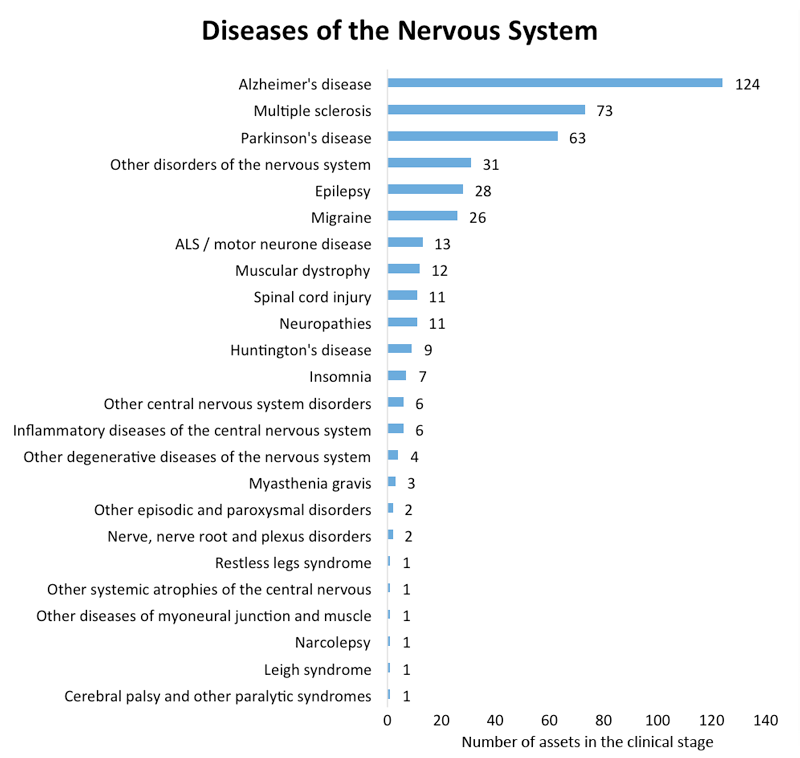
LSN tracks therapeutic assets for two areas of neurology: diseases of the nervous system and mental and behavioral disorders. The former is a far more robust area of innovation at present, with 646 assets in clinical trials. We have been able to determine the specific disease areas that 437 assets are targeting. (See Figure 1.)
Figure 1
For many severe neurological disorders, there is tremendous competition among treatments at present; more than one hundred Alzheimer’s cures are presently in clinical trials, as are dozens of potential treatments for Parkinson’s disease, multiple sclerosis, and epilepsy. However, the pipeline is limited or dry for many rare neurological disorders. Leigh syndrome, a severe pediatric disorder, has only one asset in the clinical stage. For some other indications that we track, including Charcot-Marie-Tooth disease and Steinert disease, no drugs are currently in clinical trials. Potential treatments for these rare diseases could qualify for an orphan drug designation, so an early stage investment could yield not only a life-changing result for thousands of patients but also an opportunity for an investor to benefit from limited competition and a long period of exclusivity after the treatment has received approval.
Less innovation is taking place to address mental and behavioral disorders; only 164 therapeutic assets are in clinical trials. We have been able to determine the disorders that 144 assets are targeting. (See Figure 2.)
Figure 2
There are fewer medtech neurology products in the development stage because they have a shorter development cycle. We have identified and categorized 119 such products that are aiming to treat neurological, psychiatric, and spinal disorders, and in 100 cases we were able to identify the type of device being developed. (See Figure 3.)
Figure 3
Some areas of innovation are seeing markedly more new products than others; electromechanical devices (such as neurostimulation devices) form a crowded competitive field, as do various forms of implantable devices, many of which are targeting the spinal care market. There is also a wide variety of neurological diagnostic and imaging technologies in development. By contrast, few inventors are developing technical aids for patients suffering from neurological disabilities.
Neurology innovation is occurring worldwide. The U.S. has the largest number of neurology companies in both the biotech and medtech sectors, while in other respects the distribution of biotech companies is quite different from the distribution of medtech companies. (See Figures 4 and 5.)
Figure 4Figure 5
The UK, Japan, and France are among the top five countries that have the highest number of biotech neurology companies, but these countries fall behind Germany, Spain, and Switzerland when counting the number of medtech neurology companies in each country. Canada is a leader in both sectors.
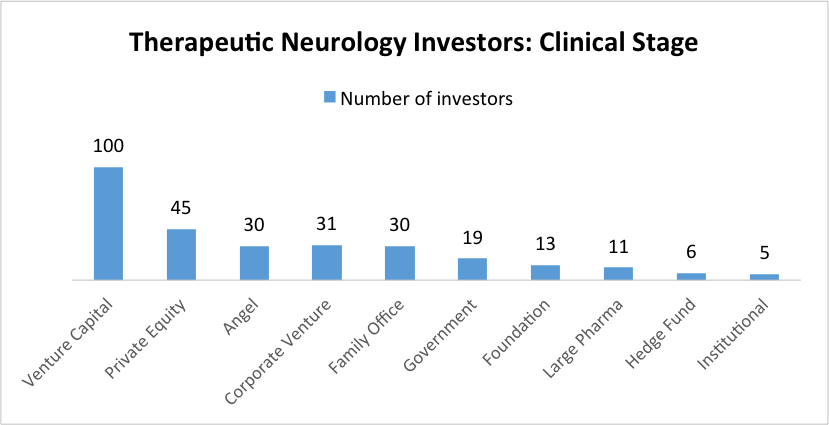
Now, let’s take a look at the investors interested in the neurology space. LSN has spoken with the investment staff at 290 organizations that are open to investing in therapeutics in the clinical stage. (See Figure 6.) We also spoke with 386 organizations that are interested in neurotech devices that are in the development or clinical stages.
Figure 6
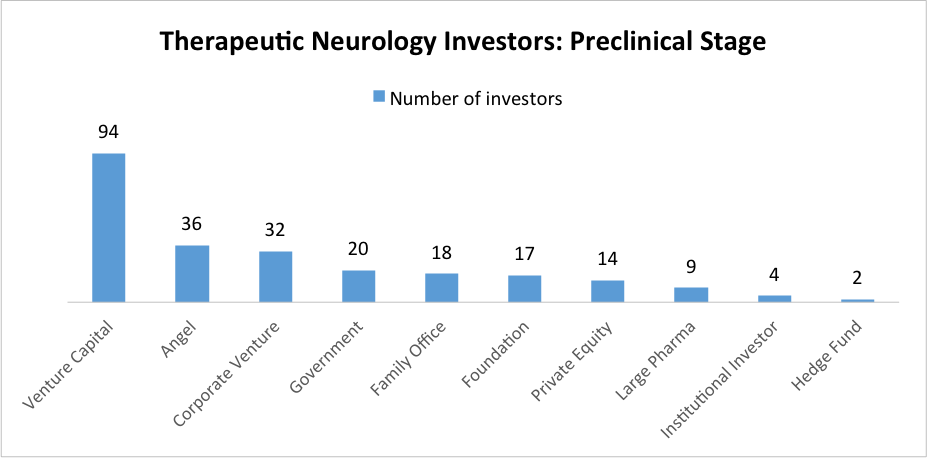
It’s interesting to see that if we look at investors interested in neurology therapeutics in the preclinical stage, we find a different pattern. (See Figure 7.)
Figure 7
Venture capital is the largest category of investors in both cases. But at the preclinical stage, angel groups, corporate venture capital funds, and foundations—all of which may be more prepared to take on risky neurology assets in return for the possibility of developing a new cure in the future—play a more prominent role.
On the medtech side, private equity firms show more willingness to get involved in products that have yet to achieve approval. (See Figure 8.) In many cases, these firms are interested in providing funds to companies that are close to receiving approval for their products and need capital for commercialization.
Figure 8
Where are these investors willing to allocate their capital? While many neurology investors are focused on the U.S. and Western Europe, a large number are looking globally, particularly those interested in the biotech sector.
Figure 9
In addition to the multitude of global neurology investors, LSN researchers have spoken with investors who are interested in investing regionally around the world.
Both global and local capital provide possibilities for companies in the neurology space. No matter where your company is based, we’ve found investors who would like to see what you’re working on.
RESI has always aimed to bring a diverse pool of investors together to meet life science entrepreneurs, and at past events, our Family Office panels have often stolen the show. As family offices grow in importance as a source of critical development capital for life science companies, LSN is excited to announce a second panel drawn from this category of investors: Family Offices Investing in Early Stage Therapeutics.
Family offices represent individuals and families with over $100 million in total assets, and therefore invest amounts far beyond angel capital. As investors seeking both capital preservation and a long-term impact, many family offices have been taken an interest in biotechnology, a sector where far horizons are required and an investment has the power to make a difference for thousands, even millions, of people suffering from a serious disease. Moderated by John Nelson, Managing Director of Genrich, Inc. the panel includes the following speakers:
What are their particular motivations for investing in therapeutic development? How does the more flexible nature of a family office structure affect their approach to biotech opportunities? What, in addition to capital, can these groups bring to the table for an early stage company? How does an entrepreneur find a family office that might be interested in biotech and get in touch, and what information do they look for in the initial correspondence?
A Canadian VC firm is currently investing from a second fund raised in 2014, with a closing target of $150 million. The fund will make equity investments in early-stage life science companies based in Canada and the USA. The firm prefers to lead or co-lead investments. Initial investments will typically be of about $5 million, with capital reserved for potential follow-on investments of up to $15 million total per opportunity. The firm is likely to make 10-12 investments over the fund’s lifetime.
The firm will make about 75% of its allocations in the therapeutics sector, with the remainder invested in diagnostics, medical devices, and/or tools or healthcare IT. The firm prefers to invest in early-stage opportunities; in the therapeutics sector, investments may be made in companies with a lead product 12-18 months prior to IND. The fund is generally agnostic in terms of technological field and indication area, but is less likely to invest in products targeting CNS disorders and pain.
The firm only invests in those therapeutic companies that have identified a lead product candidate. About two-thirds of investments will be made in Canada-based life science companies, with half of the Canadian portfolio consisting of Quebec-based companies; the remaining one-third of the fund will be invested in USA-based companies.
If you are interested in more information about this investor and other investors tracked by LSN, please email mandates@lifesciencenation.com


 Coming from a scientific background, I thought I knew well enough about using slides and making presentations, whether in laboratory journal clubs or at hundred-attendee conferences. However, as I start to help fellow scientists on their fundraising campaigns, it has become apparent to me that academia and business speak very different languages.






 RESI has always aimed to bring a diverse pool of investors together to meet life science entrepreneurs, and at past events, our Family Office panels have often