IPO’s Recycle Cash Back into Life Sciences

By Michael Quigley, Director of Research, LSN

 mike-2Several significant factors have been attracting capital to the life science sector over the past two years. An IPO explosion has provided many life science investors with positive exits, and, in turn, they have established new funds to put some of that capital back to work. In addition, new investors have come to the sector as a result of the number of successful IPOs and low interest rates; investors are looking for better returns. These factors led to life science funds raising an estimated $3.5 billion in 2013 alone.[1] Several funds have continued to raise capital this year.

This is positive news for fundraising entrepreneurs, and their next step should be to pinpoint the funds that have raised new capital and their investment targets.

The LSN research team has identified and interviewed more than 100 investors who have raised new capital since 2012. These investors fall in eight categories. (See Figure 1.)

1
Figure 1


Venture capital and private equity represent the largest number of investors; however, the other investor types represent a significant amount of new capital. Although each of these investor categories have various motivations for investing in the space—for example, financial, philanthropic, or strategic—it is promising to see so many groups with new capital to allocate to the space.

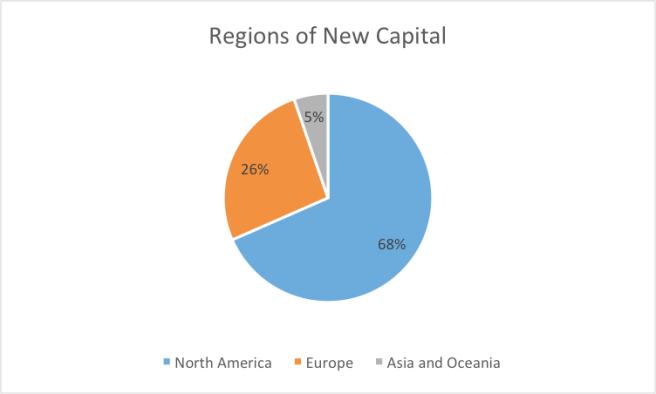
Also worth noting are the regions where these investors are based. The investors we identified are based in 20 countries in North America, Europe, and Asia, and Oceania. (See Figure 2.)
2
Figure 2

This distribution of investors with new capital reflects the IPO environment in these regions. The U.S. and therefore North America has had the highest number of IPOs, followed by Europe and Asia and Oceania. More important than where the investors are based, however, is where they are looking to allocate. Of the investors we spoke with, more than 50% are looking to invest across continents or globally. Previous articles in this newsletter have discussed the globalization of investment in the life science sector; this trend is validated by the current interests of funds and investors.

It would appear that the time is now for a start-up to execute a fundraising campaign if it has the data and team to support it. Not only is there capital to be had, but early on in a funds lifecycle, investors often consider research and technologies at earlier stages of development as the investors have the time and capital on hand to support them.


[1] Life Sci VC, “Perspectives on VC-Back Biotech: Looking Backward & Forward,” 2013 (http://lifescivc.com/2014/01/perspectives-on-biotech-looking-backward-forward/).


Partnering with Corporate Venture Capital: Tips from Industry Veterans

By Shaoyu Chang, Research Analyst, LSN

Shaoyu 10*10The role of corporate venture capital (CVC) continued its remarkable expansion in 2014. In the second quarter, CVC funding accounted for 29% of total venture capital funding. In the healthcare sector alone, CVC funding soared to a five-quarter high of $1.4 billion, up 200% from the previous quarter.[1] SR One, Novartis Venture Funds, and Johnson & Johnson Development Corporation led CVC funding in life sciences, while Aduro Biotech, Coherus BioSciences, and Principia BioPharma successfully raised more than $50 million in financing rounds with their CVC partners.

CVC funds are an attractive option for life science entrepreneurs for several reasons. Compared with other investors, CVC funds are not only able to provide more capital but also willing to take on riskier projects with promising potential. Working with industry veterans can provide start-ups with critical know-how in areas such as technology design, clinical development, and product commercialization.[2] And in some cases, CVC investments lead to an acquisition or strategic partnership.

How should a fundraising executive approach a CVC fund? At the most recent RESI conference, experts from six prominent CVC funds gave the following tips.

To begin with, entrepreneurs should understand what CVC funds are looking for and manage expectations from both sides. As discussed in our previous blog post,[3] CVC funds come in different flavors. Generally speaking, internally focused CVC funds seek innovations that can bolster the future portfolio of their parent company, while externally focused CVC funds look for technologies from a return-on-investment viewpoint, with less regard for the mission of the parent company. Aligning your goals with the expectations of a corporate partner is essential. A recent study found that this is an area where there is often a mismatch.[4]

CVC funds prefer to work with entrepreneurs who have a tight grasp of intellectual property and a good understanding of the commercial potential and the competitive landscape. They also favor an academic team with whom they have collaborated or with previous experience with another industry partner. To win the confidence of a CVC fund, first-time CEOs are advised to invite experienced entrepreneurs to join the start-up and build a team with credible advisors, consultants, and board members. “If you ask for money, you’re going to get advice. If you ask for advice, you’re probably going to get money,” a panelist said.

Entrepreneurs should invest time to foster relationships. Simply submitting proposals through the websites of pharmaceutical companies is not going to result in funding. It requires a substantial amount of energy to find key industry personnel who have the scientific expertise to understand the discovery and a senior position to make decisions. When a start-up has identified the key people, entrepreneurs should use conferences, social networks, personal referrals, email, and phone calls to engage these folks in conversation.

Finally, our panelists emphasized the importance of long-term relationships. Although the first contact with a CVC fund may not always develop into an investment, entrepreneurs are encouraged to maintain the dialogue. New opportunities may open up, investment criteria may change, or a portfolio’s requirments may change. “We have a lot of continuing dialogues that blossom into something really cool and end up different from the initial conversation,” a panelist concluded.


[1] CB Insights. “Corporate Venture Capital Report – Q2 2014 – CVCs Participated in $4B of Funding Across 187 Deals,” September 23, 2014. Accessed from https://www.cbinsights.com/blog/corporate-venture-capital-report-2014-q2/.

[2] Behr, J., & Murray, P. “In Search of Dry Powder,” Nature Biotechnology, October 31, 2013.

[3] Fuller, J. “Gorillas at the Table: Corporate Venture Capital,” Life Science Nation, August 9, 2013. Accessed from https://blog.lifesciencenation.com/2013/08/09/gorillas-at-the-table-corporate-venture-capital/.

[4] McCammon, M. G., Pio, E., Barakat, S., & Vyakarnam, S. “Corporate Venture Capital and Cambridge,” Nature Biotechnology, October 9, 2014.


Hot Life Science Investor Mandate 1: Corporate Venture Capital Arm of European Chemical Company Seeking Companies Working with Device Coatings and Nanotechnology

The venture arm of European chemical company invests in companies developing technologies that are of strategic interest. The fund is flexible regarding investment and partnerships; most investments are made in Series A rounds but both seed-stage opportunities and later-stage opportunities may be of interest. Initial investments typically range from $1-7 million, and the fund generally syndicates with other investors. The fund will consider opportunities globally. In addition to capital the fund is able to provide strategic guidance and technical expertise to its portfolio companies.

Within the life science sector, the fund is interested in excipients, custom manufacturing and formulation, medical device coatings, agrochemicals, plant biotech (particularly technology that increases crop yield such as GMOs), industrial biotech (including fermentation), and medical uses of nanotechnology (including nanotech mechanisms for drug delivery). Within the coatings subsector, the fund is particularly interested in coatings that can be applied to polymers/surface technologies developed by the funds parent company.

The fund generally invests in pre-revenue companies that have developed proof of concept data or a prototype, and which have filed for patents. The fund always request a board seat subsequent to investment.

If you are interested in more information about this investor and other investors tracked by LSN, please email mandates@lifesciencenation.com

Hot Life Science Investor Mandate 2: Asian VC Fund Looking Opportunistically In the Life Science Space

A venture capital firm that was founded in 2011 and is based in China is managing one fund with committed capital of $140million. The firm typically makes equity investment into life science companies at various stages. The investment size generally ranges from $10 million to $15 million over the life of an investment. The firm seeks to make 3-5 allocations in the next year. The firm focuses on companies that are based in the China and the US.

The firm is currently looking for new investment opportunities in Biotechnology R&D, Therapeutics & Diagnostics, Pharmaceuticals, Medical Devices and Healthcare IT spaces. The firm is very opportunistic in terms of subsectors and indications. The firm is interested in in-license products or technologies for development from companies outside of China, such as US-based companies. The firm also seeks to invest in orphan drugs. Prior investments have included medical device companies, diagnostics companies, CRO and distributors. The firm will consider companies in all stages, depending on the opportunity.

The firm seeks to invest in both private and public companies. The firm has no specific requirements for companies’ management team, revenue or EBITDA.

If you are interested in more information about this investor and other investors tracked by LSN, please email mandates@lifesciencenation.com

Hot Life Science Investor Mandate 3: Venture Investment and Development Firm Seeking 510k Device Opportunities

A venture investment and development firm based in the Southern United Sates provides investment and incubation services to start-up and early-stage medical device companies. The firm provides seed capital (equity) ranging from $500K to $2M with follow-on capital of up to $5M. The firm also considers investment opportunities with smaller than typically accepted venture capital market size thresholds. The firm is geographically agnostic and is actively seeking new opportunities. 

The firm is currently looking for medical device companies/start-ups developing products with a 510(k) regulatory pathway. The firm primarily focuses on Class II medical devices but will also consider Class III. Preferably, the product should have a prototype and animal data. The firm is open to all target markets, but is more interested in cardiovascular, interventional cardiology, interventional radiology, cardiac surgery, vascular surgery, critical care, consumable product, patient care, and orthopedic markets.

The firm takes an active role in the management of portfolio companies. The firm seeks Board representation and participation as Executive Management.

If you are interested in more information about this investor and other investors tracked by LSN, please email mandates@lifesciencenation.com

Scientist-Entrepreneurs and Investors Made Compelling Connections at RESI 3

By Nono Hu, Senior Manager, Branding & Messaging, LSN

Nono 2Life Science Nation (LSN) is proud to release the RESI 2014 fall video, which captures the happenings and buzz from the third Redefining Early Stage Investments (RESI) Conference at Fenway Park. LSN is pleased that RESI provided scientist-entrepreneurs and investors with an opportunity to have a compelling dialogue that will lead to relationships and hopefully future capital allocations.

LSN would like to say thank you for coming to RESI, and we hope to see you at our next conference on January 13, 2015, in San Francisco.

Early Stage Therapeutics and Medical-Device Investors Are Often One and the Same

By Michael Quigley, Director of Research, LSN

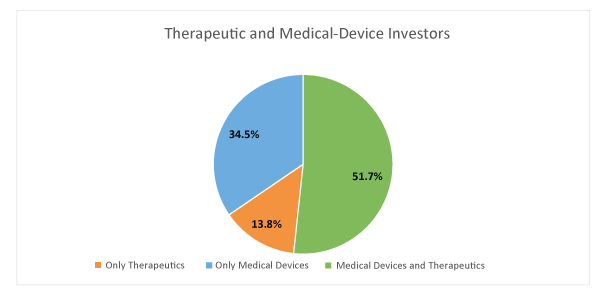
mike-2Developing therapeutics differs in many ways from developing medical devices. Therapeutics tend to have longer paths to commercialization and are more capital intensive, but they also usually deliver larger exit payouts. Interestingly, more investors are currently looking for opportunities in both of these sectors than in only one of them. An analysis of approximately 600 investment mandates gathered by our research team over the past year shows the percentage of investors interested in only medical devices, only therapeutics, or both. (See Figure 1.)

Figure 1
Figure 1

More than 50% of the investors we spoke with are looking to invest at some level in both therapeutics and medical devices. While portfolio blends may vary from investor to investor, with some looking more heavily into devices and vice versa, the bottom line is many investors are looking more opportunistically. They see great potential for ROI in these two spaces, so they leverage their networks and expertise to diversify their portfolios in hopes of capturing the upside in both. Many investors have partners or team members who are focused on therapeutics and medical devices, and other investors have vast networks of experts and industry executives to help them during the vetting process if they are unfamiliar with a particular technology.

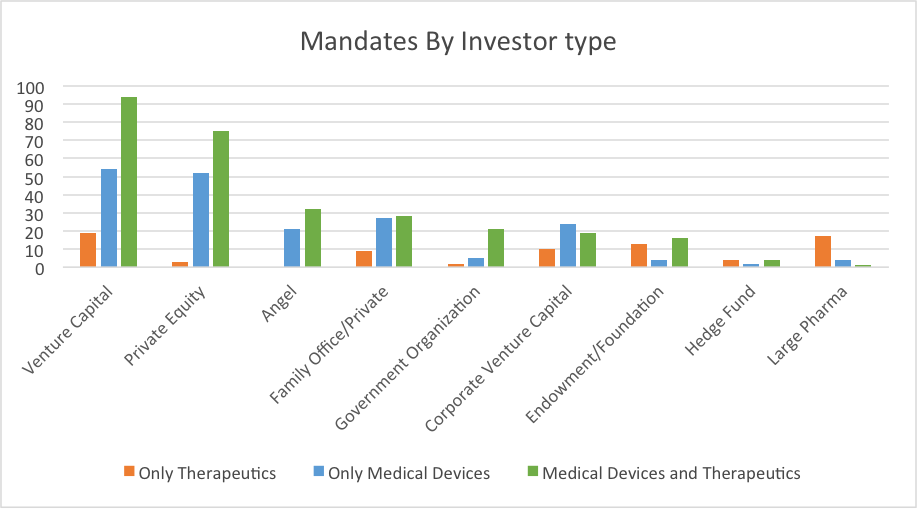
As the therapeutics approval path is a much more capital- and risk-intensive process than that of medical devices it appears logical that more investors are looking only or additionally into the medical device space. It seems that those investors are looking to diversify their portfolios and cover their bets to generate a more positive outcome. We analyzed investment mandates by investor type for only therapeutics, only devices, or both. (See Figure 2.)

Figure 2
Figure 2

It is interesting to compare mandates from the various investor types; the differences could have a number of forces driving them. Private equity groups, for example, tend to look at later-stage opportunities, such as devices that are about to reach commercialization or that have been recently approved and have begun shipping. Therapeutics at this stage, however, tend to be partnered with large pharma or biotech companies to finalize approval and distribution, making those opportunities much rarer. Given their smaller investment size compared with other investors, angel groups look to invest in companies where they can get more significant equity positions, which makes early stage devices a more viable option, compared with therapeutics that are often seeking multimillion dollar seed rounds. The corporate venture capital groups that LSN tracks also tend to favor devices because of the numerous IT and tech-based companies that are now leveraging that expertise to expand into the healthcare sector.

The most important point that can be drawn from this data is that most investors in the space are looking at both therapeutics and medical devices for new investments, and their allocations will be a function of the deals that they are presented with. As a fundraising executive, you are doing a great disservice to your company by not getting in front of investors simply because you believe they don’t invest in medical devices. Although past investment data can tell you a lot about investors, in the rapidly changing life science space, the key is uncovering which areas investors are exploring going forward. Ultimately, investors are most interested in compelling and innovative opportunities with strong teams that solve a significant problem. If you have all three things, the sheer number of high-potential investors may surprise you.