Do Traditional Marketing Techniques Apply to Life Sciences?

By Dennis Ford, Founder & CEO, LSN

Dennis book

I am a big fan of Steve Blank. For those who are unfamiliar he’s an entrepreneur and startup thought leader who has created and promoted relevant timely programs revolving around  startup strategy, fundraising, and iterating small business.

A recent focus of his is i-Corps, an audacious effort supported by a number of government organizations and spearheaded by the National Science Foundation. The goal of this program is to help early stage innovators make their ideas and technologies into real products.

Steve really stresses being “market-focused.” I am simplifying here, but he teaches how to go about validating the market for a product. He is a proponent of polling and surveying techniques that help scientists determine if there are potential clients or users for a particular product. He then encourages scientists to find large groups of these potential users and vet them. If the scientists get agreement, they have validated the market and it’s full speed ahead. If they don’t, the scientists may have to iterate or pivot until they get a group consensus and thus, market validation.

Steve’s process is a universe onto itself. He teaches through his programs why using practical common sense methodologies can drastically help in determining market acceptability. Given the NIH’s recent announcement that they will participate in i-Corps, I’m anxious to see how he adapts his philosophy (developed for software and new age media) to life sciences. I expect that much of his philosophy will transfer well. Nevertheless, the life sciences arena is unique: More often than not, the need is rather obvious: these technologies are changing or saving lives.

Probably half of the early stage life science investors (for example, family offices, venture philanthropy, patient groups, and foundations) are not as concerned as other investors about rate of return on dollars invested. They want to find a treatment for a specific type of patient (in the case of family offices, it is often a family member). This goes beyond “market adoption” and requires a different way of thinking about how to approach fundraising.

The goal for these investors is finding the best assets and the best scientists to move science forward and improve patient lives. It’s not a question of justifying a market. These technologies are addressing serious medical needs, and the key for emerging scientist-entrepreneurs is to identify where they fit and how to target the investors that are right for them. Raising capital in the life sciences is different than a traditional “market validation” approach. It’s all about finding the right investor for you, and positioning yourself accordingly. The real news here is that the NIH is embracing the fact that scientist-entrepreneurs have to broaden their understanding of rudimentary sales and marketing.

Fundraising Tactics Spotlight: Communicating Clearly with Taglines

By Jack Fuller, Business Development, LSN

Jack 2

Life Science companies pitching investors have a tough job: It’s not easy to convince people to invest in a capital-intensive industry with a low rate of product commercialization. Then there’s the challenge of conveying an extremely specialized and complex idea to people who want to net out the technology quickly. To be successful, companies must work hard to communicate complex ideas at a level that is easily understood by all potential investors, not just the “science-literate.” As Charles Bukowski once said “Genius could be the ability to say a profound thing in a simple way.”

The first place this needs to be accomplished is in a company’s tagline. Taglines are ubiquitous in the industry, but very rarely does a tagline accurately summarize that “special sauce” that makes a company so exceptional. Prospects should be able to read a tagline and grasp the goal of the company.

Take a look at the taglines below. What do they tell you?


As you can see, taglines run the gamut from completely ambiguous and semi-descriptive  to great ones that communicate a company’s brand and value to potential investors.

The goal of a tagline is not to be clever or cute but to powerfully and succinctly communicate a company’s unique value proposition. There is no one formula for a tagline, as each company needs to distill its entire investor pitch into a crisp statement.

Take a moment to think about your tagline. Crafting a clear one is the first step in the process of creating a cohesive and compelling brand and will form the basis of your outbound campaign.

Validating the Importance of a Global Target List

By Alejandro Zamorano, VP of Business Development, LSN

Alejandro 10*10

One of LSN’s Investor Platform clients recently provided some insight on his fundraising campaign. We encourage feedback from our clients as it helps us to validate our methodology and to integrate improvements into our product. Our client is a molecular diagnostics company looking to raise $3 million to $8 million to expand and perform some key clinical studies.

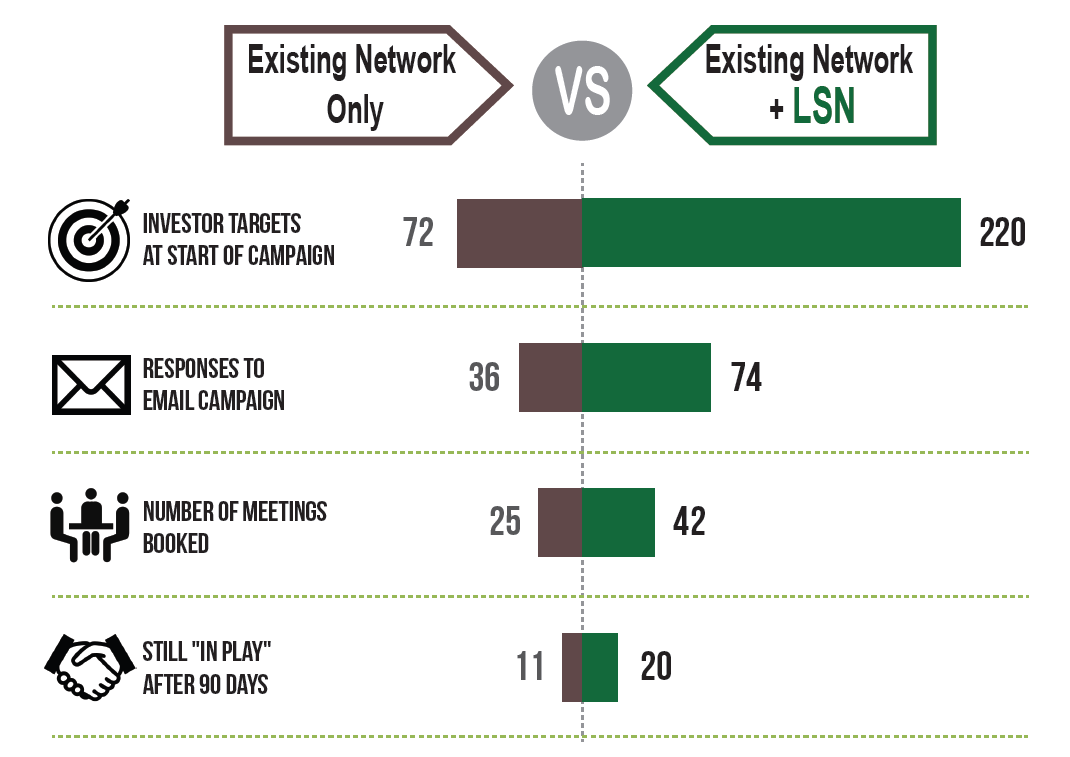
We first met the co-founder a few months before he elected to subscribe to the LSN platform. At first, like many emerging biotech and medtech entrepreneurs, he relied on the executive team’s personal network and referrals to find potential investors. He had a relatively large pre-existing network of almost 72 identified investor targets; thus, he felt that he did not need any additional help. The concept of “fit versus referral” was clear to him, but nevertheless, he felt sufficiently armed to pursue the campaign under his own steam.

In his first few months of fundraising, he reached out to his network and received responses from 36 of his prospects. He was then able to convert 25 of those responses into meetings, of which 11 remained interested in continuing the dialog. Despite his initial success, he soon hit a wall and was left waiting as his investor prospects began discussions internally. Weeks passed and investors delayed their decisions. It became apparent that in order to master the numbers game, he would need more prospects that were strong fits for his particular company. Before long, he resurfaced to LSN and elected to subscribe to the investor platform.

In the first 90 days of using the LSN Investor Platform, LSN was able to help this client identify and reach out to a global target list of 148 potential investors outside of his network. With the help of a clearly defined campaign strategy, and armed with all of the necessary cloud infrastructure to run an effective campaign, he was able to get 38 positive responses from investors he had previously not known about. He was then able to convert 17 of those responses into meetings, of which 9 were interested in continuing the dialog.

By expanding his list of qualified fits, our client was able to triple his meetings and double his investor conversations. He remains in negotiations with 20 investors currently. This is a shining example of why it is important to contact investors outside of your network and not to exclusively rely on referrals. Moreover, it shows that the same result could have been achieved in half the time, had our client started his campaign using the LSN Investor Platform form the outset. It all comes down to finding the maximum number of prospects and tactically working those leads into a handful of relationships that ultimately end in allocations.

Screen Shot 2014-04-30 at 3.32.33 PM

Hot Life Science Investor Mandate 1: CRO Looking to Leverage Service for Equity

An international life science investment group based in the eastern US is looking to invest invests in life science companies by using its product development and CRO services effectively as a capital investment. The firm has the ability to leverage 30-70% of the development cost in exchange for equity, downstream royalties, etc. The firm places a strong emphasis in the technology and will invest in companies that are based in the USA, UK, Europe, The Middle East, and Asia. The firm is actively seeking new investment opportunities. 

The firm is currently seeking to invest in biotech therapeutics, diagnostics, and medical devices. For therapeutics, the firm seeks both biologics and small molecule assets that are in pre-clinical through to phase III of clinical trials. For medical devices, the firm is also opportunistic in terms of subsectors and only invests in companies with at least a prototype that is ready for clinic. The firm is open to all indications including orphan indications.

Hot Life Science Investor Mandate 2: PE Firm Seeking Novel Therapeutics, Diagnostics, and Service Providers of All Stages

The life science venture investment arm of a leading global Private Equity firm with over $50 billion in AUM, is looking to make investments across development pipeline, from early to late stages. The firm’s investment size is highly variable depending on the stage of the company, ranging from $1M to $50M in equity. The firm has a global mandate and is actively seeking new investment opportunities.

The firm seeks compelling investment opportunities in drug discovery and development platforms developing novel therapeutics, personalized medicine, diagnostics, industrial biotechnology, healthcare services and IT. The firm does not invest in medical devices. For therapeutics, the firm seeks small molecules and biologics and is open to all indications including orphan indications. The firm will consider products in all phases of clinical trials, from pre-clinical to phase III. The firm is also interested in services such as CROs and CMOs as well as tools of genomics and proteomics. 

The firm invests for the long term, and are heavily involved in, and committed to, the growth and success of their portfolio companies. The firm, therefore, generally take a board seat/observer rights. The firm only invests in private companies.

Hot Life Science Investor Mandate 3: PE Fund Looking for Therapeutics and Devices with Human POC

A Private Equity firm based in the western United States The firm is currently making investments out of its vintage 2014 healthcare centric fund. The firm looks to make primarily growth equity investments ranging from $5-$30 million with most investments falling in the $10-$30 million dollar range. The firm is willing to review opportunities from around the Globe.

The firm currently interested broadly in the healthcare space including Medical Technology, Therapeutics, Diagnostics, Laboratory Equipment, Healthcare IT and R&D services. For medical technology the firm is looking for companies that have at least an alpha prototype and have some efficacy data.  For companies working with therapeutics the firm is looking for assets that are in Phase II of clinical trials and will only consider companies in Phase I if they have efficacy data. The firm generally does not look for companies in the cardiovascular space and they are open to orphan indications. The firm is also open to investing in companies that have products already on the market.

The firm looks for a strong management team to be in place and is open to invest in both private and publically held companies. For companies that are privately held the firm generally looks to take a board seat.

The Importance of Single-Asset Focus

By Maximilian Klietmann, VP of Marketing, LSN

Max Smile 2

LSN regularly speaks with numerous early stage entrepreneurs on the subject of asset focus. All too frequently, scientist entrepreneurs are reluctant to choose a single asset for the focus of their company unwilling to believe that it is in their best interest. Despite the feedback LSN gets from ongoing conversations with life science investors, many emerging biotech entrepreneurs still see this as a debatable point.

The typical arguments that emerging life science CEOs make against a single-asset focus may appear to make sense at first: Investors should prefer multiple shots on the goal or a portfolio of products is worth more than the sum of its parts. However, the key point that is often missed is that multiple assets frequently spell increased risk from an investor’s perspective. Why is this? It can be boiled down to three basic factors.

Capital Efficiency: The process of moving a therapeutic from discovery through the clinical trial process is extremely expensive, and it’s not getting cheaper anytime soon. Many investors tell us that given the inherent risks already present in the development process, they want their capital to be going towards the development of a single product that the whole company is focused on. This is preferable to spreading funds across a number of projects (increased overhead) that will get a portion of everyone’s focus (decreased attention).

Time to Market: The value inflection created by FDA approval is huge. A single asset on the market is almost always more valuable than a handful awaiting approval to move to the next trial phase. Relating to the capital efficiency point above, most investors we speak with would rather see one asset receive all the capital to move it across the finish line faster, regardless of the promise any other drug candidates may have.

Management Focus: This is the big one. Picking a single asset and having a laser-like focus on how to move it through the pipeline and to market shows that the management is dedicated, has clarity of vision, and is aligned with the investor. It exudes a “shortest line to cash” attitude and lets the investor be confident that the entrepreneur is able to lead the company.