Technical Risk – From Belief to Evidence 

By Dennis Ford, Founder & CEO, Life Science Nation (LSN)

DF-News-09142022

In the first article, The Problem Is Not the Science, Life Science Nation established that investability begins with defining a real, urgent market need. But once that foundation is clear, the next question becomes unavoidable: does the product actually work, and can that be demonstrated in a way others trust?

The next focus is technical risk, where belief must become evidence. It outlines how companies move from early signals to reproducible, credible, and translatable results—covering mechanism of action, proof of concept, reproducibility, safety, and scalability.

Once market risk is clear, the next question becomes unavoidable: does the product work, and can that be demonstrated in a way that others trust?

This is where many companies overestimate their position. Early data, promising signals, or strong academic foundations often create internal confidence. But investors are not evaluating belief; they are evaluating evidence. The distance between those two states defines technical risk.

Technical risk is not simply about whether something works once. It is about whether it works consistently, whether the mechanism is credible, and whether the results can survive the transition from controlled environments into real-world use.

The first layer of clarity comes from the mechanism of action. There must be a coherent explanation of how the biology or technology produces the intended effect. This is not a description of experimental outcomes; it is a causal story. Without it, data is difficult to interpret and harder to trust.

Proof of concept establishes that the signal exists. This can take the form of in vitro data, animal models, early human data, or a working prototype, but it must be observable and measurable. Reproducibility then determines whether that signal can be relied upon. A single experiment is not enough. Results must hold across time, cohorts, and independent attempts.

Translatability introduces another layer of complexity. What works under ideal conditions does not always work in patients, clinics, or real-world settings. Understanding how findings extend beyond the initial model is critical, particularly in biologically complex indications.

Safety, performance, and durability define the product profile. Even if effective, a product must be safe enough for its intended use, deliver a meaningful effect, and sustain that effect over time. A transient or marginal benefit rarely justifies the cost and risk of development.

Finally, manufacturability, scalability, and data integrity complete the picture. A product that cannot be produced consistently and at scale cannot become a company. Data that is poorly designed, uncontrolled, or selectively presented undermines confidence, even when the underlying science is strong.

Technical risk is resolved when the product moves from an interesting idea to something that consistently works, can be trusted, and can be translated into real-world use.

Core Elements of Technical Risk

  • Mechanism of action
  • Proof of concept
  • Reproducibility
  • Translatability
  • Safety
  • Performance and durability
  • Manufacturability and scalability
  • Data quality and integrity

Next in the series: Regulatory Risk — Navigating the Path to Approval

Fundraising Bootcamp Ahead of RESI Europe 2026: Preparing Founders for Investor Engagement 

By Greg Mannix, VP, EMEA Business Development, LSN

Life Science Nation (LSN), in collaboration with Cuatrecasas, will host an exclusive Fundraising Bootcamp in Lisbon ahead of RESI Europe 2026, offering early-stage life science and healthcare executives a focused opportunity to refine their fundraising strategy and strengthen investor engagement skills. 

Taking place the day before the conference, the bootcamp will bring together founders, investors, and industry experts for an interactive session designed to help companies better position themselves for capital and partnerships within the global life science ecosystem. 

Event Details 

Date and Time: Sunday, March 22, 2026 | 2:00 PM – 5:30 PM
Location: Cuatrecasas Law Firm
Av. Fontes Pereira de Melo 6
1050-121 Lisboa, Portugal
Cost: Free to attend (registration required) 

This workshop will focus on practical, real-world fundraising insights that early-stage companies can immediately apply when engaging with investors at RESI Europe and beyond. Participants will hear directly from experienced professionals who work with startups and investors across the life science sector. 

Agenda Highlights 

Signal, Legibility, and Risk Mitigation in Global Fundraising 
Learn how investors interpret signals when evaluating early-stage companies and how founders can structure their development plans to become more “legible to capital.” The discussion will also explore strategies for mitigating risk in global fundraising environments. 

Shark Tank Session (Company Pitch) 
Selected companies will have the opportunity to present their pitch and receive direct feedback from experienced investors and industry professionals in an interactive format designed to sharpen messaging and highlight areas for improvement. 

Networking 
The bootcamp will conclude with time for founders and participants to connect with fellow entrepreneurs, investors, and industry experts before the start of RESI Europe. 

This pre-conference session provides a valuable opportunity for innovators preparing for RESI Europe to strengthen their fundraising approach, refine their investor messaging, and begin building connections within the RESI community. 

Space is limited, and applications will be accepted in the order they are received. 

Life Science Nation looks forward to welcoming founders and investors to Lisbon for this interactive fundraising session ahead of RESI Europe 2026. 

Sign up for Bootcamp

Hot Investor Mandate: Investment Arm of Large Healthcare Enterprise Invests and Partners With Innovations With China and Global Market Potential

The firm is the investment arm of a diversified healthcare enterprise headquartered in Asia with international operations. The broader organization operates across medical innovation incubation, manufacturing, and large-scale commercialization, with a strong focus on technology-driven healthcare solutions and intellectual property development. Through its investment activities, the firm supports innovative healthcare companies by providing capital as well as access to industrial capabilities and commercialization infrastructure. The broader organization maintains a large healthcare distribution platform serving hospitals and pharmacies nationwide, enabling portfolio companies to access substantial market channels. The firm evaluates global investment opportunities with strong potential for commercialization in the China market.  

The firm focuses on life sciences and healthcare opportunities spanning therapeutics, diagnostics, medical devices, R&D tools, and AI-enabled healthcare platforms. Areas of particular interest include oncology and immuno-oncology, advanced therapeutic modalities such as cell and gene therapy, and innovative medical technologies with clear clinical application. Through its technology innovation initiatives, the organization collaborates with research institutions to identify and develop original scientific breakthroughs, including first-in-class medicines and novel medical devices. While the firm frequently evaluates later-stage assets and partnership opportunities, it also considers early-stage technologies with strong scientific differentiation and long-term commercial potential.  

From a company and partnership perspective, the firm prioritizes opportunities with meaningful relevance to the China healthcare market and the ability to leverage the organization’s regulatory, manufacturing, and commercial infrastructure. The firm looks for strong scientific foundations, clear unmet clinical needs, differentiated product positioning, and credible strategies for market entry and expansion. Portfolio companies may benefit from support across R&D collaboration, industrial incubation, regulatory strategy, manufacturing scale-up, and nationwide commercialization. The firm maintains a flexible investment approach and may participate as either a lead investor or a co-investor depending on the opportunity and partnership structure. 

If you are interested in more information about this investor and other investors tracked by LSN, please email salescore@lifesciencenation.com. 

EU Webinar Series: From Discovery to Decision Making Early-Stage Life Science Legible to Capital 

By Greg Mannix, VP, EMEA Business Development, LSN

Life Science Nation’s EU-focused webinar series, From Discovery to Decision: Making Early-Stage Life Science Legible to Capital, continues this week with Session III. Recordings of the first two sessions are available for those who would like to revisit the insights shared by active investors shaping early-stage healthcare financing.

This series examines a central question for early-stage companies: why strong science alone is not enough to secure capital, and how founders can structure development to become legible to investors.

Session I

Why Solid Science Fails to Translate Before Capital Even Considers It

Hosted by Richard Berenson, Managing Partner, Venzyme Catalyst

Watch the recording:
https://youtu.be/ODbukG6cjNM?si=9lj-BGKRhv2wJISW

In Session I, Richard Berenson offered a candid investor perspective on why many early-stage assets stall before diligence begins. He emphasized that the issue is often not a shortage of capital, but a failure of translation.

Scientific merit alone does not make an opportunity investable. Investors must see clarity around risk reduction, defined milestones, regulatory trajectory, and capital deployment strategy. Companies that struggle to articulate this framework may be filtered out long before meaningful evaluation takes place.

The discussion reframed from fundraising challenges as structural alignment issues rather than capital scarcity.

Session II

Legibility, Signal, and the Real Work Between Seed and Series B

Hosted by Karim Galzhar, Partner, OKG Capital

Watch the recording:
https://youtu.be/Dak112sslq4?si=9MpLvecop5Jxw4_E

Session II built on this foundation with a deeper examination of how investors form conviction between Seed and Series B.

Karim Galzhar outlined what global investors require to underwrite early-stage risk. Signals are formed across scientific validation, regulatory planning, commercial strategy, and disciplined capital use. Data alone does not create signals. Structured progress and stage-appropriate positioning.

The session highlighted how companies can unintentionally dilute signals by engaging the wrong forums too early or by misaligning fundraising expectations with development readiness.

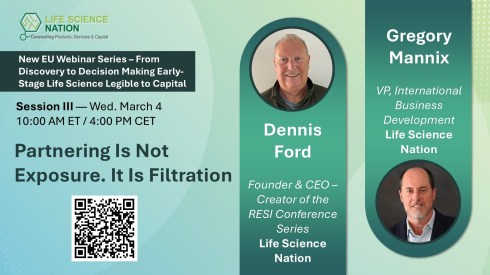
Session III — This Wednesday

Partnering Is Not Exposure. It Is Filtration

Wednesday, March 4 | 10:00 AM ET / 4:00 PM CET

Session III will feature Dennis Ford, Founder & CEO of Life Science Nation and creator of the RESI Conference Series, alongside Gregory Mannix, VP, International Business Development, Life Science Nation.

This session confronts a simple truth: great science does not raise capital, signal does. We will examine how investors actually price risk, why fundraising must be run as a disciplined global campaign, and how legibility turns complex science into an investable story.

We will also address a costly mistake: engaging the wrong partnering events and the wrong investors too early. Not every conference, forum, or investor fits every stage of development. Success requires selecting the right venues, building a stage-appropriate global target list, and engaging partners who are structurally aligned with your product. The goal is to replace activity with real transaction momentum.

Registration for Session III is open: https://us02web.zoom.us/webinar/register/WN_oe499TEOQGmrSnoAzNr1yw#/registration

Register for RESI Europe

Novotech at RESI JPM: Strategic Early Clinical Development for Biotech Sponsors 

As a sponsor of RESI JPM, Novotech joined the RESI community during JPM Week to engage with emerging biotech companies at pivotal stages of development. Marina Mullins, VP of Early Clinical Development at Novotech, shared insight into the company’s biotech-focused model, global execution strategy, and evolving approach to early-phase clinical development. 

Marina Mullins
CaitiCaitlin Dolegowski

Caitlin Dolegowski (CD): Can you briefly describe Novotech’s mission and core capabilities as a global CRO and scientific advisory partner? 

Marina Mullins(MM) : Novotech is a global full-service clinical research organization and scientific advisory partner focused on accelerating the development of innovative therapeutics for biotech and small- to mid-sized pharmaceutical companies. The company provides integrated clinical trial services across Phase I–IV, with particular strength in early clinical development, regulatory strategy, medical oversight, biometrics, and operational execution. 

With offices across Asia-Pacific, North America, and Europe, and long-standing site partnerships globally, Novotech combines regional expertise with global coordination to support sponsors from preclinical planning through proof-of-concept and beyond. Its model integrates scientific advisory and operational delivery, enabling sponsors to move efficiently from strategy to execution. 

CD: What differentiates Novotech from other CROs in terms of clinical execution, expertise, or client support? 

MM: Novotech differentiates itself through a biotech-centric approach and deep regional execution expertise. Rather than operating as a transactional service provider, the company works as a strategic partner, aligning development strategy with operational planning from the outset. 

Key differentiators include strong early-phase capabilities, particularly in first-in-human and proof-of-concept studies; deep regulatory and operational experience across high-performance regions such as Australia, Asia, and North America; therapeutic expertise spanning oncology, infectious diseases, obesity, CNS, endocrine, rare diseases, and emerging modalities; and a partnership model designed to provide agility, senior oversight, and milestone-aligned execution. 

This integrated structure allows sponsors to make data-driven decisions while maintaining timeline discipline and regulatory alignment. 

CD: How does Novotech’s global footprint support biotech and pharma companies as they advance clinical development? 

MM: Novotech’s global presence enables sponsors to strategically select development regions based on speed, regulatory pathway, patient access, and capital efficiency. 

For example, Australia offers an established regulatory framework that allows certain first-in-human studies to proceed under the Clinical Trial Notification scheme without requiring an Investigational New Drug submission to the U.S. Food and Drug Administration. This can provide an efficient pathway to first patient while maintaining internationally recognized ethical and regulatory standards. 

At the same time, Novotech’s footprint across Asia, North America, and Europe supports seamless program expansion into multi-regional trials. Sponsors benefit from consistent governance, harmonized data standards, and coordinated regulatory strategy as programs advance. 

CD: As a sponsor of RESI during JPM Week, what were your key objectives for participating this year? 

MM: Novotech’s objectives were centered on early engagement and strategic dialogue. The company aimed to connect with emerging biotech companies preparing for first-in-human or proof-of-concept studies, provide guidance on early development strategy and regulatory pathways, explore long-term partnerships beyond single studies, and support investor-backed companies in aligning clinical milestones with financing objectives. 

RESI provided a focused environment to engage with innovative sponsors at critical inflection points in development. 

CD: Who is Novotech most interested in connecting with? 

MM: Novotech is particularly interested in engaging with early- to mid-stage biotech companies transitioning from preclinical to first-in-human studies, and companies seeking an integrated CRO partner that combines regulatory advisory, scientific strategy, and operational execution. The emphasis is on building strategic relationships with sponsors who value early alignment between scientific design, regulatory positioning, and clinical operations. 

CD: Are there particular trends in early clinical development shaping Novotech’s ECD strategy? 

MM: Regulators are placing greater emphasis on optimized dose selection and robust early-phase data packages, increasing the use of adaptive designs, expansion cohorts, and integrated pharmacokinetic and pharmacodynamic modeling in first-in-human studies. 

There is also growing strategic use of healthy volunteer studies, where scientifically appropriate, to better characterize safety, pharmacokinetics, and target engagement before patient expansion. This can reduce downstream risk and improve capital efficiency. 

Biotech sponsors are under pressure to generate milestone-defining data efficiently. As a result, early programs increasingly incorporate translational biomarkers, seamless SAD and MAD structures, and optional proof-of-concept expansion pathways within unified protocol frameworks. 

Together, these trends reinforce a shift toward positioning early clinical development as a strategic foundation for the entire program lifecycle. 

Interested in sponsoring an upcoming RESI conference? 

To explore sponsorship opportunities, please contact resi@lifesciencenation.com. Life Science Nation would welcome the opportunity to meet and discuss organizational goals for connecting with the global RESI investor and innovator community.

RESI Europe Partnering Opens March 2: Secure Investor Meetings Early and Bring a Complimentary Second Attendee

By Greg Mannix, VP, EMEA Business Development, LSN

As RESI Europe 2026 approaches, one of the most important milestones is just ahead. On March 2, the partnering platform officially opens, giving registered attendees the opportunity to begin requesting and scheduling meetings with investors, strategic partners, and fellow innovators across the global life science ecosystem.

Below are two key updates to plan around.

Partnering Opens March 2: Secure Meetings Early

Partnering is the foundation of every RESI conference. From the moment the platform opens, companies can review attendee profiles, identify aligned investors and strategic partners, and begin building a focused meeting schedule.

The earlier you register and enter the platform, the more time you can:

  • Refine your profile and messaging
  • Target investors who match your stage and sector
  • Send thoughtful, customized meeting requests
  • Fill your calendar with high-value conversations

RESI Europe is structured to help early-stage companies connect efficiently with active investors. Through curated matchmaking and detailed attendee profiles, startups can prioritize fit over volume. Beyond pre-scheduled 1-to-1 meetings, the conference also creates opportunities for ad hoc introductions and follow-up discussions that often extend well beyond the event itself.

To help attendees prepare, Life Science Nation will host a dedicated RESI Europe Partnering Tutorial on Tuesday, March 3 at 10:00 AM Eastern Time (US and Canada). Understanding the RESI partnering system and using it to its maximum capabilities can make a significant difference in a company’s success at RESI Europe 2026. During this session, LSN staff will walk participants through how to navigate the platform, identify investors and strategic partners who are the best fit, manage outreach effectively, implement a strong follow-up strategy, and leverage the full range of conference content to strengthen their overall partnering experience. You can register for the webinar here.

Complimentary Second Attendee with 5-Day Registration

To help companies maximize their partnering coverage, RESI Europe 2026 is offering a complimentary second attendee pass with a standard 5-day registration.

Bringing a colleague allows your team to:

  • Cover more investor meetings
  • Attend concurrent sessions
  • Expand networking reach across the event
  • Ensure no key conversation is missed

This offer is not valid for Virtual or Audience Access passes. Attendees who registered for a 5-day ticket on or before February 22 may contact salescore@lifesciencenation.com to add a second attendee.

With partnering opening March 2 and expanded registration value now available, now is the time to secure your place. Enter the partnering system early, prepare strategically, and position your company to make the most of RESI Europe 2026.

Register for RESI Europe

The Needle Issue #24

Juan-Carlos-Lopez
Juan Carlos Lopez
Andy-Marshall
Andy Marshall

X-ray crystallography has long been the go-to workhorse for providing atomic structures of drugs interacting with their protein targets. Increasingly, those static snapshots are being complemented by readouts from experimental analytical tools based on nucleic magnetic resonance (NMR) spectroscopy and cryoelectron microscopy (cryo-EM), offering drug developers a broader window into proteins as dynamic, breathing molecules. This is spurring a raft of new service provider startups, including AIffinity (Brno-Medlánky, Czech Republic), NexMR (Zürich, Switzlerand), CryoCloud (Utrecht), and Intellicule (West Lafayette, IN), all of which aim to supply drug-discovery teams with state-of-the-art platforms providing structural data with rapid turnaround times and low cost.

As many of the most compelling ‘undruggable’ targets are renowned shape shifters — aggregation-prone proteins like Tau, amyloid precursor protein (APP) or huntingtin in neurodegenerative diseases, or transcription factors like P53, KRAS and c-MYC in oncology — a lot of therapeutic startup activity has recently focused around so-called ‘intrinsically disordered proteins’ (IDPs). The ability to attain markedly different conformations under different conditions allows IDPs not only to play moonlighting roles or serve as hubs in signaling networks, but also to localize into liquid- phase condensates (or membrane-less organelles — attributes that make them acutely sensitive to mutations that can compromise specificity and lead to nonspecific binding, resulting in toxicity and disease.

As IDPs frequently resist attack by conventional drug discovery approaches, a slew of startups has sprung up to try to go after this target class, many using new structural techniques. These include Peptone (London, UK), Dewpoint Therapeutics (Boston, MA), brainQR Therapeutics (Göttingen, Germany), and Kodiform Therapeutics (Oxford, UK). Just last month, Topos Bio secured a $10.5 million seed round to “tackle ‘undruggable’ proteins driving Alzheimer’s and cancer”. Dewpoint also just announced it has dosed its first patient in a phase 1/2a trial of its lead beta-catenin program in gastric cancer and elected its MYC development candidate to take forward.

An important postscript to the startup activity targeting undruggable IDPs is that more conventional ‘druggable’ target classes, like tyrosine kinases, may also represent a fruitful hunting ground for dynamic conformational states that may have been missed by traditional crystallographic approaches. Given that conventional drug targets have relatively well-trodden clinical and commercial development paths, they may also represent simpler starting points and testing grounds for commercial programs aiming to apply the new analytical approaches to support medicinal chemistry programs around validated targets.

In a paper recently published in Science, the team of Charalampos (Babis) Kalodimos at St. Jude Children’s Research Hospital use high-resolution NMR spectroscopy to gain structural insight into how SRC family tyrosine kinases (Src, Hck, and Lck) achieve processive phosphorylation of multisite substrates.

The SRC enzyme family is essential for rapid and coordinated signaling in processes such as cell migration and T-cell activation. In addition, SRC family kinases are frequently overexpressed in tumors, contributing to the activation not only of multiple scaffold or signaling proteins, such as receptor tyrosine kinases (e.g., EGFR, FGFR, PDGFR or IGF1R), but also of downstream effectors (e.g., MAPKs, FAK, paxillin, p130Cas, ELMO1 and RAC1). Although there are approved drugs like the multikinase inhibitor Sprycel (dasatinib) that bind the SRC active site, these drugs have such extensive off-target and adverse side effects that there is a pressing need for new paths to more-selective SRC inhibitors.

SRC enzymes share a conserved domain organization, with a disordered N-tail, a tandem SH3–SH2 module, a kinase domain, and a disordered C-tail. All can carry out processive phosphorylation — a phenomenon where the enzyme phosphorylates multiple residues in a substrate during a single encounter. Each of these catalytic cycles typically requires ATP binding, phosphate transfer and ADP release, and ADP release is often the rate-limiting step. So, a question that has long puzzled structural biologists is how ADP-release–constrained kinases achieve sufficiently rapid turnover to successfully perform their function.

Using NMR spectroscopy with cryogenic probes — which reduce electronic/thermal noise and increase sensitivity up to five-fold compared with room-temperature probes — the St. Jude team characterized the conformational ensemble of the Src kinase domain and identified three interconverting states: a predominant active state, a previously described inactive Src/CDK-like state, and a hitherto unknown low-populated intermediate state positioned linearly between the other two. Structural determination revealed that this intermediate state displays features that are distinct from the active and inactive states. Its activation loop is partially folded, the P-loop is displaced inward, and the αC helix is shifted upward. This conformation binds ADP poorly relative to the active and inactive states, suggesting that it facilitates nucleotide release.

Using mutational analyses, the researchers then confirmed the functional importance of this intermediate state. Variants that eliminated this intermediate state while stabilizing the active state showed slower ADP dissociation, reduced catalytic turnover and impaired processive phosphorylation of the multisite Src substrate p130Cas. Instead of generating a fully phosphorylated substrate in a single binding event, these mutants accumulated partially phosphorylated intermediates. Equivalent mutations in other kinases of the SRC family, Lck and Hck, similarly reduced catalytic efficiency and impaired multisite phosphorylation of their respective physiological substrates CD3ζ and ELMO1 in Jurkat cells. Furthermore, these mutations compromised cellular functions measured via in vitro assays, including T-cell activation using Lck-deficient Jurkat cells and migration of mouse embryo fibroblasts lacking Src, Yes and Fyn in the presence of fibronectin. These molecular and functional findings indicate that the intermediate state is evolutionarily conserved and essential for processive activity across the SRC family.

Mechanistically, the work establishes that rapid ADP release, enabled by transient sampling of a structurally constrained intermediate, is critical for sustaining catalytic turnover rates that exceed the speed of substrate dissociation. More broadly, it shows that kinase conformational landscapes are tuned not only for switching between active and inactive states, but also for optimizing specific kinetic steps within the catalytic cycle.

From a drug developer’s standpoint, because Sprycel and other inhibitors target the active or inactive conformations of the SRC active site, the identification of a low-populated, functionally indispensable intermediate suggests a completely new strategy to target tyrosine kinases: selectively stabilize or destabilize the intermediate state to fine-tune catalytic turnover and processivity rather than simply blocking activity. Targeting such transient conformations could enable more precise modulation of signaling output, potentially improving selectivity and reducing off-target effects in kinase-directed therapies.

We look forward to seeing how many more of these intermediate states are uncovered in other kinase targets and whether pharmacological inhibitors targeting this state have advantages over orthosteric or allosteric chemotypes that conventionally have been used to inhibit the kinase active site or lock it in an inactive conformation. What is clear is that ultrafast NMR measurements of binding and state behavior are a powerful differentiating tool for understanding kinase activity where static structures aren’t enough.