Tag Archives: LSN

LSN Summer Reading Series Issue #4

18 Jun

By Michael Quigley, Director of Research, LSN


mike-2This week in the summer reading series, we explore the current categories of early stage life science investors. As a result of the significant changes the investor landscape has undergone in the past few years, many traditional players have moved downstream to later stage investments or out of the space entirely, and new faces have stepped in to fill the void. Understanding what motivates these different groups and how they operate is crucial when looking for a successful financial partnership.


Chapter 4 of The Life Science Executive’s Fundraising Manifesto “Categories of Life Science Investors” explains how and why the funding landscape has changed, the types of investors who are currently funding companies, and, in general, the approach these entities take toward investing.

Click here to download/print the PDF.

We hope this text proves to be informative. Next week we will turn the focus inward with Chapter 5: “Knowing Who and What You Are, and Where You Fit.”

Enjoyed the preview? Buy now from Amazon.com or Barnes & Noble

Bookcover-Front

LSN Summer Reading Series Issue #3

11 Jun

By Scott Parks, Director of Marketing, LSN 

Scott 2With the third installment of the summer reading series we take a look at the important decision of whether or not one should use a fundraising partner to help them in securing capital. Chapter 3 of The Life Science Executive’s Fundraising Manifesto “Going It Alone or Choosing a Fundraising Partner,” tackles this question head-on, describing what companies would be a suitable fit for fundraising partners, providing a breakdown of the different types in the marketplace today, and advising readers on how to go about vetting a potential partner.

Click here to download/print the PDF.

We hope you enjoy this chapter. Next week, join us for “Chapter 4: Categories of Life Science Investors.”

Enjoyed the preview? Buy now from Amazon.com or Barnes & Noble

Bookcover-Front

An LSN Summer Chapter Series

28 May

By Scott Parks, Director of Marketing, LSN 

Scott 2Your fundraising efforts certainly won’t slow down this summer, nor will the team at Life Science Nation. We’re always on the clock, committed to providing early stage life science companies and investors with the critical data necessary to create compelling connections between technology and funding. In this spirit, LSN’s Next Phase will be publishing one chapter each week of our hit book from last summer, The Life Science Executive’s Fundraising Manifesto by Dennis Ford.Bookcover-Front

The Life Science Executive’s Fundraising Manifesto helps scientists understand the fundamental skills needed to brand and market their companies. It discusses how to use a consistent message to achieve compelling results from a fundraising campaign and how to aggregate a list of potential global investors that are a fit for your company’s products and services. The book also explains how to efficiently and effectively reach out to potential investor targets, start a dialogue that fosters a relationship, and ultimately secure capital allocations.

The LSN Summer Reading series begins with “The Legal Landscape: A Basic Overview.” Contributed by Gerard P O’Connor, Esq, this first chapter provides a whistle-stop tour of all the legal issues a fundraising CEO needs to consider when raising capital.

Click here to download/print the PDF.

O’Connor introduces the regulatory bodies a fundraising CEO will encounter, defines accredited investors, and presents some of the alternative options to pursuing venture capital funds. The chapter also informs entrepreneurs regarding key concepts in dealmaking, including dilution, terms, and working with brokers.

We hope you find this exploration of the legal considerations involved in fundraising to be informative. Join us next week for Chapter 2 — “Crowdfunding and IPOs.”

Enjoyed the preview? Buy now from Amazon.com or Barnes & Noble

Investors Building Life Science Companies from the Ground Up

12 Dec

By Alejandro Zamorano, VP of Business Development, LSN

LSN tracks ten categories of life science investors around the globe. Recently, we have begun to follow and emerging trend of established investors creating and launching their own companies. These investors are cognizant of the critical importance of good management when it comes to asset commercialization. The school of thought behind this innovate approach is that emerging technologies stand more of a chance when strong leadership and organization is put around an asset from the get-go. So, why is this occurring and how exactly is this being executed?

From the firms LSN has spoken with, this approach is essentially an fusing two key elements – Access to capital and access to a network of experts, both of which help to make leaner, faster, and more efficient companies. It all starts with sourcing novel science from a translational researcher, and building a business structure around it.

Since the investor is starting the company, it is possible to structure the “perfect” company from the ground up. This goes beyond investor fit – it’s a custom tailored company to fill a portfolio need. This can create significant advantages early on in the company’s life cycle, as fundraising seed capital isn’t a problem. By avoiding this part of the process, the company can focus on moving the science forward. Moreover, the company can structure the management strategically from the get-go, by having a business-savvy CEO in place who has the sales experience required to turn innovative science into a company.

Add to this that the investor can shepherd multiple assets through the pipeline by outsourcing work to CROs, and you have a great lean model for building a portfolio of companies. This model is gaining traction, so stay tuned as LSN tracks this evolving trend.

CRO Trends in 2014

5 Dec

By Alejandro Zamorano, VP of Business Development, LSN

As we round out the final quarter of 2013, LSN looks towards the new year and what it holds for CROs (Contract Research Organizations) within the life sciences. LSN maintains regular dialogue with a broad spectrum of CROs – from top-tier full service organizations, to small niche-specialized research companies. Based on our market insight, here are the top behavior trends among CROs for 2013 as we continue to see strong growth in this critically important sector of our industry:

The Death of the Passive Business Development

The CRO space has become increasingly crowded over the past year, and with mounting pressure on biotech companies to achieve capital efficiency, the market is becoming increasingly competitive. CROs that rely on inbound leads and recurring revenues from longstanding partners will face serious challenges in an environment where only the hunters survive. Those organizations that iterate their business development tactics will be the winners, and outbound sales will rule the day. As the industry matures, we will begin to see more sophisticated marketing campaigns as sales organizations adapt to the new market dynamic.

Developing Therapeutics

Tempted by the success of their clients, and a wealth of in-house expertise, a handful of CROs are starting to leverage their proprietary technology platforms in the hopes of developing their own novel assets. This will cause a shift within the industry as the lines start to blur between a CRO and a biotech company. The biggest obstacle to success in 2014 will be the ability to raise the necessary funds needed to shepherd the asset through clinical development, especially when the focus of management will be split. However, considering the fact that CROs already have revenues from the service side of the business, they may require less outside capital for asset developments, making for an enticing investment opportunity.

Consolidation

Private equity groups are becoming a major play in the CRO space, providing much-needed capital for growth. Many of the PE players in the space are purchasing and consolidating mid-level players to create economies of scale and synergies of business. Buyouts will certainly provide some liquidity events, but more importantly, consolidation will be an important counterbalance to the growing number of CROs. Moreover, as private equity groups create more efficient players via M&A activity, the pressure is on for smaller players to stay competitive.

Investor Partnerships

Today, the growing trend among service providers is to team up with well-known investors that have a continuing demand for certain basic services such as clinical development and contract manufacturing. By building these alliances and by outlining a discounted rate, CROs can create a consistent supply of customers by providing investors with a price break. This is a win-win in both situations, where investors get increased control and cost efficiency for their portfolios, while CROs gain a powerful dealflow engine.

Investment Activity

LSN recently covered the trend of CROs making direct investments into life science companies. This trend is also likely to accelerate as CROs take advantage of the opportunity presented by early stage companies strapped for cash in the form of services-for-equity arrangements, or outright corporate venture activity.

2014 will be an interesting year for CROs, as the increasing competitive nature of the industry will leave only the most innovate companies to enjoy market growth. Be sure to stay tuned as LSN continues to track the key market dynamics affecting service providers going forward.

LSN Investor Database Feature: Non-VC Interest in Early Stage Medtech

4 Dec

By Max Klietmann, VP of Marketing, LSN

Recently, I wrote a feature detailing the increasing number of non-VC entities investing in early stage biotech companies. Due to the interest that article generated, we’ve decided to follow on with another LSN Investor Database Feature; this edition will focus on the early-stage investor interest in the medtech arena.

As mentioned in the previous feature, LSN’s investor research group maintains quarterly contact with over 5,000 active investors in the life science space, with a particular focus on those categories filling the void left by Venture Capital. This gives LSN unprecedented insight into what private investor trends look like today and going forward.

The chart below shows the results of an LSN Investor Database search mapping out all non-venture capital investors tracked by LSN with a declared interest – or mandate – in seed/venture stage medical technology companies with a prototype or early-stage clinical asset. The result is 561 investors globally. This should be very encouraging news to the executives of a space that has seen a great deal of turbulence in recent years in terms of fundraising trends.

Chart Issue 46Click to Enlarge

So what’s the next step? If you’re an early-stage medtech looking to raise money, these investor categories should certainly be on your radar. Second, do your homework on how exactly these categories behave in terms of investment activity. LSN’s research team can help elucidate this information on an investor-by investor basis. Finally, the space is in flux, so stay tuned as LSN continues to offer insights on the changing medical technology investor landscape.

LSN Announces RESI II

20 Nov

By Max Klietmann, Conference Co-Chair and VP of Marketing, LSN

The LSN team is very pleased to announce the second Redefining Early Stage Investments conference, to be held Monday, March 24, 2014 in Boston. This event is the next in LSN’s ongoing conference series focused on creating a dialogue between emerging life science companies and active early stage investors from ten categories around the world. LSN is committed to maintaining its mission of moving science forward by creating a forum for early stage innovation and capital to meet, and we are building on last September’s success. We’ve made some exciting changes for the March event – Here are some highlights:

Full Day Partnering – RESI will have partnering meetings available for the full duration of the day.

More Investor Panels – We’ve increased the number and variety of investor panels available to conference participants, based on cutting-edge content derived from our constant research of the industry.

Free Workshops – RESI will host a series of in-depth workshops in the areas of outbound fundraising, valuation, and the legal landscape.

Disruptive Technology Horizon – RESI will host a half-day session on the emerging disruptive technologies that have the potential to redefine the industry in the future.

New Company Presentation Format – RESI is offering innovative life science companies the opportunity to showcase their technologies to investors via poster displays throughout the (expanded) exhibit hall, giving them full-day exposure to investors and other conference participants.

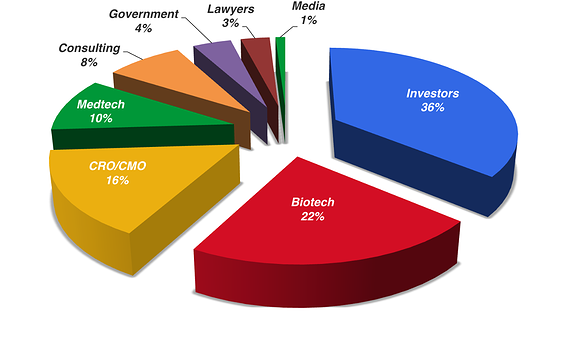
If you haven’t attended RESI yet, here is a quick overview of attendance distribution from last year:

  • Over 300 attendees last year (targeted 200), estimating 500 this year
  • Over 115 early stage investors from around the world
  • 43% International / 57% Domestic
  • Attendee profile split per the chart below:

RESI Attendance BreakdownSpecial reduced earlybird registration rates for attending and exhibiting are available for a limited time only, so be sure to register now!

Special sponsorship opportunities are also available now.

We look forward to seeing you in March. Stay tuned for more RESI II conference updates.