

Government Pensions Move Towards Direct PE Investments in the Healthcare Space

By Danielle Silva, Director of Research, LSN

Government Pensions have been investing in private equity funds for decades, but have now been increasingly moving towards direct investing into companies over the last couple of years. Like family offices, government pensions have suffered over the past two years because private equity funds have by and large displayed discouraging performance. It no longer makes sense for government pensions to continue to pay these managers fees if they are unable to help these pensions attain their mandated return targets. For this reason, government pensions are moving towards direct investments because of their familiarity with the private equity and co-investment space, and are moving towards investing in the life science sector due to the current nature of the M&A space within the sector.

Government pensions have long-term investment horizons. Historically, they have set high percentages for their target asset allocation to private equity funds due to the long-term nature of these investments. Recently, however, many have re-assessed these investments, and since many pensions have dabbled in co-investing in the past, and usually have seasoned private equity specialists in-house, a good number of pensions have moved towards direct investments in order to achieve a better ROI than they would gained through indirect investments in private equity via a fund.

Pensions also have increased control over investment selection by making direct investments. Through direct investing, pensions also have greater transparency regarding how a portfolio company is doing financially. Pensions are thus able to quickly come in and make changes to a struggling company in order to make it profitable again, whereas if they were investing in a company through a fund, they may not know about the financial issue, or may not find out about the situation soon enough to make changes that would rectify the situation. The end benefit is the increased transparency that direct investing affords government pensions helps them to more easily reach their targeted return rate.

Government pensions have been attracted to the life science sector for a number of reasons: One of the most notable reasons is the potential for a large exit; companies that government pensions are acquiring could be great potential merger or acquisition targets for pharmaceutical or large medtech companies. Government pensions, along with many other new investors in the space (such as family offices) have recognized this, and have increasingly started to allocate to the space.

Government pensions are also longer-term investors who have a longer investment horizon than other types of investors and larger allocation sizes, so they have the ability to bring a product from the discovery/development phase all the way to market.

The trend in the space has been towards larger government pensions moving towards direct investments in the sector, because these types of pensions have teams internally that have private equity experience and have had experience with co-investments in the past. Many smaller pensions typically use consultants who chose private equity funds on their behalf; many of these pensions have not yet begun to invest directly within life sciences. Larger government pensions it seems will continue to ramp up their direct investments in the life science space, and perhaps as smaller pensions begin to see the benefits of this strategy, they too will start investing directly in the space with the aid of their investment consulting firms.
The Straightest Line to Commercialization

2 Major Investment trends in Life Sciences in 2013, and what’s driving them

By Max Klietmann, VP of Research, LSN

In recent months, LSN’s research team has interviewed a large number of investors that are increasingly targeting their investment criteria in two key areas: orphan drugs and targeted therapies & companion diagnostics. This article seeks to explain exactly what defines these spaces, and what makes them so attractive given the current environment.

Trend 1: Therapeutics Targeting Orphan Indications

Orphan diseases are rare diseases defined by the FDA as having fewer than 200,000 afflicted persons in the United States – an approximate incidence of 1 in 1,500 people. These indications were historically unattractive due to the limited number of target patients, but now enjoy significant regulatory advantages due to incentives granted by the FDA.

The resulting benefits of targeting an orphan designation include a faster regulatory path, decreased regulatory scrutiny, and premium pricing. As attractive as this may have been historically, it is becoming even more interesting from an investment perspective today as many industry experts believe that FDA regulation is likely to become more restrictive in coming years, and cost pressures will force down the prices of many therapeutics that do not enjoy the “pricing buffer” that orphan drugs do. This is an important consideration for investors, especially in early stage companies, since the nature of the FDA during preclinical trials today may be very different from phase III trials a few years further down the road.

Trend 2: Targeted Therapies & Companion Diagnostics

The second major trend of high interest to strategic investors across the board in the coming year is targeted therapeutics & companion diagnostics. The concept here is also driven by regulatory pressures, and aims to carve out “micro-indications” within major disease categories. For example, if a firm is seeking to develop an oncology therapeutic targeting breast cancer, they have the opportunity to target only a specific subset of patients who exhibit a specific biomarker that correlates to a higher efficacy rate for the paired therapeutic. Essentially, this comes down to finding a target niche within an indication, which yields the best possible clinical results, expediting the regulatory path. Once the drug has made it to market, early trial data can be recycled as the indication scope is expanded to cover more populations while the company enjoys an active revenue stream.

Fundamentally, both of these trends reflect a growing understanding among investors in life sciences that the days of “hot-potato-ing” an asset on to the next investor are over. The industry requires long-term investors with a genuine willingness to bring drugs to market, and therefore, the active capital is streaming towards those product areas that are not targeting the blockbuster indications, but can make it to market fastest. The trend for 2013 is most certainly “bunt to market” rather than “swing for the fences.

The Benefits of Technology Transfer in Today’s Marketplace

By Alejandro Zamorano, VP of Business Development, LSN

Every successful business starts with an idea that is commercialized and brought to the marketplace.

At the core of an academic researcher’s role is to be unbiased arbitrator of the natural world. As a result, academic institutions often prevent academic researchers from taking financial positions in their discoveries within the confines of the institutions.

Consequently, few academic researchers take a lead role in actively commercializing their discoveries. Since lead investigators lack the incentive to commercialize their discoveries, this responsibility of commercializing assets is assumed by an institution’s tech transfer office.

Tech transfer offices play a major role in the industry by providing a marketplace for these emerging technologies. The most active bidders for technologies have been emerging biotech companies and sophisticated private equity firms that have been busy compiling assets in anticipation of big pharma’s patent cliff. By giving the assets to third party developers, it liberates the institution conflict of interest while still retaining a vehicle that enables financial rewards. These licensing agreements usually come in the form low upfront payment, a 1-3% downstream royalty, and a buyout option.

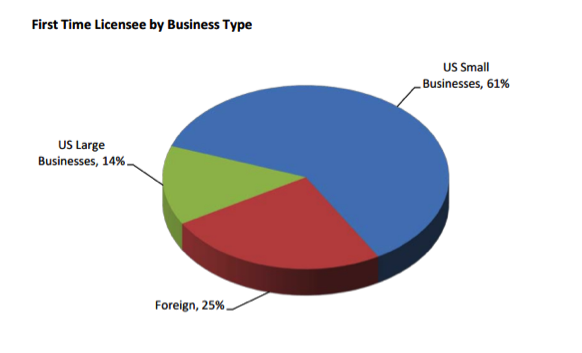
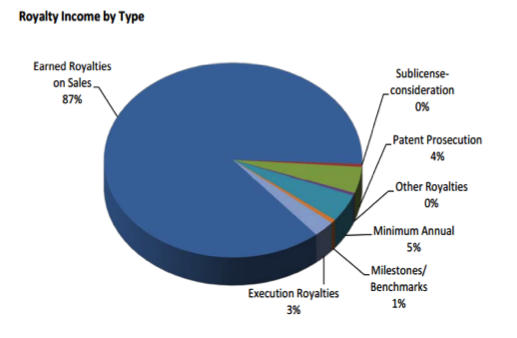
For example, by taking a look at the NIH – which has had one of the most prolific tech transfer offices in the past two decades – one can gain insight into the inner workings of traditionally obscure sectors of the industry. In 2011, the NIH generated $97m in payments from commercialized technology that NIH had out licensed. This revenue was generated from 411 technologies, with the top 20 technologies representing around 73% of the total revenue. In that same year, the NIH executed 197 licensing agreements with 82% US companies of which 52% were considered small business. In addition, of technologies out licensed by the NIH in 2011 22% were companies that were in-licensing technology from the NIH for the first time. Issuance for first-time recipients has been trending upwards for the past five years indicating a shift over the past several decades.

ImageImage

Despite the success of a few tech transfer offices in the industry, the majority of tech transfer offices suffer the lack of a centralized database to sort through academic assets. The inability to easily search through technologies is hampering the growth of the life sciences industry by limiting visibility to interested bidders. As a result, interested bidders usually obtain their technologies by leveraging their personal contacts, which tend to be regionally focused.

Hot Life Science Investor Mandate 1: Evergreen Family Office Looking to Move on New Medtech Opportunities – February 5, 2013

A family office located in the Eastern US is currently looking for new companies in the medtech space. The firm, which has over $200 million in total assets under management, is specially looking for medical device companies, however has no specific preference in terms of what kind of device the company produces. They typically invest around $5 million in equity per company. Because the firm has an evergreen structure, there is no set timeframe to make an allocation, and thus the firm is always opportunistically sourcing new investment opportunities.

The firm primarily engages in buyout transactions, but does sometimes provide growth or venture capital to firms on a case-by-case basis. With that being, said the firm may consider a pre-revenue company that does not have a device currently on the market. The firm prefers companies that have under $100 million in revenue, and between $1.5 and $15 million in EBITDA. The firm invests in deals up to $75 million in transaction value.

Hot Life Science Investor Mandate 2: PE Group Seeks Software Suppliers, Healthcare IT – February 5, 2013

A private equity group based in the Eastern US is currently looking for new investment opportunities in the life science space, and plans to invest in four firms throughout 2013. The firm currently has around $150 million in total assets under management, and is deploying capital from its third fund.

The firm is currently looking for new opportunities in the suppliers and engineering space as well as the service providers space. In the suppliers and engineering space, the firm is looking for software suppliers, and in the service provider space, the PEG would be most interested in healthcare IT firms.

The firm is looking to take at least a 60% equity stake in all future portfolio companies. Also, they will not invest in any pre-revenue companies, and consequently will only consider firms that currently have a product on the market. The PEG is looking for firms that have at least $1 million in EBITDA, and annual revenue within the $2-20 million range.

Hot Life Science Investor Mandate 3: Large Pension’s PE Arm Targeting Small CROs for Add-On Acquisitions – February 5, 2013

A private equity investment arm of a pension plan located in Canada, which has over $100 billion in total assets under management, is looking for new opportunities in the life science sector, and is currently targeting add-on acquisition targets for one of the firm’s portfolio companies. The pension’s equity investment size will vary depending on the size of the add-on target, however the firm is looking to acquire a strategic partner for their portfolio company as soon as possible.

The PE arm is currently looking for firms in the biotech R&D services sector. More specifically, they are seeking small, clinical-focused contract research organizations (CROs), and are most interested in firms that specialize in the areas of cardiology and endocrinology.

The fund is currently only seeking firms for acquisition, and thus is only looking for firms that are interested in a buyout or recapitalization transaction. The pension is seeking firms that have around $2-5 million in EBITDA.

Leveraging Outbound Marketing for Fundraising Campaigns

By Tom Crosby, Marketing Manager, LSN

As a branding, messaging and marketing tool, digital publications are unmatched in their ease of use, cost-effectiveness, and wide deliverability. Whether it is a monthly journal, a weekly newsletter, or a mailing targeted at a list of people you want to keep updated, the savvy life science marketing department will ultimately make use of this medium to gain exposure for their brand and deliver the message to your prospective marketplace.

The benefits of web marketing are as innumerable as they are beneficial; this is no truer for any industry than it is for the life sciences. By instantaneously connecting the entire range of professionals – from drug developers to business developers – the conversations that bring life-saving technologies to market are facilitated in time frames that were unimaginable just decades ago.

Recently, LSN helped a client with a targeted mailing in a fundraising campaign. The client is a drug developer with a novel treatment for an orphan disease for which there was previously no relief, short of disabling the patient’s immune system. The mailing, which went out to a vetted list of 300 new investor contacts, was aimed at developing a pipeline of investor candidates to help raise funds to complete the drug’s clinical trials.

The goal was to broaden the range of investors from VC’s and grants, to mid-level PE, family offices, foundations, and new corporate venture. And by the end of the same day that the mailing went out, there was a 20% open rate for the email (or 67 opens), with 7 actually clicking on the link to his executive summary provided in the email.  Three different foundations dedicated to the exact condition had even seen the call to action, and followed the links to his website.

Considering the Basics of Newsletters

Targeted mailings are only effective in special situations, however. One of the best methods for reaching your audience on a regular basis is some sort of digital canvass, followed up with a phone call canvass. Smaller firms often choose to go with a newsletter-type outreach to their target audience, because it works well to provide ongoing status updates regarding the progress of a company’s product development. At LSN, for example, we make it a weekly objective of ours to write about something industry-related; usually, it is wherever our work takes us throughout the week. The trick is to cover relevant, interesting, and useful information. With a little focus, the right topics inevitably come to light. After all, we are all daily consumers of media. If it interests you, there’s a good chance it will interest industry peers.

In reality, content is one of the easy parts of producing a newsletter. There are many other things to consider when launching your company newsletter that may seem insignificant, but can actually have a large impact on the success or failure of your web marketing campaign. For instance, when will you send your email: early in the morning, or after lunch? Do you wait for California to wake up, or catch Europe in their offices before the end of the day? And on what day of the week? These are just a few of the questions that you must ask yourself when beginning any online campaign. Failure to consider any of these things could mean your mailing gets buried, and the right set of eyes never sees it.

Another important aspect of your mailing campaign is whether you’ll facilitate the mailing in-house, or if you’ll let a third party handle the delivery. Until the last few years, the best option may have been the former. And for smaller operations with a smaller amount of targets to reach, it may still be; it isn’t difficult to manage a list of 500 emails, even with Microsoft Outlook. However, the advantages that third-party clients offer are vast, and they’re getting better all the time.

One of these advantages is flexibility. Doing an in-house mailing means that you either have to keep it simple, or have someone that knows HTML. Third-party sites like Constant Contact, iContact, and Benchmark – in addition to traditional HTML – offer the choice of using browser-integrated creation software. This gives you the opportunity to go as simple as an introductory letter, to as complex as an industry-standard newsletter, while maintaining a professional look and feel along the way.

The biggest advantage of using a newsletter hosting service, however, is using the integrated contact management tools. This covers everything from subscription management to performance tracking. Without help, these tasks can be fairly daunting, even for experienced users, because of the legal implications involved. And while it is interesting and useful to be able to track the success of your newsletter or targeted mailing down to the finest detail, if you are not 100% compliant with the law, your campaign will not get too far. The peace of mind alone is worth your monthly subscription fees. With the health of your contact list constantly being monitored, you are free to focus on the quality of your content and design.

If you are successful in keeping your content at a high level of quality, and don’t step on too many toes along the way, your mailings will eventually pay off. Like most things, it takes time, and a lot of patience; investors aren’t likely to make allocations based on a few well-written articles. However, email correspondence is absolutely vital, and by keeping yourself and your firm on the minds of the right people, your efforts will ultimately pay off in a big way.