Archive | March, 2017

Redefining Early Stage Investments Conference Series – RESI on MaRS 2017 Program Guide

23 Mar

By Nono Hu, Director of Marketing, LSN

With RESI on MaRS coming up in 10 days, the LSN team is getting ready to head to Canada’s hub of healthcare innovation, Toronto!  RESI on MaRS will bring more than 250 investors under one roof, providing you with one-of-a-kind networking and partnering experience.

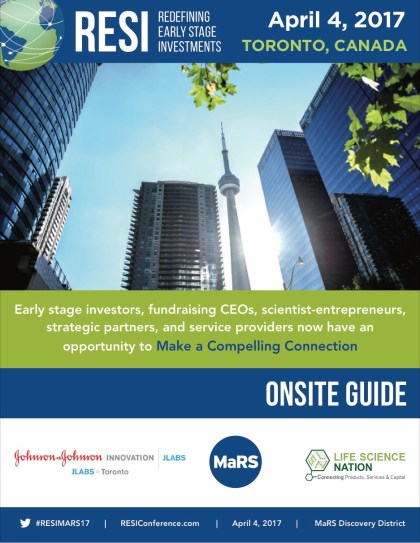
LSN is proud to present the RESI on MaRS Program Guide. If you’re planning your day at RESI on April 4, 2017 to see full lists of the investor panel speakers, RESI Innovation Challenge finalists and service providers you could meet, look no further!

Hot Investor Mandate 1: Family Office Seeking 510K Devices Throughout US

23 Mar

A Venture Fund/Family Office founded in 2002 and based in Nashville Tennessee is looking to make series A rounds of approximately $1.0 – $1.5 million in rounds totaling $3-$7 million. The firm is open to investing into companies located throughout the United States and makes approximately 2-4 new investments per year.

Within life sciences, the firm is most interested in companies in the medical device and diagnostics space. The firm is looking for companies that have a 510k regulatory pathway with at least a working prototype of the product and preferably some in-human data. The firm is generally open to all indications with particular interest in oncology, rare cancers, diabetes, neurology, ophthalmology and cardiology. The firm is especially interested in CLIA lab diagnostics, software enabled devices, molecular diagnostics for rare cancers and diseases, and algorithms that interpret genetic information and recommend treatment options. The firm is also interested in nutraceuticals, expedited drug development, HIT and business to business technology companies although these areas are less of a focus.

The firm is looking for private companies with experienced management team and looks to take a board seat following investment. The firm looks to be a hands on investor and is willing to both lead and co-invest.

If you are interested in more information about this investor and other investors tracked by LSN, please email mandates@lifesciencenation.com

Hot Investor Mandate 2: Global VC with New Fund Seeking Innovative Therapeutics

23 Mar

Venture Capital firm with offices in the US, Canada and Europe focuses on seed and series A and B investments in early stage biotechnology companies, as well as growth equity investments in medical devices companies. The firm’s typical investment size for early stage companies is $5M-$15M and the firm can allocate up to $35-40M total over the life of an investment. The firm focuses on companies that are based in the U.S., Canada and Europe and is actively seeking new investment opportunities.

In early 2017, the firm closed its newest fund that will use a diversified global investment strategy to find, form and fund innovative healthcare companies with an emphasis on novel therapeutics. The fund will invest in approximately 20‐25 biotechnology companies in the U.S., Canada and Europe.

The firm is opportunistic in terms of subsectors and indications. The firm is interested in novel small molecule and biologic therapeutics that address oncology, orphan or genetic based diseases, inflammation, infectious diseases, fibrosis and CNS indications. The firm also is interested in regenerative medicine. In medical devices, the firm is generally agnostic to subsector, but is more interested in revenue-generating devices that address cardiovascular, orthopedic, ophthalmic and neurological disorders. The firm prefers devices with proof-of-concept and strong IP.

The firm seeks a company with a strong and experienced management team or technical experts in the relevant technology. The firm generally is flexible with management teams.

If you are interested in more information about this investor and other investors tracked by LSN, please email mandates@lifesciencenation.com

Hot Investor Mandate 3: Family Office Seeking Seed Stage Investment Opportunities in Healthcare

23 Mar

Family office based in Seattle, WA typically provides $50K equity capital to seed stage companies in the life science space, but has invested up to $500K in the past. The firm is looking to make about 2-3 investments per year. Additionally, the firm will provide strategic and directional expertise to their portfolio companies and support their growth to later developmental stages. The firm considers US-based companies with a focus in the West Coast.

The firm is open to all sectors within the life science space including therapeutics, diagnostics, medical technology, and healthcare IT. The firm is particularly interested in companies developing therapeutic products of all indications, as the firm’s strongest expertise lies in this space. The firm will consider companies with assets that are pre-clinical or in Phase I clinical trials. In terms of medical technology, the firm will consider medical devices in development or undergoing clinical trials, and is open to those in 510k and PMA regulatory pathways.

The firm is a passive, early-stage investor and will not require a board seat in portfolio companies. The firm seeks to work with passionate, experienced entrepreneurs with a track record of success, but will not rule out companies that are run by first-time entrepreneurs.

If you are interested in more information about this investor and other investors tracked by LSN, please email mandates@lifesciencenation.com

Hot Investor Mandate 4: Chinese PE Firm Seeking US Based Clinical Stage Therapeutics, Devices and Diagnostics

23 Mar

PE firm founded in 2015 and is based in Beijing, China has approximately $100M assets under management and manages 2 active funds – the RMB and USD Funds – that focus on investments in the life science space. The RMB Fund invests $5-40 M in companies based in China, and the USD Fund invests $5-10 M in companies of all parts of the world, with a focus in US and China. With these funds, the firm will make 1-2 investments per year in companies that have market opportunities in China. The firm will provide companies with resources and expertise for competitive market entry and will assist pre-market products with commercialization.

The firm is opportunistic and is open to all life science sectors in all indications, including therapeutics, medical technology, diagnostics, and healthcare IT. The firm will not consider companies with pre-clinical or early clinical assets. In therapeutics, the firm will consider products that are in Phase II clinical trials and beyond. In the medical technology sector, the firm will support devices of all regulatory pathways and will also assist with CFDA regulatory filing and approval. These devices are expected to be undergoing pivotal trials at the earliest, and should be close to commercialization.

The firm will invest only in companies that are looking to enter the market in China, and is willing to both lead and co-invest. The companies will ideally have an IPO or trade sale runway of 6 to 24 months. Companies should be backed by an experienced management team but for companies based in China, the firm can assist with the assembly of a complete management team.

If you are interested in more information about this investor and other investors tracked by LSN, please email mandates@lifesciencenation.com

Life Science Nation’s RESI Conference – The Sweet Spot

16 Mar

An interview with Life Science Nation’s CEO Dennis Ford regarding the up and coming Redefining Early Stage Investments conference series – By Ying Tam

Ying Tam, Head, Digital Health Cluster, Venture Services, MaRS:

Dennis, what is the key differentiator of the Redefining Early Stage Investments (RESI) Conference?

Dennis Ford, Founder & CEO, Life Science Nation; Creator of RESI Conference Series:

The sweet spot. RESI is the only “dedicated” early stage global investor conference out there that I can find. On another note, we actually deliver 10 categories of early stage investors. Also, to your point, RESI is unique and the only one that goes across the silos of Drugs, Devices, Diagnostics and Healthcare IT, which is one of the reasons why JLABS has stuck with RESI as title sponsor for three years now. Many investors have multiple investment mandates covering multiple silo’s in the life science arena.

Ying Tam: Who does the RESI Conference compete with?

Dennis Ford: There are other conferences that we share the marketplace with. RESI is focused on Preclinical, Phase I and Phase II funding strictly. Other conferences tend to be more general and more focused on Phase III and commercialization centric in their content and RESI has 16 panels of dedicated to early stage investment content aimed precisely at fundraising CEOs and scientist-entrepreneurs.

Ying Tam: Explain how you and other conferences know you are getting the right investors?

Dennis Ford: I attend these conferences regularly and pay very high fees ($3,500 + USD) to go and therefore get the attendee lists. From the last one I attended, I downloaded the alleged 120 investors attending and gave them to our research group to validate. What we found was 22 investors that actually had investment mandates for early stage preclinical and the rest were I-Banks, consultants, and finance BD folks who go to these events trying to get fundraising CEOs to pay them a monthly stipend for services to aid in raising capital. All of which is fine for them and a draw which creates revenue. RESI only allows “real” investors with vetted mandates. RESI Investors need to adhere to these strict guidelines. RESI@JPM had 500+ investors so the numbers speak for themselves.

Ying Tam: What about Pharma partners?

Dennis Ford: All of the Big Pharma players globally regularly attend RESI conferences and present on our RESI panels. They are seeking technology assets for their pipelines. Pharma attendees are the scouts and BD players and are typically the buy side staff for the Pharma.

Ying Tam: How is RESI business model different?

Dennis Ford: I created the RESI conference and the business model is a real challenge because the price point has to stay relatively low for our scientist-entrepreneur and fundraising CEOs audience. The challenge is investors don’t pay (and won’t) so only half the attendees pay and that makes it hard from the business side. I can understand why other conferences in the market are more general and have a broader content reach as that really helps the bottom line. That said, RESI is a success on many other fronts which is providing a vehicle every 45 days for CEOs to get in front of investors, start a dialogue, that leads to a relationships and hopefully an allocation. We now have 5 RESI conferences a year, JPM, Toronto, BIO, Boston, NYC and that means that a CEO can get 16-20 investor meetings per event and that is a BIG deal as fundraising is a numbers game. RESI provides a vehicle to match up investors and scientist-entrepreneurs and if they attend all 5 RESI meeting can have a dialogue with up to 100 investor meetings and that is a game changer.

Ying Tam: How successful is RESI in terms of getting companies funded?

Dennis Ford: We have run some metrics and have found 15-20% of the firms who buy our global investor database, attend our RESI conferences, and use the techniques outlined in my book do raise capital. We can do better than that but that would mean really getting the sell side players educated and more efficient at branding and messaging and understanding how to run a compelling fund raising campaign.

Dennis Ford, Founder & CEO, Life Science Nation; Creator of RESI Conference Series

Dennis Ford is an entrepreneur and author with expertise in sales, marketing, and business development. He has spent most of his career launching new companies. Over the last decade, he has worked extensively with global alternative investors interested in high-growth early-stage technologies. His expertise encompasses using database subscription services to create business solutions and using the Internet to create an interactive dialog between buyers and sellers. He is a big proponent of using profiling and matching technology to find that all-important business fit in the marketing and selling process. Before LSN, Dennis was the President and CEO of Brighton House Associates (BHA). BHA was launched in order to improve the way hedge fund and private equity fund managers raised capital and marketed their funds to investors. Ford is the author of The Peddler’s Prerogative and The Life Science Executive’s Fundraising Manifesto, two well-received sales and marketing books.

Ying Tam, Head, Digital Health Cluster, Venture Services, MaRS

Ying Tam is a seasoned entrepreneur and business executive, and is currently Head of Digital Health, Venture Services for MaRS, one of the world’s leading urban innovation hub. MaRS works with a large network of corporate partners and venture funds to help entrepreneurs launch and grow the innovative companies that are changing the future. Ying has co-founded several start-up companies, including Mindful Scientific, a medical device company addressing concussion diagnostics and management, abridean (acquired by nCipher PLC), a software company developing application provisioning and identity management solutions, and i-HRx (acquired by Healthconnex), a digital health company focused on chronic disease management. He has significant strategic and functional experience with operating roles in a wide range of organizations, from early stage companies to major multi-national corporations.

Toronto’s Medical Device Sector Climbs Global Rankings

16 Mar

By Sarah Mortimer, MaRS Discovery District

With venture capital and private equity investing hitting levels not seen since the dot-com boom, Canada is increasingly drawing foreign investors scoping the latest innovations. One of their areas of focus is the country’s medical device and equipment sector, which is now ranked ninth globally, according to Canada’s federal department of Foreign Affairs, Trade and Development.

“The medical devices sector in Canada is one to watch,” says Dan Mathers, investment director at the MaRS Investment Accelerator Fund (IAF), noting that the same government report estimates the sector’s worth at $6.8 billion, with additional exports totaling $1.9 billion. “Canada has always had a very strong ecosystem for driving innovation in health sciences, particularly in medical imaging, equipment and devices. The vision here is big.”

Over the past decade, Canada’s medical device sector has seen steady growth, with close to 1,500 medical device firms based in the country (not including medical imaging or assistive device companies), and a growing number of companies being acquired internationally. For example, companies like Mitra (acquired by Agfa), Karos Health (acquired by Vital Images) and Sentinelle Medical (acquired by Hologic) have paved the way for a new generation of companies getting noticed on the global stage.

Many of these firms are based in Toronto, the fourth-largest city in North America, as well as Canada’s largest city and a hub for innovation and entrepreneurship. “There’s a lot of activity here,” said Mathers, referring to successful medical device companies like Perimeter Medical Imaging, Synaptive Medical, eSight and Intellijoint Surgical. “With all the research centres and innovation activity in Toronto, you end up with the ability to turn what was previously science fiction into real-life solutions.”

This growing reputation is drawing investors to Toronto’s annual Redefining Early Stage Investments (RESI) on MaRS conference on April 4. Canada’s largest health investor event, it connects investors to the country’s top health startups across a range of key sectors, including medical devices. Over 150 investors have already confirmed attendance. This year, RESI on MaRS will be followed by MaRS HealthKick on April 5, an invite-only event that will see a select number of companies pitch to investors for the opportunity to win a cash prize.

Mathers, who has invested in eSight and Intellijoint Surgical – both of which recently expanded to the US market – believes Toronto’s concentration of top talent and “hospitals and universities with significant research budgets” is part of what makes the city an ideal location for medical device ventures. For example, the University of Toronto, which ranks 11th worldwide for clinical research and first in Canada for innovation, is located within a short walk of five renowned research hospitals and just across the street from MaRS Discovery District, an innovation hub that is home to a range of tenants, including life science giants like Johnson & Johnson’s JLABS incubator.

All of this is reflected in the bold medical device research currently taking place in the city. “Investing money in trialing new technologies is one of our greatest strengths,” said Mathers, adding that the US National Institutes of Health has ranked Canada third globally when it comes to the number of sites for active clinical trials for medical devices.

Generous funding opportunities for medical device businesses are another draw for investors, Mathers says. A number of Toronto-based venture firms, including MaRS IAF, the Business Development Bank of Canada (BDC), Genesys Capital and Lumira Capital, include the medical devices sector as a specific area of focus. The country also offers “significant grant money” for medical device businesses, Mathers says. For example, it offers up to $500,000 in low-interest loans for small businesses, as well as federal research grants, federal tax credits like SR&ED and market readiness funding from organizations like the Ontario Centres of Excellence.

These factors, combined with the low cost of manufacturing medical devices in Canada and the expertise and entrepreneurial support of organizations like MaRS, all lead Mathers to predict “accelerated growth for the sector.”

Arun Menawat, CEO of Profound Medical – a company that makes a real-time MRI-guided ultrasound procedure that destroys cancer cells in the prostate while sparing surrounding tissue – says it’s an exciting time to be in the medical device industry in Toronto.

“There has been a stream of medical device companies that have successfully created growth in the area,” he said. “I think that trend is likely to continue.”

Profound Medical won the MaRS HealthKick Challenge in 2014 and is among the many Canadian medical device companies heading to this year’s RESI on MaRS conference. The company, which went public two years ago, has since grown to a market valuation of $50 million. And in a sign of continued momentum, they secured $17.4 million in bought deal financing just last October.

“There are more and more people in New York and San Francisco who are getting the message that there is a pool of talent in Toronto, which is a great thing,” Menawat says, adding that he looks forward to connecting with investors and other great minds in the medical device industry as Profound prepares to present at this year’s conference.

“Getting the medical device community together is something I’m always excited about,” he says. “I think there’s going to be a lot of talent at that conference.”