
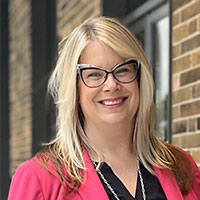
 Vanessa Williamson Vanessa Williamson |
Interview with Vanessa Williamson, Entrepreneur-in-Residence/CEO at Gliachem
By Caitlin Dolegowski, Marketing Manager, LSN |
 Caitlin Dolegowski Caitlin Dolegowski |
Caitlin Dolegowski (CD): Please introduce us to Gliachem and the company’s technology.
Vanessa Williamson (VW): Gliachem is a pre-clinical stage company developing small molecule therapeutics for rare and neurological diseases being spun out from the University Health Network (UHN) in Toronto, Canada. We have a first-in-class neurology drug development program with a unique mechanism of action and are targeting Rett Syndrome as our initial clinical indication.
Rett Syndrome is a rare, x-linked neurological disorder that affects how the brain develops, typically manifesting in females at 18-36 months. Its symptoms are highly debilitating and include intractable motor and cognitive disabilities, breathing issues, and seizures. Lifelong caregiver support is required, and patient lifespan is often reduced. Limited treatment options exist, and the only approved drug, Trofinetide, shows small effect size and tolerability issues, leaving significant room for improvement. With 350,000 Rett patients worldwide, including 34,000 in major markets, there is the chance for blockbuster success.
We are currently in the advanced hit to lead stage. We have strong genetic target validation for a novel Rett target, target PD assays developed and qualified to support lead candidate identification and have developed 3 distinct chemical series (NCEs), each demonstrating potency, selectivity and drug-like properties.
CD: Tell us about Gliachem’s team.
VW: Gliachem is in the process of incorporation, which will be complete by the end of 2023. Our team is currently our scientific co-founders – Dr. James Eubanks and Dr. Mark Reed – and myself as CEO. Over the next few months, we will be expanding the leadership team.
The technology originated in the lab of Dr. Eubanks at UHN. Dr. Eubanks is a neurodevelopment and molecular genetics expert with over 30 years of experience in academic research, including translational development. He is also a well-recognized KOL in Rett Syndrome. At UHN, he is a Senior Scientist and Research Division Head for Experimental and Translational Neuroscience at the Krembil Research Institute.
Dr. Reed is an accomplished medicinal chemist and expert in CNS drug discovery with over 20 years of experience in academia, biotech, and large pharma. He is currently the Director of the Center for Medicinal Chemistry and Drug Discovery at UHN, as well as co-founder and CSO of Treventis Corporation, a biotech start-up focused on protein misfolding related specifically to Alzheimer’s, who recently partnered their lead program with Takeda for $350M.
I have executive experience in the life sciences sector, including the scale-up and commercialization of small molecule therapeutics and diagnostics. Prior to Gliachem, I’ve most recently held VP Corporate Development roles in the diagnostics space, focusing on business and partnership development, sales and marketing, as well as M&A and fundraising.
CD: This was Gliachem’s first time at RESI. How did you initially learn about the conference and what did you think of the RESI experience?
VW: In a word, RESI was AMAZING. We learned about the conference from the Commercialization Office at UHN, who also supported our participation. We did the in-person partnering, as well as the Innovators Pitch Challenge (IPC). RESI curated a fantastic list of investor attendees, and the entire event was so smooth and well organized. The details about the investors that you could access through the partnering platform, especially if you elected the Premiere Mandate, was second to none. That enabled us to strategically target investors, making the whole meeting highly productive.
CD: What stage of fundraising is Gliachem in and what are your goals in 2024?
VW: RESI was the soft launch of our fundraising. We had the opportunity to meet with many early-stage investors from around the world and test both the market and our business plan. We had some very engaging meetings and positive feedback, and are ready to get into deeper discussions. We are raising a $3.2M CAD seed round, which will enable us to complete our hit to lead activities, identify an advanced lead, complete our proof of concept in a Rett animal model and initiate lead optimization. We are looking for strategic investors, who will not only provide financing, but who will also support us in this very exciting stage of early growth.
CD: Congratulations on your second-place finish at RESI Boston September Innovator’s Pitch Challenge (IPC)! What do you think was the key to your success at RESI September?
VW: Thank you! We are so proud of this accomplishment!
Aside from our team and technology, it absolutely was the amount of time we spent preparing. A 4-minute pitch is not easy. There is an opportunity to add a bunch more content than you would with just a standard elevator pitch, but you can’t overload. Coming up with a succinct message that focused on the problem, solution, differentiation and market opportunity was key. As tempting as it was to get deep into the science, we focused on the business opportunity.
The LSN and RESI resources were also invaluable. We attended the prep session you offered and followed the recommendations with respect to focus.
Preparation also applies to the investor meetings. Research the investors. Reach out to the right ones with a tailored and succinct message. And be persistent. Needless to say, many of my best meetings did not come from immediate replies to my initial message.
CD: What advice would you like to give to fellow entrepreneurs about RESI conferences?
VW: In short, do it! It was an invaluable experience. Take advantage of the IPC (including the poster area) as it does enable another level of exposure that you wouldn’t usually get. The judges also provided written feedback which we have used as we continue to evolve our pitch. Finally – prepare, prepare, prepare. Have a plan. There is a lot going on in a really short time, and to maximize the opportunities you need to have a plan. That said, don’t be constrained by your planning and be open to going with the flow. The serendipitous connections for me were just as valuable as the targeted ones.


 Next Phase Newsletter
Leave a comment