
By Max Braht, VP of Business Development, LSN

Whether in San Diego, Philadelphia, or Boston, there are a handful of weeks each year when the life science industry gathers in force. Founders, investors, pharma, and advisors all show up at once. Multiple events run in parallel, each with its own programming, audience, and purpose. From the outside, it looks like one opportunity.
It is not.
Each event is designed to serve a specific audience. Some programs are intentionally broad and inclusive. They bring together large numbers of participants across the ecosystem and create a wide surface for interaction. Others are more focused. They are designed to reach a narrower audience with a specific objective.
The challenge for early-stage companies is that it is not always obvious which environment they are actually entering.
Most of the broader convention programming is built around partnering between established biotech companies and large pharma. These conversations assume a certain level of maturity. The data has been prepared for external review. Development paths are clearer. The work is far enough along for a downstream buyer to evaluate.
For companies at that stage, the environment works. For earlier-stage companies, the situation is different.
They enter the same system, but the conversations are not always aligned with what they need. Licensing discussions can be premature. Data packages are still forming. Investor meetings are possible, but they are not the primary function of the week. Competition for attention is high, and much of that attention is directed toward later-stage opportunities.
Nothing is wrong with the environment. It is doing exactly what it is designed to do.
The issue is alignment.
Early-stage companies are not primarily seeking licensing outcomes. They are seeking capital. Capital behaves differently. It requires a higher concentration of relevant investors, a structure built around evaluation, and conversations that lead to funding decisions. Seed rounds up to two million, Series A up to ten million, and Series B up to fifty million are fundamentally different conversations than late-stage programs discussing Phase III data, scaling, and commercial expansion with pharma. They are different buyers, different expectations, and different decision processes.
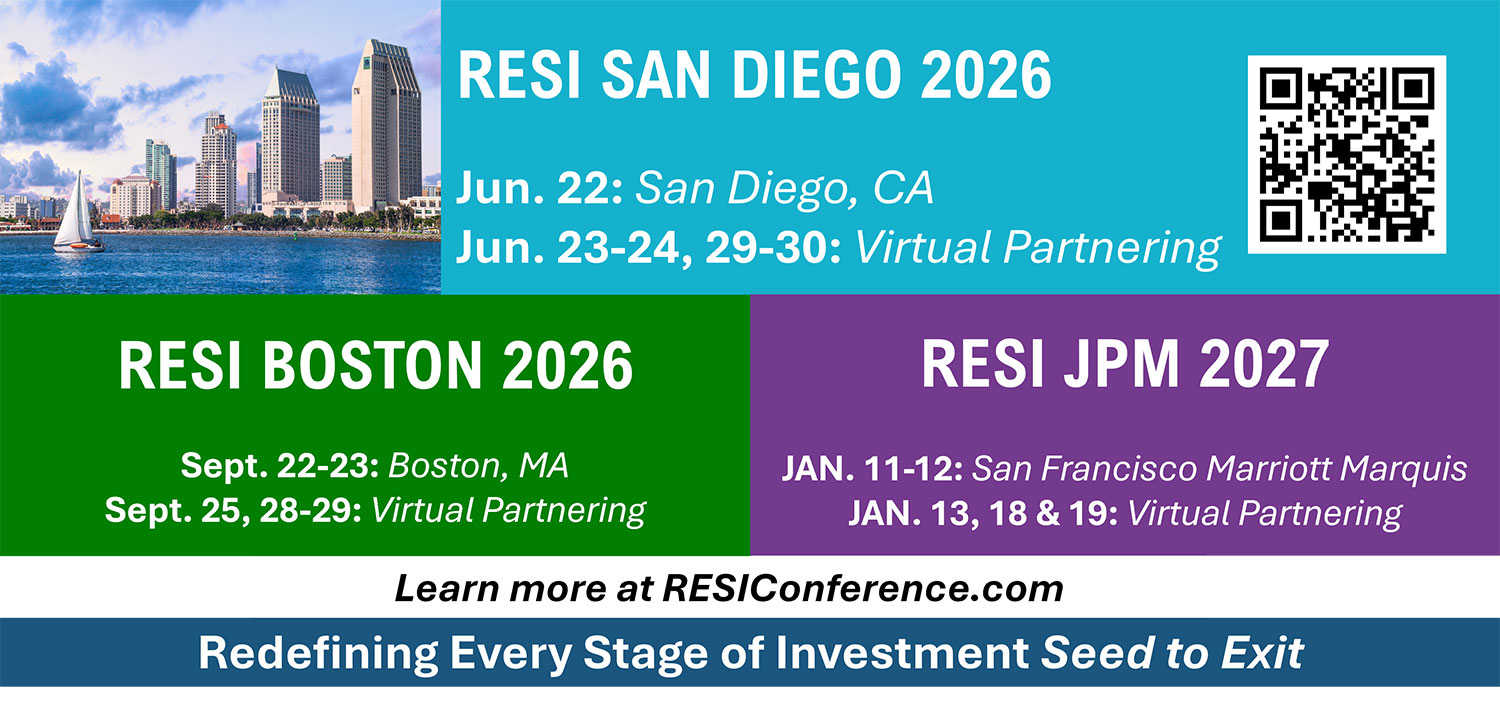
During that same week, RESI operates as a separate market focused on early-stage capital formation. The investor base is concentrated around seed through Series A and early Series B. The conversations are centered on investment. The environment is designed to match companies with investors who are actively deploying capital into emerging opportunities.
This creates a different dynamic.
Instead of competing for limited attention in a broad, later-stage environment, companies operate in a setting where the density of relevant investors is higher, and conversations are aligned with their stage. This is not a question of which event is better.
The question is whether you are in the right room.
If your objective is licensing or a strategic partnership with large pharma, the broader convention environment is the right place to spend your time. If your objective is to raise capital at the early stage, the question becomes more direct. Where are the investors actively deploying to companies like yours, and how concentrated are they? Many companies try to do both. Some can. Most dilute their effort. The cost is not just the registration fee. It is time, focus, and missed opportunity. In weeks like this, the difference between being in the right room and the wrong one is not subtle. Please choose a room that fits your stage.
| Register for RESI San Diego |


 Next Phase Newsletter
Leave a comment