
By Claire Jeong, Director of Research, Asia BD, LSN
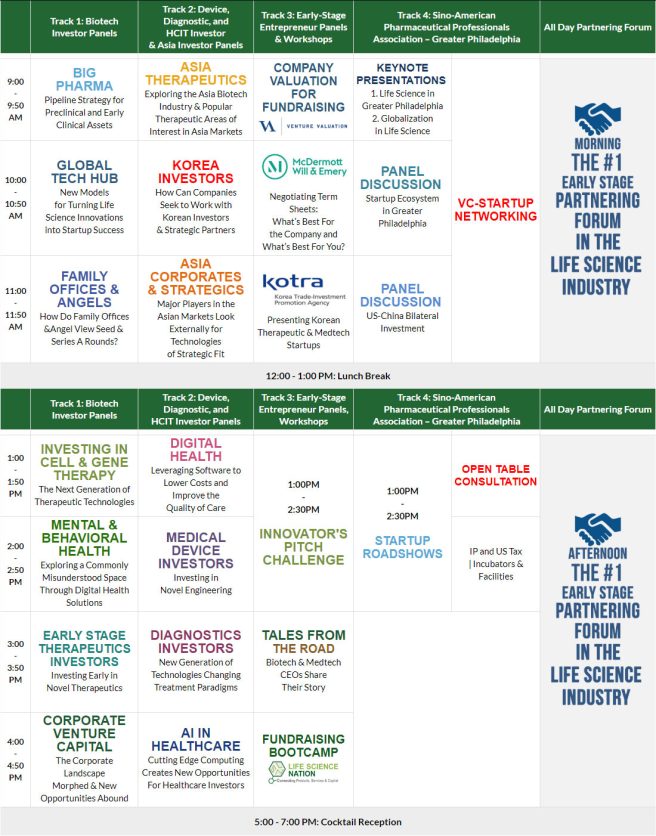
 Our next Redefining Early Stage Investments (RESI) Conference in Philadelphia is now just 4 days away, and is anticipated to be our largest RESI held concurrent with the BIO International Convention. A few weeks ago, I covered LSN’s partnership with the Korea Trade-Investment Promotion Agency (KOTRA) and supporting organizations to bring a large delegation of startup companies from South Korea, similar to what we have done at last year’s RESI around BIO. We believe that all 10 participating companies have strong potential to scale and are fully capable of engaging with global investors and strategic partners. Some of these companies were selected to participate in the RESI Innovation Challenge and will be exhibiting posterboards of their technology throughout the entire day, and select others will be presenting short company pitches to a panel of active life science industry professionals during the “Korea Pitch Challenge” session from 11:00 – 11:50 am. We hope you will have the chance to meet some of these companies at RESI next week!
Participating Companies:
 Orum Therapeutics (OT) is a biotech company with offices in Daejeon, Korea and Cambridge, Massachusetts. OT developed cell-penetrating antibodies that can access the cytosol of living cells following receptor-mediated endocytosis. This will enable producing next-generation therapeutic antibodies that directly target cytosolic proteins, which are associated with many untreatable or difficult-to-treat human diseases including cancer and other rare diseases. OT can engineer various therapeutic antibodies capable of entering the cytosol. Because OT’s fully human antibodies do not require chemical conjugation or formulation for delivery, their manufacturing procedures are similar to those used for any therapeutic monoclonal antibody. OT’s antibodies can be engineered to specifically bind different cell-surface receptors to enhance targeting to specific tissues.
 NEXEL focuses on biotherapeutic development where candidates are derived from internal stem cell-based research. Using its expertise in stem cell, NEXEL also provides highly pure and functional iPSC-derived cell products. NP-011, a pre-clinical stage anti-fibrotic recombinant protein, has a potent anti-fibrotic activity. It has demonstrated its efficacy in NASH, IPF, MI animal models and has demonstrated an excellent safety profile in a 4-week multi-tox study. NEXEL offers iPSC-derived cardiomyocytes, neurons, and hepatocytes for drug discovery and development activities.
 Genesen Inc. is developing peptide-based new drugs that selectively inhibit toll-like receptors (TLRs), to treat autoimmune diseases. Computational simulation and phage display are used to discover peptide candidates, followed by secondary structure prediction and molecular dynamics simulation to optimize the peptide sequence. The experienced Genesen team is aimed not only to develop the first-in-class peptide drug to cure lupus patients, but also to expand to other immune diseases such as rheumatoid arthritis, IBD, Psoriasis and Multiple sclerosis.
 Soundable Health is a digital health company with leading sound AI technology. Our mission is to help people to understand and manage their health and diseases easily to live with dignity. Our first product, PRIVY™, is a mobile app that records the sound of the urine stream on the smartphone at the bathroom and turns it into clinical-grade urine flow exam results for prostate and bladder patients and their physicians Through alpha and beta test we launched the open-beta app in the US and Korea and have collected over 4000 actual measurement data and results from users and physicians.
 Shaperon is a biotech company navigating in the universe of immunology and inflammation. Their flagship compounds are TGR5 agonists, the first of its kind developed for inflammatory diseases such as atopic dermatitis, ulcerative colitis, sepsis, and Alzheimer’s disease. TGR5 receptor as signal transduction modulator is the optimal target for inflammatory diseases where immune homeostasis is critically damaged due to multiple factors and its restoration requires global regulation of immune cell interactions.
 Genome Opinion‘s goal is to integrate genomic and health data to develop novel technologies to improve human health. The Company was co-founded by a medical doctor from Seoul National University Hospital and researchers from Genome Analytics of Samsung Group in 2017 – together, our team has +30 years’ experience of genomic data analytics. We are currently focusing on integrating NGS based in-vitro diagnostic test results and longitudinal health record data, in order to predict and diagnose risks related to cardiovascular diseases and cancers. The Company launched a study on inherited risk related to cardiovascular diseases by conducting analysis on ~36,000 samples from Korea Biobank. We have also formed a strategic alliance with a health checkup clinic in Korea to conduct cardiovascular disease related risk analysis on ~5,000 personnel.
 BIO3S is a research-oriented startup launched in 2016 with its mission to benefit life for humans by uncovering host defense mechanism against virus infections. Based on big data analysis obtained from proteomics, metabolomics, and transcriptomics, BIO3S developed two core bioconversion technologies: (1) producing mannunnorate oligosaccharide from seaweed alginate using safe bacterial enzyme, and (2) developing oncolytic virus using virus culture technology.
 Tomocube, Inc. is a high-tech startup with optical diffraction tomography and DMD technology. Opening a new era for microscopy, Tomocube’s revolutionary 3D holographic microscopy technique makes it possible to take 3D images of live cells without using fluorescent probes which may cause severe phototoxicity and require time-consuming preparation steps. Its products are actively used in Harvard Medical School, MIT, UPMC, and other leading institutions.
 NuriBio has vigorously focused on research and development of PCR-based genetic analysis tools, resulting in proprietary technology that outperforms its’ competitors. NuriBio’s PROMER™ tech is composed of DNA-RNA-DNA structure and performs primer and probe function simultaneously, unlike primer and probe system consisting only of DNA. RNase H enzyme, which degrades the RNA-DNA structure within PROMER, is added and only when the PROMER RNA site binds precisely to the target gene, the RNA-DNA structure is degraded and amplification begins. Therefore, only the target gene can be selectively amplified, so that it is possible to realize high performance with low cost without additional experiments with fewer components.
IH Bio
 IH Bio’s cancer immunotherapy (IH002B) is a monoclonal antibody therapy that induces complete remission (CR) in the most advanced metastatic pancreatic ductal adenocarcinoma as well as in a wide range of tumors at much lower concentrations. It has also been reported to induce CR in end-stage cancer. Histologically, the process involves fibrotic encapsulation of the tumor and creation of a space between the normal and cancerous tissues to induce spontaneous tumor resection, thus completely preventing tumor growth, motility, invasion, and metastasis.
Sponsoring Organizations:
 Korea Trade-Investment Promotion Agency (KOTRA): KOTRA is a Korean government agency dedicated to promoting international trade and investment, drive the nation’s economic development, and build prosperity for the global community. Through its 129 offices in 84 countries, KOTRA serves small and medium-sized Korean enterprises looking to tap into the overseas markets. Cultivating innovation and building a vibrant, sustainable startup ecosystem is key to reaching the next stage of Korea’s economic growth. To that end, KOTRA is committed in mentoring rising startup companies and providing institutional support to facilitate their continued success.

Korea Biotechnology Industry Organization (KoreaBIO): Korea Biotechnology Industry Organization (KoreaBIO) emerged in 2008 following the merger of three biotechnology industry associations in Korea. Representing over 300 corporate members from the pharmaceutical and biotechnology sectors, KoreaBIO offers training programs and policy advocacy roles to improve the regulatory climate, promote R&D investments, and facilitate global partnerships.

Bluepoint Partners: Bluepoint Partners is a partnership-driven startup accelerator and an early stage VC fund that concentrates on bridging talented high-tech entrepreneurs with real global solutions. As champions of progressive startups, BP’s partners and expert mentors work hand-in-hand with entrepreneurs enabling them to build a viable business, make connections, raise capital, seek growth, and fulfill their vision.
Korea Institute of Marine Science & Technology Promotion (KIMST): Since 2006, the Korea Institute of Marine Science & Technology Promotion (KIMST) has led the nation’s marine science research and ocean management planning initiatives. KIMST develops and implements national marine policies, establishes ocean planning strategies and systems to maximize productivity, and drives future growth by putting research results to practical use.























 Ibraheem (Ib) leverages his expertise in smart materials and biomaterials to support the medical device sector of Johnson & Johnson. From 2010 to 2013, Ib was a Research Fellow at Global Surgery Group of Johnson & Johnson, where he was responsible for external and front-end innovations and intellectual property for Ethicon Biosurgery. Previously, he was the Chief Scientist of Closure Medical Corp, and has held positions at Bayer, North Carolina State University, and the College of Charleston. He currently serves as an Adjunct Professor of Biomedical Engineering at Drexel University.


 Shahram Hejazi, Ph.D., is a life science investor & entrepreneur. Over his 25+ year career, Shahram has invested and/or directed more than two dozen startups. Since 2008, he has been a Partner with BioAdvance, where he serves on the Boards of 6 portfolio companies and is responsible for leading investments in medical devices, diagnostics, digital health. Shahram has also been on the faculty of Princeton University, since 2014. Previously, Shahram was the president of Kodak’s life science division, and before that, he was the founding CEO of Zargis Medical Corporation (a Siemens’ spin off). Prior to that, Shahram was the Global Head of the Strategic Business Development at Siemens Medical. Shahram is also the Chairman of the advisory board of Integral Molecular Inc., and the Chairman of PPDC at CHOP. Shahram has a Ph.D. in electrical engineering and an executive business education.