Archive | Redefining Every Stage Investments (RESI) RSS feed for this section

LSN Summer Reading Series Chapter 6: “Branding and Messaging”

2 Jul

By Michael Quigley, Director of Research, LSN

mike-2Last week we discussed how to determine where your company fits within your marketplace. Once you have completed that process, the next step in a fundraising campaign is to develop your marketing materials. In this week’s edition of the summer reading series, we describe the importance of and what constitutes a strong set of marketing materials in the life science fundraising world. While your team and your technology are what will ultimately secure an allocation, having marketing collateral that clearly and concisely communicates your message will help you tremendously in getting in the door with investors.

Chapter 6 of The Life Science Executive’s Fundraising Manifesto discusses in depth the different pieces of marketing collateral you should be putting into the marketplace and how to develop everything from your logo to your pitch deck.

Click here to download/print the PDF.

Join us next week for Chapter 7: “Building a Web Presence,” where we take an even deeper dive into how best to use a website as a fundraising tool.

Enjoyed the preview? Buy now from Amazon.com or Barnes & Noble

Bookcover-Front

Family Offices and Walled Gardens

25 Jun

By Dennis Ford, Founder & CEO, LSN 

Dennis book

The LSN mantra is that raising capital is a numbers game.  To succeed, you must find investors that are a fit for your product and stage of development, go global rather than restricting yourself to your local region, and target all ten categories of early stage life science investor rather than restricting your view to one source of capital.

Every few months it seems that someone in the investment world has an epiphany that they must create a global family office network. The idea always seems compelling and usually involves a plan to sponsor small, intimate conferences that target companies seeking investors. The network creators begin courting the venture community and healthcare CEOs with descriptions of the family offices that allegedly bought in and will attend these conferences — and the price to appear at them is often  a lot of money. The attending fundraising CEOs theoretically benefit from getting in front of the new hot category of investor, and it’s suggested that the family offices will participate in such a small meeting in return for the chance to trade strategies, tactics, and evaluations with other similar entities.  This model and concept is all about getting special access, which sounds almost too good to be true…right?

Having been involved in capital fundraising for decades, I have seen this model surface countless times. Many of these family office networks can provide examples of the allocations and partnerships their network has generated; the question is how many and how much?  This model has been called a “walled garden” because of the illusion it perpetuates of a bevy of family office players  banding together in a closed, almost secret network who can be accessed by paying a fee for a chance to connect with the  right contact. While these networks may include at least a handful of contacts with whom a dialogue can be established, I have yet to encounter a walled garden family office firm that employs any research staff to track what the family offices’ investing interests are. This is an absolute necessity for staying up to date on investment mandates, which are ever-changing—without accurate data and an understanding of the possible fit between your company and the investor, contact information has tenuous value.

Additionally, most family offices (institutions with over $1 billion in assets under management that form one of the categories of investors that LSN tracks) would rather not be a part of any organization that would compromise their anonymity; these firms are well known for a predilection for stealth mode and a preference for flying under the radar. Because they have access to large sums of capital they do not need to form syndicates, so have little to gain from the walled garden model.  As for the opportunity to share information and strategies behind a virtual secret wall, family offices already source from each other and don’t need third parties or service providers to facilitate this. Also, while syndication does occur regionally and within close networks of like-minded family offices, it doesn’t seem relevant on a global scale simply because of the low ratio of family offices to fundraising CEO’s. The larger Family Office conferences can be useful to fundraising executives, offering the possibility of contact with a handful of family office representatives, but these bigger venues  are primarily populated by family office service providers who are also being charged high fees to attend.

LSN tracks 970 family offices globally, has identified 180 as private life science investors, and has forged a deeper relationship with 70, which use LSN as a trusted sourcing vehicle. This is also true of the other nine categories of investors that we track. Many family offices see us as a trusted source that has proven our worth and provides a compelling and augmenting service offering that can be vetted quickly for no cost. But we recognize that focusing too much on one category of investors, especially a group like family offices, can be counterproductive, which is why over three years we have built up a true global network of over 5000 early stage investors covering ten categories.

RESI@TMCx Biotech Family Office Panel

25 Jun

By Michael Quigley, Director of Research, LSN

mike-2Earlier this month Life Science Nation’s RESI Conference at the TMCx in Houston was home to a panel of representatives and experts in the Family office world who spoke to how their groups go about sourcing and making investments in the therapeutic space. Key topics discussed include the position of family offices in the investment ecosystem, the differences and similarities between family offices and other investors, how family offices go about identifying opportunities, and what these particular groups are looking for right now.

Click on the video below to hear the views of these family offices speaker for yourself.

LSN Summer Reading Series Chapter 5: “Knowing Who and What You Are, and Where You Fit”

25 Jun

By Shaoyu Chang, MD, MPH,  Senior Research Analyst, LSN

Shaoyu 10*10In this latest edition of the summer reading series, we will be explaining the importance of understanding where your opportunity fits within the marketplace. Knowing who you are and how you compare with other companies in the space is crucial in determining the investors to whom you should be reaching out, what you should be highlighting in your marketing materials, and, in some cases, whether you need to “pivot,” or change, your commercialization plan.

Chapter 5 of The Life Science Executive’s Fundraising Manifesto, “Knowing Who and What You Are, and Where You Fit,” discusses how to define yourself and your market, as well as the importance of being able to pivot after receiving feedback and how to identify when it is strategically relevant to do so.

Click here to download/print the PDF.

We hope this text proves to be informative. Join us next week for Chapter 6: “Branding and Messaging”, for some tactical tips on how to build a brand for your company.

Enjoyed the preview? Buy now from Amazon.com or Barnes & Noble

Bookcover-Front

RESI Wraps Up in Houston and Heads Back to Boston

18 Jun

By Scott Parks, Director of Marketing, LSN 

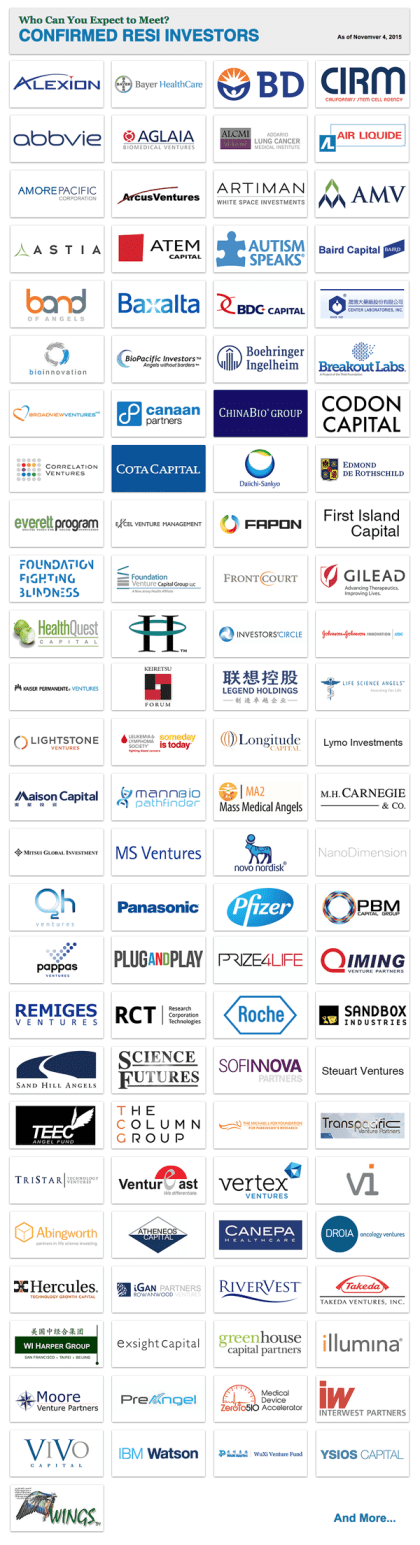
Scott 2June 8th was the 5th Redefining Early Stage Investments (RESI) conference, and the first at Houston’s Texas Medical Center’s Innovation Portal (TMCx).  With nearly 500 registrations the 100,000 square-foot accelerator space was filled with CEOs, scientists, entrepreneurs and more than 150 investors (from LSN’s 10 investor categories including:  Family Offices, Hedge Funds, Venture and Private Equity). The venue served as an exhibition space as well as a partnering forum for investors and entrepreneurs who compressed a total of 700 meetings into a single day in order to network, build relationships and close investment rounds.

LSN’s CEO Dennis Ford comments, “It can be overwhelming and we absolutely love that aspect.  We want to give everyone who comes here more opportunities than they can make a decision about, because if we’re doing that, we’re doing our job. We really want to inundate everyone, for one day, and submerge them in this early stage investor world to let them get a lot of bang for their buck instead of stretching it out over a period of several days. We want to give them as much value as possible.”

Throughout the day, and in several conference rooms, panels and workshops provided platforms for investors to communicate directly to fundraising entrepreneurs. Topics covered included biotech angels and venture philanthropy.  The event offered firsthand accounts from investors explaining their current investment mandates and procedures for identifying and qualifying candidates.

RESI@TMCx provided the platform for early stage investors and life science entrepreneurs to make a compelling connection, and is a result of partnerships between Life Science Nation, Texas Medical Center, Johnson & Johnson Innovation, and JLABS (JLABS @TMC).

Those who missed the Houston event will have only 90 days to wait until RESI comes to Boston on September 16 at the Westin, Copley.  For now, the RESI conferences are limited to 3/year (Boston-Fall, San Francisco-Winter, Houston-Spring/Summer).  As interest and attendance continue to grow, so too will RESI’s frequency and geographic footprint.

RESI BOSTON Now Open for Registration

Registration (with early bird pricing) is now available for RESI Boston (September) and RESI SF (January).

RESI@Boston-Banner-600

sf16

Early-Bird-RESI-Boston-wp

Refining the Global Target List: How to Prioritize Investor Leads

18 Jun

By Lucy Parkinson, Senior Research Manager, LSN 

lucy 10*10While creating a target list of investor contacts is a good first step on your road to financing, lists have to be used strategically. It’s important to refine and prioritize your investor targets before embarking on a fundraising campaign, and in this article, I’ll explain how we conduct this process at LSN.

LSN’s primary goal is to help life science companies connect with investors who are a suitable fit for their opportunities. By searching the LSN Investor Platform, a fundraising executive can create a Global Target List (GTL) of potential investors in their company. This list typically includes 250 to 500 possible investors—enough to create a considerable amount of outreach work. So how can the list be filtered so this work can be conducted most effectively?

Our strategy is to divide this list into tiers, ranked by the quality of fit between your opportunity and the firm’s investment thesis. By using this method, you can focus on the most relevant life science investors first. Connecting to these highly promising targets may lead to securing a lead investor to anchor your raise, which will make it easier to fill out the rest of your financing round.

After generating a GTL, our next step is to go through the list and read each investor’s mandate one by one. This takes time, but it’s crucial if you want to focus your outreach effectively. You may find that several investors have specific criteria that your company doesn’t match; for example, you might discover that an investor is only interested in companies based within a very small geographic area, or associated with a particular university. It’s important to identify these “deal-breaker” criteria before wasting effort on initiating contact. We mark such investors as “Not a Fit” for the opportunity.

But among the investors who are relevant to your company, not all fits are alike. As we read through each investor’s criteria and areas of focus, we can divide these investors into three tiers: Strong Fit, Opportunistic Fit, and Tenuous Fit. We then tag each profile with a tier in our CRM system to allow for more efficient outreach.

So how do we define these three tiers?

A Strong Fit is an investor that has a specific interest that applies to your company in some regard. Perhaps the investor is highly focused on a certain medical indication or technology that you are addressing. For example, if an investor has expressed a particular interest in therapeutic platform technologies in the neurology space, and that’s exactly what your company is developing, you’re going to want to prioritize this investor! As you study each entity on your list, keep an eye open for a specific area of alignment, whether it’s a particular patient population or a field of technology that is of interest to the investor, or perhaps an underlying investment theme your company fits within, such as delivering care more cost efficiently. This is how you can identify the strongest fits that require the most urgent outreach and the most frequent follow-up.

The second tier consists of Opportunistic Fits. For these investors, you’re definitely in the ballpark of what they are interested in, but they’re not specifically focused on what you have to offer. Some life science investors are open to a wide range of approaches within certain parameters; for instance, they might have a general interest in preclinical therapeutic opportunities throughout North America, but they haven’t displayed a specific focus on technologies like yours. As these investors have a potential interest in what you do, they should be the targets of the second wave of outreach; you might not follow up with them as frequently as you would with the first tier, but there’s a strong potential for dialogue.

In the case of a Tenuous Fit, while there is a potential basis for a match between your company and the investor, you likely do not represent a typical deal for them. For example, if an investor focuses on companies based in the Northeast U.S., and your company is based in Toronto but is a good fit in other regards, it may be worth asking if they’d like to talk to you about the opportunity. Or perhaps the investor is interested in your area of medicine but usually only considers companies at the IND filing stage, whereas your lead asset is already in Phase II trials. Even though this company does not represent the perfect fit, they might prove to be a very important contact. In LSN’s experience, outreach to these “tenuous fits” has frequently resulted in good strategic connections and sometimes future investment opportunities. For example, the investor may be able to act as a “pointer,” that is, they may be able to refer you to another investor who is really interested in your field, or to other important strategic connections for your company. It’s therefore important to approach these “tenuous fits” as people with whom you want to have a conversation about your company, not necessarily as sources of capital; a broader discussion might reveal areas where you can work together, or might lay the groundwork for an investment in a future financing round.

Once you’ve categorized each investor into one of the above tiers, you’ll have a detailed picture of the investor landscape for your company. It’s a vital second step to take after generating your global target list. By executing this process, you’ll know where to make your first forays into fundraising, what to expect from each investor conversation, and how to focus your follow-up efforts, and will increase your odds of carrying out an efficient fundraising campaign.

LSN Summer Reading Series Issue #4

18 Jun

By Michael Quigley, Director of Research, LSN


mike-2This week in the summer reading series, we explore the current categories of early stage life science investors. As a result of the significant changes the investor landscape has undergone in the past few years, many traditional players have moved downstream to later stage investments or out of the space entirely, and new faces have stepped in to fill the void. Understanding what motivates these different groups and how they operate is crucial when looking for a successful financial partnership.

Chapter 4 of The Life Science Executive’s Fundraising Manifesto “Categories of Life Science Investors” explains how and why the funding landscape has changed, the types of investors who are currently funding companies, and, in general, the approach these entities take toward investing.

Click here to download/print the PDF.

We hope this text proves to be informative. Next week we will turn the focus inward with Chapter 5: “Knowing Who and What You Are, and Where You Fit.”

Enjoyed the preview? Buy now from Amazon.com or Barnes & Noble

Bookcover-Front