Category: Redefining Every Stage Investments (RESI)
The Redefining Every Stage Investments (RESI) Conference is an ongoing conference series that provides an international venue for life science companies across Biotech, Medtech, Diagnostics and Healthcare IT and to source investors from around the globe, create relationships, and eventually, secure funding.
How will you make the most of your time in San Francisco in January? If you read our previous article, you’ll know that a record number of investors will attend RESI on January 12th. The RESI Innovation Challenge provides entrepreneurs with a way to engage with this huge audience of active life science investors throughout the event.
The RESI Innovation Challenge showcases selected entrepreneurs in an exhibition-style format throughout the full-day conference. From the pool of applicants, LSN’s internal scientific review board will choose the top 30 companies to present their technologies. Presenters will gain exposure to investors and potential partners by showcasing their companies and products in a poster board format in the RESI Exhibition Hall. Unlike traditional 5- to 15-minute pitch presentations, which don’t provide any real one-on-one interaction or actionable feedback from investors, the RESI Innovation Challenge enables executives to share their pitch directly with attendees, which can generate more in-depth and frequent conversations with potential investors throughout the event.
To add some friendly competition to the mix, LSN invites all attendees to participate in the RESI Innovation Challenge as virtual investors. At the start of the day, each attendee will receive “RESI Cash” to allocate to the entrepreneurs whose technologies they expect will be most successful. The capital invested will be tallied up at the end of the day, and the top three winners will receive prizes and be featured in our RESI newsletter recap that will go out to LSN’s 20,000 newsletter readership.
If you’re developing a cutting-edge biotech or medtech product, apply to the RESI Innovation Challenge to put your technology into the spotlight. We’ll look forward to seeing you take part in the biggest RESI Innovation Challenge yet.
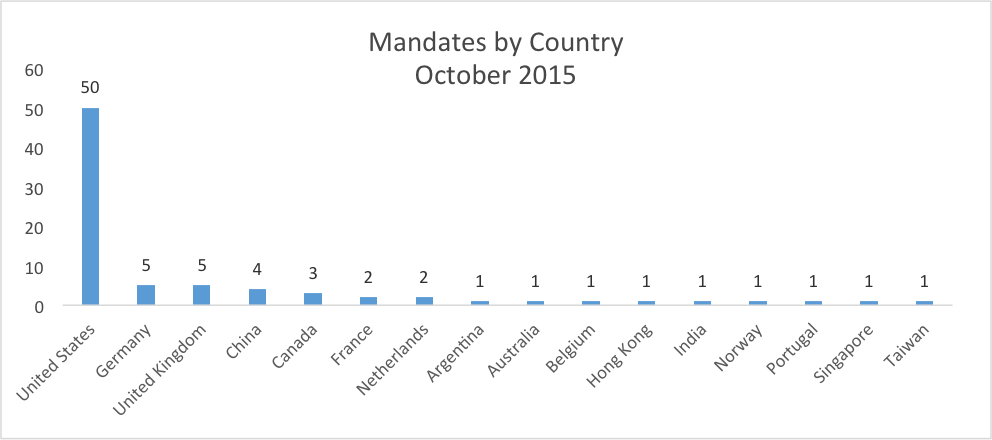
Last month, the research team at LSN spoke with 80 investors seeking to make allocations into privately held life science and healthcare companies. These investors spanned 16 countries, and while a majority were based in the United States, LSN found a significant investor presence spread all around the globe (See figure below).
Source: LSN Investor Platform | Data as of October 31, 2015
What is more interesting than where these investors are based, however, is where geographically they are willing to make allocations if the right opportunity were to arise.
Source: LSN Investor Platform | Data as of October 31, 2015
Nearly half of the investors LSN’s research team spoke with in the last month are looking around the globe for investment opportunities. This trend is driven by a number of factors LSN Research is seeing in the space, including Asia-based investors looking overseas to bring technologies back to their local regions. LSN Research has also found that large pharma, medical device and technology companies (and their corporate VC arms) are increasingly interested in scouting globally for new technologies for their pipelines.
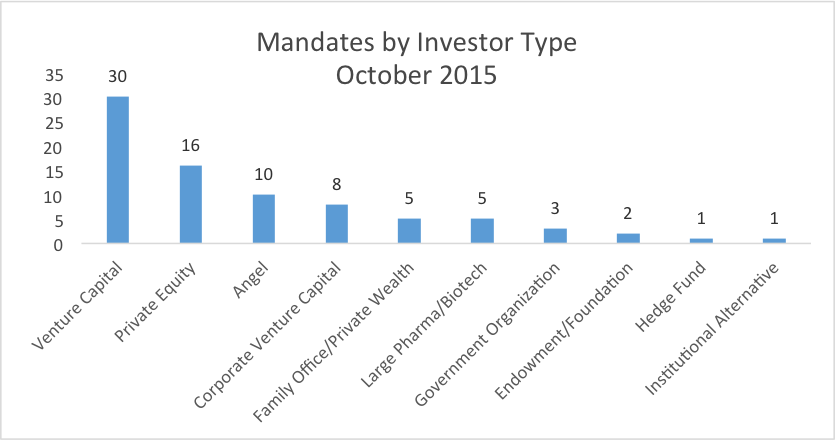
The chart below shows the different types of investors that LSN’s research team spoke with in October; LSN has found great diversity in the investor ecosystem.
Source: LSN Investor Platform | Data as of October 31, 2015
As LSN researches life science investors, the team meets an increasing number of investors outside of the traditional path of venture capital who are seeking to make allocations in the space. While venture capital remains a significant player that catches a majority of headlines, there are also many other investors operating in the space. By only attempting to secure funding from venture capital groups, you are greatly limiting your chances of finding the right funding partner.
While this roundup provides an overview of some of the information LSN has recently gathered regarding investor interest, LSN collects many other details that help us identify suitable opportunities for each investor. The research team at LSN looks forward to continuing to fill in our readership with any and all developments and trends we uncover when speaking with investors in this space.
What is the best way to get to family offices? What trends are they looking at and what do they evaluate when looking at companies? The Medtech Family Offices panel answered these questions at LSN’s RESI Boston conference in September.
The panel was moderated by Colin Widen, CEO of Boston Innovation Capital, LSN’s subsidiary company. Our panelists include:
“The [life science] industry is organized chaos,” Oded Levy of Blue Ox Capital described. Organized because there are rules in the delivery system and method of providing care, and chaotic because everyone is trying to position themselves as strategic investors. Yet at the same time, the key for investors is to answer whether the management strategy is applicable to the market, and whether or not the market will accept it.
Companies must pay attention to the outside world and the overall market. “The market is going to change dramatically over the next 4-5 years,” Levy added, “rates will be higher and cash will be much different.” Furthermore, the spectrum of buyers is changing dramatically. “If it was only healthcare companies interested in the past, now it could be Google or Oracle.”
Since the industry is continually changing, “if you’re able to get an exit, take it,” Ron Paliwoda of The Paliwoda Group advised. Yet if the science is significant and the company is growing tremendously in profit, “I’ll hold onto it.”
Family Offices evaluate on science, legalities, and vision.
For a number of investors, including Paliwoda, the most important evaluation is the science. “You can’t throw a Kim Kardashian and say [the technology] is cool. It’s the science – that’s how we rank our opportunities.”
Along with considering due diligence and time to exit, Alejandra Paredones of BSI Capital emphasized the consideration of the cost of legalities, especially as a foreign investor.
Levy added the importance of a legal system. “Everyone is rosy and opportunistic once they enter, but it’s not how much money we make, but how we can protect investors when [companies] get in.” There should be a strong operating agreement between the investor and company allowing the investor to have a say on a number of items, such as capital events, hiring, compensation issues, and the financing committee.
Paliwoda added the importance of the vision because “if you want our relationship to be purely transactional, we’re not interested.” The investor wants to know how he or she can add value to a company’s vision through other assets aside from capital. “I want a relationship that can last longer than just one project.”
Investors look outside the big science ‘hubs’
The panelists debunked the myth that family offices only look at the big science hubs (i.e. Boston, New York, Silicon Valley, etc.). “I love roadtrips!” Paliwoda immediately responded.
Currently in due diligence with three companies outside of the traditional hubs, Maria Berkman of Broadview Ventures addressed that the only real, though minor, concern these companies face is recruiting talent to build the company, as the traditional hubs have more access to greater talent. “But it’s nothing to shy away from,” Berkman assured, “It just means we have to help more and be aware that we have to be more hands-on.”
Companies, here is your advice –
Have a strong, collaborative management team. “There’s strategy, then there’s equity. What’s your strategy? Are you the right people to execute it? If not, would you listen to us? If you’re not going to listen to us, we don’t care, even if you have the best product in the world,” Levy explained.
Connect to family offices first through someone you know and trust. “Lawyers, portfolio CEOs, someone from their network” Brian Grulke of Volcano Capital explained. “A warm introduction de-risks management risk enough so that we can feel comfortable to set up a meeting and hear the story,” Berkman added.
Make your last step a cold email. Both Grulke and Berkman identified several successful opportunities that had come through cold emails, though “make it a final step.” For Paliwoda, “A cold email for us is trash and junk. We never see it.”
Make sure you are a fit before reaching out! “I get a lot of emails everyday with companies that are not a fit.” Paliwoda described, “It’s easy to put those in the trashcan.”
Successfully articulating the value proposition of your digital health/medicine product or service and receiving funding requires a great deal of thought and careful consideration to your message. Not only is it a particularly noisy space, the fact that it garners interest from both traditional tech as well as healthcare investors means you need to tailor your message considerably based on the investors level of understanding and expertise in the various aspects of your opportunity.
Each sector differs in key characteristics affecting business models, including metrics of success; typical timelines and financing required to bring a product to market; product attrition rates; the importance of regulatory oversight; the types and importance of IP; reliance on, timing of, and types of revenue; and relationship to the eventual consumer and target markets [1]. In order for the health IT entrepreneur to succeed in such a laborious endeavor, a well-thought-out, cohesive business model and a complete understanding of the investment landscape is a must.
As with any fundraising campaign, the importance of understanding the types of investors who are playing in a space can’t be overstated. Additionally important is understanding that these different types of investors are going to have different rationales for investing in Health IT, and your strategy for approaching them should reflect this.
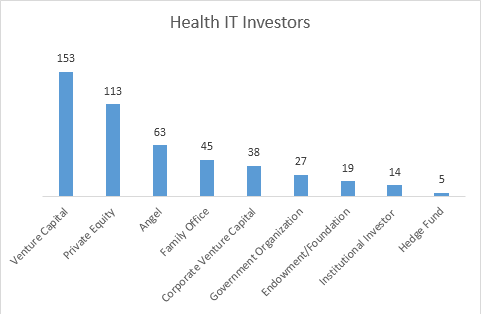
Figure 1 | LSN Investor Platform | Data as of October 28, 2015
Taking a look at the LSN investor database gives an idea of what types of investors are most interested in Health IT companies. Nearly 500 of the investors that LSN has spoken with have stated an interest in Health IT companies. Figure 1 shows a breakdown of the investor by type that are interested in looking at these types of companies. Although traditional venture capital and private equity firms are highly involved in Health IT, if you aren’t targeting the rest of the field, then you’re missing half of the investors interested in your type of technology.
Given the stringent regulatory requirements healthcare products face, partnerships with pharmaceutical companies are very valuable for companies in the digital health realm. These companies have many valuable assets and capabilities in healthcare, such as large clinical trial networks, existing patient, physician and payer relationships, and deep biological and medical expertise that can be brought to bear on challenging digital medicine problems [1]. These strategic value-adds can accelerate the progress of an early stage health IT company.
Depending on what camp you are coming from (biotech/pharma or tech/SaaS) you will need to meld pieces of each into your pitch to investors. The most drastic differences between the two industries would be the time to get a product to market and the funds required to do so. Being able to foresee and address special situations that are likely to arise in this dynamic, emerging field will be a big difference maker for investors and partners alike. Given that digital health companies are somewhere in between the tech and healthcare industries (or rather a combination of the two), that puts them in a unique position, and will require that they approach fundraising with very tailored and well-thought-out messaging.
Click here to watch a panel of VCs discuss the Health IT landscape at last year’s RESI San Francisco conference.
Steinberg, D., Horwitz, G., & Zohar D., Building a Business Model in Digital Medicine. Nature Biotechnology33, 910-919 (2015).
By Shaoyu Chang, MD, MPH, Senior Research Analyst, LSN
Travel is an essential business expense for early stage companies. One conference plus a 1-2 week road trip per quarter can cost anywhere from $22,000 to $35,000 per year. It’s important to get the most out of your time on the road.
Experienced scientists are used to attending academic conferences. They do their research, prepare a poster or talk, speak and answer questions from the audience, take a good rest in the hotel, and head home. Some fundraising scientist-entrepreneurs fly out with the same mentality; as a result, they are missing out on big opportunities to grow their business.
Just this month, an LSN client attended an event in the Midwest where, based solely on online research, it appeared that the investors in attendance were generally looking for later stage opportunities. However, after reaching out and shaking hands in person, he found they are currently open to opportunities at an earlier stage than was historically the case, and were impressed with his company’s investment pitch. The entrepreneur now has ongoing conversations with several of these investors. This is just one example of how meeting in person can create more opportunities than simply sending an email or making a call.
This article provides a few tips on planning business trips and making them productive:
Research the best conferences
There are a plethora of investor conferences all over the globe, focused on healthcare, hi-tech, philanthropy and more. Entrepreneurs should identify the best conferences for their technology type and stage of development, where they are likely to meet the most relevant partners.
Be wary of conferences that make large promises regarding investor attendance but do not release the names of the firms that will be in attendance. Oftentimes these groups will lump investment banks and even service providers under the investor category to inflate their numbers. Do your research on current and past attendees to really get a grasp on who will be going. Contact companies that have attended in previous years to hear their experience; an unbiased option can be very telling of an event’s value.
Use outreach tactics to schedule strong strategic meetings
Even when there are no conferences taking place, if you are actively fundraising you will be in dialogue with potential investors from all over the world. If you’re visiting an investor far from home, look at other potential investors in the area and hit them up with a cold call or email. In addition to progressing the conversation with the investor you’re visiting, you can uncover and meet with investors who would not have been available to meet had you stayed at home.
A quick outreach often works wonders: “Hello, I wanted to ask if it would be possible to set up a meeting in two weeks as my team and I are going to be in town. We are very flexible and can meet any time, including breakfast and dinner.” The sentence “we just happen to be in town and close by” fills in any scheduling holes. LSN has found that with a sense of urgency, investors are more likely to get back to you. Use this to your advantage.
Line up additional meetings
Flying to a city to attend only a single event is a waste of time and potential opportunities, and in the world of fundraising where one meeting can make or break a campaign, no opportunity should go to waste. Think of a region like a big mall. Always identify the prize accounts in the area, such as major industry players, medical centers, and investors that are a good fit. Often there are secondary accounts nearby. When attending a conference, don’t limit yourself to only the groups attending the event but also reach out to major corporations or medical centers.
Don’t be afraid to cast an even wider net than usual in determining who is a likely fit for your opportunity. Be resourceful. Ask someone who understands your product, “now that I am flying to X city, who else should I go after in this region?” It’s amazing how much intelligence you can gather this way. A successful entrepreneur can work from one high-profile meeting to a week of meetings.
An outbound campaign is essential to keep your business alive and growing. This article highlighted the importance of traveling and hopefully helps you plan for your next business trip. Feel free to check out our blog for tips on other aspects of outbound fundraising that will help you land those meetings: how to build a successful pitch deck, and how to write a compelling partnering message.
In my opinion, you need to initially canvass investors that can fit into your indication or service and stage of development. LSN business development staff see over and over again entrepreneurs with beliefs about fundraising that really hinder their chances for success. Entrepreneurs are building walls that do not need to exist — “I can do my fundraise regionally; I only want to talk to family offices; I don’t need a 3-5 year plan because I will exit long before that; I know all the usual suspects so I will just go after them.” Every time you put down an assumption that is not true and then build a universe around that assumption, you waste valuable time going in the wrong direction.
I steadfastly believe that one has to be completely open and nonjudgmental when raising capital. Make no assumptions other than “let’s go find a global list of investors that are a general reasonable fit”. Seriously, take a broad brush approach and find and aggregate as many reasonable fits as possible, and then canvass them with compelling emails and succinct phone calls over the course of a few months.
The market for capital is extremely competitive and a fundraising CEO who takes the time to package up their technology and company into a lucid message will rise above all the noise. Investors are evaluating you from the first second you surface, and their job is to weed out the CEOs that show they are not aware of how the game is played and thus not a fit for capital investment.
The days of 20-30 page PowerPoints and white papers are gone. Concise, adroit messaging is key. A sensible in-context logo; a tagline that captures the essence of what you do; an elevator pitch that nets out who you are and what you do in 4-5 sentences; a 2-page executive summary that tells a succinct and compelling story; a 10-12 slide PowerPoint that presents your value and advantage; a 3-minute video of your pitch that nets out why the investor ought to have an introductory chat with you; and last but not least, a website that hosts all the aforementioned material, plus enough content and data to allow the investor to make a cursory first pass on you and your team.
When your marketing message is in place, then you can begin to canvass your global investor list. Email marketing software will allow the targets to click on links if they want to learn more. You will get reports on what links the targets clicked and how many times, allowing you to gauge their interest and find the most engaged readers to contact.
So let’s say we create a list of 400-500 reasonable targets and start the outreach process through canvassing, and find that 100 that show some interest. Via further dialogue you can then vet those investors down to 50 good fits, then vet that down to 25 who are interested in a meeting, and may find that 12 are engaging in further dialogue and starting to develop a relationship with your company. That 12 will go down to 6 as time moves on, and eventually you will have 2-3 qualified investors that are the right fit, have a good relationship with you, and could invest.
Of course, there are many different iterations and configurations that can manifest in this process and the aforementioned is just a generic example. But the effort involved in getting those investors into your funnel through a canvassing process that highlights the fact that fundraising is strictly a numbers game and you need to set up that numbers game globally in order to succeed. A big part of the canvassing is getting your marketing messaging right and web presence pristine so that when investors get to your web site, there is a full pitch sitting front and center on the home page. This, in turn, makes it easy for them to decide to pick up the phone or answer an email and set up a meeting.
Cancer immunotherapy technologies frequently star in biotech news headlines. Scientists have pursued many approaches intended to enlist the immune system to fight tumors, including CAR-T therapies and checkpoint inhibitors. Cancer vaccine technology is one of the technologies under this broader immuno-oncologic umbrella. This approach entails using one or more immunogenic antigens to teach the immune system to attack tumors.
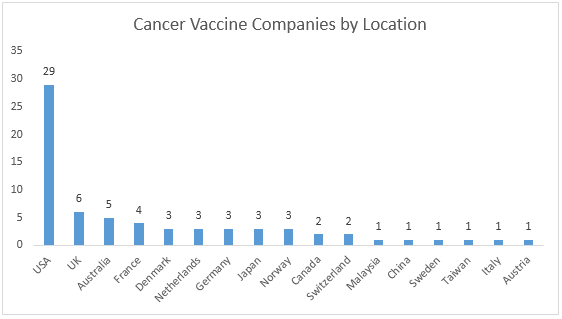
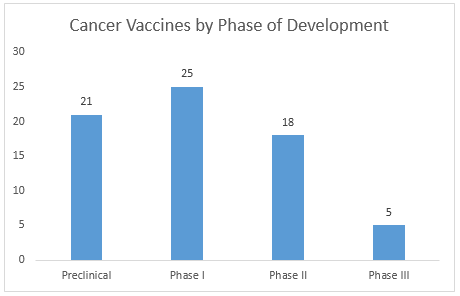
The LSN Company Platform provides detailed profiles on early-stage life science companies and products under development worldwide. From this data, we took a sample of vaccine companies developing therapeutics for the oncology sector. This sample consisted of 69 companies. While a significant number of these companies are based in the USA, we also found information on companies developing cancer vaccines throughout Europe and the Asia-Pacific region.
Source: LSN Company Platform, Data as of Oct. 21, 2015
Only 5 cancer vaccine assets in this sample are currently undergoing Phase III trials. This affirms the perception that cancer vaccine technology is a field that is approaching maturity; the many early-stage assets identified by the LSN Company Platform show the field’s potential, but few cancer vaccine assets are likely to reach market in the near term. However, investors interested in early stage immuno-oncology assets will be closely watching the field’s progress.
Source: LSN Company Platform, Data as of Oct. 21, 2015
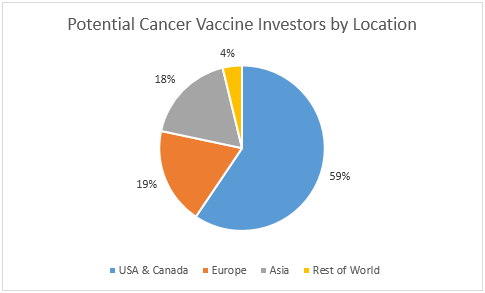
On the topic of investors, the LSN Investor Platform tracks investors both by indication area (such as cardiovascular, respiratory or cancer) and also by technology types of interest (such as small molecules, antibodies or vaccines); this means that we can use the platform to identify investors who are open to considering both vaccines and cancer. Our data set includes over 500 investors who are open to considering development-stage products in both of these two fields, thus representing a broad universe of potential investors for a cancer vaccine company. Much like the emerging companies in this field, these investors span the globe:
Source: LSN Investor Platform, Data as of Oct. 21, 2015
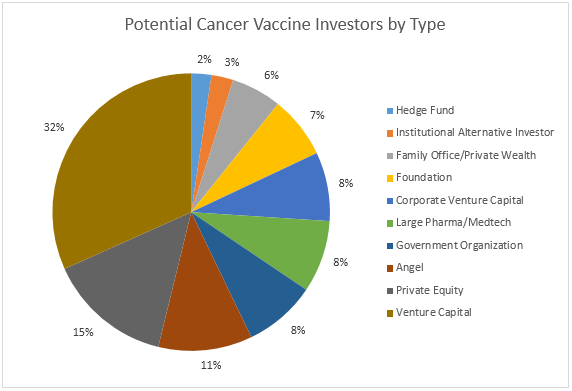
Multiple investor types are open to investing in cancer vaccines. Venture capital and private equity firms predominate, but we see significant potential interest from other types of investor, including large healthcare corporations and their venture arms.
Source: LSN Investor Platform, Data as of Oct. 21, 2015
With this level of global investor opportunity, cancer vaccine companies have many potential sources of capital to move their assets forward. LSN will look forward to seeing cancer vaccine technology mature and reach the marketplace in the years ahead.