Archive | Redefining Every Stage Investments (RESI) RSS feed for this section

Hot Investor Mandate: Europe-Based Venture Group Investing Globally in Therapeutics, Open to All Modalities and Indications

1 Jun

The firm was founded in 2020 and is headquartered in Spain. Prior to being formally founded, the firm began as a support structure for an initial group of private investors interested in life sciences and grew into a platform that sources investment opportunities and represents several high net-worth individuals. The firm’s network invests globally in biotherapeutic companies from Seed to Series A and expects to participate in a limited number of later stage investments, following the capital allocation desires of the private investor network. The firm’s investors typically invest as a group, with check sizes ranging from 1 to 3 million USD with the intention to make up to three new investments per year.

The firm is focused on therapeutics but is modality and indication agnostic. This includes orphan diseases. Platform or multi-asset companies are often valued over single asset opportunities. Preferred stage of development varies based on the validation level of both the therapeutic target(s) and technology being applied. The more validated the targets and/or technology, the earlier the firm’s investor group is able to invest, including specific investment cases prior to pre-clinical animal efficacy.

The firm does not have specific management team requirements and has taken board seats in the past, however it is not a requirement.

If you are interested in more information about this investor and other investors tracked by LSN, please email mandates@lifesciencenation.com.

Hot Investor Mandate: Investor Group Looking to Make Impact Investments in Companies in All Sectors with Products Including a Core Technology Component

1 Jun

Founded in 2020, the firm is a group of Silicon Valley and India based ex-entrepreneurs and executives with operational experience and global networks investing in India’s next billion. The group focuses on impact investing, looking to help technology and health advance in India, especially serving the underprivileged communities. The four key areas of interest are healthcare, agritech, livelihood, and education-tech. The group is looking for companies in the Pre-Series A round with typical check sizes ranging from $125k-500k. The group looks at global companies.

The firm is sector-agnostic and is open to looking at any life science/healthcare startup with impactful technology, but it should have either a soft or hard-tech core component. The group is open to all stages and indications, however the firm does not look at orphan diseases.

The firm would like to see companies have 2-3 years of experience working with grant funding and passionate, resolute teams with 2+ years of proven commitment and strong market/technology expertise. Additionally, although companies are not required to relocate to India, they are required to clearly target at or involve India’s emerging and historically neglected populations of over 600 million and meeting a pressing need. The firm may take a board seat on a case-by-case basis as they act on both leading and co-investing.

If you are interested in more information about this investor and other investors tracked by LSN, please email mandates@lifesciencenation.com.

Hot Investor Mandate: US and Asia Based Private Equity Firm Investing Opportunistically in Companies Looking to Enter the China Market

1 Jun

The firm was founded in 1996 and has offices in California, China and Taiwan. The firm is currently making investment from its USD 1.4B fund into promising private healthcare companies and from its $635M Opportunity Fund into promising public healthcare companies, invest in promising early-stage healthcare companies from its Innovation Fund. The firm invests exclusively in the healthcare sector; the firm invests primarily in the USA and Greater China but will also invest in other regions such as Europe and ASEAN countries. Within China, the firm makes growth investments in companies but also find some companies with interesting and innovative product in recent years there; in the USA and other regions, The firm makes both venture and growth-equity stage investments in both pre-revenue and revenue-stage companies. The firm’s allocations are highly varied. From the main fund, investments typically range from $20-50m, though larger investments are of interest as well; the Innovation Fund makes investments of typically $5-20 million. The firm is open to syndication. The firm is also particularly interested in working with companies that are open to or actively interested in seeking partnerships or opportunities in China.

The firm invests in therapeutics, medical devices, diagnostics, healthcare services, and clinically-oriented healthcare IT, and will consider investing in any indication area or technology subsector; however, orphan indications, dermatology/aesthetics, oncology, gene therapy, cell therapy, are of particular interest in the biopharma space; general surgery, neurovascular, cardiovascular, minimally invasive technologies, women’s health, respiratory care, novel diagnostics and orthopedics are of particular interest in the device space. Healthcare AI is an area they are interested and exploring. The Innovation Fund focuses on early-stage opportunities in biotech; from the main fund, the firm in most cases makes investments in products that have obtained market approval or are very close to commercialization, but earlier investments may be considered for highly innovative products or products that can demonstrate strong efficacy signals at an earlier stage (such as anti-infectives). For devices and diagnostics, the firm only invests in commercial-stage companies. Generally, the firm does not invest in imaging.

The firm is flexible regarding management teams and works with both serial entrepreneurs and entrepreneurs who lack industry experience. In addition to investing in private companies, the firm is able to invest in public companies by means of PIPEs or public market placements. The firm is interested in investing in companies with products that can demonstrate cost-effectiveness.

If you are interested in more information about this investor and other investors tracked by LSN, please email mandates@lifesciencenation.com.

Hot Investor Mandate: East Coast Based Strategic Partner Looking to Invest in, License or Acquire Medical Device and Digital Health Technologies

1 Jun

The firm is a medical technology company based on the East Coast. The firm works with early-stage startups using a variety of structures including co-development, equity investments, licensing, and acquisitions (most common). In terms of equity investments, the $850M USD firm invests in companies from Series A to Series C (or later) with an average of $3-5M as the initial size of investment. In terms of acquisitions, the firm has done deals in the range of $10s to $100s of millions of dollars. The firm is interested in partnerships with breakthrough, disruptive technologies. The firm is a multi-stage investor and is interested in technologies worldwide.

The firm is interested in disruptive technologies that are strategically related to the company’s focus on digestive health and pain management. The firm is primarily interested in medical devices and digital health. Within medical devices, the firm is primary interested in 510K and De Novo’s and are open to PMA devices. The firm will consider working with companies at any stage of development. Within digital health, the firm is most interested in consumer facing products that are linked back to medical devices, and the associated data analytics around the products.

The firm primarily values a management team with technical experience as they are interested in promising disruptive technology. The firm also prefers a team with previous management experience. The firm acts as a strategic investor in equity investments. As a strategic investor, the firm will require board seating.

If you are interested in more information about this investor and other investors tracked by LSN, please email mandates@lifesciencenation.com.

Interview with Michelle Chien  – National Health Research Institutes

26 May
130X130
Michelle Chien 
Interview with Michelle Chien, Manager of Technology Transfer and Incubation Center, National Health Research Institutes

By Erika Wu, Business Development Manager, Global Tech Hubs, LSN

erika
Erika Wu

Erika Wu (EW): Please introduce us to National Health Research Institutes (NHRI). Such as mission statement and brief overview of the services offered?

Michelle Chien (MC):

The National Health Research Institutes (NHRI) is a non-profit foundation established by the government with its organization charter. NHRI is dedicated to the enhancement of medical research and the improvement of health care in Taiwan.

Scientists at the NHRI conduct mission-oriented medical research and investigate many aspects of the basic biomedical sciences, as well as specific diseases. There are several research institutes and research centers are trying to deal with common problems such as aging, cancer, infectious diseases, mental disorders, occupational diseases, to health policy. It is our hope that the knowledge, experience, and facilities at the NHRI will become important resources to the whole nation in understanding, preventing, and curing diseases.

The technology transfer and incubation center (TTIC) is as a research support unit in NHRI divided into three groups of Industry-Academia Collaboration Planning Division (IACP), Intellectual Property Management & Technology Transfer Division (IPTT) and Innovation & Incubation Center (IIC). The IACP is the window for NHRI’s industry-academia cooperation and promote NHRI’s R&D outcomes. The IPTT assists research institutes in intellectual property management and out-licensing. The IIC mainly uses platform-based coaching methods to provide new startups with various resources to help them grow and thrive.

NHRI website: https://www.nhri.edu.tw/eng/

TTIC website: https://ttic.nhri.edu.tw/en/

EW: What are some traits of the Taiwan markets that are different from the USA or Europe markets?

MC:

1) The rapid growth of the global biopharmaceutical market has driven business opportunities for contract development and manufacturing (CDMO), while the growth of the generic drug market has driven business opportunities for joint development.

2) Taiwan has established bilateral cooperation promotion units with the United States and Japan respectively, and has listed biotechnology as a key cooperation project. At the same time, it has also signed relevant agreements on biotechnology cooperation, which will help international cooperation and market development of the domestic biotechnology industry.

3) The number of items entering late-stage clinical trials will increase, which will help opportunities for cooperation or authorization with multinational pharmaceutical companies.

4) The R&D cost of new medicines in Taiwan is lower than that in neighboring countries (such as Singapore, Japan, Australia), which helps to save drug development expenditures.

5) In addition to having publicly transparent drug review regulations that align with international standards, there are also counseling agencies that provide regulatory consultation services for products from research and development to market launch in Taiwan. Furthermore, the biomedical research and development capabilities are very strong. There are 26 medical centers and 124 clinical trial hospitals, abundant biotech R&D human resources, and high-level biotech talents familiar with the operation of European and American markets returning to Taiwan to start businesses. We have also established the Taiwan Clinical Trial Consortium (TCTC), which has sufficient capacity to conduct clinical trials for new drugs or medical devices.

EW:  What should investors look for from startups that want to enter the Taiwan/Asian markets? How does NHRI evaluate whether they made the most of it or not, and is that a good indicator for future success? How would you characterize the current startup investment scene in Taiwan? What kind of opportunities should we be aware of? 

MC:

From investors’ perspective on the biomedical industry, key success factors include market, technology, finance, and talent. In terms of the market, the total addressable market must be large enough; the technology must be innovative, feasible, and have a complete patent network protection; there must be completed financial planning and fundraising abilities; and the team must have a clear vision, determination for risk management, and technology transfer capabilities. All four elements are essential. During the COVID-19 pandemic, there has been an increase in investment funds being allocated to the biomedical field. 

Besides, owing to the coming aging society, the investment focus of the biomedical industry will be on medical care and technologies such as the Internet of Things (IoT) as well as the international market.  

According to the Taiwanese Biotech industry report from 2022, it points out the following domains are investment scene in Taiwan.  

Firstly, under the support of favorable policies, regenerative medicine and CDMO (Contract Development and Manufacturing Organizations) are experiencing an investment boom. While facing the challenges of an aging population, the prevalence of chronic diseases, and the rapid advancement of medical technology, there is a growing demand for innovative disease treatments. In response to this trend, the global regenerative medicine and cell therapy companies have been increasing in number, and the market size of gene therapy continues to expand. 

Secondly, the COVID-19 pandemic has accelerated the implementation of digital healthcare and precision medicine, creating a new investment opportunity. Taiwan’s early-stage investments in digital healthcare have followed this trend. Investors see the promising future in combining Internet of Things and biomedicine. Over the past five years, the number of investments in digital healthcare has exceeded those in pharmaceuticals and medical devices, becoming a new investment frontier in the healthcare sector. 

Therefore, TTIC will look for the potential MedTech companies would offer innovative ideas and technologies, we will assist them in providing bio bank data, regulatory counsel, VC&CVC partners. 

EW: What makes Taiwan an attractive launchpad for American or international startups who are interested in entering the APAC region? Why did you choose Taiwan, and what is your plan for the Asian market hereafter?  

MC:

There are some reasons that American or international startups can start their business here. 

1) Taiwan is a democratic country and locates near major metropolises such as Hong Kong, Singapore, Shanghai, Tokyo and Seoul in Asia. It’s appropriate for international startups to start their business in Taiwan first then extend out in other Asia countries.   

2) The National Biobank Consortium of Taiwan (NBCT) was established through the fund support and governance from the government and managed by NHRI. There are over 35 local biobanks being approved by the Ministry of Health and Welfare in Taiwan. Through the cooperation of all biobanks with uniform quality standards and clinical data content, a large and comprehensive human biobank network can be quickly established. Thus, Biobank can not only provide high-quality medical information and specimens for academic use, but also the industry for commercial use legally. It will be an advantage to appeal to more startups utilizing and having the clinical trial or further research in Taiwan. 

3) The government also focuses on the combination of Taiwan’s strengths in the ICT and biotech industries. For example, the majority of global gene testing chips are manufactured in Taiwan since Taiwanese ICT industry is already very mature. If it can be combined with the medical industry to develop medical materials and devices, medical diagnosis, digital healthcare, and use mature resources to drive new technologies and new drugs, this should be a feasible development strategy to explore. 

4) The policy is currently to boost recruitment and retention of international talents. There are a couple of actions below. 

  • Relaxing the work and visa requirements: the government is issuing Employment Gold Cards (a four-in-one work permit, resident visa, alien resident certificate and reentry permit).  
  • Relaxing residency requirements. 
  • Improving tax incentives and social protections. 
  • Relaxing entry and residence restrictions for nationals without household registration. 

To conclude, the strengths of developing ICT with bio data in Taiwan will increase more incentives for American or international startups to launch the business or have the collaboration with local clinical trial here.   

EW: What can NHRI provide for the international startups?

MC:

Technology Transfer and Incubation Center (TTIC) in NHRI can provide co-development, technology transfer, business cooperation, and international startup collaboration models which can be used to connect solutions to overseas clients.  

In 2022 NHRI has been having the innovative collaboration with ASUS Cloud and NVIDIA to create a platform. Leveraging NHRI’s biomedical research capacity, the latest generation of NVIDIA AI supercomputers and AI models, and analytical computing applications, AIHPC cloud platform developed by ASUS Cloud Infrastructure Software Center (OCIS), and operational consulting services and training from Taiwan Web Service (TWS), which creates Taiwan’s first dedicated supercomputer for healthcare and pharmaceutical purposes. Developers and data scientists can engage in tasks such as development, deployment, testing of applications, and high-speed computation of big data AI, all through a single platform. This significantly reduces the computation time for massive data and expands the capacity for pharmaceutical research and development. Hence, TTIC can help international startups connect with the biomedical supercomputers within NHRI, enabling precise research data analysis and saving time in clinical trials and validation.  

Additionally, Innovation and Incubation Center (IIC) of TTIC has collaborated with ASUS subsidiary, Taiwan Web Service (TWS), to promote the AI Biomedical Accelerator Program in 2023. Startups are recruited by developing AI technology in biotech and medical fields. This program mainly provides fundraising, regulations, business matching, and talent development, enabling startups to grow rapidly.  

EW: What are some initiatives and strategic goals in 2023 and how are you using LSN & RESI and partnerships to benefit your community? This is your opportunity to discuss strategic goals, how NHRI and other tech hubs can form strategic partnerships, etc.

MC:We hope to establish a long-term partnership with Life Science Nation. Our startups in early stage can gain exposure to international investors and have fundraising opportunities by participating in the RESI conference’s Innovative Pitch Challenge for entering overseas markets. Additionally, we hope to introduce NHRI to international startups by Tech Hub, allowing for potential collaborations with NHRI research units in cases of technology licensing needs. In meanwhile, we also welcome international biomedical startups to join IIC and launch their business in Taiwan, as well as collaborate with NHRI in terms of technology development.


RESI-Boston-2023-June-1100px

Check Out the Lineup at RESI Boston June 2023Program Guide

25 May

By Dennis Ford, Founder and CEO of Life Science Nation, Creator of the RESI Conference Series

I am thrilled to present LSN’s Program Guide for RESI Boston, June 5-7, at the Westin Copley, Back Bay, Boston. This will be a hybrid RESI event, face2face June 5, followed by international virtual partnering June 6-7. The Program Guide takes you through our investor panels, sponsor workshops, exhibitors, and 50+ Innovator’s Pitch Challenge companies participating in this RESI.

LSN will debut a leading-edge platform called the “Global Partnering Campaign (GPC), Fundraising & Licensing Partner Roadshow Management” at this conference.

GPC-with-tagline

The GPC integrates LSN’s Investor and Licensing Partner Database and the Salesforce CRM. Subscribing companies receive a vetted Global Target List (GTL) of likely capital investors and licensing partners garnered through one-on-one interviews with the LSN research team, which can be organized into three tiers of Investor Priority:

  • Tier 1: Partner is matched on a specific mandate.
  • Tier 2: Partner is matched on an opportunistic mandate seeking compelling technology assets.
  • Tier 3: Partner is matched as a potential fit based on past or recent actions. This is where the numbers game comes into play.

LSN will also announce a partnership with Big4Bio, whom we have teamed with to create a daily news aggregator for the global startup community called LifeSci Startup.

LifeSci-Startup-Logo

RESI is a dedicated global partnering event, and the international attendees are the leaders, innovators, and who’s-who of early-stage drugs, devices, diagnostics, and digital health (the 4 Ds).

It is not too late to attend if you seek capital investment or licensing opportunities. RESI offers a 3-day hybrid ticket (June 5-7), a 2-day virtual ticket (June 6-7) and an Audience Access Pass option. Learn more about our registration options here. We hope to see you next June 5th at the Westin Copley Boston!

Register-now-button-new

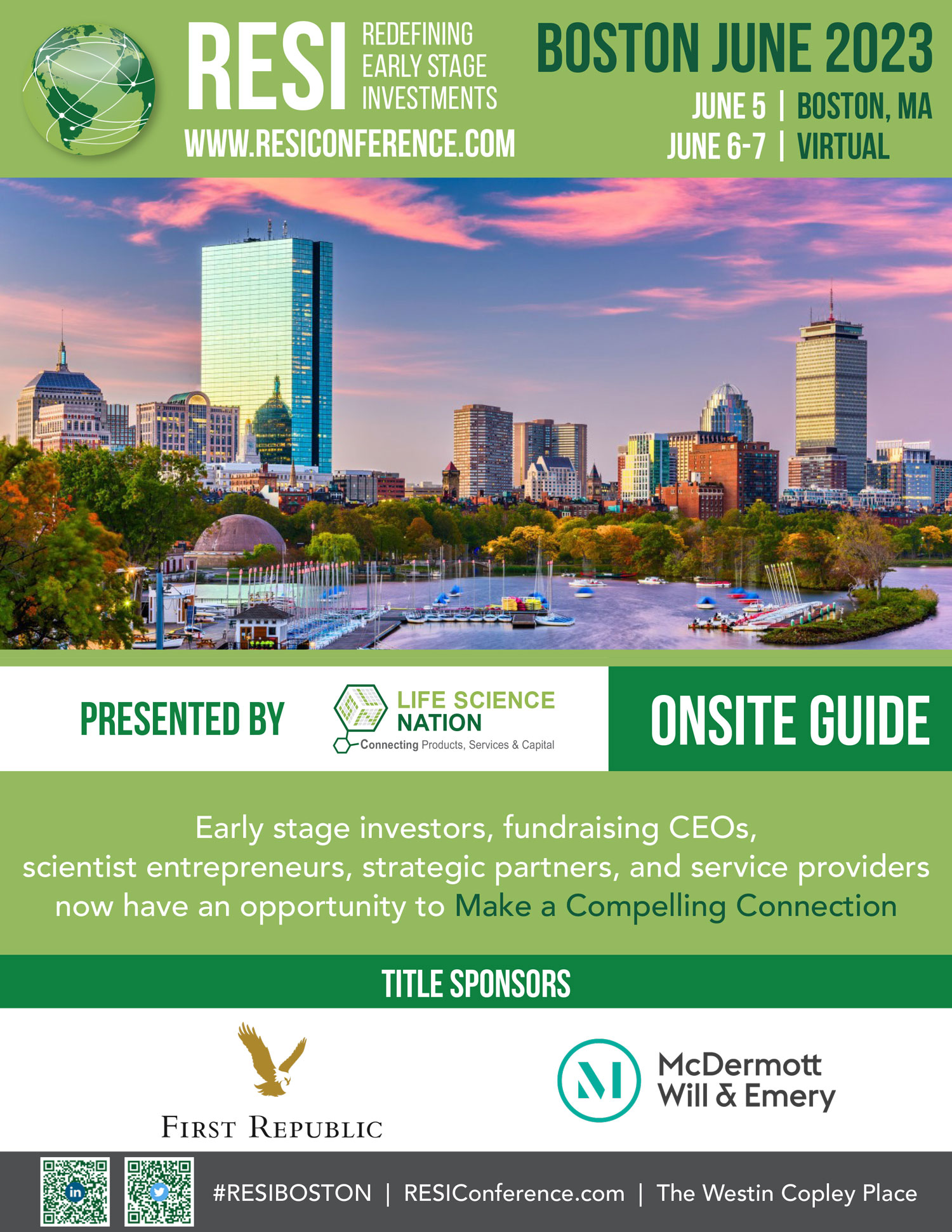
RESI-Boston-June-2023-Program-Guide_5192023_v1Click to View RESI Boston June Program Guide

RESI-Boston-2023-June-1100px

Life Science Nation New Product Announcement

18 May

Global Partnering Campaign (GPC), Fundraising & Licensing Partner Roadshow Management.”

GPC-logoFundraising & Licensing Partner Roadshow Management

By Dennis Ford, Founder and CEO of Life Science Nation, Creator of the RESI Conference Series

 Karen Deyo, Director of Product, Israel BD, LSN

LSN will debut a leading-edge platform called the “Global Partnering Campaign (GPC), Fundraising & Licensing Partner Roadshow Management.” The GPC integrates LSN’s Investor and Licensing Partner Database and the Salesforce CRM. Subscribing companies receive a vetted Global Target List (GTL) of likely capital investors and licensing partners garnered through one-on-one interviews with the LSN research team, which can be organized into three tiers of Investor Priority:

  • Tier 1: Partner is matched on a specific mandate.
  • Tier 2: Partner is matched on an opportunistic mandate seeking compelling technology assets.
  • Tier 3: Partner is matched as a potential fit based on past or recent actions. This is where the numbers game comes into play.

Information on these profiles is automatically updated daily, and user outreach and tasks can be tracked intuitively with CRM components, including the following:

  • Status of Outreach (Lead, Reviewing Materials, Call/Meeting Scheduled, etc.)
  • Materials Sent (Executive Summary, Pitch Deck, etc.)
  • Notes (NDA status, DD, and data room)
  • Reporting (investor/licensing pipeline)

LSN customized this platform, leveraging years of experience as a broker/dealer helping early-stage life sciences companies attract capital. Fundraising is a numbers game, and as companies transition from the regional to the global arena, difficulty juggling outreach with many different companies and contacts worldwide is inevitable. Managing your fundraising campaign adroitly is essential, and with the GPC platform, LSN makes it simple. The GPC product is a game changer for early-stage startups seeking between $100K and $50M (Seed-Series B).

Request a demo of the new GPC product here.

Request-a-Demo