By Rory McCann, Director of Marketing & Conference Producer, LSN
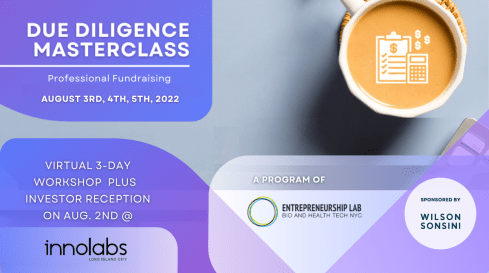
The Entrepreneurship Lab for Bio- and Healthtech in NYC (ELabNYC) invites you to join next week’s Due Diligence Master Class, August 3-5. Learn from 18 active investors and 5 founders, who have collectively raised over $300M in the past year, to develop strategies for professional fundraising success!
Hear from investors and founders from:
Included in this event is an in-person networking reception at InnoLabs on August 2 with investors, founders, and mentors! The RESI community can save 20% off registration with code: COMMUNITY20.
By Rory McCann, Director of Marketing & Conference Producer, LSN
Summertime and the living is easy. This old, popular song was clearly not written by a fundraising entrepreneur with an early-stage life science company. While investors, strategic partners, academics, and industry professionals alike put on their out-of-office away message, the startup founder remains in work mode, trying to keep up with and stay ahead of economic trends that could impact their next raise. If you’re spending your summer archiving automatic replies as deadlines loom, know that there is still much you can do to make this time count for you and your team.
If you’re attending RESI Boston, September 21-23 or engaging in networking and partnering once the summer winds down, now is the time to set yourself up for success. There is much to do today for tomorrow to be as profitable as possible:
Prepare and update your marketing materials. When was the last time you reviewed your pitch deck, executive summary, data sheets, etc.? These are the materials that investors are going to want to see ahead of that initial meeting. Has your team grown? Have you achieved any meaningful milestones? Have you benefited from recent press or awards? Have you built new collaborations and partnerships that would entice more investment? It’s important to keep these materials updated and readily available for that next connection.
Build a list of potential partners who are a fit for you. This is especially important if you’re hitting the road and looking to partner and network this fall. Fundraising is a numbers game and now is the time to build up a global target list of investors who are a fit for your product set and stage of development. Answering these questions ahead of outreach has the potential to limit ghosting from investors.
Get your story straight. Understanding your company story and being able to tell it effectively is essential in business. Leaving pitch sessions and investor meetings with a strong sense of who your company is and what it stands for can provide you with an edge over the competition that blends into a competitive market. Many founders unwisely assume that their product and technology is exceptional, and the value should be obvious and speak for itself. That’s a risky move in assuming investors who are a fit for you aren’t also courting your competition. Having a strong brand identity is central to standing out in a crowded space, outlasting the competition, and surviving a transitioning market. Learn to communicate it well and watch how it can change the quality of your meetings.
These are all essential to successful fundraising but contain many soft skills that do not always receive the attention and practice necessary in order to see the benefits. If you’re frustrated by the current pace of your fundraising, take advantage of the time you must make sure you’re walking into a new season of networking, partnering, and pitching with your best foot forward.
Still haven’t signed up for RESI Boston, September 21-23? There are only a couple weeks left to save on early bird rates! Sign up today to save $300!
By Alexander Vassallo, Manager of Business Development West Coast (US), Entrepreneurial Education Lead, LSN
The best entrepreneurs are the best storytellers. Irrespective of the industry or discipline you find yourself in, the ability to deliver a compelling and powerful narrative of your unique technology or product, highlighting clearly why you’ve undertaken a new business venture, is one of the most important skills a fundraising executive must have. Last week’s fundraising bootcamp – “It All Starts with the Story” – delivered by members of LSN’s BD team, Greg Mannix and Alex Vassallo, offered a deep dive into one of the most critical determinants of a startup entity’s success.
Potential partners you may approach during your global fundraising initiatives will be looking for entrepreneurs who have not only managed to portray their company’s unique story into a cogent message threaded through multiple modalities, but they will be looking for authenticity. Finding your voice and being able to inspire partners to learn more about your company is part and parcel of undergoing the transformation from aspiring scientist-entrepreneur to successful life science executive. However, only those entrepreneurs who truly commit to the process and come to terms with the importance of entrepreneurial agency will be the ones who find success in the shark tank.
Finding your voice and developing a compelling narrative goes beyond the obvious benefits of highlighting your startup’s unique value points to potential partners in a meeting. In fact, undertaking this process successfully prepares you to speak different languages within the context of a deal, allocation, or partnership. And by different languages, we don’t mean Spanish or French, we mean business and science. From speaking generally to the gatekeepers who will evaluate the possibility of progressing your investment opportunity down the deal chain, to the navigators and evaluators with whom you can speak more scientifically, and eventually the decision maker with whom you will be speaking a heavily business-centric language, if you can net out your company’s unique story in as little as a 5-7 word tagline and as extensively as a 2-page executive summary and a 10-12 slide pitch deck, you truly will have found your voice.
Most importantly to consider when approaching your potential partners, even more so than the estimated ROI of your opportunity or the unmet medical need being addressed, is the fact that investors will always bet on the team. Investing in a company is commonly referred to as getting into bed with the company or investor; this is a relationship that could last anywhere between 5-15 years, and unless investors see that you have an inspired team behind you that shares your vision and believes in the same compelling narrative, they will be dissuaded from viewing your investment opportunity as a tangible relationship that can grow and develop throughout the years. So not only do you need to get your story straight to bring to potential partners, but to be successful in the early-stage life science arena, you must be able to inspire your colleagues to share in your company’s narrative.
All of this and more was covered in LSN’s Fundraising Bootcamp, “It All Starts with the Story”. If you are interested in learning more, have a look at the recording of last week’s session. We are the industry leaders in connecting early-stage life science firms with active investors and strategic partners, and it is our pleasure to share the story of what we have learnt over the past decade with the next generation of leading industry professionals.
By Karen Deyo, Director of Investor Research, Israel BD, LSN
When starting a fundraising journey, it is important for startups to keep an open mind for any relevant source of funding or means of advancing their technology. Whether a standard equity investment, convertible note, joint partnership, licensing deal, or non-dilutive funding, it is necessary for startups to understand all options, weigh the pros and cons, and find the best way forward for the company.
Non-dilutive funding is a great option for early-stage startups for many reasons. First, it provides a great way to advance to value inflection points without reducing their equity stake in the company. Second, investors like to see non-dilutive funding because it proves that, in many instances, experts in the relevant field believe strongly in the technology and its promise. Additionally, investors benefit from the lack of equity dilution and can indicate a better ROI for them. Lastly, non-dilutive funding can serve as a bridge when a company is having difficulty with fundraising, helping them reach that milestone that investors want to see before investing.
There are many sources for non-dilutive funding – this includes regional organizations, non-profits and government entities. These grants often require an extensive application process, with several specific deadlines each year. Many of these organizations also have support staff that can help companies improve their odds of getting funded. Doing your research for these programs can play a large role in your success – but the benefits are worth the effort! Keep an eye out for these opportunities, and remember to check all potential avenues, including your regional economic initiatives, government organizations promoting startup advancement, and patient non-profit groups or foundations supporting the indication you are addressing. Good luck with your journey!
A life sciences venture capital fund in Asia currently manages three funds with over $630 million assets under management and is actively seeking investment opportunities. On average, the size of investment is $5-25M in venture rounds. The firm prefers to act as the lead investor but is also open to co-investing. The firm looks for companies located around the globe, with a preference in the US and China. The firm is actively seeking new investment opportunities.
The firm is focused on Therapeutics and Medical Devices opportunities. The firm’s core focused therapeutic areas include oncology, immunology, metabolic and CNS diseases, but is also focused on new modalities and platform technologies. The firm is also interested in interventional, novel medical devices in cardiovascular, neuro-vascular diseases.
The firm prefers management team with strong scientific background and expertise, successful track records would be a plus but is not required. The firm generally takes a board seat.
If you are interested in more information about this investor and other investors tracked by LSN, please email mandates@lifesciencenation.com.
A healthcare venture capital investment firm currently manages over $800 million, including their recently announced venture fund in early 2022. The firm generally makes investments in early stage companies targeting healthcare technology and services. The investment size will vary, depending on the opportunity. The firm typically invests in companies based in the United States though is open to companies based on a global level.
In the healthcare technology sector, the firm is actively seeking new investments in healthcare software and tech-enabled services sectors with a specific focus on payment reform, patients as consumers, healthcare analytics, healthcare infrastructure, and novel service delivery models. The firm has a specific interest in transformational technologies and services that enable value-based healthcare. The firm currently is not focused on therapeutics or traditional medical device investment opportunities, though may consider medical devices with a software/data component, such as sensors, that have either already obtained FDA clearance or are not subject to FDA regulation. The firm is indication agnostic and invests in pre-revenue to growth stage products.
The firm seeks to invest in privately held companies with a strong and experience management team. The group prefers to invest in companies with cutting-edge technologies and large market potential.
If you are interested in more information about this investor and other investors tracked by LSN, please email mandates@lifesciencenation.com.
A newly established venture capital firm manages a fund dedicated specifically to life science investments. Though it could largely vary on a deal-by-deal basis, the firm’s initial size of investment is usually around $1M, with a significant portion dedicated to follow-on investments. Geographically, the firm is focused on companies headquartered in Japan and those that are looking to expand into the Japanese market.
The firm is most interested in biotech and digital health technologies. The firm is very interested in emerging therapeutic technologies such as cell and gene therapy, as well as platform technologies. With regards to digital health technologies, the firm is most interested in (i) IT solutions for people in terms of health management, disease prevention, diagnosis, therapy, disease management, and nursing care; (ii) healthcare industry in terms of drug discovery & development, medical information, distribution system by leveraging AI, big data, IoT, VR, etc. The firm is opportunistic in terms of stage, and will seek opportunities that are pre-clinical and beyond.
The firm is actively seeking opportunities in Japan and those that are looking to expand into Japan. The firm will prefer to lead investments in companies headquartered in Japan where they can best leverage their resources and network, but will generally follow larger syndicates for deals outside of Japan.
If you are interested in more information about this investor and other investors tracked by LSN, please email mandates@lifesciencenation.com.
The firm is focused on therapeutics companies and does not invest in medical devices, diagnostics, or digital health. The firm is open to considering assets of very early stages, even those as early as lead optimization phase. The firm considers various modalities, including antibodies, small molecules, and cell therapy. Currently, the firm is not interested in gene therapy. Indication-wise, the firm is most interested in oncology and autoimmune diseases but has recently looked at fibrotic diseases and certain rare diseases as well.
The firm is opportunistic across all subsectors of healthcare. Within MedTech, the firm is most interested in medical devices, artificial intelligence, robotics, and mobile health. The firm is seeking post-prototype innovations that are FDA cleared or are close to receiving clearance. Within therapeutics, the firm is interested in therapeutics for large disease markets such as oncology, neurology, and metabolic diseases. The firm is open to all modalities with a special interest in immunotherapy and cell therapy.
A strategic investment firm of a large global pharmaceutical makes investments ranging from $5 million to $30 million, acting either as a sole investor or within a syndicate. The firm is open to considering therapeutic opportunities globally, but only if the company is pursuing a market opportunity in the USA and is in dialogue with the US FDA.
The firm is currently looking for new investment opportunities in enterprise software, medical devices, and the healthcare IT space. The firm will invest in 510k devices and healthcare IT companies, and it is very opportunistic in terms of indications. In the past, the firm was active in medical device companies developing dental devices, endovascular innovation devices, and women’s health devices.
A venture capital firm founded in 2005 has multiple offices throughout Asia, New York, and San Diego. The firm has closed its fifth fund in 2017 and is currently raising a sixth fund, which the firm is targeting to be the largest fund to date. The firm continues to actively seek investment opportunities across a […]









 Next Phase Newsletter