
By Claire Jeong, Vice President of Investor Research, Asia BD, LSN

One of the biggest challenges facing fundraising CEOs working to bridge the gap between potential and partnership is the ability to stand out among a sea of promising tech and connect with the right investors for their work. Life Science Nation (LSN) wants to make the choices clearer for investors, which is why we’ve developed the Innovation Challenge for early-stage companies. The Innovation Challenge is designed to highlight the best of the best so deserving companies can showcase their work to strategic partners.
The Innovation Challenge for the 3-Day Digital Redefining Early Stage Investments (RESI) Conference in September is now accepting applications for two weeks only, due August 12!

For fundraising life science companies, participating in the Innovation Challenge is a great way to increase visibility. All participating companies will have a dedicated landing page featuring materials (example screenshot below) that the companies can use to promote and direct traffic, just like they would do at an in-person RESI.
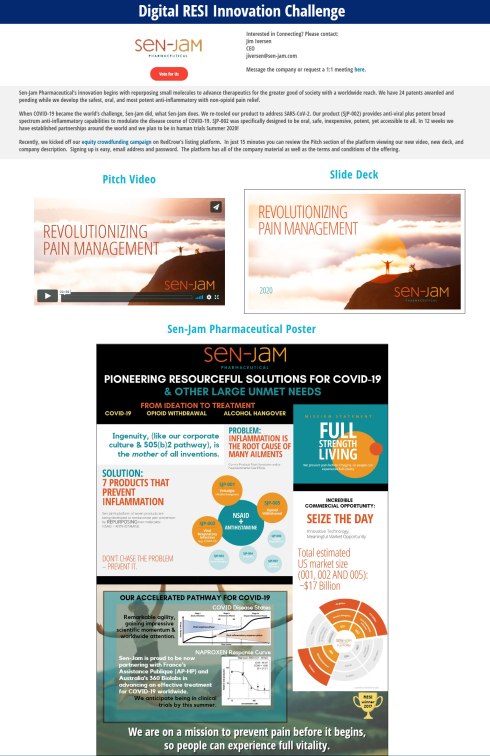
In addition, they will be featured on the Next Phase blog and newsletter, as well as LSN’s social networking platforms. Finalists also are indicated with a special badge within our partnering system indicating their Innovation Challenge Finalist status.
Attendees are also encouraged to vote for their favorite, most innovative companies and the Top 3 Winners who receive the most votes can receive free tickets for up to 3 future RESI Conferences of their choice.
The Innovation Challenge review team has compiled a list of guidelines to help companies with their application process:
What makes a high-score company?
The evaluation process is based not only on scientific merit, but also on how ready the company is to present to an investor (“investor-readiness”). A perfectly scored company would have a transformational technology that can achievably address a high unmet need using a differentiable novel approach or target. Alongside high innovation, differentiation, unmet need, and market fit, a high-scoring company would have a broad IP position, an experienced management team and CEO with top-tier advisors, and strategic alliances with manufacturing and clinical partners. The company will also receive high marks for having what we call “investor-ready” marketing material (executive summary, pitch deck, website).
Clearly describe your technology.
Like any marketing material, you need to be clear. Be sure you understand and answer the questions fully. The team has seen unclear responses as to what a company’s technology is and its significance in improvement.
Be honest with your answers.
The team frequently reviews applications that state they have no competitors in the space, when most likely, they do. Novel products do have competitors before them, for established technology does exist in the indication your product targets. Be honest with whom your competitors are, and then address what the key differentiators are to your product. Even if your product is an incremental improvement, be honest and highlight this and it can still be attractive!
For example, competitors for your disease-modifying therapeutic may be symptom-treating therapeutics in the same indication that are either commercialized or being developed. You should identify these symptom-treating therapeutics and highlight your novel target approach that makes your product disease-modifying.
Explain your current standings in detail.
Outline everything you have in terms of your current standing, while also providing your outlook of where you hope to go. Avoid ambiguous statements such as, “CEO is an experienced entrepreneur”. Instead, provide details that highlight the CEO’s experience – years as an entrepreneur, number and names of companies exited, background expertise, etc.
Provide short-range and long-term horizons.
If you do not have certain criteria, such as a strategic alliance or IP, that’s perfectly fine. State your current standing and provide what steps you are currently taking to reach that milestone. For Alliances and Collaborations, state your verbal relationships; for IP status, state how many you have filed or are planning to file. Providing your strategy is better than a simple yes or no.
Put in a balanced effort.
You should not spend 5 minutes on this application, and neither should you spend 5 hours. Your answers should be brief, as well as detailed – the team has received hasty, effortless applications that are quickly discarded with a low score. On the other hand, you also shouldn’t spend an excessive amount of time on the application, as these are all straight-forward questions that you should be comfortable answering. Remember, as your executive summary should answer all these questions alone, this application is the backbone of the evaluation process and essentially your executive summary.
Send us your marketing material.
If you have marketing material, send it. This includes your slide deck, executive summary, website, videos – any supplemental material that can boost understanding of your technology and whether your company is investor-ready. The application provides limited space – while this forces you to get straight to the point, supplemental material explains what an application cannot (i.e. figures, graphs, pipeline, non-confidential data, etc.)
Companies can submit their applications for the Digital RESI September Innovation Challenge by August 12 at here. Learn more about Digital RESI September at resiconference.com.


 Andrew Satz is the CEO and Co-Founder of EVQLV, a technology company leveraging AI to accelerate the speed and lower the failure rates of biologics discovery and development. He co-developed EVQLV’s biologics discovery engine, which uses a wide range of machine learning and software engineering techniques to design and screen novel biologics. A data scientist by training, Satz is a seasoned entrepreneur and technologist having founded multiple startups and holding leadership roles in companies ranging from insurance to biotech. Satz holds a BA in Economics and MS in Data Science, both from Columbia University.
 Gini Deshpande, PhD, is the founder and CEO of NuMedii, a data-driven drug discovery company that pioneered the use of artificial intelligence and advanced data sciences to rapidly discover new precision therapeutics. Having raised the company’s financing and overseen successful partnerships with several large pharma companies, she is now spearheading the company’s efforts in the development of its own pipeline in fibrosis and orphan oncology indications. Previously, she helped Affymetrix and other companies with market development strategies for their innovative technologies. She led intrapreneurial efforts at Children’s Hospital Boston for the creation of new devices for the tiniest of patients and vaccines for the developing world. Gini has also helped commercialize early-stage life science technologies in research tools, diagnostics & therapeutics and has closed licensing deals worth several million. Gini received her PhD in Biological Sciences from Purdue University and did post-doctoral work at Massachusetts General Hospital.
 Veronomics, Inc. is a Delaware C Corporation (registered in New York State) headquartered in the University at Buffalo New York State Center of Excellence in Bioinformatics and Life Sciences. The company was founded by Irwin H. Gelman, PhD, who is a Distinguished Professor of Oncology and Director of Research Integration in the Roswell Park Comprehensive Cancer Center, and Track Chair of the UB-Roswell Park academic program in Cancer Genetics, Genomics and Development. Dr. Gelman received his BA in Biochemistry at Wesleyan University, MA, MPh and PhD degrees from Columbia University, and was an American Cancer Society Postdoctoral Associate in the lab of Prof. Hidesaburo Hanafusa at The Rockefeller University. Dr. Gelman has been involved with two biotech startups currently traded on the NASDAQ, Antigenics LLC (now Agenus) and Kinex Pharmaceuticals (now Athenex), where he helped develop the Src-family kinase inhibitors, KX2-391 and KX2-361, now in Phase II and III clinical trials for several cancers.
 Rafael leads Genialis’ effort to integrate and mine vast and diverse sources of biomedical knowledge to realize the promise of precision medicine and therapeutic discovery. He spent nearly 20 years in biomedical research prior to Genialis, publishing on the evolution of innate immune systems, bioengineering of microbes, and genetics of development. Rafael co-invented the j5 DNA assembly design automation software for high-throughput molecular design and analyses (since commercialized by TeselaGen). Rafael earned his doctorate at Yale University, and conducted postdoctoral research at Lawrence Berkeley National Laboratory’s Joint BioEnergy Institute (JBEI) and Baylor College of Medicine. In his free time, Rafael enjoys cooking and rock-climbing, and raising heirloom tomatoes and two precocious children.
 Nabiha Saklayen is a bio-inspired physicist and entrepreneur. Nabiha launched Cellino to converge physics, biology, and machine learning to enable paradigm shifts in regenerative medicine. Cellino is building the next generation of cell and tissue therapies with a proprietary platform technology that makes stem cell-derived therapies scalable for the first time. Nabiha was recognized as a Pioneer in MIT Tech Review’s 35 Innovators under 35 list for her inventions in laser-based delivery methods and is on the 2019 Forbes under 30 List for Healthcare. She received her PhD in Physics from Harvard University as an HHMI International Fellow. She made significant scientific contributions to the field of pulsed-laser delivery to cells, with several peer-reviewed papers published, patents pending, and grants awarded. Nabiha grew up in Saudi Arabia, Bangladesh, Germany, and Sri Lanka.


 Next Phase Newsletter