Building a Brand: From Blah to Boom

6 Aug

By Karen Deyo, Senior Investor Research Analyst, LSN

“You don’t need marketing materials because your technology speaks for itself,” said no investor ever, besides the ones living in the minds of hopeful, yet branding-challenged, CEOs. What many often neglect until the last minute is that a company’s marketing collateral is one of its most important assets when reaching out to investors, often the first glimpse an investor has of the company. The goal is to keep a clear, consistent message across all channels of communication. No matter who interacts with your company in any context, they should all have the same understanding of who you are and what you do.

Of these channels, the pitch deck can often be a challenge to master, balancing the visual format while allowing investors to understand the whole with no explanation. Furthermore, a pitch deck needs to provide a good snapshot of the company in 10-12 slides – as an investor once said during a RESI panel, a pitch deck should be like a movie trailer.

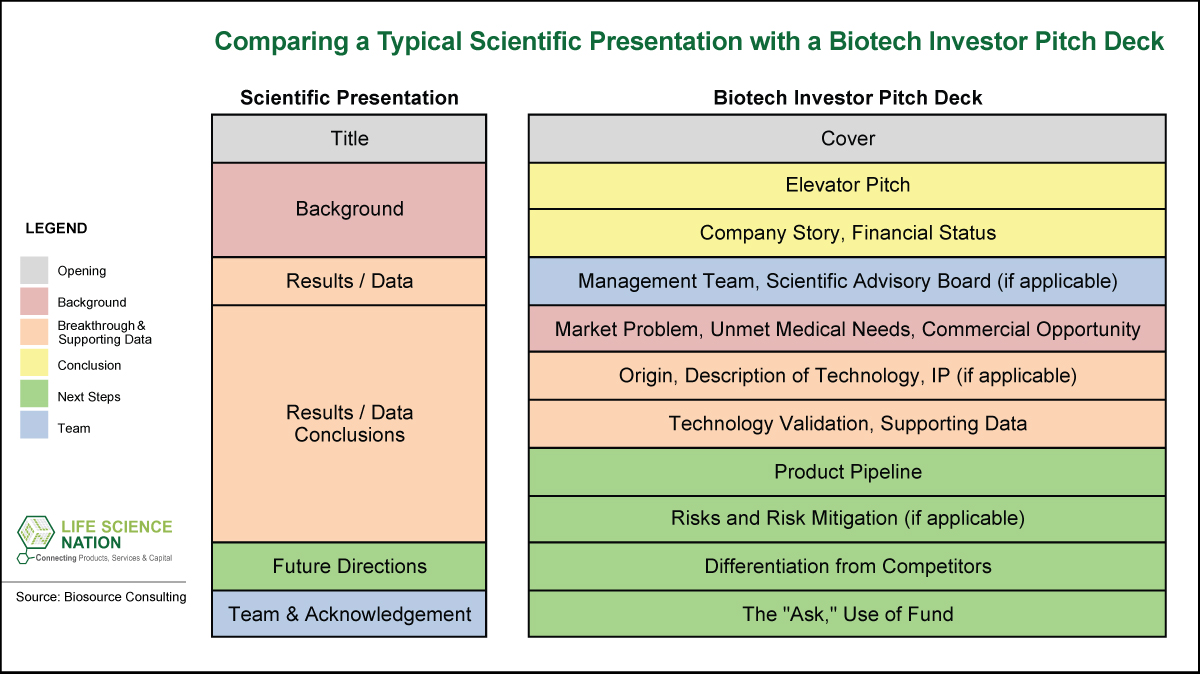
The key to a good pitch deck is to ensure that no one portion dominates. It should tell the story of your company, and we recommend that it include the following information:

  • Elevator Pitch & Tagline: Clear, informational, but concise and memorable.
  • Company: Who are you as a company? Who is your management team, and what stage of development is your company now?
  • Technology: What need is your tech filling in the market? Where is the opportunity, and how does your idea fill it? Describe your tech, and back up your claims with supportive data that is visually appealing and easy to digest. Remember, this isn’t a thesis defense.
  • Pipeline & Future Projections: You’ve got this great idea, but what’re the next steps? What’s your path to market and, eventually, exit? Do you have competition that you stand out from? Are there any risks you anticipate, and how do you plan to mitigate these? This would also be a good time to share milestones (both achieved and future), as well as a timeline for the use of funds you are raising. Again, keep it clear and visually palatable.

Companies, especially those guided by scientist-entrepreneurs, have a tendency of focusing on the science, leading to pitch decks that are heavily weighted on the technical aspects of the technology and are much too long. Remember, the purpose of your pitch deck is to hook the investor’s interest, and leave them wanting a meeting, where they can learn more.

You won’t get that second meeting unless you’re delivering a clear image of your company and its value to the market. Remember that this isn’t rocket science (you’ve probably already done that), just telling a compelling story to an audience that ultimately wants the same thing as you – a successful partnership.

A Week of Partnering: An Interview with Life Science Nation (LSN) Chief Conference Officer, Greg Mannix

6 Aug

Greg Mannix

By Rory McCann, Marketing Manager & Conference Producer, LSN

Rory McCann

When it comes to the fundraising CEO on the lookout for strategic partners, it’s essential to be both visible and active in the partnering scene. Partnering is a relationship that requires frequent attention over time. One well-timed conversation rarely cuts a deal in healthcare, but it’s the CEOs who show up regularly and prepared that catch the eye of their ideal partners.

This is why Life Science Nation (LSN) is pairing their successful RESI conference series with their new partnering event, 4D Meets AI. Artificial intelligence (AI) has countless applications in healthcare, and this conference is highlighting the most advanced and powerful applications across drugs, devices, diagnostics, and digital health (4Ds). The team that has connected hundreds of fundraising CEOs to investors in relationships resulting in millions of invested capital now brings AI to center-stage as a companion to the wildly successful RESI conference series. In this interview, LSN Chief Conference Officer, Greg Mannix pulls back the curtain on why the team has built a week of partnering, and what 4D Meets AI is bringing to these essential conversations.

Rory McCann (RM): Let’s start with RESI. What is the difference between the Digital RESI 2-day partnering event and Digital RESI September?

Greg Mannix (GM): First of all, Digital RESI September has 3 full days of partnering, so the potential for getting a lot of meetings is really amazing. I have seen some attendees get upwards of 40 meetings over the 3 days of our June conference. Another difference is that this is a full RESI conference, meaning that there will be new and insightful investor and workshop panels, the Innovation Challenge, the Featured Company Pitch Sessions and a virtual Exhibit Hall. All of this great content is aimed at adding value for fundraising CEOs.

RM: RESI is very popular with early-stage companies. How can a company stand out and get increased visibility at RESI?

GM: One of the ways companies can get more traction with investors and strategic partners is through the Innovation Challenge. It is free to apply and participate, and the selected finalists are tagged as such in their partnering profiles for investors to see, and they get their own dedicated landing page on the conference live agenda. CEOs can submit an Innovation Challenge Application until August 12.

Another great option is to pitch to a panel of investors. The Featured Company Pitch Sessions put a company’s 4-minute pitch in front of a panel of 5 focused investors. There is a live Q&A session, and afterwards the pitching companies can follow up with the investor panelists. Participating companies also get their own dedicated landing page. It’s really a unique opportunity available to CEOs for a small fee for the benefit of pitching in front of lead investors that are a fit for their company and product. CEOs can submit a Pitch Sessions Applications on a rolling deadline.

RM: What’s new about RESI September?

GM: This upcoming Digital RESI will have more live-streaming content than ever before. We have found that real-time panels and pitch sessions, with the possibility of live Q&A, are very popular. We are expecting more investors than ever to participate in this global event—more than 450 expected—and companies can choose to have 1 day or 3 days of partnering. Additionally, the 4D Meets AI conference is the other huge novelty in September. This conference is a great addition to RESI, enabling attendees to access up to 5 days of partnering.

RM: Sounds like there’s a lot going on at RESI. Tell me about the new 4D Meets AI conference.

GM: 4D Meets AI is LSN’s newest conference focused on how AI is accelerating development in the 4 Ds: Drugs, Devices, Diagnostics and Digital Health. It is an incredibly dynamic field that is growing tremendously. I believe we are in a golden age of technology in the life sciences, and therefore RESI and 4D Meets AI are a showcase of some amazing people and products that will change the world and help many.

The conference will have a full track of panels focusing on the hottest new applications of AI in life science, and another track of panels with investors interested in AI-enabled technologies. To sign up for 4D Meets AI, register HERE.

RM: Lastly, fundraising CEOs are often strapped for cash. Is there a special discount to attend both conferences?

GM: Yes! Companies can save on each conference with the super early bird registration rate until August 7. If they choose to bundle for a 5-day partnering experience, they can save $200 with the combo registration which is $1,200.

Sign up for RESI, 4D Meets AI, or register for the combo deal for 5 days of continuous partnering. You won’t regret it!

Hot Investor Mandate: USA Headquartered VC Firm Invests In Novel Therapeutics, Devices, Diagnostics, Digital Health With Newly Raised Fund

6 Aug

A venture capital firm headquartered in the USA has invested over 160 startups in deep tech-focused areas such as SaaS, Biotech, AI chips, Fintech, Blockchain, and Semiconductors; with multiple unicorns in the firm’s portfolio. The firm recently closed its fourth fund, of $50M AUM, and is actively seeking investment opportunities across a wide range of industries. Within the Life Science area, the firm is interested in Therapeutics, Med Devices, Digital Health, and Diagnostics. The fund will focus on investing in the US or companies who are interested in entering the US market. On average, the typical size of investment is $0.5 – 1M but the firm also has follow-up investment strategies. The firm seeks to invest in early-stage companies, which Seed to Pre-A round is their sweet spot.

The firm is an opportunistic investor and will consider therapeutics, medical devices, diagnostics, and digital healthcare companies. The firm is open to a wide range of technologies including novel techniques. Within Medtech, The firm is strongly interested in robotics, semiconductors, sensors, AI modeling diseases, and telemedicine. The firm is open to novel medical devices of all FDA regulatory pathways, including 510k and PMA.

The firm has a preference for companies with a full-time founding team and was founded recently (no more than 10 years). The firm can act as either a lead investor or co-investor depends on applicable cases. If the firm acts as the lead investor, it will seek a board seat or an observer seat.

If you are interested in more information about this investor and other investors tracked by LSN, please email mandates@lifesciencenation.com.

Hot Investor Mandate: Large VC with Offices in USA & Europe Invests Up to $20M in High Growth Digital Health & Tech-Enabled Health Services Companies

6 Aug

A venture capital firm with offices in Western Europe and USA is investing out of its first fund that makes both seed/venture and growth stage investments ranging from $500k – $20M. The firm typically prefers straight equity investments, but will also consider convertible note financings. The firm has a fairly broad mandate, and invests evenly among enterprise software, fintech, consumer and digital health sectors. The fund’s LPs are large insurance companies, and along with capital, the firm looks to add value by providing portfolio companies direct introductions to these groups to help scale and realize their potential.

The firm plans to have digital health companies make up roughly 25% of its portfolio and will invest in consumer and B2B healthcare IT and tech-enabled health services. It is a requirement that the technology has utility for payers and providers. Some of the firm’s digital health portfolio companies include a behavior change platform that partners with insurers, Accountable Care Organizations (ACO) and Self-insured employers to provide research-based behavioral incentives for members to better manage their chronic conditions.

The firm invests in early-stage companies with annual revenues under $5M as well as growth stage companies with annual revenues exceeding $5M. The firm will consider pre-revenue companies with strong management teams and previously successful entrepreneurs. The firm invests globally.

If you are interested in more information about this investor and other investors tracked by LSN, please email mandates@lifesciencenation.com.

Hot Investor Mandate: Healthcare Investment Arm of a Family Office Interested in Investing in Therapeutics, Devices, Diagnostics, with Opportunistic Interests

6 Aug

A healthcare focused arm of a family office is interested in global companies, but is currently more focused on the US, Canada, Europe, and Israel regions. The firm makes investments ranging from $5 – $80 million. The firm is open to both leading and co-investing. The firm prefers investing in companies that have demonstrated clinical data and is currently not limited in the number of investments they plan to make this year.

The firm is interested in therapeutics, medical devices, and diagnostics. The firm is agnostic to the types of therapeutics, devices, and diagnostics they look to invest in. The firm is most interested in highly differentiable products that address unmet medical needs. Current portfolio companies include companies involved in cancer care, neurostimulation device, and cardiology device companies.

The firm looks for experienced management teams and depending on the deal, may or may not seek a board seat.

If you are interested in more information about this investor and other investors tracked by LSN, please email mandates@lifesciencenation.com.

Hot Investor Mandate: Asia-Based Venture Capital Firm Focuses on Breakthrough Technologies Including Smart Devices, Digital Health, Genomics, Synthetic Biology, and More

6 Aug

A venture capital firm headquartered in Asia invests in breakthrough technologies changing healthcare. The firm invests from seed-Series A. The fund’s LP’s include groups in the healthcare sector.

The firm invests in early stage life science startups with a focus on breakthrough technologies and sciences in healthcare. This includes genomic and synthetic biology technologies, digital health, ML/AI, therapeutics and diagnostics. The firm focuses on pre-IND assets in therapeutics. For technologies regulated as medical devices, the firm focuses on smart medical devices in the pre-commercial stage.

The firm’s partners have a strong clinical perspective; the firm has the capability to help portfolio companies develop clinical resources, and has helped academic scientists form companies to commercialize their discoveries.

If you are interested in more information about this investor and other investors tracked by LSN, please email mandates@lifesciencenation.com.

Putting the AI in Taiwan: A Peek inside the Use of Intelligent Technology in Taiwan’s Life Science Ecosystem

30 Jul

Cheng-Yu Chen

An interview with Cheng-Yu Chen, VP of Taipei Medical University
By Jessica Yang, Investor Research Analyst, LSN

Jessica Yang

In recent years, Taiwan has rapidly been catching up to the global Artificial Intelligence (AI) wave, as the government, leading industries, and academic institutions have proactively worked together to make Taiwan an AI talent hub in Asia. The well-known information and communications technology (ICT) and semiconductor industry in Taiwan have established a great foundation for intelligent technology development.

I had the opportunity to speak with Cheng-Yu Chen, VP of Taipei Medical University (TMU). Dr. Chen is also the Director of the Research Center for Artificial Intelligence in Medicine at TMU. Taipei Medical University has worked with Life Science Nation (LSN) and brought its spin-off companies to attend the Redefining Early Stage Investments (RESI) conferences for multiple years. TMU is also one of the most active academic institutions in Taiwan and has built its own AI in Medicine ecosystem. This includes the Technology Commercialization Center (TMU-TCC), the Smart Hospital Simulation Lab (SHSL), an incubator/accelerator, and hospitals, which not only support AI professionals, but also help with early-stage AI companies’ fundraising and business development.

Dr. Chen shared a comprehensive perspective of Taiwan’s AI in life science developments, and how Taipei Medical University has become an AI innovation hub in Taiwan.

Jessica Yang (JY): How do you see AI in life science developments and opportunities in Taiwan?

Cheng-Yu Chen (CC): Taiwan has been seeking to develop world-leading AI infrastructure and to become an important player in the global AI value chain. Especially within the life sciences area, I think Taiwan can leverage the following advantages that make it an essential hub to develop and promote AI technology:

(1) An industry leadership position in the manufacturing of ICT & semiconductor hardware

(2) The Taiwan government’s strong support and commitment to improving the AI R&D environment

(3) A no.1 ranking in the Global Open Data Index and a high level of transparency of data-sharing

When all these data combine with our ICT industries, it provides a friendly environment for testing the application of AI. In addition, the Taiwan government’s ongoing AI action plan, which includes the intent to introduce new laws and regulations to promote AI development, also helps professionals gain access to over 20 years of data from the National Health Insurance Administration while maintaining patients’ privacy. Overall, I see lots of promising opportunities in Taiwan to incorporate AI in life sciences.

JY: What are Taipei Medical University’s current efforts and accomplishments in AI in life science development?

CC: Here at Taipei Medical University (TMU), we understand that “No data, no AI,” thus TMU established the first Graduate Institute of Biomedical Informatics in Taiwan in 1998, which cultivated a sufficient talent pool to catch up the current global AI trend. Then we followed the government’s AI action plan to build more professional programs in AI in Medicine in recent years. These programs are aimed to increase the number of medical doctors, medical technologists, and clinic professionals with a working knowledge and skills in AI.

Furthermore, we also have the Research Center for AI in Medicine, the Smart Hospital Simulation Lab (SHSL), the Technology Commercialization Center (TMU-TCC), incubators, and hospitals, all designed to advance AI technologies. A professor who has a great idea can start a company through the commercialization center, the incubator programs can help find resources, and our research centers and labs can provide systems to complete proof-of-concept. As an example, we have already curated three AI-related companies in the past two years:

(1) DermAI: AI solutions to detect Malignant Melanoma (MM) and the risk of acnes

(2) AESOP Technology: AI-based prescription error prevention solution to maximize patient safety

(3) Redica Health: Ted-ICU AI solution to help with smart hospital construction

We plan to start two more companies next year.

JY: Both DermAI and AESOP have attended RESI before! Speaking of this, does TMU have any international collaborations in AI in life science development?

CC: Yes. There are many aspects on which we work with international corporations and institutes. For example, we partnered with AstraZeneca on incubator programs and clinical trial collaboration. We have also cooperated with the Massachusetts Institute of Technology (MIT) to organize Hackathons on Health IoT programs. We also worked with Stanford University, University of Pennsylvania, and the University of California, and sent our talents to learn AI imaging and surgical planning, etc. at these institutions. For the spin-off companies I just mentioned, AESOP Technology partnered with Harvard Innovation Labs and Brigham and Women’s Hospital to complete prescription screening tests. We expect to have more collaborations worldwide in the next few years.

JY: As we know, Taiwan did a great job in in preventing COVID-19 spread – do you think AI helps with this successful response?

CC: Yes. Our government, hospitals, and research institutes all took rapid actions that made Taiwan able to develop a nationwide mask sitemap using AI in real-time, as well as an AI-applied alert system incorporated in hospitals to decrease the risk of COVID-19 spread and local transmission.

In addition, the Ministry of Science and Technology (MOST) is gathering principal investigators’ ideas to further develop preventive strategies for such a pandemic, and many are AI-related. I think that as long as Taiwan keeps an innovative mindset and grasps the advantages of AI development, we will be able to build a successful and leading ecosystem in AI in the life science arena.

As AI is playing a significant role in the healthcare arena worldwide, LSN plans to launch the inaugural 4D Meets AI partnering conference September 17 – 18, 2020. This new 4D Meets AI conference is set to provide a new platform for all companies developing Drugs, Devices, Diagnostics, and Digital Health (the 4 Ds), with an Artificial Intelligence (AI) vertical, to meet and connect with investors and strategic partners. Visit http://4dmeetsai.com/ to learn more and register.