LSN Summer Reading Series, Chapter 14: “Thirty-One Tips for Effective Fundraising”

By Nono Hu, Director of Marketing, LSN

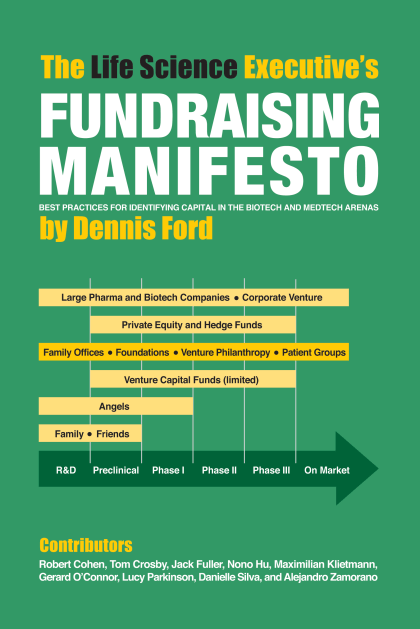
To bring LSN’s Life Science Executive’s Fundraising Manifesto toward a close, we provide some motivational advice and tactical reminders to help a fundraising CEO bring their outbound campaign to a successful resolution.

With illustrations and helpful mottos, this ‘cheat sheet’ chapter will help the reader find their way through the fundraising maze in good spirits. From how to stay optimistic during the tough times, to when to stop marketing to investors, this chapter has it covered.

Click here to download/print the chapter PDF

Join us next week for the book’s addendum: “The View Beyond Venture Capital.”

Enjoyed the preview? Buy now from Amazon.com or Barnes & Noble

Bookcover-Front

Hot Investor Mandate 1: $100 Million Fund Makes Early Stage Deals in Therapeutics, Devices and Diagnostics

An investment firm based in Taiwan is interested in the life sciences and will target new investments from a new USD 100 million fund. The firm can sometimes leverage different funds to invest. The fund’s target investment size is USD 3-5 million per company and USD 1-1.5 million for early stage companies. Capital allocation per company will not exceed 10% of the fund. The firm seeks companies in Asia-Pacific, including the US and Japan. The firm is actively seeking new investment opportunities.

In the life sciences, the firm is interested in therapeutics, medical devices, and diagnostics. For therapeutics, the firm will consider a broad range of modalities including small molecules and biologics with an emphasis on stem cell, immunotherapy, and CNS therapies. The firm is opportunistic in terms of indications. For companies in Asia, the firm is agnostic to the phase of development. For overseas deals, the firm is currently looking for preclinical to phase 2 assets. The firm prefers candidates with in-human data and are conducting clinical trials in the US, while this is not a requirement.

For devices, the firm considers minimally invasive class III devices in the cardiovascular and cancer space that have prototype and have obtained proof-of concept. For diagnostics, the firm is interested in genomics and big data analytics. Recently there is an interest in the cosmetics and supplements area, and the firm is seeking acquisition opportunities to commercialize products through distribution channels within its network.

The firm only invests in private companies and aims to be a minority investor.

If you are interested in more information about this investor and other investors tracked by LSN, please email mandates@lifesciencenation.com

Hot Investor Mandate 2: Corporate VC Seeks Digital Medicine Devices and Wearables in Chronic Care

A pharma firm established a new corporate venture arm in 2015.  The firm is based in London and invests from a $30M fund, typically contributing $250K-$3M to a finacing round. The firm will participate in rounds for digital health companies at all stages, as early as seed and through later venture rounds. They are open to working with companies globally, but focus on US-based investments.

Within digital health, the firm is seeking digital medicine devices and wearables that address chronic or respiratory diseases, oncology, and consumer health. Past investments in the space include a wearable nicotine delivery device with integrated software and data analytics component to aid in smoking cessation.

The firm prefers to work with full management teams with a track record in the space. A strong business plan should be in place, and companies should have IP around their products.

If you are interested in more information about this investor and other investors tracked by LSN, please email mandates@lifesciencenation.com

Hot Investor Mandate 3: Asia-based Firm Invests in US Therapeutics and Devices at Series A and B

An Asia-based investment firm backed by a large bank is managing a US$60M healthcare fund raised in 2014.  The firm invests in several sectors across healthcare. The firm generally participates in Series A or B rounds and prefers a clear exit in less than 5 years. The firm is open to both leading and co-investing. Typical equity investments range from US$2-10M. The firm currently focuses 60% on regional-based deals and 40% on China- and US-based deals.

The firm considers therapeutics and medical devices. Within therapeutics, the firm is open to all modalities including small molecules, biologics, cell therapy and gene therapy with a focus on cancer therapies. The firm would also consider R&D services, healthcare services, and healthcare IT products such as EMR management software. The firm seeks to invest in venture stage companies in Series A or B rounds.

The firm prefers to back entrepreneurs with a successful track record. The firm typically requests a board seat in their portfolio company.

If you are interested in more information about this investor and other investors tracked by LSN, please email mandates@lifesciencenation.com

Hot Investor Mandate 4: Korea Fund Opens US Office To Invest In Oncology, Opthalmology & Platform Technologies

An investment firm headquartered in Seoul, Korea, has established a US office in Boston to focus on US-based biotechnology companies. The firm invests from their third fund of $500 million. The firm is interested in opportunities at all stages of development and can allocate from $500 K up to $20 M in equity investments, acting as a lead or follow on.

The firm is currently focusing on the areas of immuno-oncology, gene therapy, ophthalmology, and platform technologies. Recent investments include companies targeting clinical stage small molecule therapeutics for oncology, peptide drugs for inflammatory diseases, and delivery methods and therapeutics in ophthamlology.

The story behind the company and management team is important to this firm. They look for a cohesive business plan and strategy, and are especially interested in opportunities with potential to expand into the Korean market.

If you are interested in more information about this investor and other investors tracked by LSN, please email mandates@lifesciencenation.com

Big Data, Digital Medicine, and A View of the Future at RESI X

By Caitlin Kramer, Research Analyst, LSN

caitlin-wp

RESI X featured the arrival of a new panel session – Big Data in Healthcare.  If you were unable to attend, you will have another opportunity to hear insights from investors and influencers in the space at RESI SF on January 10th.

The panel, available for your viewing below, was moderated by Nicole Fisher (Founder & CEO, HHR Strategies) and featured the thoughts and experiences of:

Each discussed the unique approaches their firms take toward evaluating big data and software investment opportunities, how they partner with and shape start-up growth, and how the healthcare system landscape is (or is not) shifting to enable a realization of the big data vision.

A unique angle toward the healthcare system and policy was brought to the table by moderator Nicole Fisher, who works on Capitol Hill as a senior healthcare policy advisor, Forbes’ Contributor, and Founder and CEO of HHR Strategies.

At many points throughout the panel discussion, the conversation trended toward how data can improve healthcare delivery and outcomes. Emerging technologies blending healthcare, science, and data do not enter the same marketplace as other generalist tech software; instead they must interface with provider systems and policies in ways that are new and different from the existing therapeutic and device sectors. Morris gave an illustrative example of the “noise” created by this new relationship: he and his primary care physician ordered genetic tests, and faced with interpreting the 24 pages of results realized “neither of us are cardio-geneticists, so now what?” While the technologies advanced by new companies may provide actionable information, the health system will ultimately play a central role in their utilization and continued innovation in the space.

Entrepreneurs need to know that technology itself frequently takes a back seat to other aspects of a company. Getting blunt, de Winter shared: “The way investors think is driven by fear and greed. You want to think about how your idea specifically addresses the greed part of that equation.” Morris, an entrepreneur himself, had to transition away from his natural enthusiasm for the underlying science of a company when he began his career in venture capital. “The order of operations in the way we look at a company is market, then team, then the product, and then finally technology”, he said.

There is consensus that teams are central to accomplishing a company’s goals. Hazlehurst describes how oftentimes a company’s goal is to “translate science into software”. She goes on, “It’s a fun and challenging problem because the lifestyle and culture between the people building in these different domains is very different, and getting everyone you need working together is more than just a technical problem.” Deep and practical expertise in life sciences and software engineering are indeed vastly separate, and teams need to effectively coordinate internally and externally with strategics to formulate long-term visions.

With regard to the technology, two main aspects of big data technologies were touched upon: algorithms and data. Entrepreneurs may be surprised to learn that IP around algorithms is not a core focus of potential investors. Algorithms will change and evolve in response to higher quality or increased data. Therefore, a more important focus is access to high quality proprietary data through partnerships or through its generation as part of the platform. “We have now over 300 million individual patient records spanning 5-10 years, but that’s not enough and we still crave more”, said Pan.

Wearables, which continuously record certain metrics for individuals, inevitably enter conversations about health data. Their true utility to big data applications in healthcare is still unclear, although it is clear that in many respects they empower individuals to better understand and track their daily habits. Creating a distinction, and if necessary a distance, between digital health trends and rigorously validated data acquisition is important to avoiding hype cycles and fostering continued innovation in the field.

How we can ultimately arrive at the vision shared by entrepreneurs, investors, established companies, and individuals is explored in moderator Nicole Fisher’s recently authored whitepaper “The Digital Medicine Crystal Ball: Unlocking the Future of Real-Time, Precise, Effective, Healthcare”, published by EBD Group last month: “It is time we agree on defining and refining the meaning of digital medicine, particularly as it pertains to the toys versus the tools that will usher in a new age of healthcare. This will determine how the proper tools can lead to the most efficient and effective R&D process, strengthen the patient-physician relationship, and simultaneously enable individuals to become the CEO of their own health.”1

Life Science Nation is proud to have hosted these thoughtful and influential individuals and the firms they represent, as well as the many inspiring entrepreneurs doing the heavy lifting to champion their technologies. Said Hazlehurst, “One of the beauties of investing in early stage companies is that you’re waiting for the day an entrepreneur is going to walk through your door and pitch you on something that’s really unique and disruptive.” To our life science entrepreneurs in the audience: get out there and do it. Many, like LSN, are here to help.

  1. Fisher, Nicole. The Digital Medicine Crystal Ball: Unlocking the Future of Real-Time, Precise, Effective, Healthcare. Publication. Carlsbad: EBD Group, 2016. 4.

Preparing for JPM? It’s Time to Apply to the RESI Innovation Challenge

By Dr. William Kohlbrenner, CSO, LSN

bill-1010-2wpWith summer now behind us, the world’s biotech and medtech community is counting down to the San Francisco healthcare conference season. If you’re making your JPM plans now, it’s definitely time to apply to the RESI Innovation Challenge.

LSN’s scientific team is preparing to review the RESI Innovation Challenge applications from biotech, medtech, diagnostic and healthcare IT companies.  Successful applicants will be provided with an all-day display space for their startup company at RESI – and with the heavy foot traffic at JPM, there’s never been a better opportunity to win investor exposure for your new technology. All applicants are vetted by LSN’s scientific review team, with a view to not just the quality of the company’s scientific work, but also the strength of the management team and how well-positioned the company is to receive investment.

On January 10th, all RESI attendees will have the opportunity to vote on the 30 Innovation Challenge finalists.  See below for the past winners – a diverse group of startups from every area of the life sciences.

What makes the RESI Innovation Challenge so valuable?  We’ve included a few words from previously successful participants below, but in short, being part of the Innovation Challenge provides startups with a new way to get attention and start dialogues with the investors who attend RESI. Participants can share their message all day in the exhibit hall, with their Innovation Challenge display providing a starting point for a meaningful conversation about the opportunity.

Here is what our previous winners are saying about the RESI Innovation Challenge:
DSC00392

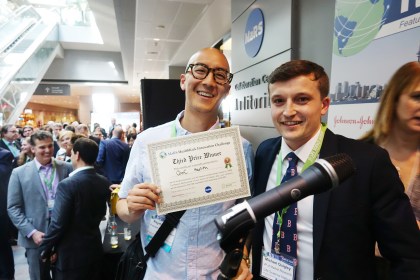
“It was an absolute pleasure to participate in the RESI conference held at MaRS in Toronto. The unique structure of the conference facilitated creating new relationships with potential investors and partners. In particular, the Innovation Challenge pushed us to introduce ourselves to new people, which will be useful as we look towards a future financing round. I definitely recommend the RESI conferences to entrepreneurs seeking financing in the bio / health space.”
 
– Raymond Shih, President, Co-Founder, QoC Health
3rd Place, RESI on MaRS, June 23, 2016

“I love the RESI Innovation Challenge because it is a great way to give our pitch to practice it and try to obtain a scarce resource from these investors. Practicing with these investors is a great way to build relationships and continue that on to the real investment conversations.”

– Niko Skievaski, Co-Founder, Redox

1st Place, RESI@TMCx, June 8, 2015

02

“The RESI Innovation Challenge is a really good opportunity to meet investors and other companies in the space.  It’s a good showcase to reach that audience.”

– Jessica Ching, CEO, Eve Medical

2nd Place, RESI San Francisco, January 12, 2016

“The RESI Innovation Challenge is a unique way to pitch, and provides a great opportunity to see what other companies are doing in the industry, while allowing you to meet with potential investors and strategic partners outside of the partnering meetings.”

– John Connolly, VP Corporate Development, Rna Diagnostics

1st Place, RESI Boston, September 16, 2015

01

“RESI offers small companies like GeneSegues a direct line to potential partners and potential investors in a small setting conducive to relationship building and conversation. The Innovation Challenge was a particularly great way to introduce our company to a broader audience than I could meet with personally which allowed us to leverage the showcasing of our technology more efficiently.”

-Laura M. Brod,Chief Executive Officer,GeneSegues Therapeutics

-1st Place, RESI @TMCx, April 11, 2016

Previous RESI Innovation Challenge 1st place winners include:

237521341025992000

You’ll be redirected to the application page. Please fill out this form as completely as possible. The application process takes approximately 15 minutes. If it will take you more than 30 minutes to fill out the form, please download the application form here: https://goo.gl/09TuE9 and send it to resi@lifesciencenation.com. Note: There is no fee to apply.