A venture capital founded in 1992 and based in Virginia invests in life science companies primarily in the growth stage or at the series A or B round; if investing early, the firm would be part of a syndicate. The firm typically invests around $1-$15M into early companies, and $10M-$30M into growth stage companies. The firm seeks to make 10-15 new investments within the next year. While the firm focuses on companies based in USA and Canada due to practical matters, they may be open to investments on a global level.
The firm has a primary focus in healthcare IT, particularly in EMR companies, analytics, and any next generation IT tools for enterprise or ambulatory settings. The firm’s secondary focus is in tools and diagnostics, specifically in 510K genomics diagnostics, though is open to any kind of new diagnostic tool or test. The firm currently does not have interest in therapeutics or medical technology. The firm prefers companies with a commercialized product that is producing revenue, though does not have a revenue requirement and may be open to clinical stage products.
The firm focuses on growth stage companies where 80% of their invested companies have revenue with a product looking to expand in the market and 20% of invested companies at the pre-revenue, close to commercialization stage. The firm typically invests in pre-revenue companies when the technology is close to commercialization (i.e. steps away from approval) and/or when the company has a strong management team with members the firm has known from before.
If you are interested in more information about this investor and other investors tracked by LSN, please email mandates@lifesciencenation.com
A private equity firm located in the US Southeast has $1 billion in assets under management. The firm is interested in companies located all over the globe and makes 1-3 equity investments per year into commercial stage, revenue generating companies. The firm will lead a round if it is less than $20m but – if larger, co-invests alongside other private equity firms that it has relationships with. The minimum investment size is $1 million.
The firm is interested in therapeutics, medical devices, R&D services, and suppliers & engineering. The firm is particularly interested in over-the-counter and consumer health products and is otherwise open to all indication areas. Within medtech, the firm looks for products that have already received regulatory approval. Within therapeutics, the firm will consider Phase 3 or later. Orphan diseases are of interest as well.
The firm has no fixed management team requirements and takes a board seat on all investments.
If you are interested in more information about this investor and other investors tracked by LSN, please email mandates@lifesciencenation.com
The Affordable Care Act (ACA), passed in 2010, has had a profound impact on the US healthcare industry; its provisions have been implemented gradually, and investors in the life science sector have been paying close attention to its impact in their search for new opportunities. The ACA has been particularly impactful in healthcare IT investment, and we have also seen some effects in medical technology. As LSN’s research staff continue to converse with investors, several have spoken about this trend in depth. Here are a few effects of the ACA that our investor dialogues have brought to light.
Investors Find Opportunities in ACA Incentives
The ACA provides financial incentives and penalties for care providers to meet certain care quality goals. Some investors are therefore seeking technologies that will help care providers achieve these ACA-defined goals, as these technologies have the potential to be rapidly adopted by care providers seeking to meet ACA targets and avoid penalties.
For example, since 2012 hospitals have been penalized by a reduction in Medicare payments if they have high readmission rates. Some investors are therefore focused on services that can prevent readmission, such as data-driven care management platforms that will identify patients that need more support after being discharged from hospitals and connect those patients with services outside the hospital setting. Hospital safety is another area in which the ACA has created incentives, and some investors are focused on technologies that improve surgical safety or address hospital-acquired infections.
Investor Relationships with Hospitals Matter
As the aforementioned ACA incentives focus significantly on hospitals, investors with an eye to the ACA are typically seeking to invest in products that will be used in a hospital setting, or which focus on hospitals as their customer market. Several investors have focused on building relationships with hospitals or hospital networks; the investors can tap these relationships to help them assess deals, or to drive adoption of a product in which they’ve invested. Hospital consolidation is a significant trend within healthcare, and this consolidation often leads to hospitals becoming more powerful as customers, with the potential to drive rapid adoption of a product if it offers them better value than the status quo. In addition to building their own relationships with hospitals, investors will also consider whether a company is well positioned for working with hospital networks as customers and what existing relationships the companies have formed with major hospitals.
Insurance Companies Making Venture Investments
The health insurance industry is rapidly changing and consolidating in the new environment. An ACA feature called the Medical Loss Ratio compels insurers to spend 80-85% of premiums on providing care or improving the quality of care; as investing in new technologies can be classed as quality improvement spending, several insurance companies are now getting hands-on about investing in new healthcare technologies that can be deployed throughout their networks. Some insurers have become LPs in venture capital funds, whereas others have launched their own corporate VC arms. Consistently, LSN has found that these entities are primarily focused on healthcare IT and healthcare service opportunities that align with the ACA incentives; in many cases, the insurer may become investor and customer, and can use their internal resources to assess the value of a new product or service.
If your company’s technology aligns with one of the incentives outlined in the ACA, it’s definitely an angle that’s worth emphasizing in your pitch to investors, as many have a specific interest in investing in helping care providers meet their ACA goals. ACA implementation is changing many aspects of the healthcare industry, and a savvy CEO will position their company favorably in the new landscape.
As healthcare and the life science space continue to evolve, the term “diagnostic” is taking on more and more meanings—and branding yourself as simply a “diagnostics company” is becoming increasingly ambiguous. This growing intricacy lends itself to the difficulties inherent in the sector. Whether you are developing a molecular-based point-of-care (PoC) diagnostic, a new in vitro diagnostic (IVD) test used in a clinical laboratory, a companion diagnostic for an oncology therapeutic or a biomarker discovery platform, there are some distinct challenges standing in the way of your technology and a successful exit.
Taking a look at some of the happenings in the diagnostics sector, some data from the LSN Investor Platform, and some of the things we’ve heard from diagnostic investors helps paint a better picture of the market, elucidating some guidelines to follow and common pitfalls to avoid for entrepreneurs developing diagnostic products/services.
As diagnostic technologies mature, we are seeing them make a push into the marketplace, sometimes figuring out how they fit in along the way. Point-of-care diagnostics, in particular, are expanding and evolving from pure technology development to applications development in various settings. As the assortment of new diagnostics find their niche in the healthcare marketplace, some investors tend to be somewhat reluctant to dive in headfirst, given the impediments these companies are bound to run into.
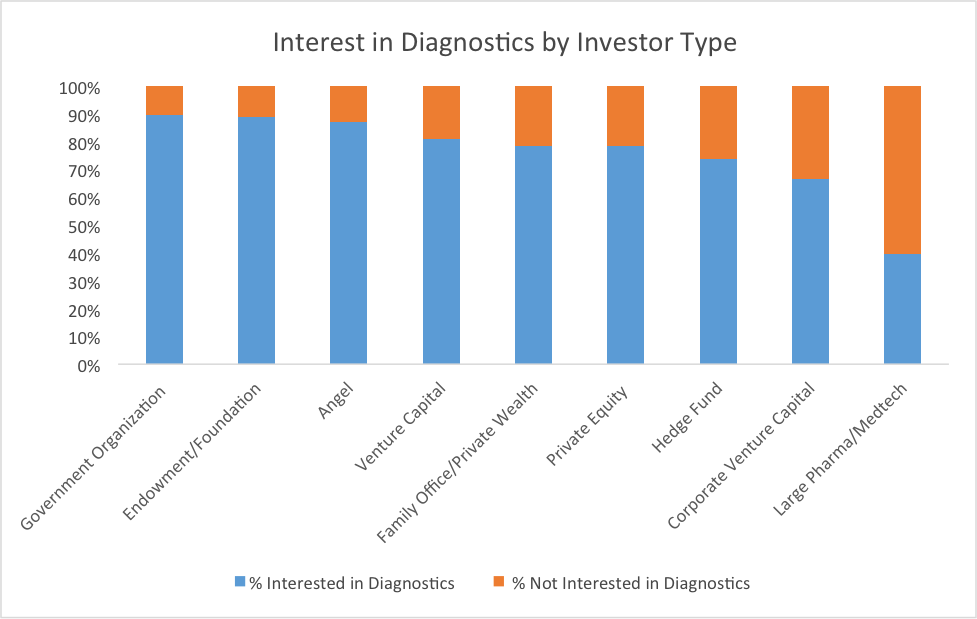
At LSN, we have spoken to over 900 investors in the last year about their specific interests and investment criteria in the life science space. Figure 1 shows the percentage of investors by type who have expressed interest in diagnostic products or services.
Figure 1 | LSN Investor Platform | Data as of December 7, 2015
It’s not surprising that a large proportion of the government organizations and foundations we’ve spoken with are backing diagnostics companies, given their ability to take on more risk and invest at early stages, and the fact that they don’t require the returns typical of venture firms. However, as these technologies continue to mature and gain traction in the clinic/marketplace, traditional venture capital investors are becoming more active. On the federal level, President Obama’s Precision Medicine Initiative should also help bolster the diagnostics sector.
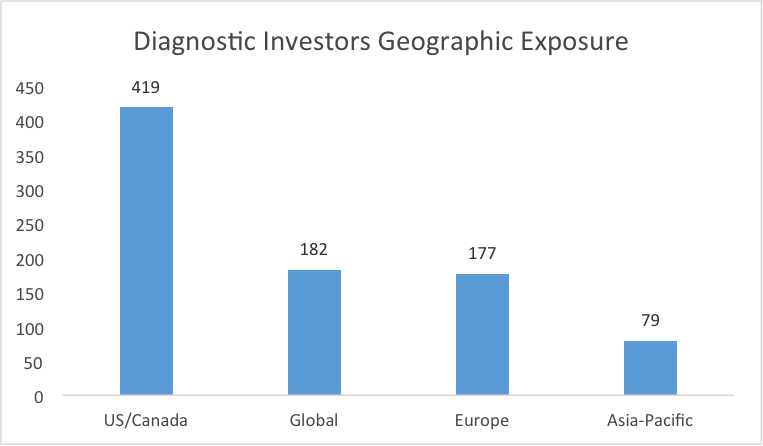
Taking a view of where these investors interested in diagnostics are looking to deploy capital, Figure 2 shows a mix of regionally-focused investors as well as investors with a global focus, with North America significantly out in front in terms of investor regional focus.
Figure 2 | LSN Investor Platform | Data as of December 7, 2015
There’s a lot of excitement surrounding the potential of diagnostics to improve outcomes and access to care, reduce the cost of care, and help spearhead personalized medicine, among other things. However, some investors voice concerns about reimbursement rates for diagnostics. We’ve heard from multiple investors that it is extremely important to engage payers very early and start the conversation, not waiting until you have the perfect amount of data. Many investors have said they are not interested in “me-better” tests that merely aim to replace an existing product, but rather something with a new business model that unlocks value within the healthcare system to deliver a huge upside, as this helps counter the reimbursement risk. Tests that have clinical utility and are going to change the treatment paradigm are typically more appealing to investors. A strong management team is always heavily favored when investing in early stage companies, but given these challenges, investors tend to place a premium on the quality of teams developing diagnostics.
The LSN team will continue to track diagnostic companies, deals in the space, and the investors that fund these companies, bringing you updates along the way.
The orphan and rare disease space has gained significant traction among life science investors. Despite the smaller market populations and limited clinical trial participants in rare diseases, technology in this space has remained attractive to investors due to its expedited FDA process and its lack of current treatment options for such uncommon conditions. Overall, while there are many challenges, there remains a lot of hope to drastically impact patient populations, scientific advancement, and market potential.
RESI San Francisco will bring together well-established investors in the rare and orphan disease space on January 12th. Moderated by Mark Day, Executive Director and Head of External Research & Scouting of Alexion Pharmaceuticals, panelists will include:
Stephen Knight, President & Managing Partner, F-Prime Capital
Panelists will discuss the attractiveness of orphan and rare disease technologies in comparison to non-orphan opportunities; what the rare disease spaces offers to investors; the best way to position an orphan opportunity to a potential investor; the evaluation process in assessing products in the space; as well as common trends, challenges, and excitement in the scientific advancement of the field.
To all the hopefuls in the orphan and rare disease space, this panel is for you. Register for RESI San Francisco now to hear this panel live – partnering has already begun and this event will be LSN’s biggest RESI yet.
A large pharma company based in Hong Kong makes equity investments and also in-licenses assets for development. Typical equity investments range from $2-3M per deal. The firm has partnered with companies in Japan, the USA and Europe, and is currently looking for new opportunities globally.
Currently the firm is seeking therapeutics in oncology, supportive care, cardiovascular, and ophthalmology. The firm focuses on small molecule, biologics, biosimilars, and repurposed and reformulated drugs. The firm typically in-licenses assets that have completed IND enabling studies, while it can consider from pre-clinical to on-market assets.
The firm is seeking innovative assets that address large unmet medical need. The firm generally seeks development and/or commercialization rights in China and Southeast Asia.
If you are interested in more information about this investor and other investors tracked by LSN, please email mandates@lifesciencenation.com
A firm based in Switzerland is a specialized investor in oncology, and is currently investing from a fund of USD 51 million. The firm generally makes investments in Series A, B or C equity rounds; the firm is not interested in seed rounds. The firm typically makes allocations of $3-8 million, and may either lead investments or act as a co-investor alongside a syndicate. The firm is open to oncology opportunities globally but has recently invested primarily in the USA.
The firm is currently focused on oncology therapeutics. The firm will consider any form of therapeutic molecule in oncology, including small molecules, antibodies or new technologies such as cell therapies. The firm generally invests at the late preclinical stage, from 6-12 months pre-IND, but is also interested in companies Phase I or Phase II assets.
The firm places high importance on the management team’s scientific rigor and industry experience; the firm prefers to work with entrepreneurs who have led biotech companies previously. The firm also considers the strength of the investor syndicate and their alignment of interests.
If you are interested in more information about this investor and other investors tracked by LSN, please email mandates@lifesciencenation.com