Hot Life Science Investor Mandate 1: Family Office Seeking Digital Health and Novel Therapeutic Opportunities

A private investment firm funded by a single LP based in the Western United States invests in seed and early-stage health technology companies. The typical investment size for seed investment ranges from $250K to $1M (usually in equity or convertible notes). For early-stage companies, the firm typically co-invests with other VC firms in Series A and B financing and the investment size will depend on the company’s financial needs. The firm is geographically agnostic but prefers start-ups to be based on the West Coast. The firm is actively seeking new investment opportunities.

The firm has a focus on the digital health and informatics space, but also invests in novel therapeutics. Generally, the firm focuses on opportunities that avoid or mitigate FDA regulatory risks. The firm is agnostic in terms of subsectors and indications, but does not consider orphan indications. The firm will only consider technologies with proof of concept. Historically, the firm has invested in therapeutics that address oncology, infectious diseases, cardiovascular, and metabolic disorders; drug delivery; orthopedic devices; genomics.

The firm prefers to take a board seat but is generally flexible.

If you are interested in more information about this investor and other investors tracked by LSN, please email mandates@lifesciencenation.com

Hot Life Science Investor Mandate 2: Chinese VC Firm Seeking to In-license Specific Technologies From Around the Globe

An approximately 200 million USD China based venture capital firm currently invests in healthcare (Pharmaceutical, medical device, diagnostics and Health IT) companies exclusively in China. In addition to investing in Chinese companies the firm is actively involved in and seeking to make new partnerships with technologies from around the globe in a number of specific technology areas exclusively for the Chinese market.

On the pharmaceutical end, the firm targets late stage assets post phase IIb to marketed products. For Medical technology products the firm currently holds companies that are looking for orthopedic products (spinal motion preservation and other non-fusion technologies), women’s health medical products, surgical instruments, dental devices and cardiovascular medical devices. On diagnostics, the primary focus is on oncology next generation sequencing systems and reagents; lastly for Health IT, diabetes management hardware.

If you are interested in more information about this investor and other investors tracked by LSN, please email mandates@lifesciencenation.com

Hot Life Science Investor Mandate 3: Virtual Pharma Company Seeking to In-license Oncology Therapeutics

A virtual pharma company founded in 2010 is currently seeking to in-license assets in the oncology sector, and is open to partnering with companies worldwide. The firm uses a wide variety of partnership structures, depending on the stage of development of the asset in question. The firm assesses therapeutic opportunities regularly and makes a new intake of assets every 1-2 years. The firm is open to working with companies worldwide, but generally focuses on North America and Europe-based opportunities.

The firm is interested in oncology therapeutics with novel mechanisms of action, and is open to working with small molecules and biologics, but not cell therapies. The firm seeks assets at any stage of development, from early preclinical development onward. The firm may also consider partnering with companies developing biomarker diagnostic technologies that guide cancer care decisions. In addition to standalone assets, the firm is interested in potential combinations of oncology treatments in areas such as immuno-oncology, checkpoint inhibitors, and other types of agents with combination potential. The firm will consider opportunities in all cancers, including orphan cancers; the firm’s portfolio currently includes ovarian and breast cancer assets, but other areas of cancer will also be considered, including liquid tumors. The firm is not currently interested in supportive care.

If you are interested in more information about this investor and other investors tracked by LSN, please email mandates@lifesciencenation.com

Hot Life Science Investor Mandate 4: Corporate Venture Fund of Large Pharma Seeking Early Stage Therapeutics and Devices

The corporate venture arm of a large pharmaceutical company is mandated to invest directly in private early-stage life science companies with promising new products that may be future pipeline candidates. The firm seeks to invest across the more expansive business footprint of its parent company. The firm has a global mandate and is currently seeking new equity investment opportunities.

The firm is particularly interested in therapies for rare diseases, oncology, vaccines, and immune mediated diseases. The firm will also invest in breakthrough product candidates in other therapeutic areas such as cardiovascular and diabetes. The firm seeks products that are in preclinical or early clinical development and that have proof-of-concept data. The firm also willing to consider medical devices targeting these indications.

The firm generally co-invests with top tier life science investors and looks to take a minority position (<20%) in each portfolio company. The firm seeks to be a long-term investor with board responsibilities either as a full seat or as an observer.

If you are interested in more information about this investor and other investors tracked by LSN, please email mandates@lifesciencenation.com

What Does It Take to Get a Meeting: The Targeted Outreach Curve

By Lucy Parkinson, Senior Research Manager, LSN

Earlier this month, we covered the benefits of using CRM to organize your fundraising campaign. By logging every contact, you can collect useful data points that will map your campaign’s progress. LSN’s advisory arm, Boston Innovation Capital, logs every call made and every email sent during the course of a fundraising campaign in a CRM system. Using data from a current BIC project, we’ll take a look at what it typically takes for a company to get a meeting.

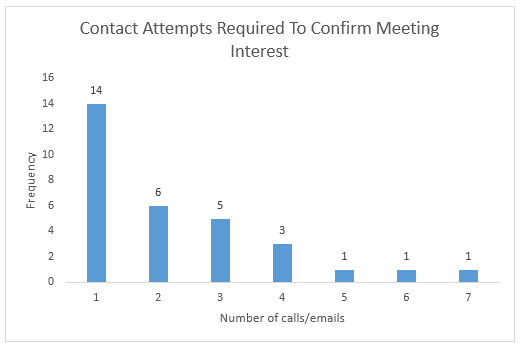
Using the LSN Investor Platform, BIC generated a list of over 250 investors from around the globe as strong potential fits for the company (a US-based medical device developer). The outreach team designed a concise email pitch and a phone message, and performed outreach to all of the investors on the GTL. Thus far, this outreach has generated meetings with 31 investment and strategic firms. But how many outreach attempts did it take to generate a positive response from each investor? As we store all this information in the campaign Salesforce account, it’s easy for us to dive in there and take a look at the road we’ve travelled.

cc

(Note: the y-axis tracks the number of outreach attempts it took before the investor responded with interest in a meeting. In most cases, it took several more exchanges to pin down a suitable meeting time!)

As the chart demonstrates, if you use a targeted outreach method and contact only investors who are a suitable fit for the opportunity, many investors will respond positively to a well-composed email asking for a meeting. In 14 cases, only one message was required in order for the investor to express an interest in a call. However, if we’d stopped at that one message, our client would have missed out on over half of their total meetings. There are more meetings available in the long tail of persistent outreach than there are in the initial email blast.

Making a second, third, fourth, or more attempts to get in touch with an investor will double your outreach success. Persistence will, of course, also help you filter disinterested investors out of the process; investors can hardly follow up on every opportunity that crosses their desk, and receiving a polite decline allows your campaign to continue more efficiently.

We also found it’s important to vary the outreach. It’s good to use calls to follow up on emails; sometimes the investor saw the original mail, but hasn’t had time to take a deep dive on the opportunity yet, and appreciates the reminder. Leaving a voicemail may also nudge the investor into responding to your email. If you’ve not received a response after several attempts, it can pay to do some research on the person you’re reaching out to; if you check on the firm website and on LinkedIn, you may find that their role has changed and they’re no longer the right person to reach out to with a deal. At this point, you may wish to select a different contact to reach out to.

Additionally it’s often useful to speak to an executive assistant at the firm, who may be knowledgeable about whether you’re reaching out to the right contact for your opportunity, and about the best time and means to reach them. (This is especially useful information during the summer, when an investor might be away from their office for an extended period of time!) Asking the right questions could get you referred internally; once passed to the correct person to assess the opportunity, one typically receives a rapid yes/no decision regarding the meeting request.

Persistence pays off when you’re fundraising. Investors are very busy people, and the most important contacts are sometimes the hardest ones to reach. Even after securing an initial meeting and opening a dialogue with an investor, the follow-up process will be lengthy and frustrating. We hope that this data showing the benefits of outreach persistence will keep your spirits up.


Double Panel Announcement: Medtech and Biotech Angels

By Shaoyu Chang, MD, MPH,  Senior Research Analyst, LSN

Shaoyu 10*10

Angel investors are some of the earliest and most important allies for entrepreneurs. They supply early stage companies with the much needed capital along with their sector expertise, business acumen, and professional network.

We have seen a growing trend of angels syndicating and participating in larger deals. Angel investment round sizes increased sharply in 2014. The healthcare sector showed the largest growth, where the median angel round reached $2 million, up from $1.57 million in 2013. However each angel group comes with unique membership composition, professional knowledge, and investment focus. It is an often daunting task for a scientist entrepreneur to identify and build relationship with the right angel who will move their new ideas forward.

LSN have gathered the most prominent angel groups in life sciences for two panel sessions to be held simultaneously at RESI Boston: Biotech Angels and Medtech Angels.

The Biotech Angels Panel will be focused on current trends in angel investment in the biopharmaceutical field. The panel will be moderated by Pravin Chaturvedi from TIE Angels, and will hear from:

The Medtech Angels Panel will discuss trends in angel investment in medical technologies including devices, diagnostics, and smart devices. The panel will be moderated by Steve Goodman, Co-Founder at Mid Atlantic Bio Angels, and will hear from:

These sessions will help scientist entrepreneurs to better understand the perspective of an angel. What types of deals are most attractive to each angel? Who is the right group for my technology and how to initiate a dialogue with them? What to expect in the due diligence process? For early stage entrepreneurs considering angel capital, this is an excellent opportunity to meet them face-to-face.

LSN Summer Reading Series, Chapter 14: “Thirty-One Tips for Effective Fundraising”

By Michael Quigley, Director of Research, LSN

mike-2

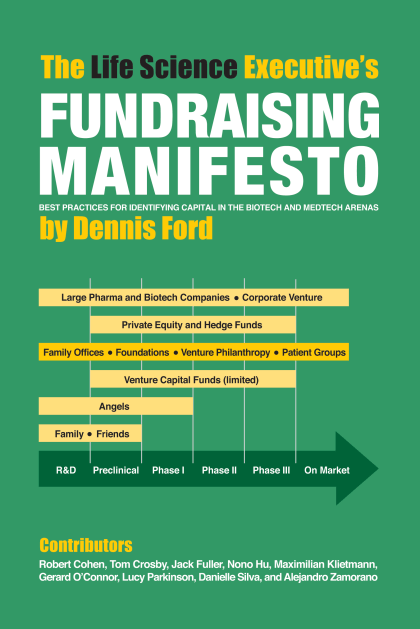
To bring LSN’s Life Science Executive’s Fundraising Manifesto toward a close, we provide some motivational advice and tactical reminders to help a fundraising CEO bring their outbound campaign to a successful resolution.

With illustrations and helpful mottos, this ‘cheat sheet’ chapter will help the reader find their way through the fundraising maze in good spirits. From how to stay optimistic during the tough times, to when to stop marketing to investors, this chapter has it covered.

Click here to download/print the chapter PDF

Join us next week for the book’s addendum: “The View Beyond Venture Capital.”

Enjoyed the preview? Buy now from Amazon.com or Barnes & Noble

Bookcover-Front