LSN Summer Reading Series Chapter 6: “Branding and Messaging”

By Michael Quigley, Director of Research, LSN

mike-2Last week we discussed how to determine where your company fits within your marketplace. Once you have completed that process, the next step in a fundraising campaign is to develop your marketing materials. In this week’s edition of the summer reading series, we describe the importance of and what constitutes a strong set of marketing materials in the life science fundraising world. While your team and your technology are what will ultimately secure an allocation, having marketing collateral that clearly and concisely communicates your message will help you tremendously in getting in the door with investors.

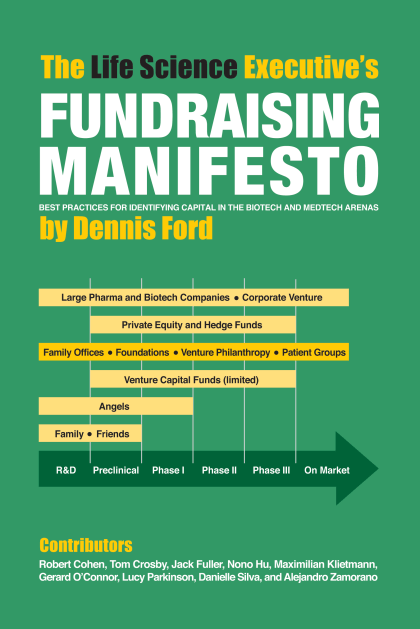
Chapter 6 of The Life Science Executive’s Fundraising Manifesto discusses in depth the different pieces of marketing collateral you should be putting into the marketplace and how to develop everything from your logo to your pitch deck.

Click here to download/print the PDF.

Join us next week for Chapter 7: “Building a Web Presence,” where we take an even deeper dive into how best to use a website as a fundraising tool.

Enjoyed the preview? Buy now from Amazon.com or Barnes & Noble

Bookcover-Front

Hot Life Science Investor Mandate 1: Large Chinese Healthcare Firm Seeking North American Early Stage Therapeutic and Medical Devices in a Number of Indications

A fully integrated healthcare solution provider that was founded in 1993 and is headquartered in China is seeking in-licensing, acquisition, and partnership opportunities. For early stage assets, allocation sizes can be flexible, ranging from $2-10M per deal. The firm can either lead or co-invest in a financing round. The firm prefers companies with a China angle and seeks distribution rights in the Chinese market; however this is not a prerequisite criterion. The firm is currently looking for opportunities throughout North America and China.

The firm considers a wide range of technology sectors including therapeutics, medical devices, diagnostics, and healthcare IT. In therapeutics, the firm is interested in small molecules, biologics, cell and gene therapies, and biosimilars for oncology, women’s health, CNS, pain management, and infectious diseases. The firm seeks assets from preclinical stage to proof-of-concept phase 1. In medical devices, the firm prefers 510K and low-risk devices.

The firm is looking for companies with a complete management team formed by devoted and trustworthy members with domain expertise. The firm typically seeks board representation after investment.

If you are interested in more information about this investor and other investors tracked by LSN, please email mandates@lifesciencenation.com

Hot Life Science Investor Mandate 2: International Angel Group Seeking Early Stage Bioinformatics and Medical Device Investments

An international investment group based in California looks to make equity investments into early stage companies in the life science and technology sectors. The firm makes investments generally ranging from $50,000 to $500,000 into companies and is generally involved in 2-4 deals per year. The firm is willing to consider companies around the globe.

The firm is generally open to all areas within the life sciences though they tend to avoid drug development opportunities as the capital requirements are too large. The firm has current interest in companies in the bioinformatics spaces utilizing genomics and/or proteomics that aid in the drug discovery process, as well as other implementations of bioinformatics. The firm is also open to medical devices across technology types and indication areas. The firm generally makes investment in the seed and series A stages.

The firm is looking for privately held companies with motivated management teams. The firm looks to take board seats into companies on a case by case basis.

If you are interested in more information about this investor and other investors tracked by LSN, please email mandates@lifesciencenation.com

Hot Life Science Investor Mandate 3: Corporate Venture Capital Fund of Large Pharma Company Seeking Innovative Therapeutic, Device, Diagnostic and HIT Opportunities

The corporate venture arm of a large biotech firm utilizes an evergreen structure and currently holds $750 million in assets under management. The fund invests separately from its parent and is not mandated to invest in areas of strategic relevance with it parent. The firm makes equity investments in early venture rounds. The firm typically invests up to $10 million initially with a total of $15-25 million going to a single company over multiple financing rounds. The firm is willing to both lead and co-invest in companies located around the globe and could make as many as 5-6 investments over the next year.

The firm invests in therapeutics, medical devices, diagnostics, and healthcare IT. The firm invests in early stages of development, from preclinical through to Phase IIa drug trials for therapeutics; and for medical devices and diagnostics, the firm prefers to invest in companies that are anywhere from in-development to on the market.  The firm is interested in all classes and indications of therapeutics, devices, and diagnostics with their main focus being that the technology be truly innovative and novel. They are not interested in cases of reformulations, repurposing or “me too” ideas. The firm makes approximately 75% of its investment in therapeutics and 25% across medical devices, diagnostics and healthcare IT although they are actively looking to increase exposure in these areas. The firm is also open to investing in laboratory equipment and drug development enabling technologies though this area is less of a focus.

The firm prefers to invest in management teams that have demonstrated prior success in the life science industry and are oriented on the goal of bringing a product to market. The firm is currently most interested in privately held companies and looks to take a board seat following investments.

If you are interested in more information about this investor and other investors tracked by LSN, please email mandates@lifesciencenation.com

Hot Life Science Investor Mandate 4: VC Fund out of Southern United States Looking for Personalized Medicine Diagnostics

A venture capital firm based in the southern United States is currently making investments out of its vintage 2013. The fund currently has approximately $200 under management. The firm is looking to make equity investments in companies ranging from $500,000 to $3million. The firm will invest in companies across the United States and plans to make approximately 3-4 investments over the next 6-9 months.

The firm is currently most interested in areas of personalized medicine diagnostics, particularly in the genomic and proteomic subsectors. Other areas of high interest include: digital health, platform technologies, nutrition, clean environment, and much more selectively drug development and medical devices. The firm has experience in immunology and is more familiar with vaccine and antibody based technologies. The firm is open in terms of indication and considers orphan indications as well but requires strong data and a clear pathway to exit. The firm is looking to invest in early to mid-stage companies and generally does not make seed investments.

The firm invests in privately help companies and will both lead or co-invest. The firm looks to take a board seat in some of its portfolio companies though it is not a requirement. The firm looks for smart and passionate management teams with high levels of experience in the field.

If you are interested in more information about this investor and other investors tracked by LSN, please email mandates@lifesciencenation.com

Family Offices and Walled Gardens

By Dennis Ford, Founder & CEO, LSN 

Dennis book

The LSN mantra is that raising capital is a numbers game.  To succeed, you must find investors that are a fit for your product and stage of development, go global rather than restricting yourself to your local region, and target all ten categories of early stage life science investor rather than restricting your view to one source of capital.

Every few months it seems that someone in the investment world has an epiphany that they must create a global family office network. The idea always seems compelling and usually involves a plan to sponsor small, intimate conferences that target companies seeking investors. The network creators begin courting the venture community and healthcare CEOs with descriptions of the family offices that allegedly bought in and will attend these conferences — and the price to appear at them is often  a lot of money. The attending fundraising CEOs theoretically benefit from getting in front of the new hot category of investor, and it’s suggested that the family offices will participate in such a small meeting in return for the chance to trade strategies, tactics, and evaluations with other similar entities.  This model and concept is all about getting special access, which sounds almost too good to be true…right?

Having been involved in capital fundraising for decades, I have seen this model surface countless times. Many of these family office networks can provide examples of the allocations and partnerships their network has generated; the question is how many and how much?  This model has been called a “walled garden” because of the illusion it perpetuates of a bevy of family office players  banding together in a closed, almost secret network who can be accessed by paying a fee for a chance to connect with the  right contact. While these networks may include at least a handful of contacts with whom a dialogue can be established, I have yet to encounter a walled garden family office firm that employs any research staff to track what the family offices’ investing interests are. This is an absolute necessity for staying up to date on investment mandates, which are ever-changing—without accurate data and an understanding of the possible fit between your company and the investor, contact information has tenuous value.

Additionally, most family offices (institutions with over $1 billion in assets under management that form one of the categories of investors that LSN tracks) would rather not be a part of any organization that would compromise their anonymity; these firms are well known for a predilection for stealth mode and a preference for flying under the radar. Because they have access to large sums of capital they do not need to form syndicates, so have little to gain from the walled garden model.  As for the opportunity to share information and strategies behind a virtual secret wall, family offices already source from each other and don’t need third parties or service providers to facilitate this. Also, while syndication does occur regionally and within close networks of like-minded family offices, it doesn’t seem relevant on a global scale simply because of the low ratio of family offices to fundraising CEO’s. The larger Family Office conferences can be useful to fundraising executives, offering the possibility of contact with a handful of family office representatives, but these bigger venues  are primarily populated by family office service providers who are also being charged high fees to attend.

LSN tracks 970 family offices globally, has identified 180 as private life science investors, and has forged a deeper relationship with 70, which use LSN as a trusted sourcing vehicle. This is also true of the other nine categories of investors that we track. Many family offices see us as a trusted source that has proven our worth and provides a compelling and augmenting service offering that can be vetted quickly for no cost. But we recognize that focusing too much on one category of investors, especially a group like family offices, can be counterproductive, which is why over three years we have built up a true global network of over 5000 early stage investors covering ten categories.


RESI@TMCx Biotech Family Office Panel

By Michael Quigley, Director of Research, LSN

mike-2Earlier this month Life Science Nation’s RESI Conference at the TMCx in Houston was home to a panel of representatives and experts in the Family office world who spoke to how their groups go about sourcing and making investments in the therapeutic space. Key topics discussed include the position of family offices in the investment ecosystem, the differences and similarities between family offices and other investors, how family offices go about identifying opportunities, and what these particular groups are looking for right now.

Click on the video below to hear the views of these family offices speaker for yourself.