LSN Summer Reading Series Chapter 5: “Knowing Who and What You Are, and Where You Fit”

By Shaoyu Chang, MD, MPH,  Senior Research Analyst, LSN

Shaoyu 10*10In this latest edition of the summer reading series, we will be explaining the importance of understanding where your opportunity fits within the marketplace. Knowing who you are and how you compare with other companies in the space is crucial in determining the investors to whom you should be reaching out, what you should be highlighting in your marketing materials, and, in some cases, whether you need to “pivot,” or change, your commercialization plan.

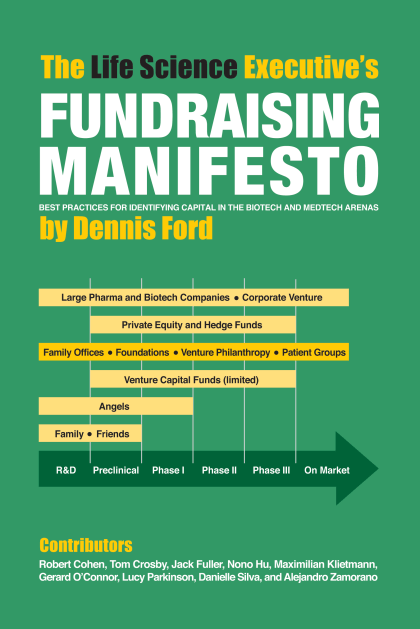
Chapter 5 of The Life Science Executive’s Fundraising Manifesto, “Knowing Who and What You Are, and Where You Fit,” discusses how to define yourself and your market, as well as the importance of being able to pivot after receiving feedback and how to identify when it is strategically relevant to do so.

Click here to download/print the PDF.

We hope this text proves to be informative. Join us next week for Chapter 6: “Branding and Messaging”, for some tactical tips on how to build a brand for your company.

Enjoyed the preview? Buy now from Amazon.com or Barnes & Noble

Bookcover-Front

Hot Life Science Investor Mandate 1:Hong Kong Based PE Firm Looking Globally for Life Science Opportunities

A global private equity firm with bases in Hong Kong and the United States is primarily focused on healthcare investments with a particular interest in the life science space. The firm looks to make allocations ranging from $250,000 as the first round in a tranched financing structure to $20 million over the lifetime of the investment and depending on the financial needs of the company. The firm is actively seeking new investments and is open to review opportunities from around the globe.

Within the life science space the firm is interested in therapeutics, medical devices, and diagnostics. The firm is currently most interested in companies with some clinical data however they are open to reviewing pre-clinical stage opportunities as well. The firm is open to biosimilar and repurposed assets, and has a preference for platform technologies but is also open to considering single asset opportunities. The firm is open to review all classes of medical devices and diagnostics. The firm is entirely open in terms of indication.

The firm is open to investing in both private and publically help companies and is currently very interested in making cross over investments. The firm is also very interested in companies that have a plan or ability to enter the Chinese market as the firm can add significant value with this strategy. The firm is open to acting as both a lead and co-investor.

If you are interested in more information about this investor and other investors tracked by LSN, please email mandates@lifesciencenation.com

Hot Life Science Investor Mandate 2:Corporate Venture Capital Arm of Global Pharmaceutical Company Seeking Preclinical/Phase I Therapeutic and Platform Opportunities

The corporate venture arm of global pharmaceutical company based in japan is looking to provide equity capital to seed and venture stage companies in the life science space. The firm is looking to provide companies with as much as $5 million over the lifetime of the investment and plans on making 2-3 investments over the next year. The firm will invest in companies located anywhere around the world.

The firm is currently looking for companies developing Therapeutics and Platform Technologies. The firm is looking for companies in this sector working with small molecules, vaccines and biotherapeutics. Indications of interested include nephrology, cardiovascular, immunology, inflammation, stroke, metabolic disease and the firm is especially interested in companies working with therapies for CNS disorders and orphan indications. Ideal companies will have assets either in preclinical stages or in Phase I of clinical trials.

The firm strongly prefers that the company has a strong management team with experience in the industry. The firm is looking to allocate to companies that will eventually be able to partner long term with its parent company.

If you are interested in more information about this investor and other investors tracked by LSN, please email mandates@lifesciencenation.com

Hot Life Science Investor Mandate 3:Family Office Seeking Innovative Therapies Targeting Cystic Fibrosis

A family office investment firm based in the Eastern United States specifically focuses on therapeutics for Cystic Fibrosis, including Adult Stem Cell Therapy. The firm manages an evergreen fund and can provide between $200K and $1M in equity per company. The firm has no specific requirement regarding where the company is located and is actively seeking new investment opportunities.

The firm is interested in all therapies for cystic fibrosis, including adult stem cell therapy. The firm looks for early-stage companies with products in pre-clinical or clinical development. Therapies for cystic fibrosis may include antibiotics, anti-inflammatories, airway surface hydrators, CFTR-modulating treatments, and others.

If you are interested in more information about this investor and other investors tracked by LSN, please email mandates@lifesciencenation.com

Hot Life Science Investor Mandate 4:Family Office Seeking 510k Devices in Eastern US

The operational and investment arm of a family office is looking to make equity investments into early stage companies and small mid-market growth companies ranging from $.5 to $1 million. The firm is very open to syndication particular with early stage deals and is capable of providing additional capital in follow on rounds when appropriate. The firm prefers to invest in companies located in the eastern United States and looks to make approximately 1-2 new investments per year.

The firm is looking for companies in the Medical Technology and Diagnostics space. Within these areas the firm is looking for 510k devices that are more technically based with a particular interest in hospital equipment and professional diagnostics. The firm is not interest in devices where the final consumer is the patient. The firm is looking to devices that improve the standard of care and is willing to invest in companies at all phases of development. The firm is generally open to all indications.

The firm looks for experienced management teams and looks to take a board seat following investment. The firm is willing to work with companies that have incomplete management teams and is looking for privately held companies.

If you are interested in more information about this investor and other investors tracked by LSN, please email mandates@lifesciencenation.com

RESI Wraps Up in Houston and Heads Back to Boston

By Scott Parks, Director of Marketing, LSN 

Scott 2June 8th was the 5th Redefining Early Stage Investments (RESI) conference, and the first at Houston’s Texas Medical Center’s Innovation Portal (TMCx).  With nearly 500 registrations the 100,000 square-foot accelerator space was filled with CEOs, scientists, entrepreneurs and more than 150 investors (from LSN’s 10 investor categories including:  Family Offices, Hedge Funds, Venture and Private Equity). The venue served as an exhibition space as well as a partnering forum for investors and entrepreneurs who compressed a total of 700 meetings into a single day in order to network, build relationships and close investment rounds.

LSN’s CEO Dennis Ford comments, “It can be overwhelming and we absolutely love that aspect.  We want to give everyone who comes here more opportunities than they can make a decision about, because if we’re doing that, we’re doing our job. We really want to inundate everyone, for one day, and submerge them in this early stage investor world to let them get a lot of bang for their buck instead of stretching it out over a period of several days. We want to give them as much value as possible.”

Throughout the day, and in several conference rooms, panels and workshops provided platforms for investors to communicate directly to fundraising entrepreneurs. Topics covered included biotech angels and venture philanthropy.  The event offered firsthand accounts from investors explaining their current investment mandates and procedures for identifying and qualifying candidates.

RESI@TMCx provided the platform for early stage investors and life science entrepreneurs to make a compelling connection, and is a result of partnerships between Life Science Nation, Texas Medical Center, Johnson & Johnson Innovation, and JLABS (JLABS @TMC).

Those who missed the Houston event will have only 90 days to wait until RESI comes to Boston on September 16 at the Westin, Copley.  For now, the RESI conferences are limited to 3/year (Boston-Fall, San Francisco-Winter, Houston-Spring/Summer).  As interest and attendance continue to grow, so too will RESI’s frequency and geographic footprint.

RESI BOSTON Now Open for Registration

Registration (with early bird pricing) is now available for RESI Boston (September) and RESI SF (January).

RESI@Boston-Banner-600

sf16

Early-Bird-RESI-Boston-wp

Refining the Global Target List: How to Prioritize Investor Leads

By Lucy Parkinson, Senior Research Manager, LSN 

lucy 10*10While creating a target list of investor contacts is a good first step on your road to financing, lists have to be used strategically. It’s important to refine and prioritize your investor targets before embarking on a fundraising campaign, and in this article, I’ll explain how we conduct this process at LSN.

LSN’s primary goal is to help life science companies connect with investors who are a suitable fit for their opportunities. By searching the LSN Investor Platform, a fundraising executive can create a Global Target List (GTL) of potential investors in their company. This list typically includes 250 to 500 possible investors—enough to create a considerable amount of outreach work. So how can the list be filtered so this work can be conducted most effectively?

Our strategy is to divide this list into tiers, ranked by the quality of fit between your opportunity and the firm’s investment thesis. By using this method, you can focus on the most relevant life science investors first. Connecting to these highly promising targets may lead to securing a lead investor to anchor your raise, which will make it easier to fill out the rest of your financing round.

After generating a GTL, our next step is to go through the list and read each investor’s mandate one by one. This takes time, but it’s crucial if you want to focus your outreach effectively. You may find that several investors have specific criteria that your company doesn’t match; for example, you might discover that an investor is only interested in companies based within a very small geographic area, or associated with a particular university. It’s important to identify these “deal-breaker” criteria before wasting effort on initiating contact. We mark such investors as “Not a Fit” for the opportunity.

But among the investors who are relevant to your company, not all fits are alike. As we read through each investor’s criteria and areas of focus, we can divide these investors into three tiers: Strong Fit, Opportunistic Fit, and Tenuous Fit. We then tag each profile with a tier in our CRM system to allow for more efficient outreach.

So how do we define these three tiers?

A Strong Fit is an investor that has a specific interest that applies to your company in some regard. Perhaps the investor is highly focused on a certain medical indication or technology that you are addressing. For example, if an investor has expressed a particular interest in therapeutic platform technologies in the neurology space, and that’s exactly what your company is developing, you’re going to want to prioritize this investor! As you study each entity on your list, keep an eye open for a specific area of alignment, whether it’s a particular patient population or a field of technology that is of interest to the investor, or perhaps an underlying investment theme your company fits within, such as delivering care more cost efficiently. This is how you can identify the strongest fits that require the most urgent outreach and the most frequent follow-up.

The second tier consists of Opportunistic Fits. For these investors, you’re definitely in the ballpark of what they are interested in, but they’re not specifically focused on what you have to offer. Some life science investors are open to a wide range of approaches within certain parameters; for instance, they might have a general interest in preclinical therapeutic opportunities throughout North America, but they haven’t displayed a specific focus on technologies like yours. As these investors have a potential interest in what you do, they should be the targets of the second wave of outreach; you might not follow up with them as frequently as you would with the first tier, but there’s a strong potential for dialogue.

In the case of a Tenuous Fit, while there is a potential basis for a match between your company and the investor, you likely do not represent a typical deal for them. For example, if an investor focuses on companies based in the Northeast U.S., and your company is based in Toronto but is a good fit in other regards, it may be worth asking if they’d like to talk to you about the opportunity. Or perhaps the investor is interested in your area of medicine but usually only considers companies at the IND filing stage, whereas your lead asset is already in Phase II trials. Even though this company does not represent the perfect fit, they might prove to be a very important contact. In LSN’s experience, outreach to these “tenuous fits” has frequently resulted in good strategic connections and sometimes future investment opportunities. For example, the investor may be able to act as a “pointer,” that is, they may be able to refer you to another investor who is really interested in your field, or to other important strategic connections for your company. It’s therefore important to approach these “tenuous fits” as people with whom you want to have a conversation about your company, not necessarily as sources of capital; a broader discussion might reveal areas where you can work together, or might lay the groundwork for an investment in a future financing round.

Once you’ve categorized each investor into one of the above tiers, you’ll have a detailed picture of the investor landscape for your company. It’s a vital second step to take after generating your global target list. By executing this process, you’ll know where to make your first forays into fundraising, what to expect from each investor conversation, and how to focus your follow-up efforts, and will increase your odds of carrying out an efficient fundraising campaign.