By Natasha Eldridge, Marketing Manager, Life Science Nation
Panelists will discuss in-depth the key motivators behind big pharma’s shift towards an early stage strategy as a way to fill the gaps in their pipelines. What indication areas are the most sought after? How does an early stage entrepreneur interface with business development executives from pharmaceutical companies? LSN’s Big Pharma RESI Panelists will shed light on these questions and more.
Moderated by Donnie McGrath, VP, Business Development, Bristol-Myers Squibb this panel will feature:
Sylvaine Cases, Head of External Science & Partnering,US West,Sanofi
Hear from big pharma executives as they explain how they engage with early stage startups, and how they like to be contacted. The speakers will help the audience understand their timeline for contact, and give advice on how to create a dialogue that leads to a relationship and an eventual alliance. If you need to understand the timeframe and limitations of how big pharma corporate works, this expert session is crucial for you to attend.
The corporate venture capital branch of a drug retailing chain looks to make strategic equity investments into companies of up to $5 million. The firm is generally stage agnostic although they prefer companies at or near commercialization. The firm is actively reviewing new investment opportunities and is open to consider companies from around the globe.
The firm is focused on investing in companies of mutual strategic benefit to the parent company. This includes companies in sectors of Medical Devices, Point of Care Diagnostics, Healthcare Services, Pharmacy Innovation, and Sensors/Wearable devices. For medical devices and diagnostics the company prefers products that are near or have reached commercialization as the firm can add significant strategic value in distribution, marketing and sales. The firm is also very interested in products that will be sold directly to patients or devices/diagnostics that will be able to be used in the firms clinics. For wearable devices and sensors the firm is most interest in technologies with clinical value in terms of disease treatment and/or management. The firm is open to all indication types.
The firm is looking for privately held companies with experienced management teams. The firm looks to take a board observer seat following investment.
If you are interested in more information about this investor and other investors tracked by LSN, please email mandates@lifesciencenation.com
An innovative private equity firm utilizing a virtual pharma (asset centric) model is looking to in-license early stage pharmaceutical assets, and is capable of providing $15-$20 million, or more, to get a project through proof of concept. The firm prefers to in-license or acquire individual pharmaceutical assets and is much less likely to make traditional equity investments into companies. Ideal candidates have yet to receive significant VC funding and the firm prefers to invest without syndicates. The firm integrates the founders and their company into a special purpose vehicle and works with them in a very close collaborative way to maximize the product value. The firm is interested in investing in projects around the globe and is capable of making 10+ investments over the course of the next year if enough high quality investments present themselves.
The firm is looking primarily for pharmaceutical assets and to a much lesser extent diagnostics and medical devices. The firm is willing to invest in assets that are as far as 12-18 months pre-IND to those that are early in phase I of clinical trials and ideal candidates are IND ready and preparing to enter phase I. The firm is open to all therapeutic areas and indications where proof of concept can be shown in early clinical trials. For medical device and diagnostic opportunities only very select programs of extreme appeal will be considered.
The firm is looking to partner with management teams that have an extreme understanding of the science behind their product that are willing to operate in a virtual environment. The firm acts as an extremely hands on investor often integrating investments into the parent company and ensuring that all assets are developed in the most effective manner with high focus on early development de-risking.
If you are interested in more information about this investor and other investors tracked by LSN, please email mandates@lifesciencenation.com
An institutional alternative investor based in France manages an internal division dedicated exclusively to direct investments in the life sciences. The firm is currently investing out of its 4th fund which recently closed at $250 million bringing its total assets under management to over $1 billion. The firm invests anywhere from $2 to $20 million into its portfolio companies and is capable of investing into approximately 10 companies from its 4th fund. The firm looks to act as the lead investor into companies providing equity capital and assuming approximately a 20% shareholding. The firm is looking to invest primarily in companies based in Europe but has 20% of its portfolio dedicated to global investments.
The firm is looking for companies developing Therapeutics, Medical Devices and Molecular Diagnostics. The firm is open to the spectrum of subsectors and indications; however it is reluctant to allocate to cell or gene therapy and has significant experience in diabetes so companies targeting this indication are of special interest. The firm also is willing to consider companies targeting orphan indications. For therapeutics companies the firm is looking for opportunities in early Phase I or later. For medical devices the company must have some in human data to be considered.
The firm looks to have strong involvement in the firm’s management team and hold positions on the company’s Board. The firm looks to hold investments for 2-6 years before selling shares, generally to a large company that will finalize the products commercialization. Companies located outside of Europe are often recommended and advised by the firm on opening up subsidiaries in Europe using the firm’s vast European network
If you are interested in more information about this investor and other investors tracked by LSN, please email mandates@lifesciencenation.com
A venture capital company founded in 1996 with offices in the US and Europe is currently making investments out of its vintage 2012 $200 million life science focused fund. The fund is backed 50% by two large pharma companies who are members of the fund’s scientific advisory board. The firm’s investment size is variable although they look to invest in companies who are able to reach a substantial value inflection point and exit with $15-$20 million in total investment over 4-6 years. The firm is looking for companies located around the globe. The firm is actively seeking new investment opportunities.
The firm is currently seeking to invest in companies developing therapeutics. The firm is generally agnostics across indication areas and technology types and is open to reviewing small molecules and biologics as well as cell and gene therapy. The firm is looking for companies with a lead asset anywhere from the Pre-clinical phase to Phase II of clinical trials. The firm’s main investment strategy is to back/create virtual companies focused around a single therapeutic asset. The firm is able to invest in particularly early stages of companies working with antibodies and biologics as they have significant domain expertise in these areas. For companies working with novel mechanisms of action the firm requires there be a strong understanding of the underlying sciences, and for companies working with pre-existing pathways or technologies there must be clear evidence of differentiation.
The firm is looking for companies where the founders have some involvement, either in management or as advisors/consultants to ensure the project as the scientific support required to succeed. The firm looks to play an active role in companies and takes a board seat following investment. The firm is willing to invest in both private and publically held companies.
If you are interested in more information about this investor and other investors tracked by LSN, please email mandates@lifesciencenation.com
LSN Research often hears from investors that when choosing a company to invest in, a sound management team is just as important a factor as the quality of that company’s technology. Developing an innovative biotech or medtech product is a lengthy process fraught with risks, and it takes a strong management team to successfully guide a scientific discovery through all the challenging steps. So what are the qualities of the ideal management team, and how will investors judge whether yours has what it takes? Investors have reported the following important attributes:
– A Balance of Expertise
It goes without saying that investors feel most confident working with people who are experts in their fields of technology. However, many investors have told us that they look for management teams with a balance of skills, both in science and in business. While deep expertise in a company’s area of technology is valued, some investors are apprehensive about working with a scientist who has a solely academic background and lacks familiarity with the mechanics of turning IP into a commercial business. For example, an inexperienced manager might not be able to position the company to meet the needs of commercial partners, even if the company’s scientific program is carried out highly effectively.
– Ability to Build Value
Investors often stress that a scientific discovery in itself doesn’t make a company valuable. The management team has to build value by developing and positioning the technology for commercialization. They must have a solid plan for how to achieve this, and show that they have the ability to execute on this plan as well as adapt to any changes that occur on the way. A team must also demonstrate that they have the vision to grow a company and will be able to handle difficulties that may arise, such as issues with competitors and regulatory requirements.
– Capacity to Strategically Work with Partners
Developing and commercializing a biotech or medtech asset requires coordination with development and strategic partners. Management teams not only have to identify the right partners for their company, but also must ensure that their work is carried out according to those partners’ requirements. Big pharma scouts are typically very focused on this quality in smaller collaborators; they want a management team that shows awareness of the particular data the partner needs to see, and how to structure a study in order to obtain that data. Working effectively with others may be particularly challenging if the company has multiple partners who have differing goals that they require the management team to meet.
– Ability to Adapt with the Changing Environment
Considering the long development time frame that is required for healthcare products, it’s very likely that a company will be affected by changes in the landscape that occur as they move forward. Certain factors that are favorable today, such as buoyant public markets for biotech companies and an increasing pace of FDA drug approvals, might change in the future. Investors need to rely on the management team to continue to build the company’s value even if the environment becomes more adverse.
– A Solid Track Record
In order to gauge the strength of a team across all of these factors, investors typically study the group’s track record in great depth. Even if you’re not a serial entrepreneur, it’s important to highlight your relevant past experiences, both successful and not. Have you operated in a challenging environment? Have you demonstrated your ability to adapt to changes in your field? As one experienced investor told us recently, there is never a way to guarantee that a management team will be able to succeed, but indications of experience and depth throughout their track record increase the odds.
A great technology can be doomed to failure without the right team and while many investors are willing to tolerate scientific risk, they generally pass whenever they feel this risk extends to management or execution. Keep these variables in mind when you are building your team and identifying your strengths and weaknesses, and your company will have a much higher chance of making it through an investor’s vetting process.
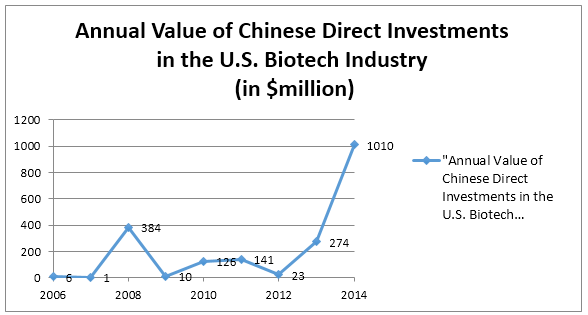
As China’s economy has grown over the past 10 years, Chinese investors have begun to allocate their capital to companies overseas, including those in the U.S. life science industry. Figure 1 shows that the annual value of Chinese direct investments in the U.S. biotech industry has increased most rapidly in the past two years.
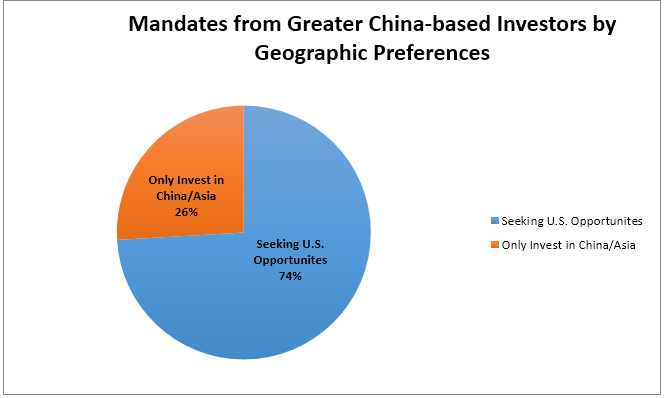
Of the Greater China-based life science investors interviewed by LSN Research, a staggering 75% are interested in opportunities based in the U.S. [See Figure 2.]
Figure 2 Source: LSN Investor Platform data as of May 12, 2015
Let’s take a look at the factors that make the U.S. life science industry an attractive opportunity for life science investors based in China.
Rising Chinese Wealth
China now has the world’s second largest millionaire population—over two million millionaires as of 2013.(1) Additionally, many Chinese companies have increased their resources and are interested in investing capital overseas for both financial and strategic purposes. Many of these companies and individuals are particularly interested in investing in the U.S., where patent and legal systems can provide better protection for their investment assets than in China.(2) These investors are often interested in diversifying their investments across U.S. industries, including the life science and healthcare fields.
Strong Life Science Industry and Innovation Ecosystem
The U.S. is the global leader in the life science industry, with a complete value chain from R&D to market and distribution. Some 46% of global life science R&D is carried out in the U.S., which is one of highest shares in any industry.(3) Solid financing supports the research successes in the U.S., with NIH funding supporting life science companies at a variety of stages of development via STTR and SBIR grants.
The U.S. has many other resources for early stage life science companies that are scarce in Greater China, such as incubators that provide financial assistance and expertise to life science start-ups. Since 2012, at least 12 new biotech incubators have been founded in North America to provide support to life science start-ups spinning out of academia.(4) The increasing numbers of biotech incubators launched by academic institutions, laboratories, medical centers, and top pharma companies are well placed to provide space, equipment, services, expertise, and other resources to early stage companies. These companies are developing innovative technologies and are prepared to move to the next stage of their development, and many are therefore attractive investment targets.
Talented Entrepreneurs and Access to Expertise
In the U.S., large bioclusters have formed in cities that boast top universities and research institutions. A large number of talented entrepreneurs have emerged from those universities, which provide access to expert scientific guidance. This talent pool provides early stage life science companies with leadership that supports companies in their development process. Investors generally put great emphasis on the quality and depth of a management team, and companies based in U.S. life science hubs are often able to satisfy this requirement.
Exits
For life science investors, return on investment is key, and exit opportunities are therefore an essential consideration. With the number of IPOs among U.S.-based companies up 66% in 2014 compared to 2013, the market for life science IPOs is hot.(5) The U.S. also sees significant M&A activity in the life science sector, thus providing multiple avenues to exit.
Challenges
For foreign investors seeking opportunities in the U.S., barriers and challenges are unavoidable. The time difference might make it difficult to set up a meeting, and cultural differences might cause misunderstandings between investors and entrepreneurs. Also, Chinese investors may not have expertise navigating the U.S. regulatory system, whether for financing or clinical development. All parties must be prepared to address these unique difficulties.
Over time, we have come across several China-based investors employing creative methods to overcome these challenges. A few larger institutions have set up outposts in major biotech hubs such as San Francisco and Boston. These overseas offices act either as scouts for new technologies or as bridges to expand the parent company’s business operations. A considerable number of consulting and broker agencies are emerging to provide services to China-based investors who are looking to increase exposure to U.S.-based companies.
However, as this article has outlined, there are compelling reasons that Chinese investors are interested in U.S. start-ups, and LSN Research has contacted many investors in that region who have expressed such interest. We expect that increased connections and communications will pull Chinese investors and U.S. companies more closely together in the future.


 Panelists will discuss in-depth the key motivators behind big pharma’s shift towards an early stage strategy as a way to fill the gaps in their pipelines. What indication areas are the most sought after? How does an early stage entrepreneur interface with business development executives from pharmaceutical companies? LSN’s Big Pharma RESI Panelists will shed light on these questions and more.