Tag Archives: Investors

Panel Announcement: Venture Philanthropy Investors

19 Nov

By Christine A. Wu, Research Analyst, LSN

chrsitine

Venture philanthropy has been a vital source of capital for early stage life science companies over the years. Philanthropic organizations provide more than just financing; a foundation with a niche indication focus may supply a network of experts, patients, and resources in the field. These organizations have an underlying mission to improve specific patient outcomes, going as far as using their financial returns toward further initiatives and investments to achieve their mission. Due to these organizations’ unique missions, LSN has uncovered a number of investment trends and accumulated advice in how to approach venture philanthropy investors.

LSN is pleased to announce a panel of five expert representatives in the venture philanthropy space for the RESI San Francisco Conference on January 12th. Moderated by Chris de Souza, Director of Broadview Ventures, the panel will be joined by:

Panelists will address their specific investment criteria and unique missions; their particular investment decision-making process; the relevant questions to ask and the best approach to reach and heighten their interest; along with important trends to keep in mind.

If venture philanthropy investment is part of your plan to get your company funded, this panel is a fantastic opportunity to extend your network and expand your understanding of these organizations.


RESI-San-Francisco-2016

RESI Panel Announcement: Medical Device Investors

12 Nov

By Lucy Parkinson, Senior Research Manager, LSN

Medical technology represents a major segment of life science investment, with $2.7 billion in venture allocations going into devices and diagnostics in 2014.  At LSN, we track over 700 investors who have an interest in development or clinical-stage medical devices.  For RESI San Francisco, LSN has gathered a panel of experienced medical device investors to share their expertise and advice with medtech entrepreneurs.

Moderated by David Cassak, Managing Partner, Innovation In Medtech, our panelists are:

The panel will explore the challenges of raising a financing round in the medical device sector, providing advice for entrepreneurs from early development stages through to commercialization.  These investors will explain what makes a device startup stand out, and how they assess the potential risks of a device opportunity.  If you’d like to join us at RESI, register now.

RESI-San-Francisco-2016


Early Stage Global Investors Converging on RESI@JPM

5 Nov

By Dennis Ford, Founder & CEO, LSN 

dennis-websit

JPM week is a very busy time of year for the biotech and medtech industries. With investors’ January schedules already filling up, it’s important for entrepreneurs to get themselves in the right place at the right time in order to meet with the hundreds of investors who will be in San Francisco that week. That is how you create relationships that could lead to an allocation.

LSN’s Redefining Early Stage Investments San Francisco event will be taking place on January 12th, 2016, and is shaping up to be the most dynamic yet in terms of investors already signing up. Evidently, investors are more organized than the rest of us! I am pleased to announce that RESI already has 150 investors from 16 countries registered to attend the event. This early trend is on track to surpass our most recent events in Boston and at TMCx in Houston in terms of investor turnout.

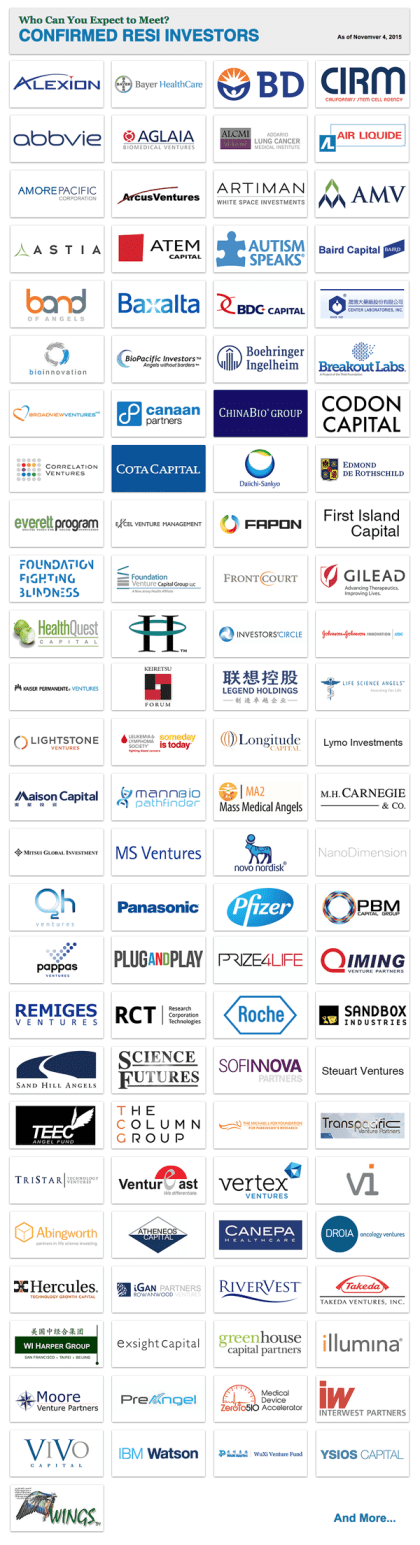
If you’d like to see all the firms and funds that have already registered for RESI, click the image below. We’re excited to welcome these and many more investors to the greatest RESI yet. If you’d like to join us at RESI, register here.

WP-list-

Investors Building Life Science Companies from the Ground Up

12 Dec

By Alejandro Zamorano, VP of Business Development, LSN

LSN tracks ten categories of life science investors around the globe. Recently, we have begun to follow and emerging trend of established investors creating and launching their own companies. These investors are cognizant of the critical importance of good management when it comes to asset commercialization. The school of thought behind this innovate approach is that emerging technologies stand more of a chance when strong leadership and organization is put around an asset from the get-go. So, why is this occurring and how exactly is this being executed?

From the firms LSN has spoken with, this approach is essentially an fusing two key elements – Access to capital and access to a network of experts, both of which help to make leaner, faster, and more efficient companies. It all starts with sourcing novel science from a translational researcher, and building a business structure around it.

Since the investor is starting the company, it is possible to structure the “perfect” company from the ground up. This goes beyond investor fit – it’s a custom tailored company to fill a portfolio need. This can create significant advantages early on in the company’s life cycle, as fundraising seed capital isn’t a problem. By avoiding this part of the process, the company can focus on moving the science forward. Moreover, the company can structure the management strategically from the get-go, by having a business-savvy CEO in place who has the sales experience required to turn innovative science into a company.

Add to this that the investor can shepherd multiple assets through the pipeline by outsourcing work to CROs, and you have a great lean model for building a portfolio of companies. This model is gaining traction, so stay tuned as LSN tracks this evolving trend.

The Myth of the NDA

12 Dec

By Danielle Silva, VP of Business Development, LSN

Most fledgling entrepreneurs are (understandably) protective about their technologies. In turn, it is common for them to ask investors to sign an NDA before engaging in a dialogue. An NDA (Non-Disclosure Agreement) is essentially a confidentiality agreement that two parties engage in to ensure that the information shared amongst the two parties is not made publicly available. Companies do this in an attempt to ensure that any technologies or processes that are integral to the firm’s operations are not disclosed to any other party. However, an NDA can discourage conversation, especially if incorporated into the introductory dialogue. So what is the right path to follow when considering whether or not to put an NDA in place?

Firstly, always consult your lawyer. This article isn’t intended to be legal advice, rather it is intended to help you think strategically when engaging investors. Many life science entrepreneurs may be tempted to make investors sign NDAs before even speaking with them. However, these investors typically look at hundreds or even thousands of deals every single year. An NDA could discourage a conversation. Especially when targeting investors that get a lot of solicitations, and NDA will probably constitute a burden. If you can’t express to an investor in the initial dialogue why your company has value, you’re probably not ready to start talking to investors. That doesn’t mean that there is information worth protecting, but you needn’t disclose “the secret sauce” in the introductory email.

Secondly, keep in mind that investors aren’t purely looking at your technology, they are also looking at you. Ideas are more like mushroom spores than lightning strikes – They emerge simultaneously from various sources, and the right leadership (not just the right idea) makes the difference between success and failure. Management is just as important as product from an investor standpoint. Many entrepreneurs we speak with are surprised by how many companies are in their competitive landscape. There is probably someone else doing something very similar to you, so rather than hiding your idea, show investors how you, as an executive, can do it better, faster, and more effectively.

Finally, remember that the purpose of your initial dialogue is supposed to facilitate a relationship. If things look promising and meetings surface, that’s the right time to discuss putting together an NDA with your lawyer. Avoid making it appear that it’s complicated to do business with you from the get-go. Again, always consult your lawyer before engaging in investor dialogue, but remember to keep a tactical mindset. Fundraising is a numbers game and the easier you make it to start a dialogue, the more meetings you’ll net.

Understanding Technology Risk & Investor Mindset


4 Dec

By Lucy Parkinson, Research Analyst, LSN

LSN recently released an article detailing the competitive landscape for therapeutic indications, and how your asset fits in. We all know that not all subsectors are equal from an investor standpoint; if you’ve been out there looking for investors, you’ve probably discovered whether your particular niche is currently ‘hot’ or ‘cold’. You’ve also probably noticed that investor appetite shifts, and that cold sectors can quickly turn red hot, and vice-versa.

So what drives these trends in life science investment, and what does it mean for your company?
 
Given the rapid pace of progress in life sciences, many investors find it hard to keep on top of every new innovation, particularly if their firm doesn’t specialize in life sciences. Though things change, opinions are often influenced by past experience. “We’re only human,” one investor told me last week. “We lost money on our diabetes investments, so we’d think twice about investing in that field again.” Many factors influence an investor’s risk assessments. One is the size of the potential market; it’s ironic that some investors have come to see larger markets such as diabetes and heart disease as unacceptably risky. A large market means established competition, expensive clinical trials and high overhead costs required to attain market share.

Even if an investor feels like they can rely on the science behind your product, they may have a prior opinion of your technology.  Some subsectors came to be seen as damaged goods due to publicized failures, and rather than focusing on the mistakes that were made and learning from those mistakes, investors may see an entire technology area as being a poor investment. Such failures can set a field back for years, as the gene therapy field experienced after a patient death in a clinical trial at the University of Pennsylvania in 1999. Fortunately, gene therapy has slowly recovered from this setback and is starting to see investment interest again.

So how can you optimize your search for financing if you’re working on something that’s seen as a tough sell?  The most important thing to keep in mind is that it’s not just about your technology; investors are also looking at you, and perhaps 50% of the factors that influence their investment decision will be related to you and your management team, not simply your products.  If you can show them that you’re a great business leader with enough experience in your field to learn from past mistakes made by others, and that you’ve got a solid team who have the skills to succeed where others failed, they may be willing to take a risk on you.

Next, look at investors who have backed successes in your field; finding an investor who’s a fit for your company and has invested in your area in the past is one of the most important aspects of fundraising. Seeking out the winners can help you hit the right target investors.

Finally, target funding sources who have incentives other than risks and returns. Foundations, patient groups and government funds might regard the promise of a potential breakthrough in your field as being worth placing a stake on, even without any guarantee of returns, accelerating the funding cycle, and shortening your time to market.

Hot Life Science Investor Mandate 3: VC Looks to Companies in Pre-Clinical Trials

20 Nov

A venture capital firm based in the Central US manages 2 funds for a combined total of more than $250 million in assets under management. The firm generally invests between $2-$6 million of equity capital per round, and up to $10 million over the life of the investment. The firm plans to invest in 2-5 companies over the next 6-9 months, and will consider firms located throughout the United States. The VC looks to syndicate with other venture firms, and often acts as the lead investor.

Currently, this organization is looking for companies developing Medical Devices, Therapeutics, Diagnostics and Healthcare IT products. For medical devices and therapeutics, the firm is open to the full spectrum of subsector and indication, and will consider companies developing orphan indications. They are interested in seed and venture stage companies, generally looking to invest in companies with a lead asset in pre-clinical trials. Only in certain cases of reformulation and repurposing would the firm consider investment into a company with a product in clinical trials. They are also willing to consider companies targeting orphan indications. In the Healthcare IT space, the firm has stated interest in areas of clinical sequencing and diagnostic platforms but will also consider other companies that fall into the Healthcare IT space as well with the exception of tradition EMR companies.

As such an early stage investor, they invest almost exclusively in pre-revenue companies. The firm also looks for experienced management teams and generally takes a seat on the company’s board.