Archive | December, 2015

Trends in Diagnostic Investment: Who, Where and Why

10 Dec

By Cole Bunn, Research Analyst, LSN

cole-wp

As healthcare and the life science space continue to evolve, the term “diagnostic” is taking on more and more meanings—and branding yourself as simply a “diagnostics company” is becoming increasingly ambiguous. This growing intricacy lends itself to the difficulties inherent in the sector. Whether you are developing a molecular-based point-of-care (PoC) diagnostic, a new in vitro diagnostic (IVD) test used in a clinical laboratory, a companion diagnostic for an oncology therapeutic or a biomarker discovery platform, there are some distinct challenges standing in the way of your technology and a successful exit.

Taking a look at some of the happenings in the diagnostics sector, some data from the LSN Investor Platform, and some of the things we’ve heard from diagnostic investors helps paint a better picture of the market, elucidating some guidelines to follow and common pitfalls to avoid for entrepreneurs developing diagnostic products/services.

As diagnostic technologies mature, we are seeing them make a push into the marketplace, sometimes figuring out how they fit in along the way. Point-of-care diagnostics, in particular, are expanding and evolving from pure technology development to applications development in various settings. As the assortment of new diagnostics find their niche in the healthcare marketplace, some investors tend to be somewhat reluctant to dive in headfirst, given the impediments these companies are bound to run into.

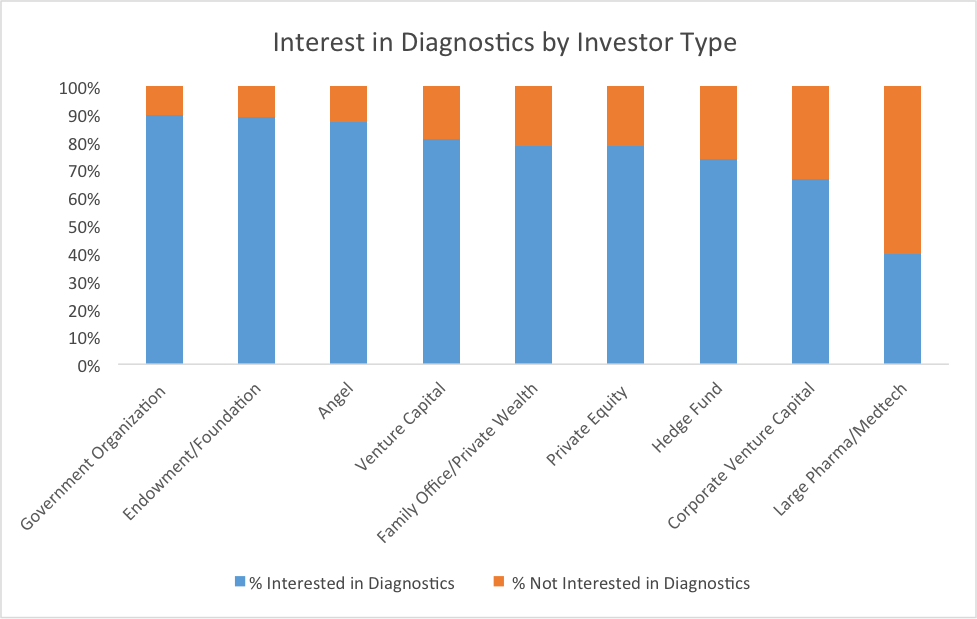
At LSN, we have spoken to over 900 investors in the last year about their specific interests and investment criteria in the life science space. Figure 1 shows the percentage of investors by type who have expressed interest in diagnostic products or services.
f1

Figure 1 | LSN Investor Platform | Data as of December 7, 2015

It’s not surprising that a large proportion of the government organizations and foundations we’ve spoken with are backing diagnostics companies, given their ability to take on more risk and invest at early stages, and the fact that they don’t require the returns typical of venture firms. However, as these technologies continue to mature and gain traction in the clinic/marketplace, traditional venture capital investors are becoming more active. On the federal level, President Obama’s Precision Medicine Initiative should also help bolster the diagnostics sector.

Foundations often pursue novel diagnostic technologies with the goal of diagnosing diseases earlier, and therefore making treatments more effective. If you are seeking capital from a foundation, recently we highlighted some best practices for pitching and working to receive an investment from these types of organizations.

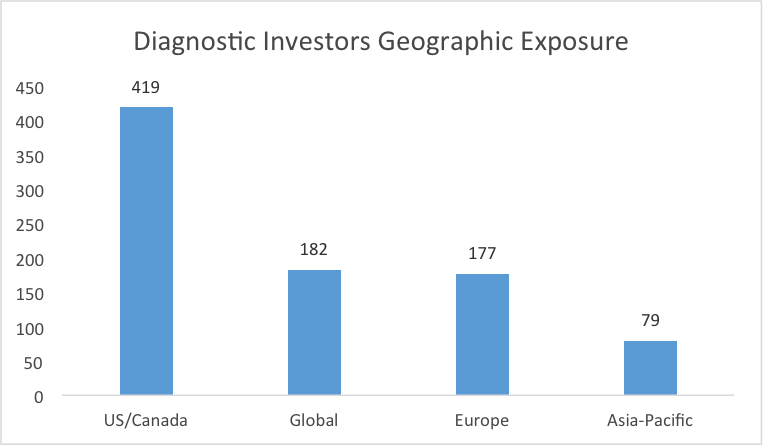
Taking a view of where these investors interested in diagnostics are looking to deploy capital, Figure 2 shows a mix of regionally-focused investors as well as investors with a global focus, with North America significantly out in front in terms of investor regional focus.
f2

Figure 2 | LSN Investor Platform | Data as of December 7, 2015

There’s a lot of excitement surrounding the potential of diagnostics to improve outcomes and access to care, reduce the cost of care, and help spearhead personalized medicine, among other things. However, some investors voice concerns about reimbursement rates for diagnostics. We’ve heard from multiple investors that it is extremely important to engage payers very early and start the conversation, not waiting until you have the perfect amount of data. Many investors have said they are not interested in “me-better” tests that merely aim to replace an existing product, but rather something with a new business model that unlocks value within the healthcare system to deliver a huge upside, as this helps counter the reimbursement risk. Tests that have clinical utility and are going to change the treatment paradigm are typically more appealing to investors. A strong management team is always heavily favored when investing in early stage companies, but given these challenges, investors tend to place a premium on the quality of teams developing diagnostics.

The LSN team will continue to track diagnostic companies, deals in the space, and the investors that fund these companies, bringing you updates along the way.

  1. http://www.medgadget.com/2015/11/global-point-of-care-poc-diagnostics-market-in-need-of-accurate-and-cost-effective-solutions-2.html
  2. http://www.fda.gov/MedicalDevices/ProductsandMedicalProcedures/InVitroDiagnostics/ucm407296.htm
  3. http://www.genengnews.com/insight-and-intelligence/point-of-care-diagnostics-an-expanding-field-driven-by-technology-development/77900558/
  4. https://www.youtube.com/results?search_query=diagnostics+investor+panels+resi+4
  5. https://www.youtube.com/watch?v=C7ygVJENdBQ

Redefining Early Stage Investments (RESI) Conference: Orphan & Rare Disease Investors Panel

10 Dec

By Christine A. Wu, Research Analyst, LSN

chrsitine

The orphan and rare disease space has gained significant traction among life science investors. Despite the smaller market populations and limited clinical trial participants in rare diseases, technology in this space has remained attractive to investors due to its expedited FDA process and its lack of current treatment options for such uncommon conditions. Overall, while there are many challenges, there remains a lot of hope to drastically impact patient populations, scientific advancement, and market potential.

RESI San Francisco will bring together well-established investors in the rare and orphan disease space on January 12th. Moderated by Mark Day, Executive Director and Head of External Research & Scouting of Alexion Pharmaceuticals, panelists will include:

Panelists will discuss the attractiveness of orphan and rare disease technologies in comparison to non-orphan opportunities; what the rare disease spaces offers to investors; the best way to position an orphan opportunity to a potential investor; the evaluation process in assessing products in the space; as well as common trends, challenges, and excitement in the scientific advancement of the field.

To all the hopefuls in the orphan and rare disease space, this panel is for you. Register for RESI San Francisco now to hear this panel live – partnering has already begun and this event will be LSN’s biggest RESI yet.

RESI-San-Francisco-2016

Hot Investor Mandate 1: Global Pharma Makes Equity Investments In Oncology, Cardio and Ophthalmology

10 Dec

A large pharma company based in Hong Kong makes equity investments and also in-licenses assets for development. Typical equity investments range from $2-3M per deal. The firm has partnered with companies in Japan, the USA and Europe, and is currently looking for new opportunities globally.

Currently the firm is seeking therapeutics in oncology, supportive care, cardiovascular, and ophthalmology. The firm focuses on small molecule, biologics, biosimilars, and repurposed and reformulated drugs. The firm typically in-licenses assets that have completed IND enabling studies, while it can consider from pre-clinical to on-market assets.

The firm is seeking innovative assets that address large unmet medical need. The firm generally seeks development and/or commercialization rights in China and Southeast Asia.

If you are interested in more information about this investor and other investors tracked by LSN, please email mandates@lifesciencenation.com

Hot Investor Mandate 2: Fund Seeks Oncology Therapeutics in Late Preclinical or Clinical Trials

10 Dec

A firm based in Switzerland is a specialized investor in oncology, and is currently investing from a fund of USD 51 million. The firm generally makes investments in Series A, B or C equity rounds; the firm is not interested in seed rounds. The firm typically makes allocations of $3-8 million, and may either lead investments or act as a co-investor alongside a syndicate. The firm is open to oncology opportunities globally but has recently invested primarily in the USA.

The firm is currently focused on oncology therapeutics. The firm will consider any form of therapeutic molecule in oncology, including small molecules, antibodies or new technologies such as cell therapies. The firm generally invests at the late preclinical stage, from 6-12 months pre-IND, but is also interested in companies Phase I or Phase II assets.

The firm places high importance on the management team’s scientific rigor and industry experience; the firm prefers to work with entrepreneurs who have led biotech companies previously. The firm also considers the strength of the investor syndicate and their alignment of interests.

If you are interested in more information about this investor and other investors tracked by LSN, please email mandates@lifesciencenation.com

Hot Investor Mandate 3: VC Invests In Therapeutics In Infectious and Inflammatory Diseases

10 Dec

A venture capital firm with offices worldwide specialises in early stage investments in the technology and life sciences sectors. The firm accelerates commercialisation of ground-breaking innovation through investments, experienced hands-on management and the intelligent use of partnering. The firm typically invest at seed stage or before a company has been formed and develop these early opportunities through preclinical phase; at late preclinical/early clinical stage the firm gets co-investors involved. The firm prefers areas where there are multiple capital efficient routes to market, with opportunities for early proof of concept or early outlicensing or exits. The firm manages a $150M fund and makes investments from $100K to $10M, depending on the opportunity. The firm is seeking a couple of opportunities to add to its portfolio. The firm invests in companies based in the USA and/or Europe.

The firm looks at early stage biotech therapeutics. In terms of indications, the firm is interested in anti-infectives and particularly antimicrobial resistance, as well as immuno-modulatory anti-inflammatory indications and orphan and rare diseases.

The firm looks for a strong management team with track record and a ground-breaking technology addressing an unmet need. The firm seeks to take significant minority stakes and board seats. In addition, the firm will provide hands-on support from its own bench of senior execs, experts and advisors to accelerate its ventures after investment.

If you are interested in more information about this investor and other investors tracked by LSN, please email mandates@lifesciencenation.com

Hot Investor Mandate 4: PE Firm Seeks Medical Devices and Advanced Synthetic Bio, AgBio & Industrial Biotech

10 Dec

A private equity firm that was founded in 2008 and is based in California makes equity allocations between $5-$50m in medical devices and advanced biotechnologies such as synthetic biology. The firm is currently seeking opportunities globally.

The firm manages a bioventures fund that investment strategies in/around advanced biotechnologies. This focus includes scalable, portable and sustainable technologies within high human-imperative sectors such as agriculture-food, energy-resources, industrial chemicals-materials, water-environment, and defense-space. The firm also has an interest in medical devices of any size, stage, geographic location and indication area. The firm is stage-agnostic and considers from seed and venture stage products to on-market products.

The firm is seeking experienced management teams. The firm typically takes a board seat in the companies it invests in.

If you are interested in more information about this investor and other investors tracked by LSN, please email mandates@lifesciencenation.com

4 Tips on How to Get the Most Out of Partnering

3 Dec

By Alejandro Zamorano, VP of Business Development, LSN

Alejandro 10*10

The life science partnering conference circuit provides entrepreneurs with many venues to book meetings with potential strategic partners and investors, and ultimately to build relationships that will lead to allocations. When it comes to raising funds for your emerging life science company, partnering conferences are an important aspect of a campaign. Below are 4 key lessons on how to use a partnering system effectively:

Register Early

Several advantages are derived from registering early for partnering events. Conferences typically open their partnering systems several weeks prior to the event, so by registering early you ensure that you will have access to partnering and can send meeting requests early. Due to this flurry of early activity, some investors will fill up their schedules well in advance. Registering early can also boost your chances with investors who plan their schedules closer to the event; most partnering systems order messages from first received to last, so sending a message out early will put you on top of the heap.

Leverage Partnering for Meetings Outside of the Event

A partnering portal is more than just a messaging system. A partnering system tells you which investors will be present and may provide you with detailed profiles of those investors. Knowing who’s attending and having a direct means of contact matter even more with events during JPM, as there are so many investors in attendance and they will likely have a long list of events to attend. If an investor’s partnering schedule is already full, ask if they can meet outside the event: perhaps in the evening, or the next day. You would be surprised how many people give up once investors have said their event schedule is full, instead of looking for an alternative option.

Put in the Time

Many entrepreneurs wait until the last minute to send partnering invitations and tend to spam investors with a generic message about their company that has no specific draw for the investor to which it’s addressed. They are doing themselves a huge disservice as they fail to provide a specific, compelling reason why investors should meet with them. You should spend time on qualifying and personalizing all your partnering messages. The results are well worth the effort as you’ll get more meetings, and those meetings will have a stronger basis and therefore be more productive. Remember, investors and strategic partners are there to meet companies like yours, so don’t be afraid to reach out, but do keep your outreach targeted. One well-crafted message to an investor who’s a strong fit beats ten vague messages to poor fits any day.

Contact Using Multiple Avenues

One of the most effective ways to get meetings is to email your targets outside of the partnering system and ask if they would like to meet at the event. This allows you to send your pitch deck as an attachment, and to make messages more personal. This second touch point increases your response rates, as it will reach investors who haven’t yet logged into the partnering system. The final step is a follow-up phone call to introduce yourself and ask if the investor would be interested in meeting.

For RESI, LSN’s goal is to create a dynamic partnering platform with customizable profiles and search features so that biotech/medtech companies can be matched with the investors that are a fit for their technology. This initial good fit provides a basis for dialogue and a starting point for a long-term relationship.

With partnering going live on Monday, the best time to register for the event is now, before investors begin to fill up their meeting slots. To see a demonstration of just how effective the partnering system can be at finding a match, please check out this video.