Technical Risk – From Belief to Evidence 

7 Apr

By Dennis Ford, Founder & CEO, Life Science Nation (LSN)

DF-News-09142022

In the first article, The Problem Is Not the Science, Life Science Nation established that investability begins with defining a real, urgent market need. But once that foundation is clear, the next question becomes unavoidable: does the product actually work, and can that be demonstrated in a way others trust?

The next focus is technical risk, where belief must become evidence. It outlines how companies move from early signals to reproducible, credible, and translatable results—covering mechanism of action, proof of concept, reproducibility, safety, and scalability.

Once market risk is clear, the next question becomes unavoidable: does the product work, and can that be demonstrated in a way that others trust?

This is where many companies overestimate their position. Early data, promising signals, or strong academic foundations often create internal confidence. But investors are not evaluating belief; they are evaluating evidence. The distance between those two states defines technical risk.

Technical risk is not simply about whether something works once. It is about whether it works consistently, whether the mechanism is credible, and whether the results can survive the transition from controlled environments into real-world use.

The first layer of clarity comes from the mechanism of action. There must be a coherent explanation of how the biology or technology produces the intended effect. This is not a description of experimental outcomes; it is a causal story. Without it, data is difficult to interpret and harder to trust.

Proof of concept establishes that the signal exists. This can take the form of in vitro data, animal models, early human data, or a working prototype, but it must be observable and measurable. Reproducibility then determines whether that signal can be relied upon. A single experiment is not enough. Results must hold across time, cohorts, and independent attempts.

Translatability introduces another layer of complexity. What works under ideal conditions does not always work in patients, clinics, or real-world settings. Understanding how findings extend beyond the initial model is critical, particularly in biologically complex indications.

Safety, performance, and durability define the product profile. Even if effective, a product must be safe enough for its intended use, deliver a meaningful effect, and sustain that effect over time. A transient or marginal benefit rarely justifies the cost and risk of development.

Finally, manufacturability, scalability, and data integrity complete the picture. A product that cannot be produced consistently and at scale cannot become a company. Data that is poorly designed, uncontrolled, or selectively presented undermines confidence, even when the underlying science is strong.

Technical risk is resolved when the product moves from an interesting idea to something that consistently works, can be trusted, and can be translated into real-world use.

Core Elements of Technical Risk

  • Mechanism of action
  • Proof of concept
  • Reproducibility
  • Translatability
  • Safety
  • Performance and durability
  • Manufacturability and scalability
  • Data quality and integrity

Next in the series: Regulatory Risk — Navigating the Path to Approval

How Early-Stage Companies Should Think About June in San Diego 

7 Apr

By Max Braht, VP of Business Development, LSN

Max-Braht-Headshot

Whether in San Diego, Philadelphia, or Boston, there are a handful of weeks each year when the life science industry gathers in force. Founders, investors, pharma, and advisors all show up at once. Multiple events run in parallel, each with its own programming, audience, and purpose. From the outside, it looks like one opportunity.

It is not.

Each event is designed to serve a specific audience. Some programs are intentionally broad and inclusive. They bring together large numbers of participants across the ecosystem and create a wide surface for interaction. Others are more focused. They are designed to reach a narrower audience with a specific objective.

The challenge for early-stage companies is that it is not always obvious which environment they are actually entering.

Most of the broader convention programming is built around partnering between established biotech companies and large pharma. These conversations assume a certain level of maturity. The data has been prepared for external review. Development paths are clearer. The work is far enough along for a downstream buyer to evaluate.

For companies at that stage, the environment works. For earlier-stage companies, the situation is different.

They enter the same system, but the conversations are not always aligned with what they need. Licensing discussions can be premature. Data packages are still forming. Investor meetings are possible, but they are not the primary function of the week. Competition for attention is high, and much of that attention is directed toward later-stage opportunities.

Nothing is wrong with the environment. It is doing exactly what it is designed to do.

The issue is alignment.

Early-stage companies are not primarily seeking licensing outcomes. They are seeking capital. Capital behaves differently. It requires a higher concentration of relevant investors, a structure built around evaluation, and conversations that lead to funding decisions. Seed rounds up to two million, Series A up to ten million, and Series B up to fifty million are fundamentally different conversations than late-stage programs discussing Phase III data, scaling, and commercial expansion with pharma. They are different buyers, different expectations, and different decision processes.

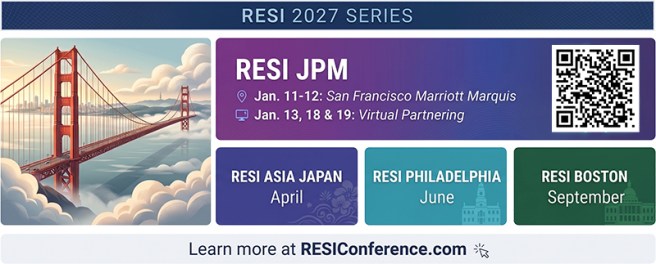
During that same week, RESI operates as a separate market focused on early-stage capital formation. The investor base is concentrated around seed through Series A and early Series B. The conversations are centered on investment. The environment is designed to match companies with investors who are actively deploying capital into emerging opportunities.

This creates a different dynamic.

Instead of competing for limited attention in a broad, later-stage environment, companies operate in a setting where the density of relevant investors is higher, and conversations are aligned with their stage. This is not a question of which event is better.

The question is whether you are in the right room.

If your objective is licensing or a strategic partnership with large pharma, the broader convention environment is the right place to spend your time. If your objective is to raise capital at the early stage, the question becomes more direct. Where are the investors actively deploying to companies like yours, and how concentrated are they? Many companies try to do both. Some can. Most dilute their effort. The cost is not just the registration fee. It is time, focus, and missed opportunity. In weeks like this, the difference between being in the right room and the wrong one is not subtle. Please choose a room that fits your stage.

Register for RESI San Diego

Extend Your Reach Across Two Key Life Science Markets 

7 Apr

By Matt Stanton, VP Sales US West, Central and South America, LSN

For companies navigating fundraising or business development, timing and consistency matter as much as the initial introduction. The RESI San Diego 2026 and RESI Boston 2026 bundle is structured to support both, offering a coordinated approach to investor and partner engagement across two high-activity windows. 

By combining these events, organizations can move beyond one-off meetings and build sustained momentum with the same network of investors and strategic partners over time. 

Two Events. One Continuous Engagement Strategy 

The bundle includes full 5-day access to both conferences: 

RESI San Diego 2026
June 22 (in-person during Convention Week) followed by four days of virtual partnering 

RESI Boston 2026
September 22–23 (in-person during Biotech Week Boston) followed by three days of virtual partnering 

Positioned three months apart, these events create a natural progression—from initial outreach and early conversations in San Diego to deeper follow-up and potential deal advancement in Boston. 

Built for How Deals Actually Happen 

Fundraising and BD are iterative processes. Initial meetings rarely lead directly to outcomes; they require follow-up, validation, and continued visibility. This bundle is designed with that reality in mind. 

Participating in both RESI events allows organizations to maintain continuity by: 

  • Re-engaging investors and partners across multiple touchpoints  
  • Strengthening credibility through consistent presence  
  • Advancing discussions with greater context and traction  

Rather than restarting conversations, companies return to Boston with warmer leads and clearer positioning. 

Limited-Time Bundle Pricing 

Discount rates are available for a limited time: 

  • Startups: From $3,490 (regularly $4,490)  
  • Service Providers: From $4,490 (regularly $5,490)  

Savings of up to $1,000 are available through April 17. 

A More Effective Way to Build Pipeline 

The RESI ecosystem is built on repeated, data-driven engagement across a global network of investors, innovators, and partners. The San Diego & Boston bundle aligns with this model—providing a structured way to build pipeline, maintain visibility, and convert conversations into outcomes. 

To register, select the bundle ticket option within the RESI San Diego registration portal.

Register for RESI San Diego and Boston Bundle

Hot Investor Mandate: Private Investment Firm Invests $2-6M in Early Clinical-Stage Therapeutics, Medical Device, and Diagnostics Companies Based in the US

7 Apr

The firm is a privately held life sciences investment vehicle focused on funding clinical development in exchange for equity and warrants. The firm primarily invests in publicly traded companies and structures investments to directly support clinical trials and related services. Typical allocations range from approximately $2M to $6M, with the ability to deploy additional capital through tranche financings. The firm focuses on companies conducting clinical trials in the United States. 
 

The firm is active across therapeutics, diagnostics, and medical devices and is generally agnostic to technology type and disease indication. The firm is particularly interested in companies that are entering or currently in proof-of-concept clinical trials, typically at Phase Ib or Phase IIa stages. 
 

From a company and management team perspective, the firm seeks publicly traded companies with experienced leadership teams and actively engaged boards of directors. The firm is open to both leading and co-investing. While the firm primarily invests in public companies, it remains open to engaging early with emerging clinical-stage opportunities ahead of formal investment readiness. 

If you are interested in more information about this investor and other investors tracked by LSN, please email salescore@lifesciencenation.com

Hot Investor Mandate: Multi-Stage Global Healthcare Platform with Strong China Commercialization Capabilities Invests in Therapeutics, Devices, Healthcare Services 

7 Apr

An investment platform with offices in Asia is backed by a large state-affiliated industrial group. The firm invests across the full company lifecycle, from early and incubation stages through growth and buyout opportunities, deploying capital through multiple funds. For early-stage investments, the firm typically deploys multi-million dollar checks with flexibility depending on the opportunity. The firm evaluates opportunities globally and has invested across key markets including North America, Europe, Israel, and Asia.  
 
Within life sciences and healthcare, the firm focuses on innovative therapeutics, medical devices, and healthcare services. The firm is open to companies across all stages of development, from preclinical through clinical and commercial stages.  
 
From a company and management team perspective, the firm seeks teams with strong industry and clinical expertise, solid scientific foundations, and globally competitive positioning supported by robust intellectual property. The firm leverages close relationships with industrial partners and an established regional network to support portfolio companies in advancing development and expanding into the China market. 

If you are interested in more information about this investor and other investors tracked by LSN, please email salescore@lifesciencenation.com

Hot Investor Mandate: Venture Formation and Investment Firm Seeks Innovative Therapeutics, With Strong Interests in Small Molecule Oncology  

7 Apr

A venture formation and investment firm focuses on identifying and developing overlooked or underutilized therapeutic assets to address critical unmet medical needs. The firm typically acquires or licenses these assets and builds new companies around them, working closely with experienced executives and strategic partners to drive development and long-term value creation. The firm prefers opportunities where assets are not already tied to established commercial or private entities, allowing the firm to play a primary role in venture creation. The firm engages with opportunities globally and, in addition to its venture studio model, also makes direct early-stage investments outside of company formation. 

The firm is open to a broad range of therapeutic assets and compounds, with a particular emphasis on small molecules. The firm is disease-agnostic but has a preference for oncology. The firm has also begun to explore opportunities in digital health technologies. The firm does not invest in medical devices. 

The firm does not impose strict requirements on companies or management teams. 

If you are interested in more information about this investor and other investors tracked by LSN, please email salescore@lifesciencenation.com

Hot Investor Mandate: Global Corporate Venture Capital Firm Invests in Therapeutics from Seed to IPO Stages, Focusing on US-Based Companies

7 Apr

A corporate venture arm of a global organization invests across a wide range of financing stages, from Seed through IPO, with flexible initial check sizes and the ability to provide follow-on capital. The firm primarily focuses on opportunities in the United States, while also evaluating companies in Europe and Asia. The firm does not lead investment rounds and prefers to participate alongside an established lead investor. Depending on the investment size and structure, the firm may take an observer or board seat. The firm invests strictly through equity and does not operate an equity-for-services model. 
 

In parallel to its investment activities, the broader organization operates a global support initiative that collaborates with accelerators, venture capital firms, and incubators to provide startups with access to development platforms, technical resources, and infrastructure to accelerate biologics and vaccine programs. Participation in this ecosystem can provide companies with non-dilutive support and development advantages. 
 

The firm invests across a broad range of biologics and therapeutic modalities, including antibody-based therapies, protein therapeutics, vaccines, and nucleic acid-based approaches such as DNA and mRNA therapeutics. The firm is also open to orphan drug opportunities. The firm does not invest in cell and gene therapy. 
 

From a company and management team perspective, the firm is open to working with both first-time and experienced founders but values teams with strong support networks. The firm seeks collaborative founders who are receptive to strategic input and partnership. The firm requires a lead investor to be in place prior to investing and typically participates as a strategic co-investor. 

If you are interested in more information about this investor and other investors tracked by LSN, please email salescore@lifesciencenation.com